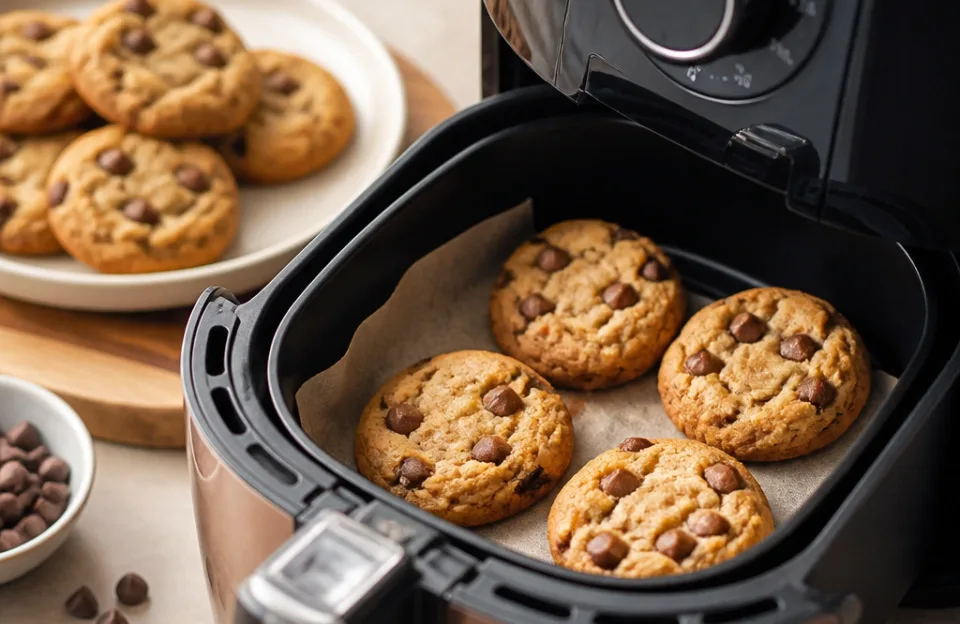
Air fryer cookies are regular cookie dough baked in an air fryer instead of a traditional oven. They cook faster, usually in 5 to 8 minutes, and develop crispy edges with soft centers because the appliance circulates hot air directly around the dough. You can use store-bought dough or your favorite homemade recipe with minor temperature adjustments.
This guide covers how air fryers change the baking process, which dough types work best, how to adjust temperatures, and what goes wrong when you treat the basket like a standard sheet pan. If you want a quick batch without heating up the kitchen, this method gets you there fast.
Why the circulating fan changes how dough bakes
A standard oven relies on radiant heat from top and bottom elements. The air inside moves slowly. An air fryer uses a powerful fan positioned directly above a concentrated heating element.
That fan pushes hot air down and around the food at high speed. This rapid circulation transfers heat to the surface of the cookie dough much faster than a conventional oven does.
Because the heat transfer is so aggressive, the outside of the cookie sets and browns quickly while the inside stays soft. You get a distinct texture contrast. The edges turn crisp within minutes.
The center remains chewy if you pull the basket out at the right moment. Leave them in too long, and that same airflow dries out the entire cookie.
The compact size of the cooking chamber matters too. There is less empty space for the heat to dissipate into. Every degree of temperature hits the dough harder.
According to FDA guidelines on safe food preparation, maintaining precise control over cooking temperatures prevents both undercooked ingredients and burnt results. That precision is especially important when adapting recipes meant for larger ovens.
How basket shape affects spreading
Round baskets force cookies into curved arrangements. Square baskets give you flat sides to work against. Either way, the perforated bottom allows air to flow underneath the dough.
This means the bottoms bake faster than they would on a solid metal sheet pan.
If you place dough directly on the bare grate, it will sink through the holes as the butter melts. You always need a barrier. Parchment paper cut to fit the basket works well.
Silicone liners designed for air fryers also work. Never use wax paper. It has a low melting point and can smoke or catch fire under the intense top-down heat.
Batch sizes and spacing limits
You cannot fit a dozen cookies in a standard 4-quart air fryer. Most baskets hold two to four cookies per batch comfortably. Crowding them blocks the airflow.
Blocked airflow causes uneven baking. The cookies touching each other merge into one giant mass, and the ones near the edges burn while the middle stays raw.
Leave at least an inch of space between each dough ball. Keep them away from the outer walls of the basket. The heating element sits close to the top, so taller dough balls might hit the fan guard.
Flatten them slightly before cooking if your machine has low clearance.
Adapting your favorite recipes for air fryer cookies
Most standard cookie recipes call for baking at 350°F for 10 to 12 minutes. You cannot use those exact settings here. The general rule is to drop the temperature by 25°F and cut the time in half.
So a recipe asking for 350°F becomes 325°F, and 10 minutes becomes 5 minutes.
Start checking at the 4-minute mark. Open the basket and look at the edges. They should be set and lightly golden.
The centers will still look puffy and slightly underdone. That is exactly what you want. The residual heat continues cooking them after you remove the basket.
If you wait until they look completely done inside the machine, they will be hard once they cool.
| Oven Baking Setting | Air Fryer Adjustment | Expected Cook Time |
|---|---|---|
| 350°F for 10-12 min | 325°F | 5-7 minutes |
| 375°F for 8-10 min | 350°F | 4-6 minutes |
| 325°F for 14-16 min | 300°F | 7-9 minutes |
Thicker doughs like chunky chocolate chip need the lower end of the time range at first, then extra minutes added one at a time. Thin doughs like shortbread spread fast and need watching from minute three.
Which dough types hold up best
Chocolate chip dough is the most forgiving. The butter content helps it spread evenly, and the chips do not interfere with the structure. Sugar cookies work well if you chill the dough first.
Warm sugar cookie dough spreads into thin puddles under the intense fan heat. Chilling firms up the fat, giving the cookie time to set its shape before it flattens completely.
Peanut butter cookies are naturally dense. They handle the rapid air circulation without drying out too fast. Oatmeal raisin cookies can be tricky.
Oats absorb moisture aggressively. In an air fryer, the moving air pulls moisture from the surface rapidly, sometimes leaving oatmeal cookies crumbly. Adding an extra tablespoon of liquid or reducing the cook time by a minute helps keep them chewy.
If you enjoy making savory snacks in the same appliance, techniques for getting crispy skin on poultry rely on similar principles of managing airflow and fat rendering.
Doughs with heavy mix-ins like large nuts or thick candy pieces sometimes cause uneven baking. The air flows around the chunks differently than through smooth dough. Press large mix-ins slightly into the dough balls so they sit flush with the surface.
Store-bought dough shortcuts
Pre-packaged refrigerated cookie dough works perfectly fine here. Slice the log or scoop the tub just like you would for a normal oven. Because commercial doughs contain specific ratios of stabilizers, they tend to hold their shape better than some homemade versions under high-speed air.
Check the package instructions for the recommended oven temperature. Subtract 25 degrees. Set your machine accordingly.
Keep in mind that store-bought dough often contains more sugar. Sugar caramelizes fast. Watch the edges closely during the last two minutes to prevent burning.
For those tracking their intake, understanding how calories shift with different cooking methods applies to sweet treats just as much as savory meals.
Getting the liner and setup right
The liner you choose dictates how the bottom of the cookie bakes. Solid parchment rounds block air from underneath entirely. This mimics a traditional baking sheet.
The bottoms stay softer and paler. Perforated parchment lets some air through. The bottoms crisp up faster and brown more evenly.
Cut your parchment to fit inside the basket. Do not let it hang over the edges. Loose paper gets sucked up into the heating element by the fan.
It will scorch immediately. Weigh the paper down with the dough balls before turning the machine on. Never preheat the air fryer with loose parchment inside.
Silicone mats made specifically for air fryers have raised ridges or holes. They allow grease to drain away and air to circulate. They are reusable and easy to clean.
However, silicone insulates slightly more than paper. You might need to add an extra minute to your bake time when switching from parchment to silicone.
Greasing the liner is rarely necessary for cookie dough. Most recipes contain enough butter or oil to release easily. If you are working with a very lean dough, a light spray of cooking oil on the parchment prevents sticking.
Avoid aerosol sprays containing propellants directly on nonstick basket coatings, as they can degrade the finish over time. A pump oil mister is safer for the appliance. When experimenting with different flavor profiles, like adding a sweet garlic glaze to savory dishes, keeping your equipment clean between uses prevents unwanted flavor crossover.
Troubleshooting texture problems
Cookies come out wrong for predictable reasons. The intense environment magnifies small mistakes that a regular oven would hide.
- Edges burn before centers cook: The temperature is too high. Drop it another 10 to 15 degrees. You can also make the dough balls smaller so the heat penetrates to the center faster.
- Cookies spread into one giant flat disc: The dough was too warm. Chill it in the refrigerator for 30 minutes before scooping. Alternatively, the basket might have been overcrowded, causing them to melt together before setting.
- Bottoms are pale and soggy: You used solid parchment and pulled them out too early. Switch to perforated parchment or leave them in for one extra minute.
- Tops are dry and cracked: The fan blew directly on the dough too aggressively. Lower the fan speed if your model allows it, or reduce the temperature by 25 degrees and extend the time slightly.
- Cookies stick to the liner: You tried to move them while hot. Let them rest on the parchment for two minutes after removing the basket. The structure sets as they cool. Trying to lift them immediately tears the soft bottoms.
If you frequently cook multiple items back-to-back, planning ahead saves time. Strategies used for organizing batch cooking sessions apply equally well when you need to run five batches of cookies for a party.
Handling different air fryer models
Not all machines behave identically. Basket-style air fryers are the most common. They have a drawer that slides out.
The heating element is directly above the food. These require the most attention to spacing and liner placement.
Oven-style air fryers look like miniature toaster ovens. They use trays instead of baskets. Baking cookies in these is closer to using a real oven.
You can fit more cookies on a tray. The fan is usually at the back rather than directly overhead, so the tops brown less aggressively. You might not need to reduce the temperature as much.
Start by dropping only 15 degrees instead of 25.
Dual-basket models let you cook two things at once. If you are baking cookies in both drawers, ensure the dough amounts are identical. Uneven loads can cause the machine to distribute power differently between zones.
Some dual models sync the timers automatically; others require manual adjustment for each side.
Wattage plays a role. A 1700-watt unit heats up faster and recovers temperature quicker than a 1200-watt unit. Higher wattage means shorter cook times.
If you follow a recipe written for a smaller machine but own a large one, check your cookies a minute earlier than suggested. Monitoring internal conditions accurately matters across all cooking tasks, whether you are checking doneness with a fast-reading probe thermometer for proteins or visually inspecting baked goods.
Cooling and storing the finished batch
Remove the basket carefully. The exterior gets hot. Slide the parchment paper with the cookies onto a wire cooling rack.
Leaving them in the hot basket continues the cooking process. The metal retains heat long after the fan stops.
Let them cool for at least five minutes before eating. Fresh out of the machine, the sugars are molten and the structure is fragile. They firm up significantly as they reach room temperature.
Store cooled air fryer cookies in an airtight container at room temperature. They stay fresh for three to four days. Because the rapid air circulation creates crispier edges than a standard oven, they tend to retain that crunch longer in storage.
If you prefer them soft, place a piece of bread in the container. The cookies absorb moisture from the bread overnight.
Freezing works well too. Flash freeze them on a tray first so they do not stick together, then transfer to a freezer bag. Reheat frozen cookies in the air fryer at 300°F for two minutes to restore the fresh-baked texture.
Pairing these sweets with savory appetizers, such as a garlic parmesan snack, makes for a balanced spread when hosting guests.
Frequently asked questions
Can you put raw cookie dough straight into the air fryer basket?
You should never put raw dough directly onto the bare metal grate. It will melt through the holes as the butter warms up, creating a mess on the heating element below. Always use parchment paper, a silicone liner, or a small oven-safe dish placed inside the basket.
Do air fryer cookies taste different than oven-baked ones?
The flavor profile remains the same since the ingredients are identical. The texture differs noticeably. Air fryer cookies develop crispier, darker edges due to the concentrated airflow.
The centers stay chewier if timed correctly. Some people prefer this contrast, while others miss the uniform softness of an oven-baked cookie.
How many cookies fit in a standard air fryer at once?
A typical 4-quart basket fits two to three standard-sized cookies comfortably. Larger 6-quart models might hold four. You must leave space between them for the hot air to circulate.
Baking them in small batches takes more time, but crowding the basket guarantees uneven results.
Should I preheat the air fryer before adding the dough?
Preheating for two to three minutes gives you more consistent results. If you put dough into a cold basket, the initial melting phase happens slowly, causing excess spreading before the structure sets. A hot chamber sears the outside quickly, locking the shape in place.
Can I bake frozen cookie dough in an air fryer?
Frozen dough works perfectly. Add two to three minutes to the standard cook time and lower the temperature by an additional 10 degrees. This prevents the outside from burning before the frozen center thaws and bakes through.
No need to thaw the dough beforehand.
Is it safe to use aluminum foil instead of parchment paper?
Aluminum foil is safe to use if secured properly. Weigh it down with the dough balls so the fan does not blow it into the heating element. Foil conducts heat faster than parchment, so the bottoms of your cookies will brown more quickly.
Check them a minute earlier than usual to prevent scorched bases.
Before you start your next batch
Baking cookies in an air fryer comes down to managing heat and space. Drop the temperature, watch the clock, and give the dough room to breathe. Once you dial in the timing for your specific machine, pulling out a warm batch takes less than ten minutes from start to finish.
Keep your dough chilled, use the right liner, and trust the visual cues over the timer.