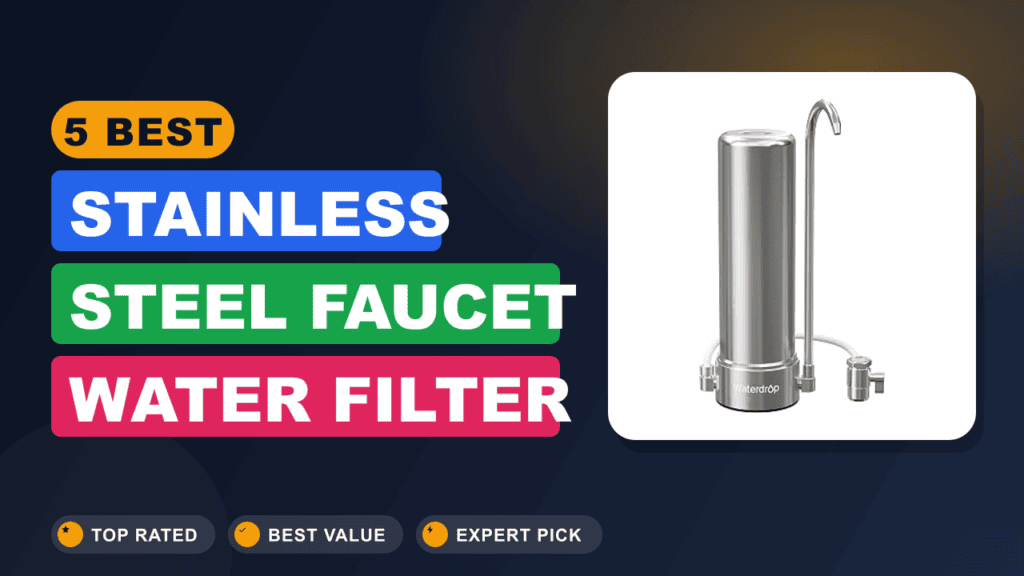
Under-sink filtration systems generally provide superior water quality and flow rates for dedicated drinking and cooking needs, while faucet-mounted filters offer a budget-friendly, renter-safe solution for basic taste improvement. The right choice between a faucet water filter vs under sink models depends entirely on your installation permissions, available cabinet space, and specific contaminant removal goals. If you own your home and want comprehensive filtration that stays out of sight, the under-sink route is typically the better long-term investment.
If you need clean water today without drilling holes or modifying plumbing, a faucet mount is the practical answer.
Understanding this distinction saves time and money because these two categories solve different problems. A faucet filter is an appliance accessory that treats water at the point of dispensing. An under-sink system is a plumbing fixture that treats water before it reaches a dedicated tap or your main line.
Confusing them leads to buying a product that cannot meet your expectations. This comparison breaks down the real-world trade-offs so you can match the system to your actual kitchen setup rather than marketing claims.
Filtration Performance and Contaminant Removal
Filtration capability is the most significant technical difference when evaluating a faucet water filter vs under sink options. Physical size dictates what the filter media can actually accomplish. Faucet mounts are constrained by weight and water pressure limits.
They typically use a single carbon block or granular activated carbon cartridge. This design effectively reduces chlorine taste, odor, and some volatile organic compounds. Some advanced faucet models include ion exchange resin to reduce lead or heavy metals.
However, the contact time between water and media is brief. Flow rates often drop noticeably as the cartridge loads with sediment. Most faucet filters do not remove dissolved solids, fluoride, nitrates, or arsenic.
They are polishing filters, not purification systems.
Under-sink systems have room for multi-stage filtration trains. A typical setup might include a sediment pre-filter, a large carbon block, and a reverse osmosis membrane or specialty media stage. This configuration allows for targeted contaminant reduction that faucet mounts simply cannot achieve.
Reverse osmosis units remove up to 99% of total dissolved solids, including salts, minerals, and many pharmaceuticals. Systems with UV stages address biological concerns in well water. Larger carbon beds provide longer contact time for chemical reduction without sacrificing flow rate.
According to the Environmental Protection Agency, point-of-use treatment technologies vary widely in their certified capabilities, making third-party testing essential for verification.
The performance gap matters most if your water has specific issues beyond bad taste. Municipal water reports list detected contaminants. Well water tests reveal private supply risks.
Match the system to those findings. A faucet filter handles aesthetic improvements adequately. Serious health-related contaminant reduction almost always requires the capacity of an under-sink unit.
Do not assume a higher-priced faucet mount equals better protection. The physics of filtration favor volume and contact time, both of which belong to under-sink systems.
Installation Requirements and Renter Considerations
Installation complexity creates a hard dividing line between these two categories. Faucet filters install in minutes with no tools beyond pliers. They attach directly to existing aerator threads.
Most include adapters for internal and external threading. The entire process is reversible. When you move out, you unscrew the unit and reinstall the original aerator.
No permanent changes occur. This makes faucet filters ideal for renters, dorm residents, or anyone who cannot modify plumbing. The trade-off is visible clutter on the spout and potential incompatibility with pull-down or spray faucets.
Many modern kitchen faucets lack standard threading or have integrated sensors that prevent adapter attachment. Always verify compatibility before purchasing.
Under-sink systems require permanent installation. Basic inline filters connect to the cold water line with a saddle valve or tee fitting. Reverse osmosis systems need a drain connection for wastewater and a separate faucet hole in the sink or countertop.
Drilling granite or quartz requires specialized bits and confidence. Connecting to copper or PEX lines demands proper fittings to prevent leaks. Cabinet space must accommodate the filter housing and tank.
Renters face lease restrictions on drilling and plumbing modifications. Even homeowners may hesitate to alter expensive countertops. Professional installation adds $150 to $300 to the total cost but ensures code compliance and leak-free connections.
This installation barrier explains why faucet filters dominate sales volume despite inferior performance. Convenience wins when permanence is impossible. If you own your home and plan to stay, the one-time installation effort pays dividends over years of use.
If your living situation is temporary or restrictive, accept the performance limitations of a faucet mount as the price of flexibility. Trying to force an under-sink system into a rental property risks deposit forfeiture or damage liability. Check your lease terms and get written permission before proceeding with any under-sink installation.
Daily Usability and Flow Rate Differences
Usability determines whether a filtration system actually gets used daily. Faucet filters add bulk to the spout and redirect water through a side outlet. Filling large pots becomes awkward.
The filtered stream is often slower than unfiltered flow, especially as the cartridge ages. Switching between filtered and unfiltered modes requires flipping a lever each time. Forgetting to switch back wastes filter life on dishwashing or hand washing.
The physical presence of the unit interferes with sink cleanup and can bump against tall glasses or pitchers. These friction points accumulate. Many users eventually bypass the filter entirely because the inconvenience outweighs the benefit.
Under-sink systems operate invisibly. Dedicated faucet models provide instant access to filtered water without affecting the main tap. Flow rates remain consistent because larger cartridges create less resistance.
There is no mode switching to remember. Pot filling happens at full speed through the main faucet while filtered water dispenses separately. Some systems integrate with refrigerator ice makers for automatic filtered ice.
The main limitation is the dedicated faucet placement. It occupies counter space near the sink edge. Small sinks may feel crowded.
Tank-based RO systems can run out during high-demand periods like holiday meal prep, requiring wait times for reservoir refill. Tankless models eliminate this issue but cost more upfront.
Consider your actual water usage patterns. Households that filter only drinking water tolerate faucet mount limitations better than those filtering all cooking water. Bakers and soup makers who need gallons of filtered water weekly will find faucet filters frustratingly slow.
Families with young children benefit from the set-and-forget nature of under-sink systems. The goal is seamless integration into existing routines. If the filter fights your workflow, it becomes shelfware regardless of its spec sheet ratings.
Test your current faucet's ergonomics before committing to a mount-on model. Visualize where a dedicated faucet would sit in your sink layout. These spatial decisions matter more than marginal differences in contaminant reduction percentages.
Maintenance Costs and Cartridge Longevity
Long-term ownership costs often surprise buyers who focus only on purchase price. Faucet filters have low entry costs but higher per-gallon expenses. Standard cartridges last 100 to 200 gallons or two to three months.
Heavy sediment loads shorten this lifespan dramatically. Replacement cartridges typically cost $20 to $40 each. Annual maintenance runs $80 to $160 depending on usage.
The small size means less media capacity, so breakthrough occurs faster. Ignoring replacement schedules degrades water quality below unfiltered levels as saturated carbon releases trapped contaminants. Manufacturer indicators are time-based estimates, not actual capacity measurements.
Tracking usage manually improves accuracy but adds mental overhead.
Under-sink systems have higher initial costs but lower operating expenses. Sediment pre-filters last six to twelve months. Carbon blocks handle 600 to 1,200 gallons before replacement.
RO membranes function for two to five years depending on feed water quality. Annual filter costs average $60 to $120 for multi-stage systems. The larger media volume provides buffer capacity that prevents sudden performance drops.
Many systems include electronic monitors or pressure gauges that signal true exhaustion rather than arbitrary timelines. Wastewater ratios affect RO operating costs. Traditional systems waste three to four gallons per gallon produced.
Modern permeate pumps and efficient membranes reduce this ratio to 1:1 or better. High wastewater areas should factor sewer charges into total cost calculations.
Calculate five-year ownership costs rather than comparing sticker prices alone. A $30 faucet filter costing $120 annually totals $630 over five years. A $300 under-sink system with $80 annual maintenance totals $700 over the same period.
The performance and convenience gap justifies the modest premium. Budget constraints may still favor faucet mounts initially. Just understand that the savings are front-loaded, not cumulative.
Also consider disposal impact. Replacing four small cartridges yearly generates more plastic waste than replacing one large cartridge. Environmental priorities align with economic ones here.
Larger systems are inherently more resource-efficient per gallon treated.
Space Constraints and Kitchen Layout Compatibility
Physical dimensions dictate feasibility regardless of other factors. Faucet filters occupy zero cabinet space. They live entirely above the sink deck.
This preserves storage for cleaning supplies, trash bins, or recycling containers. The trade-off is visual and functional interference in the sink basin. Low-clearance sinks or deep basins may not accommodate the filter body.
Pull-out sprayers are universally incompatible. Touchless faucets with motion sensors often lack threaded tips. Antique or commercial-style faucets may have non-standard sizing.
Measure your faucet tip diameter and check manufacturer compatibility lists before ordering. Return rates for incompatible faucet filters remain high due to assumption-based purchasing.
Under-sink systems demand dedicated cabinet volume. Single-stage inline filters fit in tight spaces beside garbage disposals. Multi-stage RO systems require 12 to 18 inches of width plus vertical clearance for tank height.
Garbage disposal installations compete for the same zone. Plumbing trap configurations may block access. Existing shelving or organizers might need removal.
Retrofitting older cabinets with particle board construction risks swelling from minor leaks. Waterproof liners provide insurance. Renters with finished cabinetry face restoration obligations.
Document pre-installation conditions photographically. Landlord approval should specify acceptable modification scope.
Measure your under-sink space precisely before selecting a system. Width, depth, and height all matter. Account for plumbing protrusions and disposal motors.
Tankless RO units sacrifice some capacity for compact footprints. Inline carbon filters offer minimal filtration in minimal space. If your cabinet houses critical infrastructure like electrical panels or gas shutoffs, maintain required clearance distances.
Safety codes trump filtration desires. Sometimes the honest answer is that neither option fits your current kitchen. Portable countertop RO units bridge this gap for space-constrained owners willing to sacrifice counter area.
Acknowledge spatial reality early to avoid costly returns or abandoned installations.
Common Questions About Faucet Water Filter vs Under Sink Systems
Does a faucet filter remove the same contaminants as an under-sink system?
No, faucet filters generally only reduce chlorine, taste, and odor with limited lead reduction. Under-sink systems with reverse osmosis or specialty media remove dissolved solids, fluoride, arsenic, nitrates, and pharmaceuticals that faucet mounts cannot address. Always check NSF certification listings for specific contaminant claims rather than assuming equivalence based on marketing language.
Can I install an under-sink filter myself if I am not handy?
Basic inline carbon filters are manageable for confident DIYers with standard plumbing connections. Reverse osmosis systems involving drain saddles, faucet hole drilling, and multiple tubing connections carry higher leak risk. If you lack experience with compression fittings or drill bits, professional installation prevents water damage and ensures proper function.
The labor cost is modest compared to cabinet repair expenses from installation errors.
Which option works better for renters who cannot modify plumbing?
Faucet-mount filters are the only viable choice for most rental situations since they require no permanent alterations. Verify faucet compatibility first and keep original aerators for move-out. Some landlords permit under-sink installations with written consent and professional work guarantees.
Never drill or modify plumbing without documented approval to protect your security deposit.
How do I know when my filter cartridge actually needs replacement?
Manufacturer timelines are averages that ignore your specific water quality and usage volume. Noticeable flow reduction, taste changes, or cloudiness indicate exhaustion regardless of calendar dates. Electronic monitors on premium models track actual throughput.
For unmonitored systems, log installation dates and estimated daily usage to calculate personalized replacement intervals. Overused filters can release accumulated contaminants back into water.
Is filtered water necessary if my municipal water meets safety standards?
Municipal compliance addresses legal minimums, not personal taste preferences or household-specific pipe contamination. Older service lines may leach lead after treatment plant compliance testing. Chlorine disinfection byproducts vary seasonally.
Private wells lack regulatory oversight entirely. Testing your actual tap water reveals whether filtration addresses real issues or perceived ones. Unnecessary filtration wastes money while missing genuine problems creates false security.
Which system handles high-volume cooking needs better?
Under-sink systems deliver consistent flow rates suitable for filling stockpots, pasta water, and coffee makers without waiting. Faucet filters restrict flow significantly and make large-volume tasks tedious. Households preparing meals frequently or preserving foods should prioritize under-sink capacity.
Reserve faucet mounts for drinking water only or low-volume households where patience offsets performance limitations.
Making Your Final Selection
Choose an under-sink system if you own your home, have adequate cabinet space, and need reliable contaminant reduction for cooking and drinking. The installation effort pays off through superior performance, invisible operation, and lower long-term costs. Select a faucet filter if you rent, lack under-sink space, or need immediate basic taste improvement without permanent changes.
Accept its limitations as the trade-off for flexibility and low upfront cost. Neither option is universally best. Your kitchen constraints and water quality needs determine the winner.
Start by testing your water and measuring your space before browsing products. Data-driven decisions prevent buyer's remorse in filtration purchases.
As an Amazon Associate, we earn from qualifying purchases.