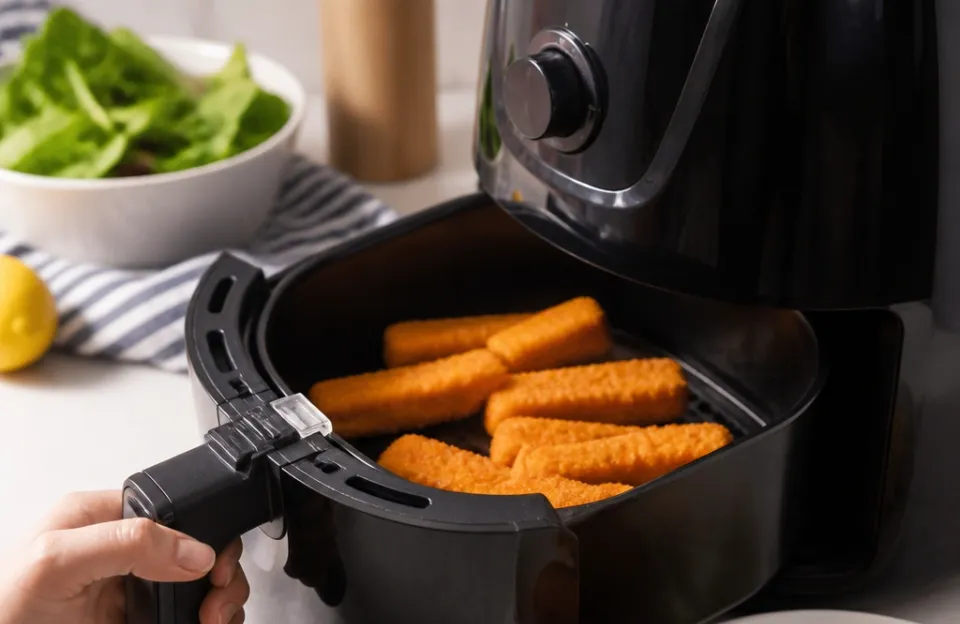
Cook frozen fish sticks straight from the freezer in a preheated air fryer at 400 degrees F (200 degrees C) for about 8 to 12 minutes, arranged in a single layer with space between each stick, flipping or shaking halfway. Standard thin sticks usually take around 8 to 10 minutes, while thicker or jumbo pieces may need 12 to 14 minutes. Check that the fish reaches a safe minimum internal temperature of 145 degrees F with a food thermometer. Package directions are often written for a conventional oven, so treat them as a starting point and adjust for your air fryer; when a package or appliance manual gives specific air fryer instructions, follow those instead.
Getting the Temperature and Timing Right
Set your air fryer to 400 degrees F and preheat it for about 2 to 3 minutes before adding anything. A short preheat helps the breading start crisping right away rather than warming gradually in a cold basket.
Timing depends mostly on stick thickness. Use this table as a starting point, then rely on color and internal temperature to confirm doneness:
| Fish Stick Type | Temperature | Time | Notes |
|---|---|---|---|
| Standard thin sticks | 400 degrees F | 8 to 10 minutes | Flip halfway |
| Thick sticks or fillets | 400 degrees F | 10 to 13 minutes | Flip halfway |
| Mini or kids’ size | 400 degrees F | 6 to 8 minutes | Check at 6 minutes |
| Gluten-free coating | 390 degrees F | 9 to 11 minutes | Slightly lower temp for delicate coating |
| General range | 400 degrees F | 8 to 12 minutes | Standard sticks usually about 10 minutes |
These figures are starting points drawn from general air fryer guidance, not tested results for every brand. If your package or appliance manual gives specific air fryer settings, follow those instead.
These times are starting points, not fixed rules. Exact timing varies by appliance wattage, basket size and brand, so follow the package or appliance manual when it gives specific air fryer instructions. If the package only lists conventional oven directions, adjust for your air fryer and check doneness with a thermometer.
Why Hot Air Beats the Oven for Breaded Seafood
Air fryers are essentially countertop convection ovens that cook food faster and consume less energy than larger ovens. The fan circulates hot air around the food, which helps the breading crisp on more sides than a still oven typically manages.
A conventional oven often takes longer to preheat and cook, and results for fish sticks can be uneven, with the top crisping before the bottom. The air fryer’s compact chamber and fan expose more of the coating to moving hot air, which generally gives breaded seafood a more even crisp.
Do You Need to Thaw or Add Oil?
No on both counts. Frozen fish sticks go straight from the freezer to the basket, and the factory breading means added oil is not required. Adding more oil tends to make the coating greasy rather than crispier.
If your basket has a worn or sticky surface, a light brushing of oil on the basket itself (not on the fish sticks) can help with release. For a related example of how little oil air frying requires, see these notes on calorie impact of air frying. For a similar temperature strategy on another air fryer favorite, see this garlic parmesan wing recipe.
Preventing Sogginess and Sticking in the Basket
The single most important rule is a single layer with a small gap between each stick. Stacked fish sticks trap steam between them, leaving the coating soft.
Overcrowding the basket prevents enough air circulation to properly cook the food, so cook large amounts in batches rather than all at once.
Flip each stick once at the halfway point to ensure both sides develop the same golden, crispy coating. If your basket tends to stick, arrange pieces with a little more space and shake gently rather than pressing them down. For more make-ahead strategy, see these meal prep portions.
Safe Internal Temperatures for Processed Fish Products
Fish is safe at a minimum internal temperature of 145 degrees F, measured with a food thermometer. The USDA FSIS Safe Minimum Internal Temperature Chart lists fish and shellfish at 145 degrees F (62.8 degrees C). The FDA similarly lists fin fish at 145 degrees F, or when the flesh is opaque and separates easily with a fork. This is the general finfish threshold; if a package for a fully cooked or partially cooked breaded product states a different internal temperature, follow the package.
Color and texture are unreliable indicators of safety. A food thermometer is the only way to ensure the safety of meat, poultry, seafood and egg products for all cooking methods. A digital meat thermometer makes this quick and reliable.
Insert the probe into the thickest part of the fish stick, avoiding the coating if possible. If the coating is browned but the center reads below 145 degrees F, extend the cooking time in short increments rather than raising the temperature. The general fish temperature of 145 degrees F applies here; there is no separate official threshold for pre-cooked frozen fish sticks.
Standard, Panko and Gluten-Free Breading Adjustments
Most frozen fish sticks use a standard breadcrumb coating that performs well at 400 degrees F. Panko-crusted sticks have a lighter, flakier coating that may brown faster than a fine crumb, so check them a little earlier and pull them when golden. Package directions control if they differ.
Gluten-free fish sticks may do better at a slightly lower temperature of 390 degrees F for 9 to 11 minutes, because the coating is delicate. Some gluten-free coatings can brown on the outside before the center heats through, so the lower temperature is an optional starting point. Package directions control if they differ.
There is no single verified brand-by-brand timing chart for every product. Treat the table above as a starting framework and adjust based on your first batch.
Troubleshooting Texture Problems Mid-Cook
Pale, soft coating: Your air fryer may not have been fully preheated, or the basket was overcrowded. Preheating for 2 to 3 minutes at 400 degrees F before adding the fish sticks helps the coating crisp better than starting from a cold basket. Remove any excess pieces to restore airflow.
Cold center but browned exterior: Drop the temperature slightly and continue cooking in short increments, checking internal temperature each time. This finishes the center without burning the coating.
Dry fish: Fish sticks are thin and cook quickly. Pull them as soon as they hit 145 degrees F. Extra time past that point tends to dry them out further.
Sticking to the basket: Space pieces more generously and shake the basket gently at the halfway point rather than flipping with a spatula that can tear the coating. An oven thermometer can help you confirm your air fryer is reaching the temperature you set, since display accuracy varies by model.
Storing and Reheating Leftovers
Refrigerate leftover fish sticks within 2 hours of cooking to avoid the Danger Zone, the range between 40 degrees F and 140 degrees F where foodborne illness bacteria multiply. Discard perishable foods left at room temperature for more than 2 hours, or 1 hour if the temperature is above 90 degrees F.
Leftovers can be kept in the refrigerator for 3 to 4 days or frozen for 3 to 4 months. Reheat leftovers to a safe minimum internal temperature of 165 degrees F.
For reheating, the air fryer at 350 degrees F for 3 to 4 minutes restores much of the original crispness. A microwave will heat them through but leaves the coating soft.
Dipping Sauces and Side Dishes That Complete the Plate
Tartar sauce, lemon-dill aioli, malt vinegar or a simple squeeze of lemon all work well with crispy fish sticks. For sauce ideas that pair just as well with seafood, browse this dipping sauce guide. Pair with oven-roasted potato wedges, a simple slaw or steamed green beans for a complete plate.
If you want to push the coating even crispier next time, these extra crispy results techniques share the same airflow and moisture principles that apply to breaded seafood.
Frequently Asked Questions
Can I cook fish sticks from frozen without thawing? Yes. Frozen fish sticks go straight from the freezer to the preheated air fryer basket. The factory breading is designed to crisp from frozen, and thawing first makes the coating soggy.
What temperature and time should I use? Preheat to 400 degrees F, then cook for 8 to 12 minutes, flipping halfway. Standard thin sticks usually take about 10 minutes, while thicker pieces may need 12 to 14 minutes. Package or appliance manual instructions take priority when they give specific air fryer settings.
Do I need to add oil? No. The factory breading is already formulated to crisp in hot air, and added oil makes the coating greasy rather than crispier.
How do I know the fish sticks are safely cooked? Use a food thermometer to confirm the center reaches 145 degrees F. Color and texture are unreliable indicators of safety. If the package states a different internal temperature for a fully cooked or partially cooked product, follow the package.
How long do leftover fish sticks last? Refrigerate within 2 hours and keep for 3 to 4 days, or freeze for 3 to 4 months. Reheat to 165 degrees F. These are general USDA FSIS leftover guidelines; package directions control if they differ.
Why are my fish sticks soggy? The most common cause is stacking or overcrowding, which traps steam and blocks air circulation. Arrange in a single layer with a small gap between each stick, and preheat the basket first. Package directions control if they differ.
Worth Remembering Before Your Next Batch
The approach is simple: preheat to 400 degrees F, arrange in a single layer with space between each stick, flip halfway, and pull when the internal temperature hits 145 degrees F. Keep the package handy for brand-specific adjustments, and treat the time ranges here as a starting point that you fine-tune for your appliance. For a related frozen favorite, this frozen chicken wings guide follows the same no-thaw, high-heat approach.