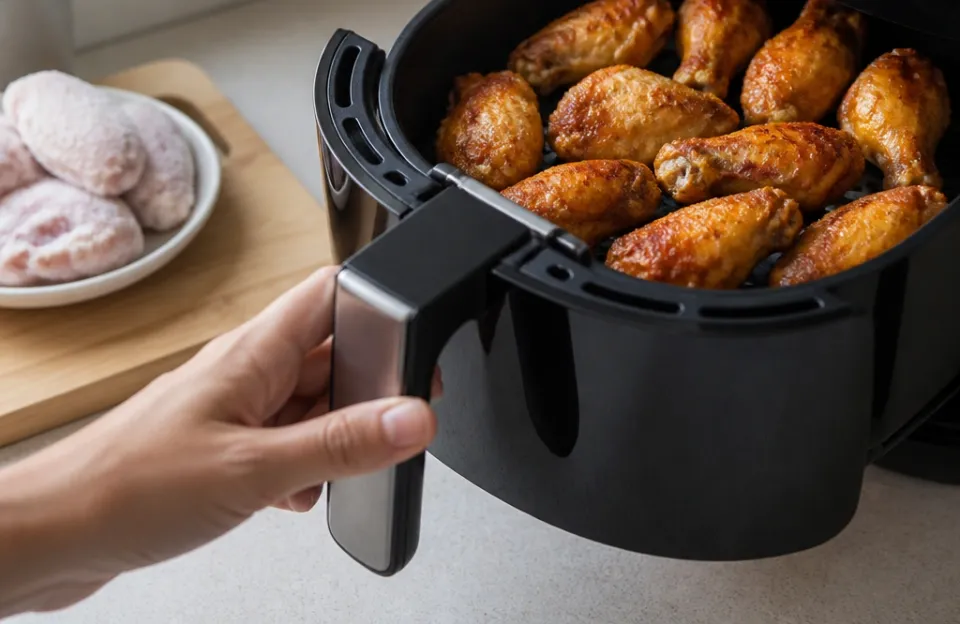
You do not need to thaw frozen chicken wings before air frying them. Cook them at 350°F to 400°F for roughly 20 to 30 minutes, flipping halfway, until a food thermometer inserted into the thickest part of the meat reads 165°F.
That is the short answer. The details that determine whether your wings come out crispy or soggy, and whether they are safely cooked, come down to spacing, batch size, and a thermometer check rather than a stopwatch.
Why Frozen Wings Work Well in an Air Fryer
An air fryer is essentially a countertop convection oven, and it cooks food faster while using less energy than a full-sized oven. The appliance is airtight, which keeps hot air inside and heats food intensely and rapidly. That fast-moving hot air is what turns the skin crisp.
Because the air circulates around the food rather than sitting still, frozen wings can go straight from the freezer to the basket. There is no safety reason to thaw them first, and skipping the thaw saves the planning step entirely. Air fryers are widely used for foods including chicken wings, nuggets, meatballs, and pork chops.
Before the Wings Go In
Handle frozen raw poultry the same way you would handle fresh raw poultry. Wash your hands with warm water and soap for at least 20 seconds before and after touching it. Keep raw wings away from other foods, and never put cooked food back on a plate or surface that held raw poultry unless it has been washed in hot, soapy water.
Do not thaw frozen chicken on the counter. Safe thawing happens in the refrigerator, in cold water, or in the microwave, and food thawed in cold water or the microwave should be cooked right away. For this recipe you can skip thawing altogether.
If your wings are frozen into a solid block, do not run them under the tap. Instead, leave the block in the refrigerator just long enough for the pieces to separate, then cook immediately. If you are short on time, place the block in a sealed bag in cold water, changing the water every 30 minutes, and cook the wings as soon as they separate.
Temperature and Time for Different Wing Types
The table below gives starting ranges. Exact times vary by air fryer model, wattage, and wing size, so treat these numbers as a baseline and verify doneness with a thermometer.
| Wing type | Temperature | Approximate time | Notes |
|---|---|---|---|
| Plain frozen wings | 400°F | 20–30 minutes | Flip at the halfway point; cook in a single layer |
| Pre-breaded frozen wings | Per package | Per package | Follow the manufacturer’s air fryer instructions when available |
| Pre-sauced frozen wings | Per package | Per package | Sauce and sugar content vary by product; package directions take priority |
General air fryer cooking falls in the 350°F to 400°F range, with most foods done in 5 to 25 minutes. Frozen wings tend to sit at the longer end of that window because they start from a solid frozen state.
One important exception: raw, stuffed breaded chicken breast products should not be cooked in an air fryer at all.
Step-by-Step Instructions
- Preheat the air fryer to 400°F for 3 to 5 minutes if your model has a preheat setting.
- Arrange the frozen wings in a single layer in the basket. Leave a little space between pieces so hot air can move around them. Overcrowding prevents proper air circulation, so cook large batches in multiple rounds rather than piling wings on top of each other.
- Cook for 10 to 12 minutes, then pull the basket out and flip each wing with tongs.
- Continue cooking for another 10 to 15 minutes, checking at the 20-minute mark.
- Insert a food thermometer into the thickest part of the meat, avoiding bone. Poultry, including ground poultry, is safe once it reaches 165°F. Poultry parts, whole birds, and stuffing all share that same 165°F minimum.
- If the wings are not yet at 165°F, return them to the air fryer in 2-minute increments and recheck.
- Rest the wings for 2 to 3 minutes before saucing and serving.
Color and texture will not tell you whether poultry is safely cooked. Always use a food thermometer to confirm meat and poultry have reached a safe minimum internal temperature.
If you want extra-crisp skin, a longer cook at a slightly lower temperature can help render more fat before the exterior sets. Techniques for getting extra snap include patting away surface moisture after the first flip and finishing at higher heat.
Fixing Uneven Browning and Soggy Spots
Uneven results almost always trace back to airflow. The most common causes:
Wings piled on top of each other. Overcrowding blocks circulation and steams the wings instead of crisping them. Cook in batches.
Wings touching the basket walls. Leave a small gap around the edges so air can pass.
Wet spots after flipping. If you notice pooled moisture, tilt the basket over the sink to drain it before continuing.
Pale patches on thicker pieces. Rotate wings toward the outer edge of the basket, where airflow tends to be strongest.
Tough texture. Toughness usually means the wings cooked too long or at too high a temperature before the interior was done. Lower the temperature by 25°F and extend the time, checking with a thermometer rather than guessing.
Times will never be identical across appliances, because each air fryer varies in size and power even though the safe internal temperature stays the same.
Managing Smoke When Cooking High-Fat Wings
Chicken wings render a fair amount of fat, and that fat can smoke if it pools on the heating element or sits in the drip tray. A few practical habits reduce the problem:
- Start with a clean basket and drip pan, since leftover grease from a previous cook burns quickly.
- Cook in smaller batches so less fat accumulates at once.
- Empty the drip pan between batches if you are cooking several rounds.
- Keep the air fryer in a well-ventilated area.
If your model’s manual includes specific grease-management or smoke-reduction instructions, follow those over any general advice. Adding water to the drip pan is not a step verified by the sources referenced here, and manufacturer guidance should take priority if it addresses the topic. The rendering process also affects the final nutritional profile of the finished wings.
Adjusting for Different Air Fryer Models
Basket, oven-style, and dual-basket air fryers behave differently enough that you should expect to adjust timing and layout:
Basket models concentrate heat in a compact chamber. Wings near the element brown fastest, so flip and rotate them.
Oven-style air fryers have more usable surface area and often cook more evenly, but they may need a slightly longer time because the larger cavity takes longer to heat.
Dual-basket models let you cook two batches at once, but each basket holds less. Keep each basket uncrowded rather than splitting a large load evenly.
Whatever the style, the doneness test does not change: 165°F on a thermometer.
Saucing and Serving
Sauce after cooking, not before. Sugar-based sauces brown and burn quickly at high heat, and a wet coating prevents the skin from crisping. Toss the finished wings in sauce right before serving, or brush it on and return them to the air fryer for 1 to 2 minutes.
If you are finishing with a sticky honey glaze, add it in the final minute of cooking or immediately after. For a marinade used on raw chicken, do not reuse it unless you bring it to a boil first. A marinade built for a better finished texture works best when applied before cooking and thickened separately for serving.
Pair the wings with your dipping options, or plan batch cooking ahead of time if you want wings ready for later in the week.
Storing and Reheating Leftovers
Refrigerate leftover wings within 2 hours of cooking, or within 1 hour if the outdoor temperature is above 90°F. The danger zone, where foodborne bacteria multiply rapidly, sits between 40°F and 140°F, so prompt refrigeration matters. Once cooked food is in the refrigerator, keep hot foods at 140°F or warmer if you plan to hold them out.
Leftovers keep in the refrigerator for 3 to 4 days, or in the freezer for 3 to 4 months. Frozen leftovers can be reheated without thawing, though safe thawing methods include the refrigerator, cold water, and the microwave if you prefer to thaw first.
Reheat wings in the air fryer at 350°F for 5 to 8 minutes, until they reach 165°F. Bring any sauces, soups, or gravies to a boil when reheating them.
Simple Rules to Remember
No thawing required, single layer in the basket, flip halfway, and 165°F on a thermometer before anything else.
Start with 400°F for 20 to 30 minutes for plain frozen wings, follow package directions for breaded or sauced products, and cook in batches rather than crowding the basket. Those four habits cover nearly every problem that shows up with frozen wings in an air fryer.