Most people need a 4 to 6 quart air fryer. That size handles meals for two to four people without taking up your entire counter. If you cook for five or more, or you want to roast a whole chicken, you need an 8 quart model or larger.
A 2 quart unit works only if you live alone and mostly reheat leftovers.
Figuring out what size air fryer do you need comes down to three things: how many people you feed, what foods you cook most often, and how much space you have on your counter. Buying one that is too small means cooking in frustrating batches. Buying one that is too big means wasting cabinet space and electricity.
The right capacity sits exactly where your daily habits meet your kitchen layout.
How Manufacturers Measure Basket Capacity
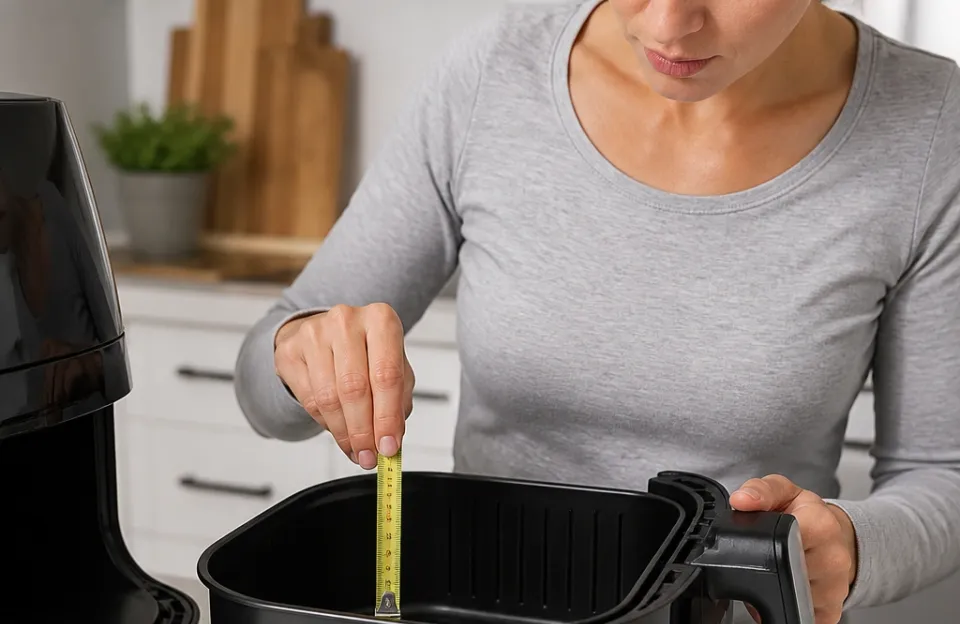
Air fryer sizes are listed in quarts or liters. That number refers to the total volume of the cooking basket or interior chamber. A 5 quart model holds roughly 4.7 liters of physical space inside the drawer.
That total volume does not equal usable cooking area. You cannot fill the basket to the brim. Air fryers work by pushing hot air rapidly around the food.
If you stack ingredients all the way to the top heating element, the air stops circulating. The food steams instead of crisping. In practice, you can only fill any basket about halfway to two-thirds full before results drop off.
This gap between stated volume and actual cooking space matters when you compare models. A wide, shallow 6 quart basket gives you more surface area for spreading out french fries than a tall, narrow 6 quart bucket shape. Both hold the same volume of water, but they cook food very differently.
When you look at specs, pay attention to the basket's footprint, especially if you plan to cook root vegetables that need to sit flat to brown properly.
Manufacturers test their stated capacities under ideal conditions. They might say a 4 quart model serves three people. That assumes standard portions and foods that don't require much spacing.
If you cook bulky items like stuffed peppers or bone-in pork chops, that same 4 quart unit will only serve two.
Matching Quarts to Your Household Size
The fastest way to pick a capacity is counting the mouths you feed every night. Here is how the numbers generally break down across standard household sizes.
| Capacity Range | Best For | Typical Meals It Handles |
|---|---|---|
| 1 to 2 quarts | 1 person | Single chicken breast, one serving of fries, reheating pizza |
| 3 to 4 quarts | 1 to 2 people | Two salmon fillets, side dishes, small batch of wings |
| 5 to 6 quarts | 3 to 4 people | Family side dishes, several drumsticks, a pound of meatloaf |
| 7 to 10 quarts | 5+ people | Whole chickens, large batches of wings, main plus side together |
A 1 to 2 quart model is strictly personal. It fits easily in a dorm room or an RV. You can toast a bagel or warm up a single portion of leftovers.
Trying to cook dinner for two in this size requires constant batch cooking.
The 3 to 4 quart range is the standard choice for couples or solo cooks who meal prep. You get enough room to lay out two decent-sized pieces of protein with some space between them. If you want to time your fish perfectly, this size gives you the clearance to check on it without crowding the drawer.
For families of three or four, the 5 to 6 quart sweet spot is where most buyers land. This size handles a standard bag of frozen fries or enough chicken pieces for everyone to eat at the same time. It also leaves room for air to move around denser items, like when you bake a compact loaf for a quick weeknight dinner.
Houses with five or more people, or anyone who entertains regularly, should start looking at 8 quart units. Anything smaller forces you into cooking multiple rounds while the first batch gets cold on the plate.
Counter Space and Cabinet Clearance
Capacity means nothing if the machine doesn't fit in your kitchen. Air fryers are bulky appliances. They take up significant real estate.
Before buying, measure the exact spot where the unit will live. Check the width, depth, and height. Then add at least five inches of clearance behind and above the appliance.
Air fryers vent extremely hot exhaust from the back and sometimes the top. Pushing one flush against a wall or under low cabinets risks heat damage to your paint or wood.
Smaller 2 to 4 quart models usually have a footprint around 10 by 10 inches. They slide under standard upper cabinets easily. A 6 quart unit pushes closer to 12 by 14 inches.
The massive 10 quart dual-basket ovens can span over 16 inches wide and weigh upward of 20 pounds.
If your counter space is tight, look at vertical designs. Some brands build their baskets taller rather than wider. A tall, narrow 6 quart model takes up less counter space than a wide, flat 5 quart oven-style unit.
The tradeoff is that tall baskets make it harder to shake fries evenly mid-cook.
You also need to consider storage. If you plan to put the air fryer away after each use, lifting a heavy 8 quart machine in and out of a lower cabinet gets old fast. Many people buy a large capacity model and realize they have no choice but to leave it on the counter permanently because it is too awkward to move.
If you prefer a minimal countertop, there are slim-profile options designed specifically to tuck into tight spaces without sacrificing a family-sized basket.
Basket Shape vs Oven Style Designs
Quarts only tell half the story. The physical shape of the cooking chamber dictates what you can actually fit inside.
Basket-style air fryers pull out like a drawer. They are usually round or slightly square. These excel at foods you toss or shake, like french fries, roasted vegetables, or chicken nuggets.
The deep shape keeps everything contained while you pull the drawer out and give it a shake. But fitting long items, like asparagus spears or whole fish fillets, can be frustrating in a round basket.
Oven-style air fryers open with a front door, similar to a toaster oven. They use wire racks instead of a solid bucket. This design gives you a wider, flatter cooking surface.
You can spread out bacon strips without overlapping them, which is why checking how long your strips need becomes much easier when they lay completely flat. You can also cook on multiple racks simultaneously, though the top rack will always brown faster than the bottom one.
Oven styles usually offer larger total capacities, often ranging from 6 to 15 quarts. They take up more counter space and require more effort to clean. Drippings fall through the wire racks onto a bottom tray, whereas a basket style keeps all the grease pooled at the base of the drawer.
Dual-basket models split the capacity into two separate drawers. A 8 quart dual basket gives you two 4 quart zones. This is ideal if you want to cook a protein in one side and a vegetable in the other, finishing both at the exact same time.
However, neither individual basket can hold anything larger than 4 quarts worth of food. You cannot fit a whole chicken in either side.
What Happens When You Overcrowd the Drawer
Buying a size too small leads directly to overcrowding. Overcrowding ruins the texture of air fried food.
An air fryer relies on a high-speed fan pushing heated air around the cooking chamber. When food touches or overlaps, the air cannot reach those contact points. Instead of the Maillard reaction creating a crispy brown crust, the trapped moisture turns to steam.
You end up with soggy, pale food that tastes baked rather than fried.
This is especially obvious with items that need maximum surface exposure. If you pile raw chicken wings on top of each other in a 3 quart basket, the skin won't crisp. Getting that perfectly crunchy exterior requires laying them out in a single layer with visible gaps between each piece.
If your basket only fits six wings in a single layer, but you need to feed four people, you either need a bigger machine or you need to cook in three separate batches.
Batch cooking introduces another problem: temperature drops. When you pull the basket out to remove the first batch, the heating chamber loses heat. The second batch starts in a cooler environment, meaning your timing changes slightly for every subsequent round.
Foods that rely on precise timing, like getting zucchini tender without turning it to mush, become much harder to manage across four consecutive batches.
If you frequently find yourself stacking food just to get dinner done faster, your current air fryer is too small for your routine.
Adjusting Cook Times Across Different Capacities
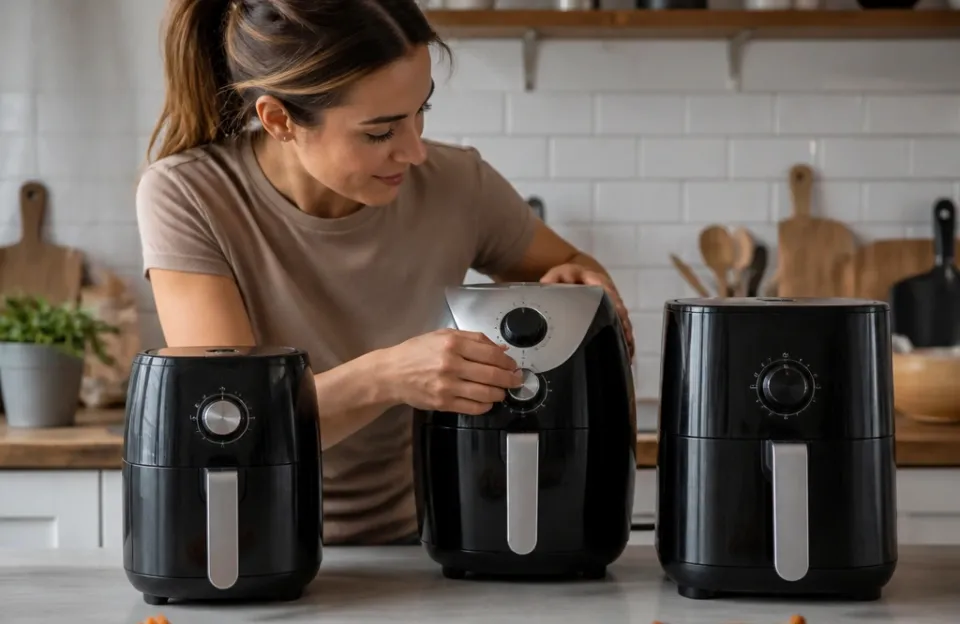
Size affects more than just how much food fits. It changes how fast the food cooks.
Smaller air fryers have less interior volume to heat. The heating element sits closer to the food. Because of this, a 2 quart model often cooks faster than a 6 quart model set to the exact same temperature.
The intense, concentrated heat in a tiny chamber accelerates browning.
Larger models take slightly longer to preheat. Once they reach temperature, the greater distance between the heating coil and the food at the bottom of a deep basket means the heat is slightly less aggressive. You might need to add two or three minutes to a recipe written for a smaller unit.
Dual-basket machines introduce airflow variables. Running both baskets at once pulls power from a single heating system. Some budget models struggle to maintain peak temperature in both zones simultaneously.
If you notice uneven cooking in a dual basket, try running only one side for critical items.
Always use visual cues and internal temperatures rather than relying blindly on the timer printed on a frozen food bag. Those instructions assume a standard 4 quart basket. If you are using a massive 10 quart oven style, the airflow dynamics are entirely different.
Picking the Right Size for Specific Ingredients
Sometimes the deciding factor isn't the number of people you feed, but the specific recipes you want to make. Certain foods demand minimum dimensions regardless of portion size.
Whole Chickens: To roast a standard 4 to 5 pound whole chicken, you need at least a 6 quart basket, and an 8 quart is much safer. The bird needs to sit without touching the top heating element. If the skin brushes the coil, it will burn and smoke before the meat reaches a safe internal temperature.
Baking and Bread: If you plan to bake cakes or breads, you need a rigid pan that fits inside the basket with at least an inch of clearance on all sides. A 4 quart basket barely fits a 6-inch round cake pan. For standard 8-inch pans, you need a 6 quart or larger oven-style unit.
Large Batches of Wings: Chicken wings are bulky and irregularly shaped. Even a modest appetizer portion for a game day gathering requires serious space. If making a big batch for meal prep is part of your weekly routine, skip the 4 quart models entirely.
Go straight to an 8 quart or a dual-basket setup so you can process two pounds at a time without stacking.
Dehydrating: Many modern air fryers include a dehydrate setting. Dehydrating fruit or jerky requires spreading items out in a thin, even layer. Oven-style air fryers with multiple racks are far superior for this task.
A basket style limits you to whatever fits at the bottom of the drawer.
Frozen Snacks: Standard bags of frozen fries or tater tots usually weigh between 16 and 32 ounces. A 4 quart basket handles a 16 ounce bag comfortably. A 32 ounce bag requires a 6 quart or larger to allow for shaking and proper crisping.
Common Mistakes When Choosing Air Fryer Capacity
People frequently miscalculate their needs, leading to buyer's remorse within the first month.
- Trusting the box claims blindly. A manufacturer stating a 3 quart model "feeds a family" is assuming child-sized portions and side dishes only. Always subtract 30% from the marketed capacity to find the realistic working volume.
- Ignoring the external dimensions. Shoppers focus entirely on the internal quart size and forget to measure their counter depth. A high-capacity unit hanging over the edge of a narrow counter is a tipping hazard.
- Buying too small to save money. The price difference between a 4 quart and a 6 quart is often minimal. The frustration of batch-cooking every meal for a family in a tiny basket makes the cheaper model a waste of money.
- Assuming bigger is always better. A 10 quart monster uses significantly more electricity than a 4 quart. If you live alone and only ever heat up a single chicken breast, a massive oven-style unit wastes energy and heats up your kitchen unnecessarily during summer months.
- Forgetting about cleanup. Larger baskets are heavier and harder to wash in a standard sink. If your sink basin is small, a massive non-stick drawer becomes awkward to maneuver without scratching the coating.
Frequently asked questions
Is a 4 quart air fryer big enough for two people?
Yes, a 4 quart air fryer is generally perfect for two people. It provides enough space to cook two generous portions of protein alongside a side dish, provided you don't stack the food. You can comfortably fit two large chicken breasts or a couple of thick steaks with room left over for the air to circulate.
Does a larger air fryer consume significantly more electricity?
Larger air fryers draw more wattage, typically ranging from 1500 to 1800 watts compared to 1000 to 1200 watts for smaller models. However, because a larger unit cooks more food at once, you run it for fewer total minutes than you would running multiple batches in a small unit. The overall energy difference per meal is usually negligible.
Can I fit a whole chicken in a 5 quart air fryer?
It is very difficult to fit a standard whole chicken in a 5 quart basket safely. While a small 3 pound bird might physically squeeze inside, it will likely touch the heating element, causing burning and smoke. For roasting whole poultry reliably, you should step up to at least a 6 quart model, with 8 quarts being the preferred size.
Are dual basket air fryers better than single large baskets?
Dual baskets are better if you frequently cook two different foods at once, like a protein in one drawer and vegetables in the other. They are worse if you occasionally need to cook one large item, like a whole chicken or a large batch of fries, because neither individual drawer offers enough continuous space for bulky ingredients.
Why does my food come out soggy even though my air fryer is new?
Soggy food almost always means the basket is overcrowded for its size. If the ingredients overlap or stack on top of each other, the hot air cannot reach the surface moisture to evaporate it. You either need to cook smaller amounts per batch or upgrade to a larger capacity model that allows for a single, spaced-out layer.
Getting the Fit Right the First Time
Choosing the right size air fryer saves you from daily frustration. Count the people you feed, measure your available counter space, and think about the bulkiest thing you plan to cook. A 4 to 6 quart basket covers the vast majority of households perfectly.
If you cook for a crowd or want to roast whole birds, jump to 8 quarts or higher. Match the capacity to your actual cooking habits, and the machine will stay on your counter instead of ending up in a donation bin.