You pull a thick ribeye off the grill, press your thumb against the center, and think it feels like a medium-rare steak. But ten minutes later, you slice into it only to find a cold, purple center or a gray, overcooked slab of leather. It’s a frustrating moment every home cook knows well.
Quick Answer: A digital meat thermometer is the only truly accurate way to measure doneness because it provides a specific, objective temperature reading. The touch test relies on subjective firmness, which changes based on the cut of meat, fat content, and individual hand anatomy, making it highly unreliable for food safety and precision cooking.
The Science of Heat and Muscle Protein
Cooking meat is a biological process where heat changes the structure of proteins. When you apply heat, the coiled proteins in the muscle fibers begin to denature and shrink. This process squeezes out moisture and causes the meat to firm up.
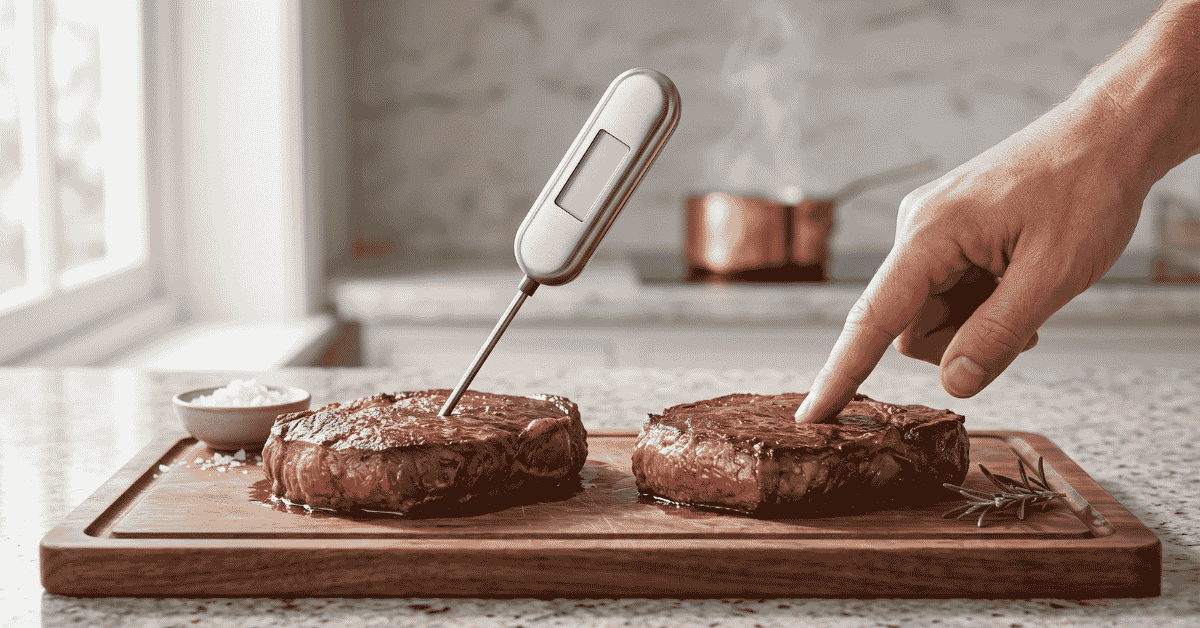
The touch test, often called the “finger-to-palm” method, attempts to use this firming process as a gauge. The theory suggests that as the meat gets harder, it corresponds to a specific stage of doneness. While the physics of protein tightening is real, the human hand is a poor tool for measuring it.
Every cow, pig, or chicken has a different muscle density. A lean grass-fed steak will feel much firmer at a lower temperature than a highly marbled Wagyu steak because fat stays soft even as the protein cooks.
Reliable cooking comes down to internal temperature, not surface tension. According to USDA Food Safety guidelines, poultry must reach 165°F (74°C) to be safe, while ground meats need 160°F (71°C). The touch test cannot tell you if a chicken breast is at 150°F or 165°F; it just tells you if the outside feels springy.
Why the Touch Test Often Fails
The biggest flaw in the touch test is subjectivity. The classic version involves touching your thumb to your fingers and feeling the fleshy part of your palm. But if you have calloused hands from manual labor or very soft hands, your baseline for “firmness” is already skewed.
Furthermore, the cut of meat dictates the feel. A beef tenderloin is naturally soft. If you cook it until it feels like a “well-done” sirloin, you have actually turned that expensive tenderloin into a dry, ruined mess.
The thickness of the meat also plays a role. A thin flank steak might feel firm because it’s touching the hot grill grate, even if the center is still raw. A thick roast might feel soft on the surface while the layer just beneath is already overshooting your target temperature.
Accuracy and Food Safety
Precision isn’t just about taste; it’s about health. When you use the touch test for pork or chicken, you are guessing with pathogens like Salmonella or E. coli. A thermometer gives you a “yes” or “no” answer.
Modern digital instant-read thermometers are accurate within 0.5 degrees Fahrenheit. They can give you a reading in two seconds or less. Compare that to poking a hot piece of meat and trying to remember if it feels like your middle finger or your ring finger.
There is no contest when it comes to repeatable results. If you want a medium-rare steak at exactly 130°F, only a probe can confirm you’ve hit the mark.
How to Use a Meat Thermometer Correctly
Buying a thermometer is only half the battle. You have to put it in the right spot to get a real reading. If you hit a bone, a pocket of fat, or a hollow cavity, the number on the screen will be wrong.
- Find the Thickest Part: Aim for the center of the largest muscle. Avoid the edges where the meat is thinner and cooks faster.
- Avoid Obstructions: Bone conducts heat differently than meat. If your probe touches a bone, it will often show a higher temperature than the actual meat. Stay at least half an inch away from any bone.
- Check Multiple Spots: Large items like a whole turkey or a brisket can have “cold spots.” Check the thickest part of the breast and the inner thigh of a bird to ensure the whole animal is safe to eat.
- Account for Carry-Over Cooking: Meat continues to rise in temperature after you take it off the heat. This is due to residual energy moving from the hot exterior to the cooler center. Usually, a steak will rise 5°F while resting, while a large roast might rise 10°F. Pull your meat slightly before it hits your final target.
The Myth of “Poking” and Lost Juices
A common argument against thermometers is that poking the meat lets all the juices out. This is largely a myth. While it’s true that a small amount of liquid may escape the probe hole, it is negligible compared to the total moisture in the cut.
Meat is not a balloon filled with water; it is a sponge-like structure of muscle fibers. Puncturing one small area does not cause the entire steak to deflate. In fact, you lose far more juice by overcooking meat, which happens frequently with the touch test, than you ever will from a tiny thermometer hole.
Overcooking causes the muscle fibers to contract so tightly that they squeeze out the moisture, leaving the meat dry and tough.
When the Touch Test Might Be Useful
The touch test isn’t completely useless, but it should be a secondary check, not the primary tool. Experienced line cooks in high-volume restaurants use the touch test because they cook hundreds of identical steaks every night. They develop a “muscle memory” for a specific cut of meat from a specific supplier.
However, even professional chefs use thermometers for thick roasts or whenever the stakes are high. For a home cook who buys different brands or cuts of meat every week, that muscle memory never has a chance to develop. Use the touch test to get a sense of how the meat is progressing, but always verify with a digital probe before you make the final call to pull it off the heat.
Common Mistakes with Temperature Checks
Many people own a thermometer but still end up with poorly cooked food. This usually stems from a few standard errors:
- Measuring too early: If you keep opening the grill or oven every five minutes to check the temp, you are letting out the ambient heat and slowing down the cook.
- Forgetting to calibrate: Even digital tools can drift. Periodically put your probe in a glass of crushed ice and water. It should read 32°F (0°C). If it doesn’t, follow the manufacturer’s steps to reset it.
- Checking the surface only: Some cheap thermometers have long sensors. If you don’t push the probe deep enough, you’re only measuring the temperature of the outer inch of meat.
- Ignoring the rest time: Cutting into a steak the second it hits the cutting board is the fastest way to lose moisture. The juices need time to redistribute as the muscle fibers relax.
Meat Temperature Reference Chart
| Meat Type | Desired Doneness | Pull Temp (with carry-over) | Final Safety Temp |
|---|---|---|---|
| Beef / Lamb | Rare | 120°F (49°C) | 125°F (52°C) |
| Beef / Lamb | Medium-Rare | 130°F (54°C) | 135°F (57°C) |
| Beef / Lamb | Medium | 140°F (60°C) | 145°F (63°C) |
| Pork (Chops/Roast) | Medium | 140°F (60°C) | 145°F (63°C) |
| Ground Meats | Safe | 160°F (71°C) | 160°F (71°C) |
| Poultry | Safe | 160°F (71°C) | 165°F (74°C) |
Frequently Asked Questions
Can I tell if chicken is done by the color of the juices?
Looking for “clear juices” is an old tip, but it’s not reliable. Sometimes chicken can have pinkish juices or even dark bone marrow staining despite being fully cooked. Conversely, juices can run clear before the meat has reached a safe temperature.
Always use a thermometer for poultry.
Which is better: a leave-in probe or an instant-read thermometer?
Both have their place. A leave-in probe is great for large roasts or smoking meats because it monitors the temp without you opening the oven door. An instant-read is best for steaks, burgers, and smaller cuts where you need to check multiple spots quickly.
Does sticking a thermometer in meat make it cook slower?
No. The probe is very thin and does not absorb enough heat to change the cooking time of the meat. In fact, by giving you an accurate reading, it helps you avoid leaving the meat on the heat for too long, which is a much bigger concern.
Why does my steak feel soft but the thermometer says it’s medium?
Large amounts of internal fat (marbling) or a very high-quality cut of meat like Wagyu will always feel softer than a lean cut like eye of round. This is why the touch test fails, it can’t account for the fat content that stays liquid and soft at higher temperatures.
Before you go
Trusting your senses is part of being a good cook, but trusting data is how you become a consistent one. The touch test is a fun party trick, but a digital thermometer is a tool for excellence. If you want to stop guessing and start serving perfect meals every time, the small investment in an instant-read probe is the best move you can make in your kitchen.
It removes the stress of the “big reveal” when you cut into the meat and ensures that every guest eats safely.