You pull the roast out of the oven, hoping for a perfect medium-rare center. But as you slice into it, the meat looks gray and dry, or worse, is still cold and pink in the middle. Everyone has faced that moment of doubt where you just can’t tell if the food is safe or tasty without hacking it to pieces.
Quick Answer: The best Cooper meat thermometer digital models are known for their industrial-grade accuracy and speed, often used by professional chefs and health inspectors. These tools, specifically the Cooper-Atkins line, provide precise readings within ±1°F and can stabilize in under six seconds. They are built to withstand high-heat commercial environments while remaining simple enough for home cooks to use for food safety.
Why Accuracy Matters in Digital Thermometry
Precision isn’t just about making sure a steak tastes good; it’s a fundamental part of food safety. In the professional world, Cooper-Atkins has been a standard for over 130 years. Their digital sensors use high-quality thermistors or thermocouples to detect heat at a molecular level.
Unlike cheap grocery store versions that might be off by five degrees, these professional tools stay calibrated even with heavy use.
Many home cooks don’t realize that a five-degree error is the difference between a juicy turkey and a dry, stringy mess. Or even more dangerously, it’s the difference between killing harmful bacteria like Salmonella and leaving it alive. When you look for the best Cooper meat thermometer digital option, you are looking for a device that meets NSF (National Sanitation Foundation) standards.
This ensures the materials are safe for food contact and the electronics are reliable under pressure.
The Technology Inside a Digital Probe
Cooper digital thermometers usually fall into two categories: thermistors and thermocouples. Thermistors are common in “instant-read” pocket models. They use a ceramic semiconductor that change resistance based on temperature.
They are very accurate and affordable.
Thermocouples represent the higher end of the spectrum. They use two different metal wires joined at the tip to create a small voltage that changes with heat. This tech is much faster, often giving you a final reading in 2 or 3 seconds.
If you are frequently checking multiple spots on a large bird or a rack of ribs, that speed keeps the oven door closed longer and prevents heat loss.
Durability and Build Quality
A kitchen is a harsh place for electronics. Steam, grease, and accidental drops can ruin a standard digital gadget. The best Cooper meat thermometer digital designs often include “IP” ratings, which stand for Ingress Protection.
This identifies how well the casing keeps out dust and water.
Many pro-level Cooper models are “waterproof” or “washable,” meaning you can sanitize the whole unit under a tap without shorting out the screen. They also use antimicrobial plastics. This helps prevent cross-contamination if you happen to touch the handle with hands that just prepped raw poultry.
How to Choose the Right Model for Your Needs
Selecting the right digital thermometer depends on what you cook most often. Not all “best” options are the same for every chef. You have to consider the environment, whether you’re at a grill, a stovetop, or using a smoker.
- Folding Probes: These are perfect for storage and safety. the probe tucks away like a pocketknife, protecting the sensor and your fingers.
- Fixed Probes: These usually have a thinner needle and are great for quick “spot checks” during a busy dinner service.
- Leave-in Probes: These have a heat-resistant wire that goes from the meat to a base station outside the oven. Cooper specializes in these for long-term roasting or smoking.
Checking for NSF Certification
One thing that sets Cooper-Atkins apart is their commitment to NSF International standards. When a thermometer is NSF certified, it has passed rigorous testing for accuracy and cleanability. If you see that blue circle logo on the back of the device, you know it isn’t just a toy.
It is a piece of medical-grade or industrial-grade equipment adapted for the kitchen.
Screen Visibility and Interface
A thermometer is useless if you can’t read it while steam is hitting your face. The best digital models use high-contrast LCD screens. Look for “backlit” options if you do a lot of night grilling or if your oven light is dim.
Some Cooper models also include a “Hold” button. This freezes the temperature on the screen so you can pull the thermometer out of the dark oven and read it comfortably on the counter.
How to Correctly Use a Digital Thermometer
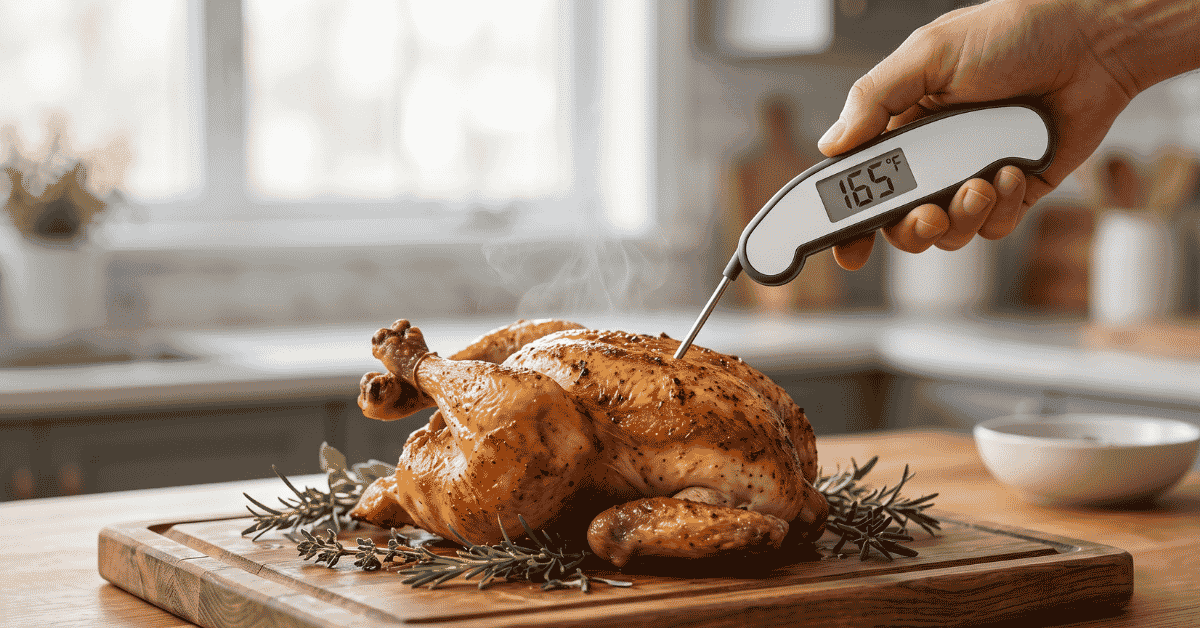
Getting a accurate reading is about more than just poking the meat. You have to know where to aim. The sensor on a digital probe is usually located in the very tip, often the last half-inch of the metal needle.
- Find the Deepest Point: Insert the probe into the thickest part of the meat.
- Avoid Bone and Fat: Bones conduct heat differently than muscle, and fat pockets can be hotter or colder than the meat itself. Either will give you a false reading.
- Check for “Carry-over Cooking”: Remember that meat continues to rise in temperature about 5 to 10 degrees after you take it off the heat. If your target is 145°F, you might want to pull the meat at 138°F.
- Angle Matters: For thin items like burgers or fish fillets, insert the thermometer into the side rather than from the top down. This ensures the sensor tip stays inside the meat and isn’t measuring the hot pan underneath.
Maintenance and Calibration Checks
Even the best Cooper meat thermometer digital devices need a check-up once in a while. You can perform an “Ice Bath Test” to see if your unit is still accurate.
Fill a tall glass with crushed ice and just enough water to fill the gaps. Stir it well and let it sit for a minute. When you stick the probe in, it should read exactly 32°F (0°C).
If it is off by more than a degree, many Cooper models allow you to hit a “cal” or “reset” button to lock it back to center.
Cleaning is just as vital. Never use a scouring pad on the metal probe, as tiny scratches can harbor bacteria. A simple wipe with a soapy cloth or an alcohol swab is usually enough.
If the model is rated as waterproof, a quick rinse under the faucet is fine, but never let a digital device soak in a sink full of water for long periods.
Common Misconceptions About Digital Thermometers
Many people believe that “digital” automatically means “perfect.” This isn’t always true. Here are a few things people get wrong:
- “The whole needle measures the temp”: Only the tip does the work. If you only stick it in halfway, you’re getting an average or a surface reading.
- “Instant-read means instant”: No thermometer is truly instant. Most take 2 to 6 seconds. If you pull it out too fast, you haven’t given the sensor time to reach the actual temperature of the meat.
- “Digital probes never break”: They are sensitive electronics. Dropping them on a tile floor or getting the wire “kinked” on a leave-in model can cause the internal wires to fray and fail.
- “Batteries last forever”: A low battery can actually cause a digital thermometer to give fluctuating or wildly incorrect readings. If the screen looks dim, change the battery immediately to maintain accuracy.
Comparison of Cooper Digital Sensor Types
| Sensor Type | Average Speed | Best Use Case | Accuracy Level |
|---|---|---|---|
| Thermistor | 5-7 Seconds | General Home Cooking | High (±1.0°F) |
| Thermocouple | 2-3 Seconds | Professional Grilling | Very High (±0.5°F) |
| Reduced Tip | 4-6 Seconds | Thin cuts (Fish/Burgers) | High (±1.0°F) |
Frequently Asked Questions
Can I leave my Cooper digital thermometer in the oven?
Most pocket or handheld “instant-read” models are not designed to stay in the oven. The plastic housing will melt. Only use specific “leave-in” probes with a high-heat cable meant for internal monitoring.
What is the “Dura-P” coating I see on some Cooper models?
The “Dura-P” or similar antimicrobial coatings are built into the plastic of the thermometer. They are designed to inhibit the growth of mold, mildew, and bacteria on the surface of the tool between cleanings.
Why does my thermometer show “LLL” or “HHH”?
This usually isn’t a broken device. It means the temperature is outside the probe’s range. “LLL” means the environment is too cold (like stuck in a freezer), and “HHH” means it’s too hot (like being too close to an open flame).
Is a Cooper-Atkins thermometer better than a cheap kitchen store brand?
While both might look similar, Cooper-Atkins tools are calibrated to NIST (National Institute of Standards and Technology) traceable standards. This makes them significantly more reliable for long-term use and food safety compliance.
Worth remembering
Choosing the best Cooper meat thermometer digital tool is an investment in your cooking skills and your family’s health. While hobbyist brands focus on flashy apps and Bluetooth, Cooper focuses on the raw speed and accuracy required in professional kitchens. If you want a tool that gives you the truth about your food in three seconds flat, sticking with an NSF-rated professional brand is the smartest move you can make.