You’ve pulled a beautiful leg of lamb out of the oven, hit your target temperature, and let it rest, only to find the center is still a bit too pink for your guests. Or maybe you’ve seared lamb chops to the same “medium” setting you use for a roast, but they ended up chewy and dry. It’s a common frustration in the kitchen because lamb doesn’t behave like a single type of meat; it changes based on how it’s cut.
Quick Answer: Lamb chops and lamb roasts require different cooking approaches because of their size and fat distribution. Chops are small and lean, needing high, fast heat to sear the outside without overcooking the thin interior. Roasts are large and dense, requiring a lower temperature and longer time to allow heat to penetrate the center and break down tough connective tissues.
The Science of Surface Area and Density
The biggest reason temperature and timing differ between these two is physics. A lamb chop is usually less than two inches thick, while a roast can be a massive six-pound muscle group. When you put a chop on a hot pan, the heat hits the center almost instantly.
If your pan is too cool, the meat sits there long enough to leak all its juices before it browns.
Roasts work differently. If you put a leg of lamb in a 450°F oven for the whole duration, the outside will burn to a crisp before the middle even gets warm. This is why we use “low and slow” methods for roasts.
A lower oven temperature (often between 275°F and 325°F) allows the heat to gently move from the outer crust toward the bone without ruining the exterior.
Weight vs. Thickness
In professional kitchens, chefs often talk about thickness rather than weight. You can have a two-pound roast that is long and thin, or a two-pound roast that is short and round. The rounder roast will always take longer to cook because the heat has a greater distance to travel to reach the geographic center.
Chops, being uniform and thin, have very little “distance” for heat to travel, making them much more sensitive to even a thirty-second delay in removing them from the heat.
Heat Transfer Methods
Chops usually rely on conduction, direct contact with a hot cast-iron skillet or grill grate. This intense heat creates the Maillard reaction, that savory brown crust we love. Roasts rely more on convection (the air in the oven) or radiation (the heat waves from grill coals).
These methods are less efficient at transferring heat than a hot pan, which is exactly what a large roast needs to avoid overcooking the outer layers of meat.
How Connective Tissue Changes the Game
Not all parts of the lamb are created equal. Chops usually come from the loin or the rib, which are muscles that didn’t do much heavy lifting during the animal’s life. These muscles are naturally tender and have very little collagen.
Roasts often come from the leg or the shoulder. These are working muscles. They are packed with connective tissue and collagen that hold the muscle fibers together.
If you cook a shoulder roast quickly over high heat, that collagen stays tight and rubbery. You need time and a steady, lower temperature to melt that collagen into gelatin. This process is what makes a slow-roasted lamb shoulder “fall-off-the-bone” tender.
The Melting Point of Fat
Lamb fat has a higher melting point than beef fat. This is why cold lamb can feel “waxy” on the roof of your mouth. When cooking a roast, the lower temperature allows the intramuscular fat (marbling) to render slowly.
This fat bastes the meat from the inside out. Chops don’t have this luxury; their fat is often on the outer edge, and because they cook so fast, that fat needs a high-intensity sear to crisp up and become edible rather than chewy.
Muscle Fiber Density
The grain of the meat also plays a role. Loin chops have very fine muscle fibers that can toughen up quickly if pushed past medium-rare. The coarser fibers in a leg or shoulder roast are more resilient.
They can handle a wider range of temperatures, which is why a roast pulled at 145°F might feel more forgiving than a chop pulled at the same temperature.
Carryover Cooking: The Hidden Factor
Carryover cooking is the phenomenon where the internal temperature of meat continues to rise after you take it out of the heat. This is where the gap between chops and roasts becomes most apparent.
A small lamb chop has very little thermal mass. Once it leaves the pan, it might only rise 2 or 3 degrees. However, a large roast is like a battery that has stored a massive amount of heat.
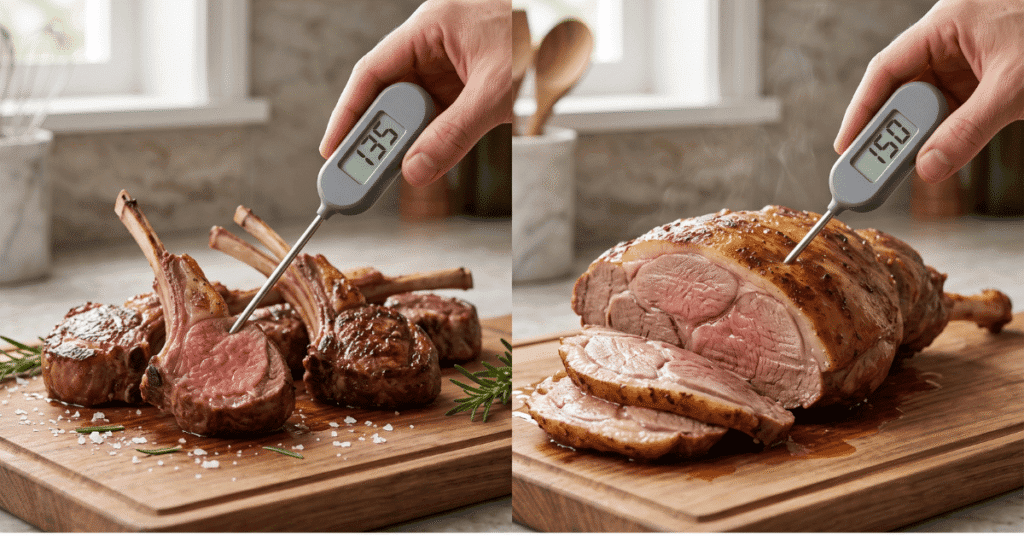
It can easily rise 10 to 15 degrees while resting on the counter. If you want a roast at a perfect 135°F (medium-rare), you must pull it out of the oven at 125°F. If you wait until the thermometer says 135°F, you’ll end up with a medium-well roast by the time you carve it.
Resting Times
A chop only needs about 3 to 5 minutes to rest. This allow the juices to redistribute so they don’t run out when you cut in. A roast, however, needs at least 15 to 30 minutes.
Breaking into a roast too early is the number one cause of dry meat. According to USDA food safety guidelines, the minimum internal temperature for lamb is 145°F followed by a 3-minute rest, though many culinary enthusiasts prefer lower temps for better texture.
Environmental Influence
Where you rest the meat matters too. If you tent a large roast tightly with foil, you are essentially creating a small oven, which will accelerate carryover cooking. For chops, a light covering is usually enough to keep them warm without overshooting the target temperature.
Practical Application: Cooking Each Cut Correctly
When you are standing in the kitchen, you need a different set of rules for each cut. Here is how to apply these temperature differences in practice.
For Lamb Chops:
-
Pat them dry. Use a paper towel to remove all surface moisture. This ensures you get a sear immediately instead of steaming the meat.
-
High Heat. Use a heavy skillet, preferably cast iron. Get it smoking hot before the lamb touches the pan.
-
Flash Cook. Aim for 3-4 minutes per side.
-
Target Temp. Pull them at 130°F for medium-rare. They will finish at roughly 133°F.
For Lamb Roasts:
-
Room Temp. Let the roast sit out for about an hour before cooking. This narrows the gap between the cold center and the hot oven.
-
Low and Consistent. Set your oven between 300°F and 325°F.
-
Use a Probe. Don’t guess. A leave-in thermometer is the best way to monitor a roast without opening the oven door and losing heat.
-
The 10-Degree Rule. Pull the roast 10 degrees before your target. For medium-rare (135°F), pull it at 125°F.
Edge Cases and Exceptions
While “high for chops, low for roasts” is the general rule, there are a few scenarios where this flips.
-
Mini-Roasts (Rack of Lamb): A rack of lamb is technically a roast, but it’s thin like a chop. It’s often best to sear it first in a pan and then finish it in a hot oven (400°F) for only 10-15 minutes. It doesn’t have the mass of a leg of lamb, so it doesn’t need the “low and slow” treatment.
-
Thick-Cut “Double” Chops: If your chops are 2.5 inches thick or more, they act more like mini-roasts. In this case, use the “reverse sear” method. Start them in a low oven until they hit 120°F, then finish them in a screaming hot pan for one minute per side.
-
Boning Out a Roast: If you take the bone out of a leg of lamb and butterfly it (flatten it out), it cooks much faster. Because it is no longer a dense “ball” of meat, you can actually grill it over medium-high heat like a giant steak.
Common Mistakes to Avoid
-
Using the same pull temp for both: Using 145°F as your “pull” temperature for both will result in a perfect chop and an overcooked roast due to carryover heat.
-
Skipping the sear on roasts: Just because you cook a roast low doesn’t mean you don’t want a crust. Brown it in a pan first or blast it at 450°F for the first 10 minutes before dropping the temp.
-
Cutting too soon: We’ve mentioned this, but it’s the most frequent error. If you cut a roast right away, the internal pressure pushes all the moisture out.
-
Ignoring the bone: Meat near the bone stays cool longer. When checking the temperature of a roast, make sure your thermometer isn’t touching the bone , or you’ll get a falsely low reading.
Quick-Reference Temperature Guide
Cut Type Cooking Method Pull Temperature Final Resting Temp Resting Time
Loin Chops Pan Sear / Grill 130°F (54°C) 133°F – 135°F 5 Minutes
Rib Chops High Heat 125°F (52°C) 130°F 3 Minutes
Leg Roast Low Oven 125°F (52°C) 135°F – 140°F 20 Minutes
Shoulder Slow Braise N/A (Cook until tender) 195°F – 205°F 30 Minutes
Frequently Asked Questions
Why does my lamb roast look gray instead of pink?
This usually happens if you cook it at too high a temperature for too long. The high heat overcooks the outer two inches of the meat while trying to get the center to the right temperature. Lower your oven temperature next time to get an even pink color from edge to edge.
Can I cook lamb chops in the oven?
You can, but it’s risky. Because they are so thin, the ambient air in the oven often dries them out before they get a good sear. If you must use the oven, use the broiler.
It mimics the intense direct heat of a grill.
Why is my lamb shoulder still tough at 145°F?
Unlike the loin, the shoulder is full of collagen. At 145°F, that collagen hasn’t melted yet. For tough working cuts like the shoulder, you actually want to cook them well past “medium” until they reach about 200°F, where the fibers finally relax and separate.
Does “room temperature” really matter?
For a small chop, not much. It will heat up fast anyway. For a five-pound roast, it matters a lot.
A cold core will stay raw while the outside overcooks. Giving it an hour on the counter makes the cooking much more even.
Worth Remembering
The difference between a great lamb dinner and a mediocre one almost always comes down to how you manage heat based on the shape of the meat. Chops are about speed and intensity; roasts are about patience and residual heat. If you treat your roast like a giant chop, it will be tough.
If you treat your chop like a tiny roast, it will be gray and bland.
Keep a reliable instant-read thermometer nearby and always check the thickness of your cut before you decide on your oven setting. Once you master the “pull temperature” for each specific cut, you’ll never have to worry about a dry roast or a soggy chop again.