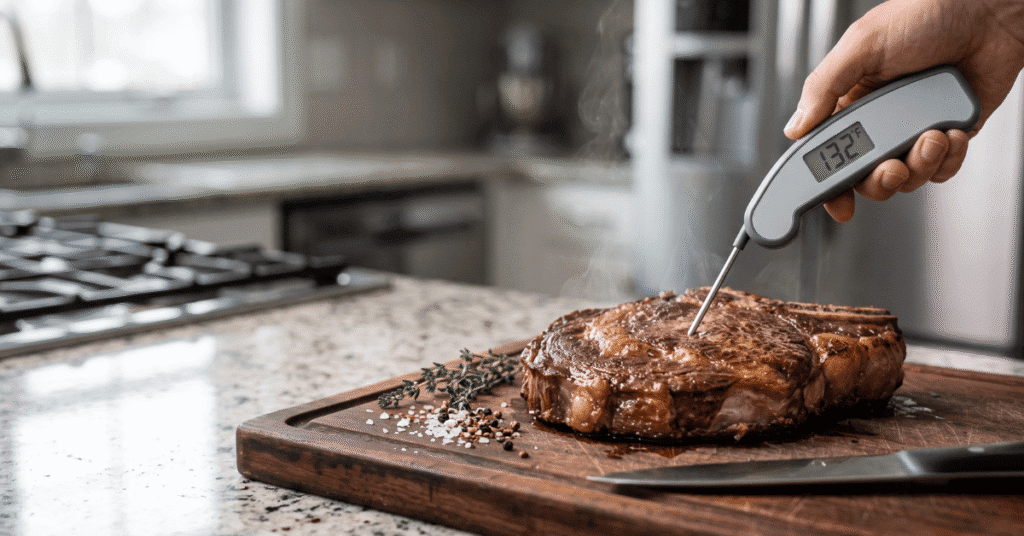
You’ve spent good money on a thick ribeye, seasoned it to perfection, and seared it until the crust looks like a work of art. But as you pull it off the heat, a familiar doubt creeps in. Is it a cool red in the middle, or have you accidentally turned a premium cut into a dry, gray slab of leather?
Quick Answer: To use a meat thermometer in steak correctly, insert the probe into the thickest part of the meat through the side, keeping it away from bone and fat pockets. Aim for the very center of the cut and pull the steak off the heat when it hits 5°F below your desired final temperature to account for carryover cooking.
The Science of Internal Temperature and Precision
Cooking by time is a guessing game because every grill, pan, and steak is different. A thermometer takes the guesswork out of the process by measuring the kinetic energy of the water and protein molecules inside the meat. When you cook a steak, heat travels from the outside in; the thermometer tells you exactly how far that heat front has progressed toward the center.
Accuracy is the difference between a steak that melts in your mouth and one that requires a lot of chewing. Most people rely on the “poke test” or looking at the color of the juice, but these methods are notoriously unreliable. A digital instant-read thermometer gives you a number you can trust within seconds, which keeps the juices inside rather than letting them escape through repeated experimental cuts.
Identifying the Thermal Center
The “thermal center” is the coldest part of the steak, usually located deep in the middle of the thickest muscle. If you pull the steak when this spot reaches your target temperature, the rest of the steak will naturally be at that temperature or slightly higher. If your probe is too shallow, you’ll get a reading from the hotter outer layers, leading you to pull the meat too early.
If you hit bone, the reading will be off because bone conducts heat differently than muscle.
The Role of Carryover Cooking
One thing many home cooks miss is that a steak doesn’t stop cooking the moment it leaves the pan. The residual heat on the surface continues to move inward. For a standard 1.5-inch steak, the internal temperature can rise by 5°F to 7°F while resting.
This is why you should always aim for a “pull temperature” slightly lower than your “eating temperature.”
Finding the Right Spot for the Probe
The most common mistake is stabbing the steak from the top down. While this works for massive roasts, it’s often inaccurate for steaks. When you go in from the top, the probe barely enters the meat before hitting the hot pan or the air on the other side.
This confuses the sensor and gives you a false high reading.
Instead, go in through the side. Hold the steak steady with tongs and slide the probe into the side of the cut, aiming for the dead center of the thickest part. This allows the sensor, which is usually located in the last half-inch of the tip, to stay fully submerged in the cool center of the meat.
Avoiding Fat and Bone
If your steak has a bone, like a T-bone or a Porterhouse, stay at least half an inch away from it. Bone heats up faster than meat, and resting the probe against it will give you a reading that’s too high. Similarly, large pockets of fat don’t register temperature the same way lean muscle does.
You want to feel the resistance of the muscle fibers as the probe slides in.
Measuring Thin vs. Thick Steaks
For a thick filet mignon or a hearty ribeye, side entry is easy. For thinner steaks like skirt or flank, you might need to lift the meat with tongs and insert the probe at a steep angle. If the steak is too thin to get an accurate reading, you may have to rely more on sear time, but even a thin probe can usually find the center if you’re careful.
Step-by-Step Guide to the Perfect Reading
- Calibrate your tool: Before you start, check your thermometer in a glass of ice water. It should read 32°F (0°C). If it doesn’t, follow the manufacturer’s steps to reset it.
- Check early: Start taking temperatures about 2 to 3 minutes before you think the steak is done. It’s better to be safe than to overshoot your target.
- The side-entry technique: Use tongs to grip the steak. Insert the probe into the thickest side, pushing it toward the center.
- Find the lowest number: Slowly push the probe a little further, then pull it back out slightly. The lowest temperature you see on the screen is the true internal temperature.
- Account for carryover: If you want a medium-rare steak (130-135°F), pull it off the heat at 125°F.
- Rest the meat: Place the steak on a warm plate or cutting board and let it sit for 5 to 10 minutes. This allows the juices to redistribute and the temperature to peak.
Why Different Thermometers Require Different Approaches
Not all thermometers are built the same. A classic dial thermometer (bimetallic coil) needs to be inserted at least two inches deep to get an accurate reading. These are generally terrible for steaks because most steaks aren’t two inches thick.
If you use one of these, you’ll almost always get an incorrect reading.
Digital instant-read thermometers are the gold standard. They have a tiny sensor (a thermistor) right in the tip. This means you only need to get the very end of the needle into the center of the meat.
According to USDA food safety guidelines, using a food thermometer is the only way to ensure both safety and quality.
Temperature Guide for Steak Doneness
While taste is subjective, these are the standard industry ranges for steak. Remember to pull the meat 5 degrees before reaching these numbers.
| Doneness | Center Color | Pull Temp | Final Eating Temp |
|---|---|---|---|
| Rare | Cool red | 115°F | 120-125°F |
| Medium-Rare | Warm red | 125°F | 130-135°F |
| Medium | Warm pink | 135°F | 140-145°F |
| Medium-Well | Slightly pink | 145°F | 150-155°F |
| Well Done | Mostly gray | 155°F | 160°F+ |
Common Pitfalls to Avoid
Many people treat the thermometer as a “once and done” tool, but it requires a bit more finesse than that. If you aren’t seeing the results you want, you might be falling into one of these traps.
- Testing too often: Every time you poke the meat, a small amount of juice escapes. While one or two probes won’t ruin a steak, twenty stabs will start to dry it out.
- Trusting the “Feel”: Don’t try to cross-reference the thermometer with your finger. Just because a steak feels firm doesn’t mean it’s done; some cuts are naturally firmer than others.
- Ignoring the Probe Path: If you push the probe all the way through the steak so that the tip is touching the pan, the reading will skyrocket instantly. Always ensure the tip is suspended in the meat.
- Cold Probes: If your thermometer has been sitting in a cold kitchen, it might take an extra second or two to climb to the correct temperature. Give the digital display time to stabilize.
Frequently Asked Questions
Does piercing the steak drain all the juices?
It’s a common myth that one small hole will “bleed” the steak dry. In reality, the amount of moisture lost through a thermometer probe is negligible. The benefit of hitting the exact temperature far outweighs the loss of a few drops of juice.
Should I leave the thermometer in while the steak cooks?
Only if you are using a leave-in probe designed for high heat. Regular instant-read thermometers will melt or break if left inside a hot grill or oven. Use the instant-read for quick checks and remove it immediately.
Can I use a meat thermometer on a frozen steak?
You can, but it won’t be very helpful until the center thaws. If you are cooking a steak from frozen (a popular technique for a better sear), you will find the center stays very cold while the outside browns. You’ll need to check more frequently as the core begins to catch up.
How do I clean my thermometer after use?
Always wash the probe with hot, soapy water after every use. Do not submerge the digital display unless it is specifically rated as waterproof. Cross-contamination can happen if you touch raw meat and then use the same unwashed probe on cooked meat.
Worth Remembering
Using a thermometer isn’t a sign that you don’t know how to cook; it’s a sign that you care about the results. Even professional chefs in high-end steakhouses use them to maintain consistency. By inserting the probe through the side, staying away from the bone, and pulling the meat early to account for carryover heat, you’ll get a perfect result every single time.
It’s the simplest way to turn a good dinner into a great one without any stress.



2 thoughts on “How to Use a Meat Thermometer in Steak the Right Way”