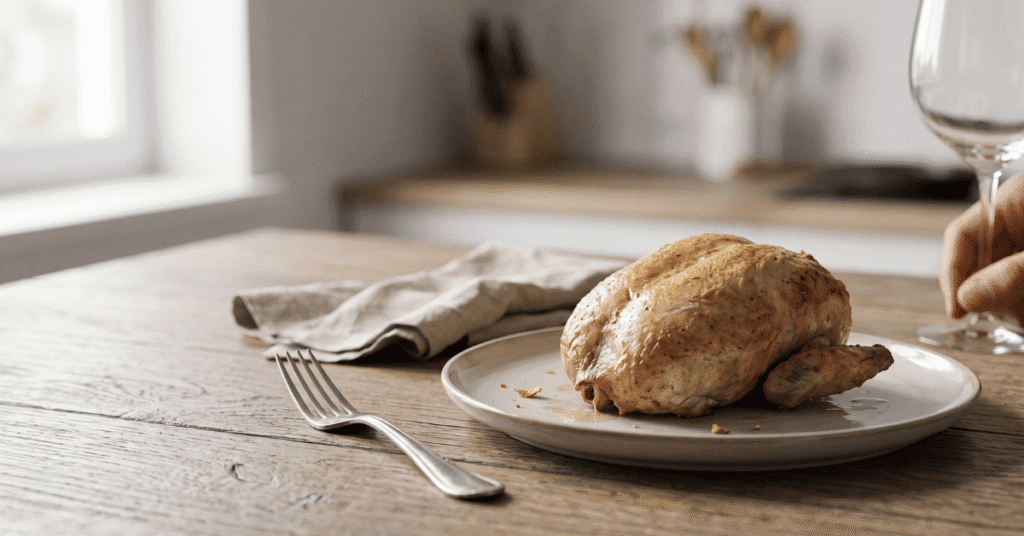
You leave a tray of chicken wings on the counter during a football game. Or maybe you finish dinner and get distracted, leaving the roast beef sitting on the table while you watch a movie. By the time you head to the kitchen, you’re staring at the plate and wondering: is this still okay to eat, or am I asking for trouble?
Quick Answer: According to the USDA, cooked meat should not sit out for more than two hours at room temperature. If the temperature is above 90°F (32°C), that window shrinks to just one hour. Beyond these limits, bacteria can multiply to dangerous levels, making the meat unsafe to eat even if you reheat it.
The Science of the “Danger Zone”
The primary reason cooked meat has a ticking clock is a concept food safety experts call the “Danger Zone.” This is a specific temperature range, between 40°F and 140°F, where bacteria like Salmonella, Staphylococcus aureus, and E. coli grow most rapidly. When meat sits in this range, the bacterial count can double every 20 minutes.
While cooking meat to the proper internal temperature kills most active bacteria, it doesn’t make the food invincible. Once the meat drops below 140°F after cooking, the environment becomes hospitable for any lingering spores or new bacteria introduced from the air, utensils, or hands.
How Bacterial Growth Works
Bacteria need moisture, protein, and warmth to thrive. Cooked meat provides all three. When you leave a steak or a pork chop on the counter, it creates a perfect breeding ground.
The concern isn’t just the presence of bacteria, but the toxins some of them produce. Certain toxins are heat-resistant, meaning that even if you blast the meat in the microwave later, the poison left behind by the bacteria remains active.
The Impact of Ambient Temperature
The “two-hour rule” is a standard guideline for a typical indoor environment (usually 68°F to 72°F). However, the environment around the meat changes the math. Kitchens often get hot while the oven is running, or perhaps you are eating outside on a patio.
Once the surrounding air hits 90°F, the biological activity on the surface of the meat accelerates so fast that the safety window is cut in half.
Why You Can’t Always Trust Your Senses
A common mistake is thinking you can smell or see if meat has gone bad after sitting out. This is a dangerous myth. There is a big difference between “spoilage bacteria”, which make food look slimy or smell sour, and “pathogenic bacteria,” which cause food poisoning.
Pathogens like Listeria or Salmonella often leave no trace. Your leftover turkey might look perfectly fine, smell like herbs and gravy, and have a normal texture, yet it could still carry a high enough bacterial load to cause severe illness. If the meat has been out for three hours in a warm room, it is biologically “spoiled” for safety reasons, even if it isn’t “rotten” in a visual sense.
The Role of Moisture and Salt
Some meats might seem like they would last longer. For example, a salty ham or a very dry piece of jerky-like brisket might resist bacteria slightly better than a moist chicken breast. Salt is a preservative, and bacteria struggle to grow without moisture.
However, safety standards do not change based on the type of meat. Whether it is lean fish, fatty pork, or a salty roast, the two-hour limit remains the firm cutoff for home safety.
Cross-Contamination Hazards
Even if your meat was cooked perfectly, the moment it sits on a counter, it is exposed to the world. A fly landing on it, someone sneezing nearby, or even using a fork that touched a different dish can introduce new pathogens. In a room-temperature environment, these new arrivals don’t have to fight against the meat’s natural defenses or high heat, allowing them to take over the surface area quickly.
How to Handle Cooked Meat Safely
If you want to keep your leftovers safe, you have to manage the transition from the heat of the stove to the cold of the fridge. Most people think they should let meat cool completely on the counter before putting it away to “save the fridge” from working too hard. This is actually a mistake.
- Divide Large Portions: If you have a massive pot of chili or a whole roast, don’t put the whole thing in the fridge at once. A large mass of meat takes too long to cool down in the center, staying in the Danger Zone for hours even inside the refrigerator.
- Use Shallow Containers: Spread the meat out in shallow glass or plastic containers. This increases the surface area and allows heat to escape much faster.
- The “Lid Gap” Trick: When you first put warm meat in the fridge, you can leave the lid slightly cracked for the first half hour to let steam escape, then seal it tight.
- Check Your Fridge Temp: Your refrigerator should be set at or below 40°F (4°C). If your fridge is stuffed too full, air can’t circulate, and the internal temperature might rise above the safe limit.
Edge Cases and Different Scenarios
Not every piece of meat is the same, and different cooking methods can slightly alter how you should think about safety. However, the one-hour/two-hour rule is the baseline that covers almost everything.
Sliced Deli Meats vs. Roasts
Cooked deli meats (like ham or turkey slices) have a very high surface-area-to-volume ratio. This means more of the meat is exposed to the air. These items tend to warm up to room temperature faster than a thick, dense pot roast.
Because of this, they are often more susceptible to rapid bacterial growth if left out on a buffet line or a sandwich tray.
Sauces and Gravies
Meat that is submerged in a sauce or gravy might feel like it’s “protected,” but the liquid actually acts as an incubator. Gravies are rich in nutrients and moisture, making them an ideal medium for bacteria. If you have meatballs in sauce or sliced steak in gravy, the same two-hour limit applies strictly.
Vacuum-Sealed and Cured Meats
You might wonder about meats that are “cured” with nitrates or salt, like pepperoni or certain types of sausage. While these are more stable than a fresh chicken breast, once they are cooked and served, they are still considered “TCS” foods (Time/Temperature Control for Safety). Professional food safety guidelines from the USDA Food Safety and Inspection Service suggest treat all cooked meats with the same level of caution to avoid the risk of foodborne illness.
Common Mistakes or Misconceptions
Many people rely on “old wives’ tales” when it comes to food safety. These mistakes lead to thousands of cases of avoidable food poisoning every year.
- “Reheating kills everything”: This is the most dangerous myth. While heat kills the bacteria themselves, it does not destroy the stable toxins left behind by certain bacteria like Staphylococcus.
- “It smells fine”: As mentioned, the bacteria that make you sick do not usually produce a bad smell.
- “I’ve done it before and wasn’t sick”: Food poisoning is often mistaken for a “24-hour flu” or a mild stomach bug. Just because you didn’t end up in the hospital doesn’t mean the food was safe; you may have just had a lucky break or a mild reaction.
- “The microwave is enough”: Microwaves often heat food unevenly, leaving “cold spots” where bacteria can survive. If you are reheating meat that sat out, you aren’t just fighting the cold; you’re fighting the biological load that grew while it was out.
Quick-Reference: Safety Timelines
| Meat Type | Max Time at Room Temp (60°F-85°F) | Max Time in Heat (90°F+) | Recommended Storage Temp |
|---|---|---|---|
| Cooked Chicken | 2 Hours | 1 Hour | 40°F or below |
| Cooked Beef | 2 Hours | 1 Hour | 40°F or below |
| Cooked Pork | 2 Hours | 1 Hour | 40°F or below |
| Fish & Shellfish | 2 Hours | 1 Hour | 40°F or below |
| Deli Meats | 2 Hours | 1 Hour | 40°F or below |
Frequently Asked Questions
Can I just reheat meat that has been out for 4 hours?
No. While reheating to 165°F will kill most bacteria, it will not remove the toxins produced by bacteria like Staph while the meat sat at room temperature. These toxins are what cause the rapid onset of food poisoning symptoms.
If it has been out more than two hours, it belongs in the trash.
Does the two-hour rule apply to meat that is still “warm”?
Yes, it does. In fact, “warm” meat is often right in the middle of the Danger Zone. The clock starts the moment the meat is no longer being actively heated (like on a stove) or kept at a safe holding temperature of 140°F or higher.
What if the meat was covered with foil?
Foil or plastic wrap helps prevent physical contaminants like dust or flies from hitting the food, but it does not stop bacterial growth. In some cases, covering warm meat can actually keep it in the Danger Zone longer by trapping the heat inside, rather than letting it escape so the meat can cool down.
Is it different for smoked or grilled meats?
Smoking meat does have some antimicrobial properties, but for home-cooked BBQ like brisket or ribs, the safety rules remain the same. Once the meat is pulled from the smoker and the temp drops below 140°F, you have two hours to get it into the fridge.
Worth Remembering
Food safety is all about managing risk. You might leave meat out for three hours and feel fine, but you are essentially playing a game of biological Russian roulette. The elderly, young children, and those with weakened immune systems are at a much higher risk for severe complications from foodborne pathogens.
When in doubt, the best policy is the simplest: Throw it out. It is never worth the risk of a hospital visit or several days of illness just to save a few dollars’ worth of steak or chicken. Keep your kitchen safe by keeping an eye on the clock and moving those leftovers to the fridge as soon as the meal is over.