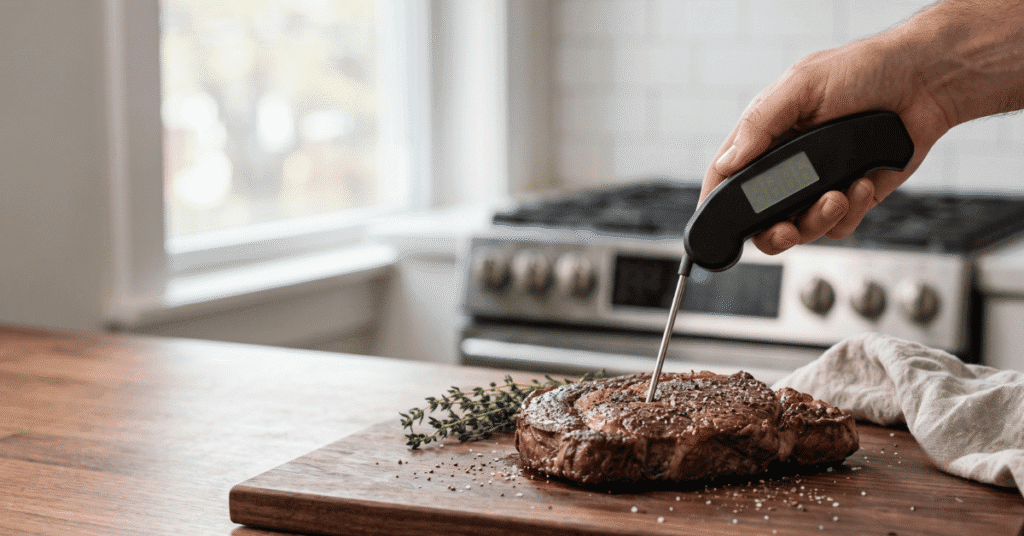
You’ve just pulled a thick ribeye off the cast iron, or maybe you’re staring at a Thanksgiving turkey that looks golden but might still be frozen in the middle. You poke the metal probe into the meat, watching the numbers or the dial slowly climb, and you wonder if you should just leave it in there or pull it out before the juices escape. If you pull it too soon, you get a false reading; if you leave it too long, you might actually damage the tool or overcook your meal.
Quick Answer: For an instant-read digital thermometer, you should leave the probe in for about 2 to 5 seconds until the temperature reading stabilizes. If you are using a leave-in (probe) thermometer, it stays in the meat for the entire cooking process until the target temperature is reached. Analog dial thermometers typically take 15 to 20 seconds to provide an accurate final number.
The difference between digital and analog timing
The time you need to wait depends mostly on the technology inside your thermometer. Not every device “thinks” at the same speed, and using a slow tool like a fast one is a recipe for undercooked chicken.
Digital instant-read thermometers are the gold standard for most home cooks today. They use “thermistors” or “thermocouples” to sense heat. A high-quality thermocouple can give you a reading in 2 or 3 seconds.
Lower-priced digital versions might take 5 to 7 seconds. You know it’s ready when the numbers stop jumping around and hold steady for at least one full second.
Analog dial thermometers are much slower because they rely on a bimetallic coil. This is a physical strip of two different metals that expands and contracts as it heats up, physically moving the needle on the dial. Because the metal has to physically warm up to the temperature of the meat, it takes much longer.
Expect to wait 15 to 20 seconds. If you pull an analog thermometer out after 5 seconds, you are likely looking at a temperature that is 20 or 30 degrees lower than the actual internal heat.
Understanding the “stabilization” point
The most important rule is to wait for the display to stop moving. In the culinary world, this is called the stabilization point. When you first insert a cold probe into a hot roast, the sensor is reacting to a massive swing in temperature.
If the numbers are still climbing, the probe hasn’t reached “thermal equilibrium” with the meat. If you get impatient and pull it out while it’s still moving, you’re guessing. For safety, wait until the change is less than 0.1 degrees per second.
Why leave-in probes are different
Leave-in thermometers, often called “probe thermometers,” are designed to sit in the oven or smoker the whole time. You don’t “leave them in” for a few seconds; you leave them in for hours. These devices have a heat-resistant cord that runs from the meat, out the oven door, to a base unit on your counter.
With these, the “how long” question is answered by the meat itself. You leave it in until the alarm beeps. However, there is a catch: if the probe is touching a bone or a pocket of fat, it will give you a “fast” reading that doesn’t reflect the rest of the roast.
These require you to be right the first time you insert them.
How to insert the thermometer for a fast reading
If you want the fastest, most accurate result, where you put the probe matters as much as how long you leave it there. If you hit a bone, the metal will heat up much faster than the muscle fibers, giving you a dangerously high reading.
-
Aim for the thickest part : This is usually the center of the breast in poultry or the middle of the thickest muscle in a roast.
-
Avoid the “bone zone”: Keep the tip at least half an inch away from any bone or large deposits of gristle.
-
Find the “cold spot”: Push the probe slightly past the center and then slowly pull it back out. Watch the temperature as you pull. The lowest number you see is the true internal temperature.
-
angle matters: On thinner cuts like burgers or pork chops, insert the thermometer through the side rather than the top. This gives the sensor more surface area to touch the meat.
According to the USDA Food Safety and Inspection Service, using a food thermometer is the only way to be sure food has reached a safe minimum internal temperature to destroy harmful bacteria. They recommend specific temperatures, like 165°F for poultry and 145°F for steaks, followed by a three-minute rest.
The “seconds” vs. “minutes” debate
Some people worry that leaving a thermometer in too long will let all the juices leak out through the hole. While it’s true that some moisture escapes, the loss is negligible compared to the risk of eating undercooked meat.
If you leave an instant-read thermometer in for 30 seconds instead of 5, you won’t ruin your steak. But if you leave a plastic-cased digital thermometer inside a 400°F oven, the casing will melt and ruin your dinner. Make sure you know if your device is “oven-safe” or “instant-read.” Most instant-read devices are meant for quick checks only and cannot handle the ambient heat of an oven.
Factors that change the wait time
Not every cooking scenario is the same. The environment around the meat can change how the thermometer reacts and how long you need to hold your hand over a hot flame.
Deep-frying and liquids
If you are checking the temp of oil for fried chicken or a sugar syrup for candy, the thermometer will react much faster than it does in solid meat. Liquid transfers heat more efficiently than air pockets in muscle. In these cases, even a cheap digital thermometer will usually give a result in 2 to 3 seconds.
Cold weather grilling
If you are grilling in the middle of winter, the body of the thermometer (and the air around it) is very cold. When you stick the probe into the meat, the cold metal of the probe’s stem can actually chill the meat right at the entry point. In freezing conditions, you might need to leave the thermometer in for an extra 3 to 5 seconds to allow the probe’s stem to warm up so it doesn’t skew the sensor’s data.
Carry-over cooking
This is a critical “edge case.” When you take a large roast out of the oven, the internal temperature continues to rise for about 5 to 10 minutes. If you leave the thermometer in during this “resting phase,” you will see the temperature climb another 5 or 10 degrees. This is normal.
If you are checking the temp during the rest, leave the probe in for the standard 5 seconds. Don’t be surprised if the meat is “done” five minutes after you took it out of the heat. This is why many chefs pull meat 5 degrees before it hits the target.
Common thermometer mistakes
-
Lifting the meat out of the pan: Many people pull the meat out of the heat to check it. This drops the surface temperature immediately. It’s better to check it while it’s still in the pan or on the grill, provided you can do so safely without burning yourself.
-
Checking too often: Every time you poke a hole, a tiny amount of steam and juice escapes. If you check every 2 minutes, you might end up with a slightly drier product. Try to estimate when the meat is about 10 minutes away from being done and check then.
-
forgetting to calibrate : If your thermometer is off by 5 degrees, it doesn’t matter how long you leave it in. You can check calibration by sticking the probe in a glass of crushed ice and water. It should read 32°F (0°C).
-
Touching the bottom of the pan: When checking small items like sausages, it’s easy to push the probe all the way through the meat until it touches the metal pan. The pan is much hotter than the meat. You will get a reading of 300°F+ and think your food is burnt when it’s actually raw.
Quick reference: Wait times by type
Thermometer Type Optimal Wait Time Best Use Case
Thermocouple Digital 2 – 3 Seconds Thin steaks, burgers, quick checks
Thermistor Digital 5 – 7 Seconds General home cooking, roasting
Bimetal Coil (Analog) 15 – 20 Seconds Large roasts where speed isn’t vital
Leave-in Probe Continuous Smoking, long roasting, turkeys
Frequently asked questions
Can I leave a digital instant-read thermometer inside the oven?
No, unless it is specifically labeled as oven-safe. Most digital instant-read thermometers have plastic bodies and electronic screens that will melt or crack at high temperatures. Only leave-in probes with heat-shielded cables are meant to stay inside the oven while it’s on.
Does leaving the thermometer in longer make it more accurate?
Only up to the point of stabilization. Once the numbers stop moving, leaving it in for another minute won’t change the reading. If the numbers keep rising after 30 seconds, you are likely seeing “carry-over cooking” where the meat is heating itself up, or your probe is too close to a heat source like a bone or the pan.
Why do some thermometers take 20 seconds while others take 2?
It’s about the thickness of the probe and the sensor type. Thermocouples have very tiny sensors at the very tip, requiring less mass to heat up. Brute-force analog thermometers use thick metal rods that take a long time to absorb enough heat to move a physical spring.
Should I leave the thermometer in while the meat rests?
You can, especially with a leave-in probe, to track the carry-over cooking. However, for an instant-read, it’s not necessary. Simply check it once at the start of the rest and once at the end to see where the temperature peaked.
Worth remembering
The goal of using a thermometer is to take the guesswork out of dinner. If you use a digital instant-read, give it five seconds of your time. If you’re using an old-school dial, give it twenty.
That small window of patience ensures you aren’t serving “medium-rare” chicken or a “well-done” steak that was meant to be juicy.
Be sure to clean the probe with hot soapy water after every single use. If you poke a raw piece of meat and then use the same probe to check it again when it’s nearly done, you can transfer bacteria from the raw stage to the cooked stage. A quick wipe ensures your thermometer stays as safe as the food you’re cooking.


1 thought on “How Long Should You Leave a Meat Thermometer In?”