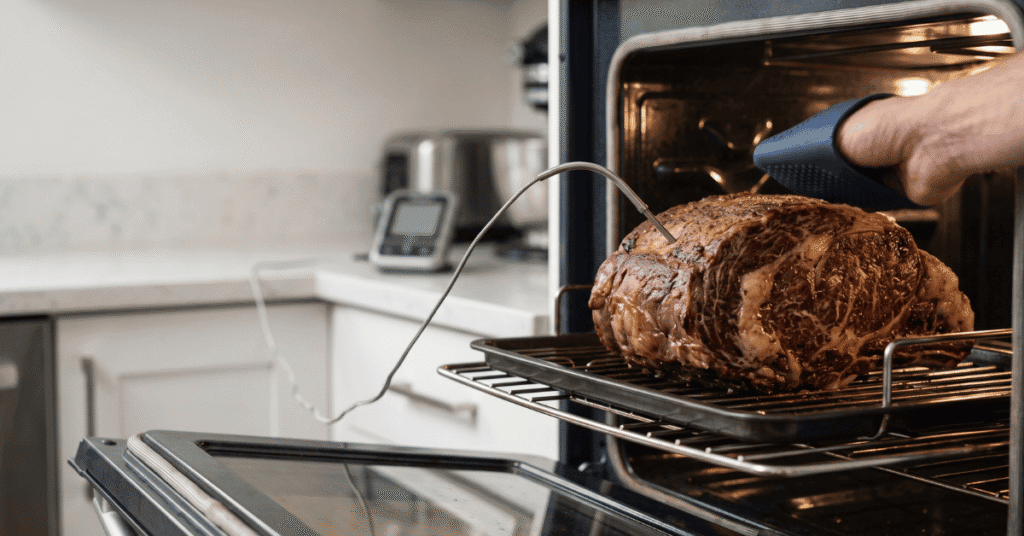
You’re staring at a beautiful prime rib in the oven, wondering if that plastic-topped dial will melt into your dinner. Or perhaps you’re tired of opening the grill lid and losing all your heat just to check a temperature. Most of us have felt that split-second panic when we realize we aren’t sure if our tools can actually take the heat.
Quick Answer: You can leave a meat thermometer in while cooking only if it is explicitly labeled as “oven-safe” or “leave-in.” Dial-style oven thermometers and wired digital probes are designed for this, but instant-read thermometers will melt or break if left inside a hot oven or grill.
The difference between leave-in and instant-read tools
The safety of your thermometer depends entirely on its build and intended use. Kitchen tools aren’t universal, and heat resistance varies wildly between a probe meant to stay in a roast for four hours and one meant to touch it for four seconds. If you use the wrong one, you risk ruining both the gadget and your meal.
thermometers are usually made of high-heat glass and heavy-duty stainless steel. These materials handle the constant ambient temperature of a 350°F oven without breaking down. Some are analog dials that sit right in the meat, while others use a heat-resistant wire that runs to a digital base sitting safely on your counter.
Instant-read thermometers are the opposite. They prioritize speed and accuracy over heat resistance. These often have plastic housings, sensitive LCD screens, and internal batteries that can explode or leak if they get too hot.
They are meant for a quick “dip and check” before being removed immediately.
Understanding heat ratings for kitchen probes
Every kitchen tool has a thermal limit. Most leave-in digital probes are rated for temperatures up to 482°F (250°C) or 572°F (300°C). This is plenty for roasting a chicken or smoking a brisket.
However, it’s not enough for high-heat searing or a self-cleaning oven cycle.
If you exceed these limits, the internal sensors, known as thermistors, can lose their calibration. This means the device might tell you your steak is 145°F when it’s actually 120°F. Factual accuracy is the only reason to use these tools, so once that’s gone, the tool is useless.
Materials that survive the oven
Oven-safe dials use tempered glass. This glass is treated to expand and contract without shattering. If you see a thermometer with a plastic face, it is almost certainly not meant to stay in the oven.
Even some “heat-resistant” plastics have a melting point lower than common roasting temperatures.
The probes themselves are stainless steel, which is excellent at conducting heat to the internal sensor while resisting corrosion from meat juices. The cables on digital versions are often wrapped in stainless steel mesh or high-temp silicone to prevent the wires from melting when they touch the oven rack or the edge of the door.
How to use leave-in thermometers safely
Using a leave-in thermometer correctly is about more than just sticking it in the meat. You have to think about the path of the wire and the placement of the probe to get a safe, accurate result. Misplacement can lead to “false positives” where the meat looks done on the screen but is raw in the middle.
-
Angle for success: If you’re cooking something flat like a thick steak, insert the probe through the side rather than the top. This keeps more of the probe inside the meat, which helps protect the internal sensor from the surrounding air temperature.
-
Check the wire path: For wired digital units, make sure the cord isn’t pinched too tightly by the oven door or grill lid. Most gaskets can handle a thin wire, but a heavy lid can crimp the internal copper, leading to a “Probe Error” message.
-
Avoid direct flames: Even leave-in probes struggle with direct fire. If you’re grilling, keep the wire and the probe away from the flare-ups. Direct flame can easily exceed 1,000°F, which is double what most probes can survive.
Critical safety limits for different cooking methods
Different cooking environments pose different risks to your gear. What works in a slow cooker might fail on a charcoal grill.
Roasting and baking
This is the safest environment for a leave-in thermometer. The heat is indirect and generally stable. As long as the thermometer is rated for oven use, you can leave it in for the duration of the cook.
The main risk here is the “bridge” between the probe and the wire; never submerge that joint in water when cleaning, as it can short out the sensor.
Grilling and smoking
Grills are more aggressive. A “low and slow” smoke at 225°F is fine for almost any leave-in probe. However, if you are roasting a chicken on a grill and the temperature spikes to 500°F, you are reaching the danger zone for many digital wires.
Always check the manufacturer’s manual for the peak temperature limit.
Deep frying
Never leave a standard meat thermometer in a deep fryer unless it is a specific “candy/fry” thermometer. These usually have a clip that holds the probe to the side of the pot. Standard meat thermometers may not be long enough, risking a steam burn to your hand, or they might not be sealed against hot oil, which can seep into the housing.
Common mistakes and how to fix them
Many people treat their thermometers as “set it and forget it” tools, but a few simple errors can lead to a ruined dinner or a broken device.
-
Leaving an instant-read in the meat: This is the most common mistake. If the screen is attached directly to the probe with no wire, it is likely an instant-read. Taking it out takes two seconds; leaving it in costs $20 to $100 for a replacement.
-
The “Waterproof” Myth: Many probes are water-resistant but not waterproof. If you leave a probe in a piece of meat that is then braised in liquid, the moisture can travel up the probe and into the electronics.
-
Forgetting the offset: Professional chefs often use the leave-in thermometer as a guide but double-check with an instant-read at the very end. This “second opinion” catches any errors caused by a probe that might have shifted during the cook.
Temperature reference for safe meat
The USDA Food Safety and Inspection Service provides specific targets that every cook should know. Using a leave-in thermometer helps you hit these without overcooking the meat.
Meat Type Minimum Internal Temp Rest Time
Beef, Pork, Veal, Lamb 145°F (63°C) 3 minutes
Ground Meats 160°F (71°C) None
Poultry (Chicken, Turkey) 165°F (74°C) None
Fresh Ham (Raw) 145°F (63°C) 3 minutes
Fish and Shellfish 145°F (63°C) None
When to pull the meat out
One of the perks of leaving a thermometer in is watching the “carryover cooking” effect. When you remove meat from the heat, the internal temperature continues to rise. For a large roast, the temp can jump another 5 to 10 degrees while resting.
If you want your beef at a perfect 145°F, you should actually “pull” it when the thermometer reads 135°F or 140°F. If you wait until it hits 145°F in the oven, it will bridge into “medium-well” territory by the time you carve it.
Frequently asked questions
Can I leave a wireless Bluetooth thermometer in the meat?
Yes, most wireless “smart” probes are designed to stay in the meat throughout the cook. They are built with a ceramic handle that protects the battery and Bluetooth chip from the heat. However, they still have an ambient temperature limit (usually around 527°F), so they shouldn’t be used for high-heat searing.
What happens if I leave a plastic thermometer in the oven?
The plastic will begin to soften and release fumes. Depending on the material, it may melt onto the meat, making the food unsafe to eat. If the thermometer has a battery, the heat could cause it to swell or leak toxic chemicals.
If you accidentally leave one in, discard any meat that the plastic touched.
Why does my leave-in thermometer give a different reading than my instant-read?
This is usually due to placement. The leave-in probe stays in one spot, which might be a slightly cooler or warmer pocket. The instant-read allows you to check multiple spots.
Additionally, leave-in probes are often slower to react to changes, while instant-reads are calibrated for high precision in under three seconds.
Can I use a meat thermometer for candy or oil?
It is not recommended. Meat thermometers usually top out around 200°F to 400°F, while oil and sugar can reach much higher temperatures. More importantly, the glass on a meat thermometer might not be rated for the thermal shock of being dipped into 375°F oil, which could cause it to shatter.
Worth remembering
Standardizing your kitchen toolkit is the best way to prevent accidents. If you haven’t already, check the back of your thermometer for an “Oven Safe” stamp or look up the model number online. Knowing your gear’s limits before you start the oven is the difference between a perfect meal and a melted mess.
A leave-in thermometer is a fantastic tool for consistency, but it only works if the hardware matches the heat. For the most accurate and safe results, use a leave-in probe for the long haul and an instant-read for the final verification.