The correct liner size matches the interior floor dimensions of your specific air fryer basket, not the exterior capacity listed on the box. A liner that is too large blocks airflow and creates a fire hazard, while one that is too small fails to catch grease and drips. You need to measure the actual width and length of the basket floor in inches or centimeters to find a safe fit.
Most round air fryers between 3 and 6 quarts use liners ranging from 7 to 8.5 inches in diameter. Square and rectangular models typically require liners between 8 and 10 inches wide. Always choose a liner slightly smaller than your measured dimensions rather than risking an oversized fit.
This guide covers how to measure accurately, which sizes correspond to common capacities, and the safety rules that apply to both parchment and silicone options.
Why Interior Dimensions Matter More Than Quart Capacity
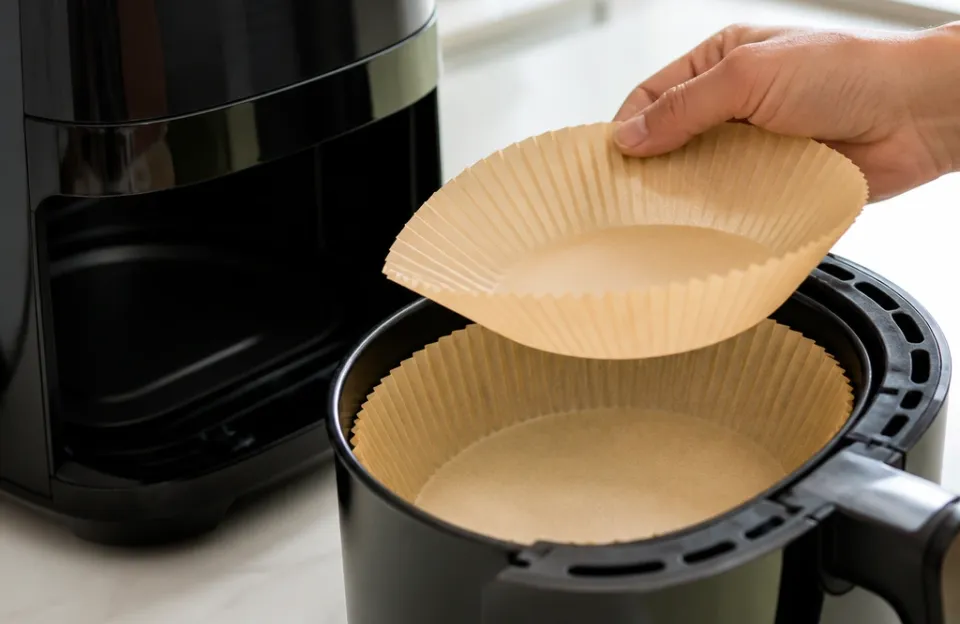
Air fryer manufacturers rate capacity by volume, but liner sizing depends entirely on surface area and shape. Two 4-quart air fryers can have completely different basket footprints depending on whether the design is tall and narrow or short and wide. Relying solely on quart size leads to mismatched liners that either curl up against the heating element or leave the corners exposed to baked-on grease.
The shape of the basket dictates the liner geometry you need. Round baskets require circular liners, while square or rectangular baskets need corresponding flat sheets or molded silicone trays. Using a round liner in a square basket wastes corner space and allows oil to pool in the gaps.
Conversely, forcing a square liner into a round basket causes the edges to fold upward, which restricts hot air circulation and prevents food from cooking evenly.
How Airflow Clearance Prevents Fire Hazards
Air fryers cook by circulating superheated air at high velocity around the food. The U.S. Consumer Product Safety Commission warns that obstructing this airflow path can cause appliances to overheat or ignite nearby materials.
A liner that touches the sides of the basket or extends above the rim reduces the gap needed for proper ventilation.
You should maintain at least half an inch of clearance between the liner edge and the basket wall. This gap allows air to flow underneath and around the food. If your liner fits flush against the sides, it is too big regardless of whether it technically sits inside the basket.
Proper clearance also prevents the lightweight parchment from lifting during the preheat cycle and contacting the upper heating coil.
Material Thickness and Heat Tolerance Limits
Parchment paper and silicone liners have different physical properties that affect sizing decisions. Parchment is thin and flexible, making it more forgiving if the size is slightly off, but it is also lighter and prone to flying up into the heating element if not weighed down by food. Silicone liners are rigid and hold their shape, so they must match the basket dimensions much more precisely to avoid blocking vents or sitting unevenly.
Check the heat rating printed on the liner packaging before use. Most food-grade parchment is rated for temperatures up to 425°F or 450°F. Many air fryers reach maximum temperatures of 400°F to 500°F.
If you frequently cook at high heat, verify that your liner material can withstand your appliance's top setting without scorching or degrading. Silicone generally tolerates higher temperatures but requires exact sizing to function safely.
Measuring Your Basket Floor Accurately
Getting the right size starts with taking precise measurements of your specific appliance. Do not guess based on photos or assume your model matches a generic size chart. Grab a tape measure or ruler and check the following dimensions directly on your unit.
For round baskets, measure the diameter across the bottom interior, not the top opening. Baskets often taper inward toward the base, so the floor is narrower than the rim. Record this number to the nearest quarter inch.
For square or rectangular baskets, measure both the width and length of the flat bottom surface. Note any rounded corners or raised ridges that might prevent a flat liner from sitting flush.
Accounting for Basket Taper and Ridges
Many air fryer baskets slope inward significantly from top to bottom. A liner sized for the top opening will bunch up at the base and block airflow channels. Always measure the lowest flat surface where food actually rests.
If your basket has a removable crisper plate or rack, measure both the plate itself and the space beneath it to determine whether the liner goes above or below that component.
Some baskets have molded ridges or embossed logos on the floor. These features reduce the usable flat area. If your measurements fall exactly on a standard liner size but your basket has prominent internal textures, size down by half an inch to ensure the liner lays flat without buckling.
A liner that tents over ridges creates uneven cooking spots and increases the risk of burning.
Verifying Fit Before Cooking
Test any new liner size with a dry run before adding food. Place the liner in the cold basket and check that it sits flat without touching the sides. Turn the air fryer on at a low temperature for two minutes and observe through the window or open the drawer briefly to confirm the liner stays in place.
If it lifts, curls, or shifts, it is unsafe to use even if it appeared to fit when cold.
Weight matters during this test. Unweighted parchment behaves differently than weighted parchment. If the dry test shows movement, try again with a small oven-safe dish or metal trivet on top to simulate cooking conditions.
Persistent lifting indicates poor sizing or inadequate airflow clearance, and you should switch to a smaller size or a perforated option designed for your specific model.
Standard Liner Sizes for Common Air Fryer Capacities
While measuring is always best, knowing standard size ranges helps when shopping or comparing models. The table below maps common air fryer capacities to typical liner dimensions based on industry standards. Use these as starting points, then verify against your own measurements.
| Air Fryer Capacity | Typical Basket Shape | Common Liner Diameter/Width | Best For |
|---|---|---|---|
| 2-3 Quarts | Round | 6.5 – 7 inches | Compact personal units |
| 3-4 Quarts | Round | 7.5 – 8 inches | Standard family size |
| 4-6 Quarts | Round/Square | 8 – 9 inches | Mid-size versatile models |
| 6-8 Quarts | Square/Rectangular | 9 – 10 inches | Large batch cooking |
| 8+ Quarts | Rectangular/Dual | 10 – 12 inches | Oven-style or dual zone |
These ranges assume standard basket proportions. Specialty shapes like oval, hexagonal, or dual-basket configurations may require custom or brand-specific liners. When your measurement falls between two standard sizes, always choose the smaller option.
A 7.5-inch liner in an 8-inch basket leaves safe clearance; an 8.5-inch liner in the same basket creates a hazard.
Round vs. Square Liner Compatibility
Round liners work exclusively in round baskets. Square liners can sometimes work in round baskets if the diagonal measurement is smaller than the basket diameter, but this leaves significant uncovered areas. For optimal coverage and safety, match the liner shape to the basket shape exactly.
Pre-cut parchment rounds are widely available for popular sizes, while square sheets offer more flexibility for non-standard dimensions.
Silicone liners are less forgiving of shape mismatches due to their rigidity. A square silicone tray will not conform to a round basket and may rock or tilt during operation. Only use shape-matched silicone accessories.
If you cannot find a molded silicone liner for your exact model, opt for parchment sheets trimmed to fit instead of forcing an ill-fitting reusable option.
Perforated vs. Solid Liner Sizing Differences
Perforated liners have holes that improve airflow but reduce structural integrity. They tend to be more flexible and may sag between basket ridges if oversized. Solid liners provide better grease containment but restrict bottom airflow more significantly.
When using solid liners, strict adherence to size limits is even more important because there are no perforations to compensate for partial blockage.
If switching between perforated and solid styles, re-evaluate your size choice. A perforated liner that fits well at 8 inches might allow too much restriction in solid form at the same size. Consider sizing down by a quarter to half inch when moving to solid liners to preserve adequate air channel width around the perimeter.
Safety Rules That Override Convenience
No matter how messy your cooking gets, never compromise on liner safety. Grease cleanup is annoying, but liner fires destroy appliances and kitchens. Follow these non-negotiable rules every time you use any type of liner.
Never preheat an air fryer with an unweighted liner inside. The fan generates enough force to lift parchment paper into the heating element within seconds. Always add food before turning on the appliance, or use a weighted silicone liner specifically designed for preheating.
If a recipe calls for preheating, wait until the cycle completes before inserting the liner and food together.
Avoiding Direct Heating Element Contact
The heating element sits directly above the basket in most air fryer designs. Any liner material that rises above the basket rim risks direct contact with this component. Even brief contact can cause instant ignition or melting.
Ensure your liner sits at least one inch below the top edge of the basket when loaded with food. Tall foods like whole chickens or stacked items may require abandoning liners entirely to maintain safe clearance.
Monitor older or damaged liners closely. Parchment that has been reused beyond its intended lifespan becomes brittle and more flammable. Silicone that shows cracks, discoloration, or warping has exceeded its thermal tolerance and should be replaced immediately.
Inspect all liners before each use and discard anything showing signs of degradation.
Manufacturer Guidelines and Warranty Implications
Check your air fryer’s user manual for specific liner recommendations or prohibitions. Some manufacturers explicitly warn against certain liner types or sizes and may void warranties for damage caused by improper accessories. Others provide approved accessory lists with tested sizes.
Following manufacturer guidance protects both your safety and your investment.
If your manual prohibits liners entirely, respect that directive. Some air fryer designs rely on the bare basket surface for heat distribution and cannot accommodate any obstruction safely. In these cases, focus on post-cook cleaning methods or use oven-safe dishes placed inside the basket instead of direct liners.
Your chicken wing marinade will taste just as good cooked in a compliant vessel.
Troubleshooting Fit Issues and Alternatives
Even with careful measurement, you may encounter fit problems. Here are practical solutions for common issues without resorting to unsafe workarounds.
If your liner consistently lifts during cooking despite being correctly sized, switch to a heavier weight parchment or add more food weight. Lightweight papers struggle in high-velocity air streams. Alternatively, use binder clips made of stainless steel to secure parchment edges to the basket rim, ensuring the clips do not touch the heating element or plastic components.
When Standard Sizes Don't Work
Custom-shaped or vintage air fryers may not match any commercial liner size. Buy larger parchment sheets and trim them to fit using your basket as a template. Trace the outline on the outside of the basket, cut inside the line to allow for clearance, and test fit before use.
This takes extra time but guarantees safe dimensions.
For dual-basket or oven-style air fryers, consider using multiple smaller liners instead of one oversized sheet. Two 7-inch rounds in separate zones provide better coverage and safer airflow than one 14-inch rectangle spanning both compartments. This approach also allows you to remove one liner mid-cook if needed without disturbing the other zone.
Cleaning Without Liners as a Backup Plan
Liners are convenient but not mandatory. If you cannot find a safe size, embrace direct basket cooking and invest in proper cleaning tools. Soaking the basket in warm soapy water immediately after cooking prevents most sticking.
Non-abrasive sponges protect non-stick coatings while removing residue. This method eliminates all liner-related safety concerns.
Some cooks prefer direct contact with the basket for better browning and crisping. Liners create a barrier that steams food bottoms slightly. If achieving maximum crispness on items like extra crispy chicken wings is your priority, skipping the liner may actually improve results.
Reserve liners for sticky sauces or heavily marinated items where cleanup difficulty justifies the tradeoff.
Frequently Asked Questions
Can I use aluminum foil instead of a liner?
Aluminum foil can be used safely if shaped to allow airflow and kept away from the heating element. Never cover the entire basket floor with foil, as this blocks critical air channels. Create a shallow boat shape that leaves the perimeter open for circulation.
Avoid acidic foods like tomatoes or citrus, which react with aluminum and degrade the foil during cooking.
Do silicone liners need to be the exact size?
Silicone liners require closer size matching than parchment due to their rigidity. A silicone liner more than half an inch smaller than your basket floor will slide around and fail to catch drips. One that is even slightly too large will buckle or block vents.
Aim for silicone liners within a quarter inch of your measured basket dimensions for stable performance.
Is it safe to reuse parchment paper liners?
Reusing parchment depends on condition, not a fixed number of uses. Discard immediately if the paper is torn, heavily stained, brittle, or shows dark burn marks. Lightly used parchment from low-temperature vegetable roasting may survive one reuse.
High-fat or high-sugar cooking degrades parchment faster. When in doubt, replace it; the cost is negligible compared to fire risk.
Why does my liner keep burning at the edges?
Edge burning indicates the liner is too close to the heating element or extends too far up the basket sides. Trim the liner to sit lower in the basket or switch to a smaller size. Also verify your cooking temperature does not exceed the liner's rated limit.
Some parchment brands rate conservatively at 425°F while others handle 450°F; check your specific product specifications.
Can I use coffee filters as emergency liners?
Coffee filters are not heat-rated for air fryer temperatures and pose a fire risk. They are thinner than parchment, lack silicone coating for non-stick release, and may contain adhesives or bleaches not intended for direct high-heat food contact. Stick to products explicitly labeled as air fryer safe.
In emergencies, cook directly in the basket rather than substituting unsafe materials.
Getting the Right Fit Every Time
Sizing air fryer liners comes down to measuring your specific basket and respecting airflow requirements over convenience. Ignore quart capacity labels and focus on actual interior dimensions. Choose smaller over larger when uncertain.
Test fit before cooking. Replace worn materials promptly. These habits prevent fires and ensure your appliance performs as designed.
Proper liner sizing is one part of overall air fryer safety and maintenance. Understanding how your appliance handles different foods and temperatures matters equally. Whether you're preparing meal prep chicken wings or experimenting with new recipes, consistent attention to equipment specs keeps cooking predictable and safe.
Measure once, buy confidently, and cook without worrying about what's happening inside that closed drawer.