An air fryer accessory size guide starts with one basic rule: measure the inside floor of your basket, then buy accessories at least half an inch smaller in every direction. Most round air fryers use 6 to 8 inch pans, while square models usually fit 7 to 9 inch inserts. Getting this measurement right stops food from cooking unevenly and keeps hot air moving the way the machine was built to handle it.
This article breaks down how to measure your specific model, what sizes work for the most common add-ons, and why a tiny gap around the edges matters more than you might think. We will also cover edge cases like dual-basket machines and oven-style models so you don't end up buying something that gets stuck halfway down.
Measuring Your Basket Before Buying Anything
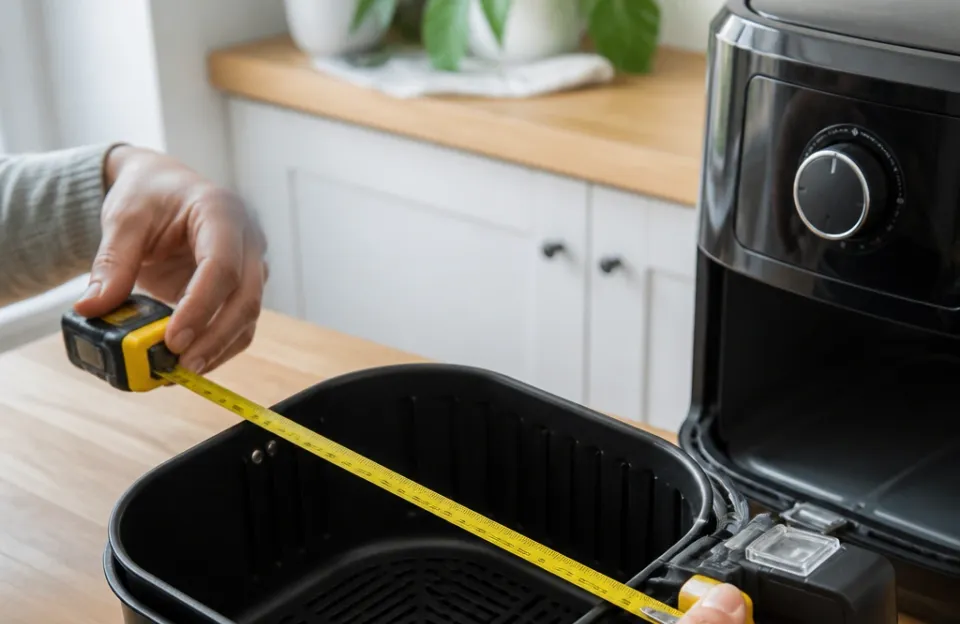
The first step is always measuring the interior space where the food actually sits. Don't measure the outside of the appliance or the top rim of the drawer. Pull the basket out and look at the bottom cooking surface.
If you have a round basket, measure straight across the flat bottom from one side to the other. That's your maximum diameter. If you have a square or rectangular basket, measure the length and width of the flat bottom area.
Write these numbers down before you start shopping.
You need to leave clearance around whatever insert you drop in. Air fryers cook by pushing superheated air down and around the food. If a pan touches the walls of the basket, that airflow stops completely.
The food on top will burn while the bottom stays raw. A good rule is to subtract at least half an inch from your total measurement. So if your basket floor is 8 inches across, look for pans that are 7.5 inches or smaller.
Some baskets have rounded corners or sloped sides. In those cases, measure the narrowest part of the bottom, not the widest part near the top. Sloped walls mean a pan that fits at the rim won't sit flat on the base.
Always size for the lowest point.
Round Pans and Cake Barrels
Round baking pans are probably the most common add-on people buy. They're used for cakes, deep-dish style meals, and roasting small cuts of meat.
For a standard 3 to 4 quart air fryer, which is the typical size for one or two people, a 6-inch round pan works best. It leaves enough room on all sides for the air to circulate. You can sometimes squeeze a 7-inch pan into a 4-quart round basket, but the fit will be tight.
Tight fits cause uneven browning.
Larger 5 to 6 quart models usually take an 8-inch pan comfortably. If you go up to an 8-quart machine, you might fit a 9-inch pan, but check the slope of the walls first. Many large-capacity fryers taper inward at the bottom.
Cake barrels are deeper than standard pans and often come with non-stick coatings. Because they are taller, they block more airflow on the sides. Stick to the same diameter rules as flat pans, but expect slightly longer cooking times.
When you're testing a new batter recipe, keeping the heat moving freely around the barrel helps the center set properly. This matters especially when you soak the chicken overnight in a wet marinade before cooking, since excess moisture already changes how the air transfers heat.
Square Baking Dishes and Casserole Inserts
Square air fryers have become very popular because they hold more usable surface area than round ones. If you own a square basket, you want square accessories. Putting a round pan in a square basket wastes the corner space where air needs to flow.
Measure the inside width and length of your square basket. For a 4-quart square model, the floor is usually around 7.5 by 7.5 inches. A 7-inch square dish fits perfectly here.
For larger 6-quart square models, the floor is often closer to 8.5 or 9 inches wide, meaning an 8-inch square dish is the safest bet.
Casserole inserts follow the exact same math. Just remember that depth matters too. If your basket is only 3.5 inches deep, a 3-inch tall casserole dish leaves almost no room for the heating element above it.
Keep the total height of the dish plus the food at least an inch below the top rim of the basket.
Silicone Liners and Reusable Mats
Silicone liners are flexible, which makes sizing them a little different. They bend and squish, so people assume any liner will work in any basket. That assumption leads to problems.
A silicone liner that is too big will fold up against the walls of the basket. Those folds create pockets where grease pools and smoke starts. A liner that is too small leaves gaps where drippings fall through to the bottom of the drawer, defeating the whole purpose of using a liner.
Buy silicone liners based on the shape and bottom dimensions of your basket. Many brands sell "universal" sizes labeled small, medium, or large. Small usually means 6.5 inches for round baskets.
Medium is typically 7.5 to 8 inches. Large runs 8.5 to 9 inches. Match the brand's stated dimension to your bottom measurement, not the quart capacity of your machine.
Quart sizes vary wildly between brands, while inches stay constant.
Reusable perforated mats made of fiberglass or silicone sit flat on the bottom. These should match the exact shape of your basket floor. If you have a square basket, buy a square mat.
If the mat hangs over the edges even slightly, it can get pushed up into the heating coil when you slide the drawer shut.
Rack Height and Multi-Layer Cooking
Most air fryers come with a basic trivet or wire rack, but aftermarket multi-layer racks let you stack food. Sizing a rack involves both width and height.
The width follows the same half-inch clearance rule as pans. The height requires more attention. Measure from the bottom of the basket to the top rim.
Then divide that space by the number of tiers you want.
If your basket is 4 inches deep and you buy a two-tier rack, each tier has about 2 inches of vertical space. That works fine for thin items like bacon or reheating pizza slices. It doesn't work for chicken pieces or thick vegetable chunks.
If you try to force tall food onto stacked racks, the top layer hits the heating element and burns instantly.
When you prep batches ahead of time and want to cook multiple layers at once, stick to single-tier racks that just lift the food off the bottom. Lifting food half an inch off the floor improves crispness without risking contact with the top heating coil.
Dual-Basket Machines Need Separate Measurements
Dual-basket air fryers have two independent drawers. Sometimes the drawers are identical. Often, they aren't.
Some models have one large drawer and one small drawer, or two medium drawers separated by a divider.
Never assume an accessory sold for a "6-quart air fryer" fits a 6-quart dual-basket model. A 6-quart dual model usually splits that volume into two 3-quart baskets. You would need accessories sized for a 3-quart machine, which typically means 6-inch pans instead of 8-inch ones.
Check the manual for the internal dimensions of each individual zone. Buy accessories specifically for that smaller footprint. Dropping an oversized pan into one side of a dual unit blocks the fan for that entire zone.
Oven-Style Models Use Different Dimensions
Air fryer toaster ovens look like mini conventional ovens. They don't have pull-out buckets or baskets. Instead, they use slide-in wire racks and baking trays.
Sizing for these models relies on standard quarter-sheet or eighth-sheet pan dimensions. A full commercial sheet pan is 26 by 18 inches. A quarter sheet is roughly 13 by 9.5 inches.
An eighth sheet is about 10 by 7 inches.
Most countertop air fryer ovens accept a quarter-sheet pan, but it fits snugly. To allow proper convection airflow, many manufacturers recommend using their proprietary trays or slightly smaller pans. Check the distance between the rack guides inside the cavity.
If the guides are 12 inches apart, a 13-inch pan won't slide in.
Always measure the interior width between the rack slots, the depth from front to back, and the height from the rack position to the top heating elements. Write all three numbers down. Oven-style units give you more flexibility, but the tolerances are tighter than people expect.
Quick Reference for Common Capacities
Here is how basket volume generally translates to accessory sizing. These are starting points. Always verify with your own tape measure.
| Basket Capacity | Typical Shape | Max Pan Diameter / Width | Recommended Accessory Size |
|---|---|---|---|
| 2 to 3 Quarts | Round | 6.5 inches | 6 inches |
| 3 to 4 Quarts | Round | 7.5 inches | 7 inches |
| 5 to 6 Quarts | Round | 8.5 inches | 8 inches |
| 4 to 5 Quarts | Square | 7.5 x 7.5 inches | 7 x 7 inches |
| 6 to 8 Quarts | Square | 9 x 9 inches | 8 x 8 inches |
| Dual Zone (per side) | Square/Rect | 6.5 x 6.5 inches | 6 x 6 inches |
Keep in mind that a 5-quart basket from one brand might have a wider, shallower floor than a 5-quart basket from another brand. Volume tells you how much food fits. Floor dimensions tell you what accessories fit.
Relying on quart size alone is the main reason people buy pans that don't work.
Why Clearance Changes How Food Cooks
Leaving space around your accessories isn't just about preventing scratches on the non-stick coating. It directly controls the temperature inside the basket.
Air fryers use a high-speed fan mounted above a heating coil. The fan pushes air down, around the food, and back up through vents. When you place a solid pan inside, you interrupt that loop.
If the pan touches the walls, the loop breaks entirely. The air gets trapped above the food. The top scorches while the bottom steams in its own juices.
A half-inch gap allows the hot air to travel down the sides and underneath the rack or pan. This creates the convection effect that mimics deep frying. Without that gap, you're just using a very small, inefficient oven.
This airflow principle applies heavily when you're trying to get the skin really crunchy. Crowding the space with an oversized tray traps steam and ruins the texture you're aiming for.
Material Thickness and True Interior Space
The material of your accessory affects how much room you actually have. A stamped aluminum pan might be paper-thin, while a heavy ceramic dish adds significant bulk.
Thick materials reduce your internal clearance. If you measure your basket at 8 inches wide and buy an 8-inch ceramic dish, the outer lip of that dish will likely wedge against the basket walls. Ceramic and glass also retain heat differently than metal.
A thick glass dish takes longer to warm up, which can throw off the timing on recipes designed for thin metal pans.
Stick to thin-gauge metals or food-grade silicone for the best results. If you prefer ceramic or glass for serving, size down an extra half-inch to account for the thicker walls. And regardless of the material, always verify the internal temperature with a reliable tool.
Using a quick digital reader lets you confirm the food hit a safe temp without guessing how the thick pan altered the cooking time.
Mistakes People Make When Sizing Accessories
Buying the wrong size happens constantly. Usually, it comes down to skipping the measuring step or trusting the marketing copy on the box.
- Measuring the top rim instead of the bottom floor. Baskets taper. The top is always wider than the bottom. A pan that clears the top rim might get permanently wedged halfway down.
- Trusting quart capacity over inches. As mentioned, a 4-quart basket from Brand A might be tall and narrow, while Brand B's 4-quart basket is short and wide. Inches are the only reliable metric.
- Ignoring the height of the accessory. A pan that fits perfectly on the floor might be too tall to let the drawer close fully. If the drawer doesn't click shut, the safety switch prevents the machine from turning on.
- Assuming universal accessories are truly universal. "Universal" usually means it fits the average mid-sized round basket. It rarely fits square, dual-zone, or oven-style models.
- Forgetting the handle. Some baking dishes have small tab handles on the sides. A 7-inch dish with handles might span 8 inches overall. Account for those tabs when checking your clearance.
Even when the size is correct, adding heavy accessories changes the thermal mass inside the drawer. If you are tracking macros closely and adjusting cook times for things like lighter wing variations, remember that a thick pan absorbs heat that would otherwise go directly into the food.
Finding the Right Fit for Odd-Shaped Baskets
Not every air fryer is a perfect circle or square. Some older models have oval baskets. Others have rounded rectangles that make finding a matching pan frustrating.
For oval baskets, measure the shortest width and the longest length. You'll likely need to buy a round pan sized to the shortest width. Yes, you lose some space at the ends of the oval.
But a round pan that fits the narrow middle will still allow airflow. An oval pan forced into the space might touch the sides at the widest points, blocking circulation.
For rounded rectangles, treat it like a square basket but measure carefully. Find the largest true square that fits inside the curved corners. That's your maximum accessory footprint.
If you can't find a commercially available pan that fits your odd-shaped basket, consider using perforated parchment paper cut to size instead of a solid pan. Parchment conforms to weird shapes and maintains airflow through the holes. Just never preheat the air fryer with parchment inside and no food weighing it down.
The fan will blow the paper into the heating element and start a fire.
Checking Safety Standards for Materials
Size isn't the only factor. The material must withstand the heat. Most air fryers reach 400°F, and some push to 450°F.
Any accessory you put inside must be rated above your machine's maximum temperature.
Look for FDA-compliant food-grade silicone or metals rated for oven use. Avoid plastics unless they are explicitly marked as high-heat air fryer safe, which is rare. Standard plastic containers will melt, release toxic fumes, and ruin the appliance.
According to general kitchen safety guidelines outlined by the Food and Drug Administration, food contact surfaces must be stable at intended cooking temperatures. If a cheap silicone liner smells strongly of chemicals when heated, or if a painted metal pan starts flaking, remove it immediately. Stick to bare stainless steel, anodized aluminum, or platinum-cured silicone.
Also, verify that your accessory doesn't block the safety mechanisms. Many baskets have a spring-loaded switch at the back that engages when the drawer is fully inserted. An oversized pan can prevent the drawer from seating deeply enough to trigger this switch.
If your machine won't turn on after inserting a new accessory, the pan is physically interfering with the latch.
Pairing Accessories With Specific Foods
Different foods require different setups, and size plays a role in how well the final dish turns out.
Baked goods like muffins or small cakes need rigid pans to hold their shape. A 6-inch round pan fits six standard muffin cups if you use a silicone mold inside it. The rigid outer pan protects the silicone from shifting when the fan blows hard.
Roasted vegetables do better on flat, perforated trays rather than deep pans. Deep pans trap the moisture released by vegetables, causing them to steam instead of roast. A shallow tray that leaves maximum wall clearance gives veggies the dry heat they need to caramelize.
Reheating fried foods requires lifting the item off the bottom. A wire rack sized correctly for your basket lets old oil drip away while hot air re-crisps the breading. If the rack is too wide, it scrapes the non-stick coating off the basket walls every time you slide it in and out.
When you're finishing wings and want to toss them in something flavorful afterward, having a simple dipping setup ready means you don't need to overcrowd the basket trying to cook sauces directly inside the machine. Keep the basket clear, size your racks properly, and sauce everything externally.
Before You Buy Another Pan
Getting the right air fryer accessory size guide information saves money and prevents ruined dinners. Pull the basket out. Measure the flat bottom.
Subtract half an inch. Buy accessories that match that final number, paying attention to both width and height. Ignore the quart rating printed on the box and trust your tape measure instead.
Every machine is slightly different. Taking two minutes to verify your exact dimensions guarantees your next cake barrel, silicone liner, or wire rack will fit perfectly and let the hot air do its job.




1 thought on “Air Fryer Accessory Size Guide: Find the Perfect Fit”