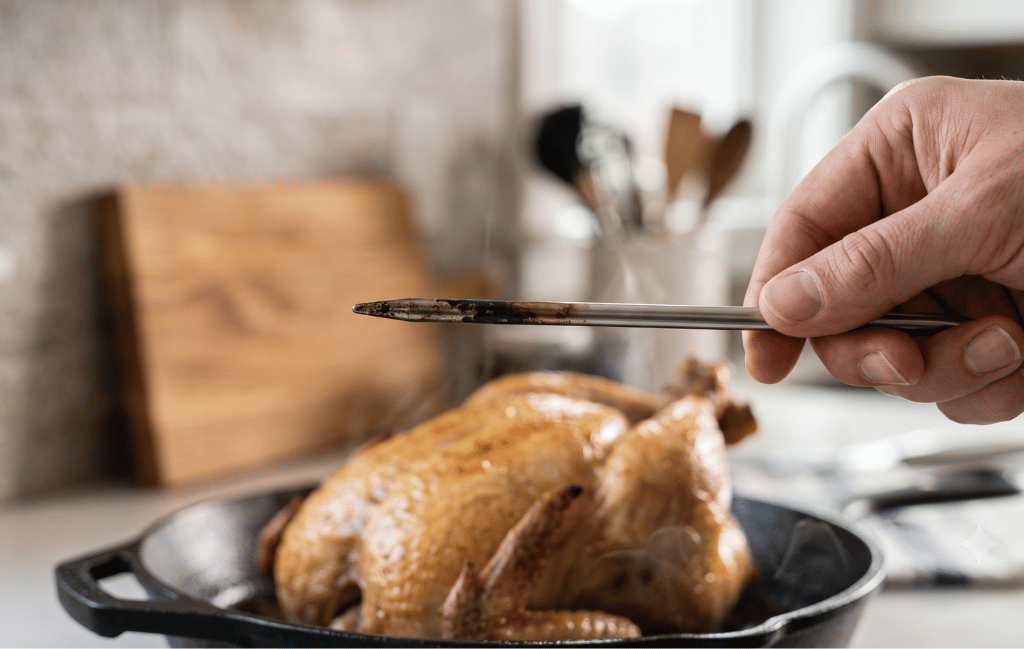
You pull your roast out of the smoker, ready for the perfect slice, but notice your thermometer probe is coated in a dark, crusty layer of black soot or discoloration. It won’t wipe off with a simple paper towel, and now you’re wondering if that residue is leaking chemicals into your expensive cut of meat. It’s a common moment of doubt that can make even an experienced cook hesitate before the next meal.
Quick Answer: In most cases, a meat thermometer probe turning black is perfectly safe to use as long as the discoloration is carbon buildup (soot) or heat tint from high temperatures. It becomes unsafe only if the metal is flaking off, rusting heavily, or if the protective coating is bubbling. If the probe is simply stained from smoke and fat, a deep clean will restore it without any risk to your food.
Why thermometer probes turn black
The most common reason a probe turns black is “seasoning,” similar to what happens to a cast-iron skillet. When you cook meat, especially in a smoker or grill, fats and sugars aerosolize and drift through the air. These particles land on the cool stainless steel of the probe and bake on under high heat.
Over time, this creates a polymerized layer of carbon that looks like black paint or soot.
Another cause is basic oxidation. Stainless steel is resistant to rust, but it isn’t invincible. When exposed to extreme heat, specifically temperatures above the probe’s rated limit, the chromium in the steel reacts with oxygen.
This creates a “heat tint” or “heat scale.” Depending on the temperature, the metal might look straw-colored, blue, or eventually a thick, matte black.
This process is a chemical change in the surface of the metal itself, but it doesn’t necessarily make the probe toxic. Stainless steel is chosen for kitchen tools because it remains stable even when it changes color. Unless the metal is actively pitting or shedding debris into your food, the safety of the probe remains intact.
Smoke and creosote buildup
In smokers, the “black” is often creosote. This happens when wood isn’t burning efficiently, creating a thick, sticky, bitter-smelling residue. If your probe looks shiny and black and feels tacky to the touch, it’s likely creosote.
While creosote tastes terrible and can be mildly irritating in large amounts, the tiny amount on a probe tip won’t poison a meal.
However, heavy buildup can act as an insulator. If a thick layer of carbon or creosote wraps around the sensor tip, it might slow down the heat transfer. This leads to a lag in temperature readings, which could cause you to overcook your meat or, worse, pull it out before it’s reached a safe internal temperature.
Electrical “frying” and moisture
Sometimes the blackening isn’t on the probe tip, but where the wire meets the metal housing. If you submerge a non-waterproof probe in water or expose the “transition” point to high-moisture environments, water can seep inside. When that water hits the internal electronics during a cook, it can cause a short circuit.
This sometimes results in a localized blackening or a “burnt” smell near the cable. This is a functional safety issue rather than a food safety issue, as the probe will likely give “HHH” or “LLL” error codes or random temperature jumps.
How to tell if your probe is actually unsafe
Safety is usually about the integrity of the material. You need to look closely at the texture of the black area. If the probe is smooth but discolored, you are fine.
If the surface is changing texture, you need to be careful.
Check for flaking and pitting
Run a fingernail or a scouring pad over the blackened area. If small flakes of black material or metal come off, discard the probe. You do not want these particles getting lodged in your food.
Pitting, which looks like tiny “craters” or pinholes in the steel, is also a sign that the metal is degrading. These pits can harbor bacteria because they are nearly impossible to sanitize completely with a standard wipe-down.
Testing the accuracy
A discolored probe is only “safe” if it still reads the temperature correctly. Food safety depends on hitting specific benchmarks, such as 165°F for poultry according to USDA Food Safety guidelines. If the black buildup is causing the probe to read 10 degrees low, you might serve undercooked chicken.
You can test this easily with an ice bath:
- Fill a glass with crushed ice.
- Add just enough water to fill the gaps (don’t let the ice float).
- Insert the probe into the center of the ice, stirring slightly.
- It should read 32°F (0°C). If it’s off by more than a couple of degrees and doesn’t have a calibration feature, the probe is compromised.
The “Bubbling” Test
Some cheaper probes use coatings or adhesives that aren’t rated for high heat. If you see the black area looks like it is bubbling or melting, that is a massive red flag. This indicates that a non-food-safe material is breaking down.
Stainless steel doesn’t bubble; only plastics, epoxies, or low-quality coatings do. If it looks like it’s “blistering,” throw it away immediately.
Cleaning a blackened probe
If you’ve determined the probe is safe but just dirty, don’t just toss it in the dishwasher. Most probe cables are not waterproof, and the dishwasher will ruin the internal junction. Instead, you need a targeted cleaning approach to remove that carbon.
- The Abrasive Scrub: Use the rough side of a sponge or a piece of fine steel wool. Apply a little dish soap and scrub the metal shaft vigorously. Most carbon buildup will flake off with enough elbow grease.
- Vinegar and Baking Soda: For stubborn smoke stains, make a paste of baking soda and a bit of water. Let it sit on the probe for 15 minutes, then scrub it off. The mild acidity of vinegar can also help break down the “heat tint” on the steel.
- The “Alcohol Wipe” Method: If the black is actually sticky creosote, use high-percentage isopropyl alcohol or a specialized degreaser. This dissolves the resins that soap and water can’t touch.
Always dry the probe immediately after cleaning. Leaving it wet can lead to “crevice corrosion” where the wire enters the probe, even on high-end models.
How to prevent blackening in the future
You can’t entirely stop a probe from changing color if you use it in a smoker or at high heat, but you can slow the process down significantly.
- Avoid direct flame: Probes are designed for ambient heat, not the 1,000°F+ temperatures of a direct lick of fire. Keep the probe away from the edges of the grill or the firebox.
- Clean early and often: Don’t let the black residue sit on the probe for weeks. The more times you “re-bake” those oils and sugars, the harder they become to remove. A quick wipe with a damp, soapy cloth right after the probe cools down makes a huge difference.
- Use a probe grommet: If your grill or smoker has a small hole (grommet) for wires, use it. This prevents the wire from being pinched by the lid, which often causes the protective mesh to break and the internal wires to scorch and turn black.
- Check your temperature limits: Most standard probes are rated for about 482°F to 572°F (250°C to 300°C). If you are searing a steak at 700°F, take the probe out. Using a probe beyond its limit will cause the metal to oxidize and turn black almost instantly.
Common myths about blackened thermometer probes
One common misconception is that the black residue is “toxic lead.” Modern food-grade meat thermometers do not use lead in the probe construction. The stainless steel used (usually 304 or 316 grade) is stable and non-toxic. Another myth is that the “black” is a sign the probe has “lost its temper” and won’t be accurate.
While extreme heat can affect metal hardness, it doesn’t change the electrical resistance of the internal thermistor unless the heat is high enough to melt the sensor entirely.
Quick-Reference: Is It Safe?
| Appearance | Probable Cause | Safe to Use? | Action Needed |
|---|---|---|---|
| Dull Grey/Straw | Normal heat tint | Yes | None; normal wear. |
| Sticky Black | Creosote/Smoke | Yes | Degrease with alcohol or soap. |
| Hard, Crusty Black | Carbonized fats | Yes | Scrub with steel wool. |
| Flaking/Peeling | Coating failure | No | Discard the probe. |
| Red/Orange Crust | Rust/Oxidation | No | Discard if pitting is present. |
| Bubbling/Melting | Plastic/Adhesive melt | No | Discard immediately. |
Frequently asked questions
Can I use steel wool to clean the black off my probe?
Yes, you can use steel wool or a scouring pad on the stainless steel portion of the probe. It will not damage the sensor inside. However, do not use it on the wire mesh cable, as it can fray the protective coating and cause the probe to fail.
Why does my probe turn black only when using a smoker?
Smokers create an environment rich in “particulate matter”, tiny pieces of unburnt wood and vaporized grease. These stick to the metal. Because smokers run for long periods (6 to 12 hours), these particles have more time to bake and harden onto the steel compared to a quick 20-minute grill session.
Does the black soot affect the temperature reading?
Usually, it won’t affect it enough to notice. However, if the carbon layer becomes very thick (like a 1/16th of an inch), it can act as insulation. This might result in a reading that is a few degrees off or takes longer to stabilize.
It’s best to keep the tip of the probe as clean as possible for the most “instant” results.
Is it safe if only the wire turned black?
If the wire mesh has turned black, it’s usually just soot from the smoke. As long as the wire isn’t frayed, melted, or showing exposed copper, it is safe. Just be careful when handling it so the soot doesn’t transfer to your hands and then to your food.
Worth remembering
A blackened meat thermometer probe is almost always a sign of a well-used kitchen tool rather than a health hazard. Steel is incredibly resilient, and the “seasoning” it picks up in a smoker or grill is mostly cosmetic.
As long as the surface remains solid, doesn’t flake, and passes an ice-water accuracy test, you can keep using it. Just make sure to give it a thorough scrub every few cooks to prevent buildup from interfering with your timing. If you see signs of physical degradation like peeling or deep rust, that’s your signal that it’s time to invest in a replacement.