Choosing between large and portable food scales comes down to where you cook and how much you weigh at once. A large scale stays on the counter, handles heavy bowls, and reads up to 20 or 30 pounds. A portable scale fits in a drawer or bag, runs on batteries, and maxes out around 5 to 11 pounds.
If you meal prep for a family or bake bread in bulk, you need the big one. If you track macros on the go or have a tiny kitchen, the small one wins.
This article breaks down what each type does well, where they fall short, and how to pick the right size for your specific cooking habits. We’ll also cover the specs that matter most, like platform size, weight limits, and power sources.
What separates a countertop workhorse from a travel companion
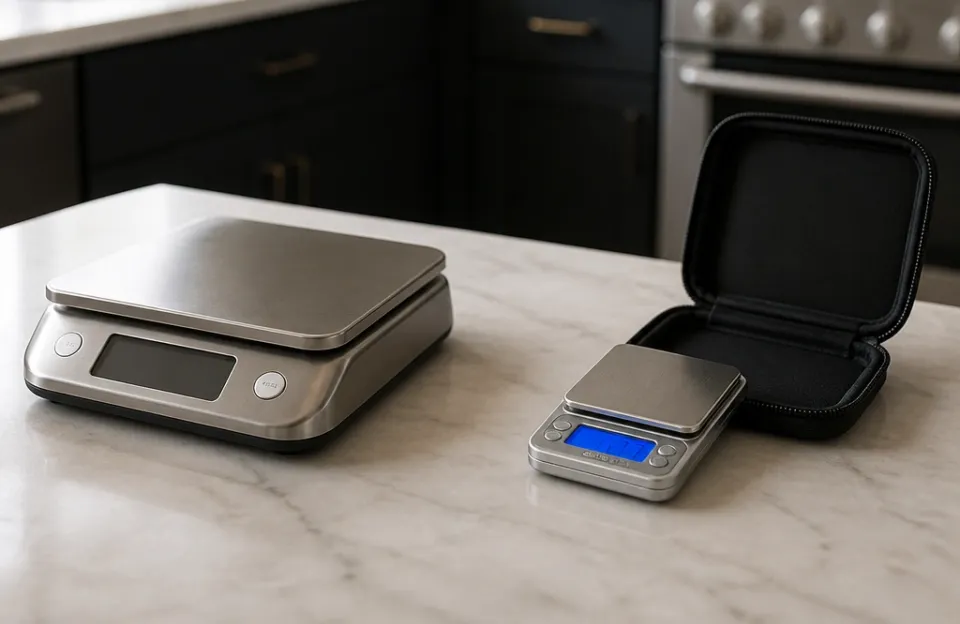
The main difference is physical footprint and maximum capacity. Large food scales have wide platforms, usually 8 to 12 inches across. They sit flat on your counter and don’t move.
You can put a massive mixing bowl on them without blocking the screen. They often plug into the wall or use larger battery packs because driving a bigger load cell takes more power.
Portable food scales are built for tight spaces. The platform might be 5 or 6 inches wide. Many fold up or come with a protective cover so you can toss them in a gym bag or suitcase.
They run on coin cells, AAA batteries, or USB charging. The tradeoff for that size is a lower weight limit and a smaller display.
Both types do the same basic math. They measure force on a sensor and convert it to grams or ounces. But the hardware inside changes based on the intended use.
A scale meant to hold 20 pounds of flour uses a different sensor than one meant to weigh a single chicken breast in a hotel room.
Platform dimensions and bowl clearance
A large scale gives you room to work. When you set a wide bowl on a 10-inch platform, you can still see the digital readout. This matters when you’re adding ingredients one by one.
If the bowl hangs over the edge of a tiny scale, the weight distribution gets uneven. The reading jumps around, or the scale tips over entirely.
Portable scales force you to use smaller containers. You might need to weigh ingredients in batches, transferring them to a separate bowl after each measurement. That adds time and extra dishes.
For someone making a quick protein shake, that’s fine. For someone baking a three-tier cake, it’s frustrating.
If you frequently use large glass mixing bowls or heavy cast iron pots, check the platform size before buying anything. Measure your widest bowl first. Then look for a scale where the platform extends past the bowl’s base.
Weight capacity and readability
Capacity and readability are two different numbers. Capacity is the absolute maximum weight the scale can handle before it errors out or damages the sensor. Readability is the smallest increment it can display.
A typical large kitchen scale holds 22 pounds (10 kg) and reads in 1-gram increments. Some commercial-style models go up to 33 or 44 pounds. A standard portable scale holds 11 pounds (5 kg) and also reads in 1-gram increments.
Ultra-compact pocket scales might only hold 1 or 2 pounds but read down to 0.1 grams.
You rarely need 0.1-gram precision for everyday cooking. Baking requires exactness, but 1 gram is plenty for flour, sugar, and butter. If you’re weighing saffron or yeast for a massive batch, you might want finer resolution.
Just know that higher resolution usually means a lower total capacity.
| Specification | Large Countertop Scale | Portable / Folding Scale |
|---|---|---|
| Max Capacity | 22 to 44 lbs (10 to 20 kg) | 5 to 11 lbs (2 to 5 kg) |
| Platform Size | 8 to 12 inches wide | 4 to 7 inches wide |
| Readability | 1g or 2g | 1g (sometimes 0.1g) |
| Power Source | AC adapter or large batteries | Coin cell, AAA, or USB |
| Storage Footprint | Permanent counter space | Drawer, cabinet, or bag |
| Tare Function | Yes | Yes |
Deciding based on your actual cooking habits
Your recipes dictate your hardware. If you mostly follow standard dinner recipes that call for a pound of ground beef or a few cups of vegetables, either scale works. The decision gets easier when you look at extremes.
Batch cooking and holiday baking push you toward the large scale. Making a double batch of sourdough means weighing 1,000 grams of flour, plus water, salt, and starter, all in one big bowl. That total weight easily hits 4 or 5 pounds.
Add the weight of a heavy ceramic bowl, and you’re approaching 8 pounds. A small portable scale might max out or struggle to stay stable under that load.
Tracking daily nutrition pushes you toward the portable scale. If you weigh your lunch at work or measure protein powder at the gym, you need something that travels. Leaving a 10-pound scale at home doesn’t help you log your midday meal.
Meal prepping for multiple people
When you cook for four or more people, volume goes up fast. Weighing five pounds of chicken thighs for the week requires a sturdy base. Large scales have heavier internal components that absorb the shock of dropping heavy items onto the platform.
Dropping a thick steak onto a flimsy portable scale can bend the sensor bracket underneath.
Consistency matters here too. If you’re dividing a large batch of chili into six equal containers, you need a scale that responds quickly as you ladle. Large scales tend to have faster stabilization times for heavy loads because their load cells are designed for that range.
Small scales sometimes hunt back and forth trying to settle when pushed near their maximum limit.
Precision in the kitchen relies on good tools across the board. Getting accurate weights pairs well with getting accurate temperatures, which is why many cooks who buy serious scales also invest in reliable instant-read thermometers to dial in their proteins.
Tracking macros away from home
Diet tracking requires consistency. If you only weigh food at home, you might guess your portions at restaurants or the office. A portable scale removes the guesswork.
Modern folding scales are incredibly thin. Some slide into a laptop sleeve. Others fit in a jacket pocket.
The limitation is portion size. You can’t weigh a massive restaurant salad on a 5-inch platform. You end up weighing individual components or using smaller containers.
It takes practice. Once you get used to the workflow, it becomes second nature.
Battery life is a real factor for travelers. A scale that dies in the middle of a trip is dead weight. Look for models with auto-shutoff timers.
Some shut down after 60 seconds of inactivity. Others give you two minutes. If you’re moving slowly through a recipe, a short timer will annoy you because you have to keep turning it back on.
Power sources and long-term maintenance
How a scale gets its electricity determines where you can use it and how much upkeep it needs. Large scales often include an AC adapter. You plug them in and leave them plugged in.
This means you never worry about batteries dying during a long baking session. The downside is cord management. You need an outlet near your prep area, and the wire sits on your counter.
Some large models use AA or C batteries instead of a cord. This gives you freedom to place the scale anywhere, even outside on a patio table. Heavy use drains batteries faster on large scales because the display is bigger and the processor handles more data.
Portable scales almost always run on batteries. Coin cells (like CR2032) last a long time because the screens are tiny and the draw is low. AAA batteries offer more juice and are easier to find in a pinch.
Rechargeable lithium batteries are becoming standard on mid-range portable models. You charge them via USB-C, just like a phone.
Keeping your kitchen gear in good shape applies to everything from scales to appliances. If you spend time prepping food, you also need to know how to maintain your equipment, like keeping your toaster oven air fryer clean so grease buildup doesn’t ruin your meals.
Calibration drift over time
All digital scales drift eventually. The metal spring inside the load cell stretches slightly after thousands of uses. Temperature changes affect the electronics.
A scale that was perfect last year might be off by a few grams today.
Large scales are generally more stable. Their heavier build resists physical shocks better. But if you drop a cast iron pan on one, you can permanently damage the sensor.
Most kitchen scales aren’t designed to be dropped.
Many decent scales allow user calibration. You place a known weight on the platform and tell the scale what it should read. You don’t need a certified lab weight.
A sealed bottle of water works. One milliliter of pure water weighs exactly one gram. So a full 500ml water bottle weighs 500 grams, plus the plastic.
It’s close enough for kitchen work.
For official standards on weights and measures, agencies like the National Institute of Standards and Technology publish guidelines on how commercial scales must perform, though home kitchen devices follow looser manufacturing tolerances.
Accuracy expectations for home kitchens
People expect laboratory perfection from a thirty-dollar kitchen tool. That expectation causes frustration. Home food scales are highly accurate for cooking purposes, but they have limits.
A scale rated for 1-gram readability means it rounds to the nearest gram. If you add 0.6 grams of salt, it might not register. If you add 1.4 grams, it shows 1 gram.
This is perfectly fine for flour, sugar, meat, and vegetables. It is not fine for measuring micro-doses of supplements or precious spices where half a gram changes the outcome.
Environmental factors mess with readings. Drafts from an open window or an AC vent push down on the platform. The scale reads that air pressure as weight.
Always use your scale away from direct airflow. Uneven counters cause problems too. If the rubber feet don’t sit flat, the load cell binds internally, and the numbers jump.
Moisture is another enemy. Spilling water into the seams of a portable scale can short the circuit board. Large scales with sealed buttons handle spills better.
If you’re kneading dough directly over the scale, wipe it down immediately after.
If you rely heavily on precise measurements for things like candy making or deep frying, pairing your scale with a dedicated high-heat thermometer prevents guessing games when sugar stages or oil temps matter just as much as ingredient ratios.
Storage realities in small versus large kitchens
Counter space dictates reality. If you have a massive island, leaving a large scale out permanently makes sense. You use it more when it’s visible.
You don’t have to dig it out of a cabinet every time you need to weigh an apple.
But most kitchens don’t have infinite space. A large scale with a 10-inch footprint takes up prime real estate near the sink or stove. You might end up moving it constantly, which increases the risk of dropping it.
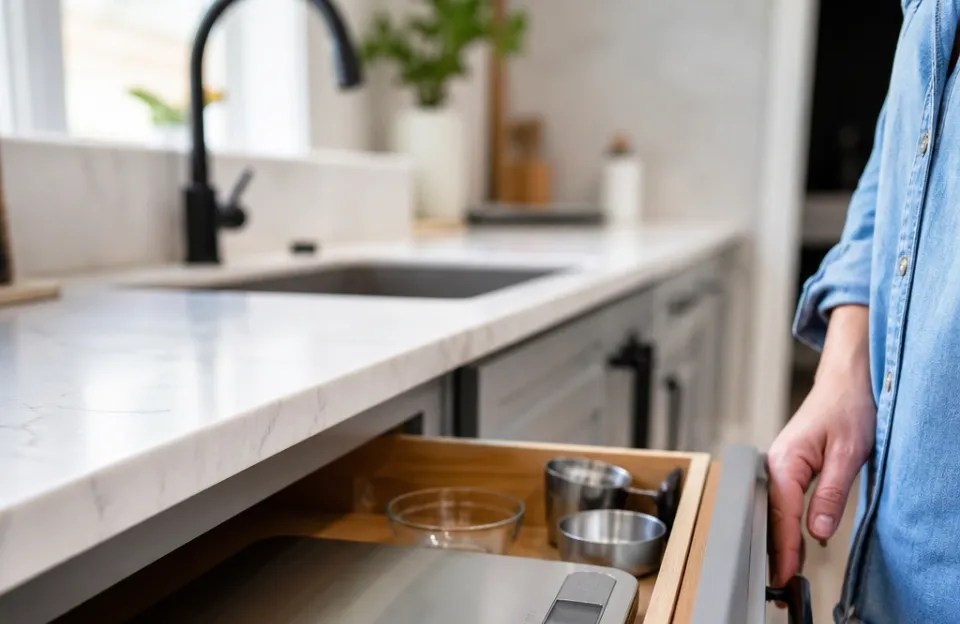
Portable scales solve the storage problem. They slide into a silverware drawer. They fit behind the toaster.
Some hang on a hook inside a cabinet door. If you only bake once a month, storing a massive scale for 29 days is a waste of space.
Think about your overall layout when choosing. If your kitchen is undergoing changes, like deciding between resurfacing or refacing cabinets, consider how new drawer depths or counter heights will affect where your scale lives.
Travel protection and durability
Taking a scale on a road trip or flight exposes it to rough handling. Luggage gets thrown. Bags get crushed.
A rigid portable scale with a hard plastic shell survives this better than one with exposed glass.
Folding scales are clever, but hinges are weak points. Opening and closing the scale hundreds of times wears out the ribbon cable connecting the platform to the display. If you travel weekly, a solid one-piece portable scale lasts longer than a folding model.
Some people buy padded cases for their gear. Hard EVA cases protect scales from impacts. If you already use protective cases for other tools, like storing wireless probes safely, applying the same logic to a travel scale keeps the sensors aligned.
Common mistakes people make when weighing food
Buying the wrong size is the first mistake. People buy a small scale to save money, then try to weigh a giant bowl of soup. The bowl covers the screen.
They lift the bowl to peek at the number, changing the weight. Buy the size that matches your largest container.
Ignoring the tare function is the second mistake. Tare resets the scale to zero with a container on it. You should never do mental math to subtract the bowl’s weight.
Put the bowl on. Hit tare. Add food.
The number on the screen is the food’s exact weight.
Placing the scale on soft surfaces ruins accuracy. A towel, a silicone mat, or a wooden cutting board that flexes absorbs some of the downward force. The scale reads lower than the true weight.
Always weigh on a hard, flat surface like granite, laminate, or solid wood.
Overloading the sensor happens when people lean on the scale or use it as a general shelf. Don’t stack heavy cookbooks on top of your food scale when you aren’t using it. Constant pressure fatigues the load cell spring.
Finally, forgetting to switch units causes ruined recipes. Grams and ounces are very different numbers. If a recipe calls for 200 grams of chocolate and your scale is set to ounces, you’ll add way too little.
Check the unit indicator before you start pouring.
Frequently asked questions
Can I use a portable food scale for baking bread?
You can, provided the total weight of your ingredients and bowl stays under the scale’s maximum capacity. Most bread recipes for a single loaf require about 500 to 1,000 grams of flour plus water. Add the bowl weight, and you approach 3 to 4 pounds.
An 11-pound portable scale handles this fine. A 5-pound pocket scale will likely error out.
Do large food scales consume a lot of electricity?
No. Even models that plug into the wall use very little power. The display and the load cell draw minimal current.
Leaving a large scale plugged in overnight costs fractions of a penny per month. Battery-powered large scales typically last months on a single set of AA batteries with daily use.
Why does my scale show different weights when I move it?
Digital scales measure force relative to gravity and their own leveling. Moving a scale from a carpeted dining table to a granite kitchen counter changes the stability of the base. Uneven floors tilt the internal sensor.
Always let the scale settle on a hard, flat surface and turn it on fresh in its new location.
Is a higher price guaranteed to mean better accuracy?
Price usually buys you better build quality, faster response times, and higher weight limits rather than raw accuracy. A twenty-dollar scale and a hundred-dollar scale might both read within one gram of the true weight. The expensive one just handles a heavier bowl, has a brighter screen, and won’t crack if you bump it.
How often should I calibrate my kitchen scale?
For normal home cooking, calibrating once a year is sufficient. If you drop the scale, spill liquid inside it, or notice your recipes acting strange, test it immediately. Use a known weight like a bag of sugar with the printed weight verified, or a sealed water bottle.
Are glass or stainless steel platforms better for food safety?
Stainless steel is generally more durable and resists scratching, which hides bacteria. Glass looks cleaner and wipes down easily, but it shatters if you drop a heavy pot on it. Both materials are non-porous and safe for direct food contact as long as you wash them regularly.
Picking the right footprint for your counter
The choice between large and portable food scales isn’t about which one is objectively better. It’s about matching the tool to your physical space and your cooking volume. A large scale makes batch cooking, bread baking, and heavy bowl work frictionless.
A portable scale makes diet tracking, small kitchens, and travel possible.
Look at your biggest mixing bowl. Look at your available drawer space. Think about whether you cook mostly at home or need to weigh food at the office.
Those three answers will point you directly to the right category. Buy the one that fits your routine, and remember to hit the tare button every single time.