You’ve just prepped a prime rib, set the alert for 130°F, and settled onto the couch. Halfway through the cook, the display suddenly jumps to 400°F or flashes “ERR.” You pull the probe, but the damage is done, the internal wires have fried or snapped, leaving you guessing on a high-stakes meal.
Quick Answer: To protect meat thermometer wires, avoid direct contact with flame or grill grates, keep the probe cables away from temperatures exceeding their rated limit (usually 500°F, 700°F), and never submerge the wire-to-probe crimp in water. Store them by loosely coiling the cables rather than wrapping them tightly around the device, which prevents internal copper fatigue.
Heat is the Number One Killer
Most high-quality digital thermometers use a thermistor or thermocouple sensor housed in a stainless steel tube. While the tip of the probe can handle high heat, the wire braided cable is the weak link. These cables usually have a Teflon or silicone coating inside a stainless steel mesh, and they have clear thermal limits.
When a wire drapes over a hot grill grate or hangs too close to a charcoal bed, the internal insulation melts. Once that insulation liquefies, the tiny copper strands inside touch each other. This creates a short circuit, which is why your base unit suddenly shows a maximum temperature reading or an error code.
Even if the wire doesn’t melt, “heat soak” can ruin accuracy over time. If you’re cooking at 225°F in a smoker, the wires are usually fine. But if you’re searing a steak at 500°F and the wire is sitting directly on the cast iron grate, it will fail.
Always check your manufacturer’s specifications; many ThermoWorks probes, for instance, are rated for 700°F, but the transition point where the wire meets the probe is often more sensitive.
The Problem with Flare-Ups
Direct flame is significantly hotter than the ambient air inside your grill. A grease flare-up can reach temperatures over 1,000°F in seconds. If your thermometer wire is in the path of that flame, the stainless steel braiding won’t save the internal electronics.
It acts like a heat sink, transferring that energy directly to the delicate wires inside.
Using Heat Shields and Grommets
Many modern smokers come with a dedicated “probe port” or a rubber grommet on the side. This is there for a reason. Running the wire through a port prevents it from getting pinched by the heavy lid of the grill.
If you don’t have a port, try to run the wire through the exhaust vent or at a corner where the lid has the most play. Avoid “crimping” the wire under the weight of a heavy steel lid, as this can sever the internal strands over time.
Moisture and the Crimp Leak
While heat is the most common cause of failure, moisture is the most deceptive. The point where the wire enters the stainless steel probe is called the “crimp.” This area is rarely 100% waterproof. If you drop your probe into a sink of dishwater, capillary action can pull moisture up into the probe housing.
Once water gets inside the probe or under the wire insulation, it interferes with the electrical resistance. This leads to wildly swinging temperature readings. You might see the temperature jump from 50°F to 90°F and back again in a second.
This “phantom” reading is a classic sign of water damage.
Cleaning Without Submerging
To clean your probes safely, use a damp, soapy cloth or an alcohol wipe. Wipe down the stainless steel tip carefully, but avoid getting the braided wire wet if possible. Most importantly, never put digital thermometer probes in the dishwasher.
The high-pressure spray and intense heat practically guarantee that water will find its way into the wiring.
The Drying Trick
If you suspect moisture has entered the wire, you can sometimes save the probe. Place the probe (not the plastic base unit) in a low oven, around 150°F to 200°F, for about an hour. This can bake out the moisture trapped under the braid.
Some people also find success placing the probes in a bowl of dry rice, though the oven method is generally more effective for sealed probes.
Storage Habits That Cause Snaps
How you pack away your gear after the BBQ matters just as much as how you use it. The internal wires in these cables are very thin. Every time you bend the wire at a sharp angle, you put stress on the copper.
Repeated sharp bends lead to “metal fatigue,” where the wire eventually snaps inside the insulation.
The Loose Coil Method
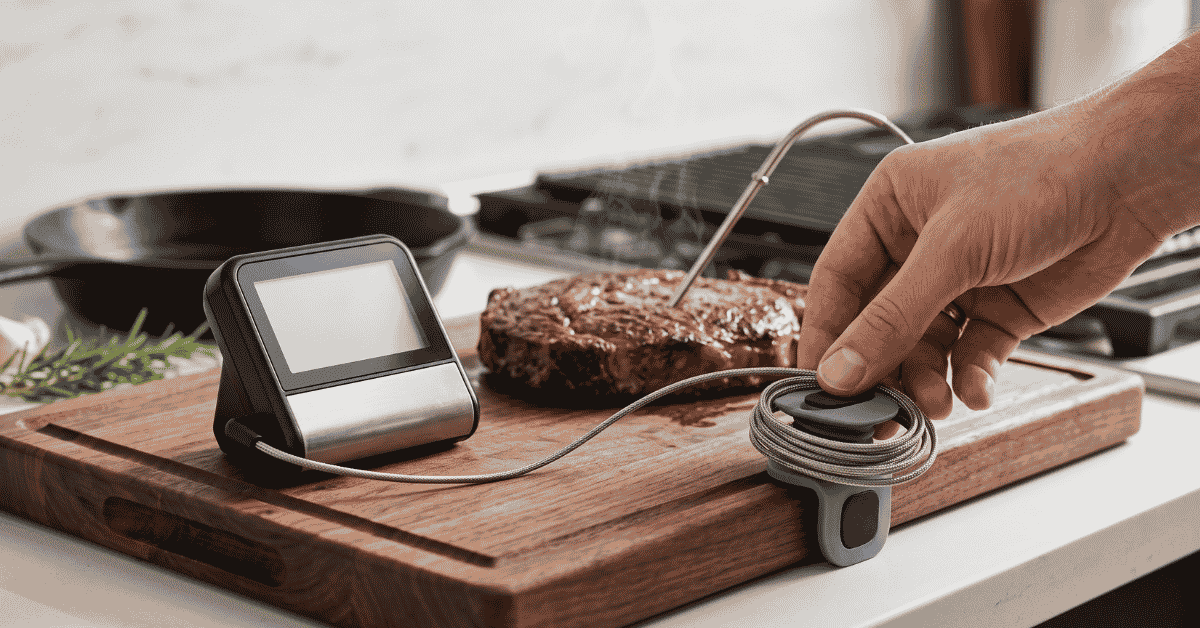
The best way to store thermometer wires is to coil them loosely around your hand, creating a circle about 4 to 6 inches wide. Avoid the temptation to wrap the wire tightly around the plastic body of the thermometer. Those tight turns at the corners of the housing are exactly where the wire will eventually fail.
Using Cable Organizers
If your thermometer didn’t come with a case, you can use small Velcro ties or even empty toilet paper rolls to keep the coils organized. Keeping each probe in its own separate bag or slot prevents the braided stainless steel from snagging on other probes. When these braids snag and you pull them apart, you can fray the wire, which exposes the vulnerable insulation underneath.
Practical Application: The Safe Setup
When you are ready to cook, follow these steps to ensure your equipment lasts for years:
- Check the Path: Before lighting the fire, thread your probes through the grill’s port or vent.
- Position the Meat: Place the meat so the wire has the shortest, straightest path to the exit.
- Avoid the Grate: Use a “probe clip” (a small metal C-clamp) to hold the ambient sensor off the grate. If the wire must touch the grate, try to place it over a “cool zone” or a deflector plate.
- Monitor the Lid: Gently lower the lid. If you feel resistance against the wire, stop. Adjust the wire so it sits in a gap or a flatter area of the rim.
- Be Ready for Flare-ups: If you see a fire starting under the meat, move the wire out of the way before addressing the fire if it’s safe to do so.
Edge Cases and Variations
Not all probes are built the same. Understanding your specific tool changes how you treat the wires.
- Wireless Probes: Newer “truly wireless” probes don’t have external wires at all. These eliminate the wire-damage issue but have much lower ambient temperature limits (usually around 527°F) because the battery and electronics are inside the probe. If you exceed this, the internal battery can explode.
- High-Temp Silicone vs. Steel Braid: Some cheaper thermometers use thick silicone-coated wires. These are often more waterproof than steel-braided ones but have lower melting points. Steel braid is more heat-resistant but acts like a sponge for grease and water.
- K-Type Thermocouples: These are professional-grade probes with yellow connectors. They are generally more durable and have higher heat ratings than standard thermistors, but the wires are even thinner and more prone to snapping if kinked.
Common Mistakes or Misconceptions
Many backyard cooks treat their probes like heavy-duty hardware, but they are precision instruments.
- Mistake: Using pliers to pull a stuck probe. This can crush the crimp and sever the wire connection. Always pull from the metal housing, not the wire.
- Mistake: Thinking “Heat Resistant” means “Fireproof.” Most wires are rated for 700°F, but a gas burner flame is roughly 3,000°F. No consumer probe wire survives direct flame for long.
- Mistake: Boiling probes to sanitize them. This is a fast track to water damage. The steam and pressure will force water into the crimp. A simple wipe with a disinfectant is sufficient according to USDA food safety standards for surface contact.
- Mistake: Leaving probes in the grill during a “clean-out” burn. If you crank your grill to 600°F+ to burn off grease, remove your probes first. The high heat in an empty grill is much more punishing than the heat during a standard cook.
Quick-Reference: Causes of Failure
| Symptom | Likely Cause | Prevention |
|---|---|---|
| Flashing “ERR” or “LLL” | Broken internal wire or moisture | Don’t kink the wire; don’t soak it. |
| Instant 500°F+ reading | Short circuit from melted insulation | Keep wire away from hot grates and flame. |
| Reading jumps 20-30 degrees | Moisture in the probe/crimp | Wipe clean only; never submerge. |
| Frayed stainless steel braid | Mechanical wear/snagging | Store in a dedicated case; coil loosely. |
| Discolored/Blackened wire | Overheating | Verify your grill’s internal temp isn’t exceeding wire specs. |
Frequently Asked Questions
Can I use electrical tape to fix a melted wire?
No, electrical tape isn’t designed for the high temperatures found inside a grill and will melt or off-gas toxic fumes. Once the internal insulation is gone, the probe is usually toast. It’s safer and more accurate to buy a replacement probe than to attempt a DIY heat-shielded repair.
Why does my thermometer work at room temperature but fail at high heat?
This usually happens when there is a tiny fracture in the wire. As the metal expands with the heat, the connection separates, causing an error. When it cools down, the metal contracts and touches again.
If this happens, it’s a sign the probe is nearing the end of its life and needs to be replaced.
Is it okay to leave the wires in the smoker overnight?
It’s not recommended. Humidity and dew can settle on the braided wires, potentially leading to moisture wicking into the probe. Additionally, the grease buildup on the wires can go rancid or attract pests.
It’s best to bring them inside after every cook.
Do “pro-series” probes really last longer?
Generally, yes, because they often have better moisture sealing at the crimp and higher-grade insulation. However, even the most expensive probe will fail if it’s hit with a direct flame or pinched in a heavy smoker door. The “pro” designation usually refers to the accuracy and the temperature range, not invincibility.
Worth Remembering
Protecting your meat thermometer wires is mostly about being mindful of how you route them and how you store them. A few seconds of care, checking that the wire isn’t touching a hot spot and coiling it loosely instead of wrapping it tight, will save you the frustration of a failed reading during your next big cook. If you treat these wires like the sensitive electronics they are, they’ll give you years of accurate service.
Most manufacturers sell replacement probes separately, so if one does fail, you don’t necessarily need to replace the entire base unit.