You pull your grill kit out of the drawer, ready to check that brisket, only to find a literal bird’s nest of metal cables. You spend ten minutes yanking on silver wires, getting grease on your hands, and probably kinking the delicate internal sensors in the process. It’s a frustrating way to start a meal, and it’s the fastest way to break an expensive piece of cooking gear.
Quick Answer: To store thermometer probes without tangling, use the “over-under” coiling method or wrap them around dedicated cable spools or notched cardboard. Store each probe in an individual zip-top bag or a slotted foam organizer to prevent them from interlocking with other kitchen tools. Avoid tight wrapping, as sharp bends can snap the internal high-heat wiring.
Why wire management is the secret to probe longevity
Thermometer probes look tough because of their stainless steel braiding, but they’re surprisingly fragile on the inside. Most digital pit thermometers use a thermistor or a thermocouple. These rely on very thin copper or alloy wires hidden beneath that metal mesh.
When these wires tangle, they often get knotted or pulled taut, which causes microscopic breaks in the circuit.
If you’ve ever had a thermometer suddenly read “High” or “LLL” when it’s clearly not in a fire, a broken internal wire is usually the culprit. Kinking the wire during storage is the most common cause of this failure. By organizing your probes, you aren’t just saving time; you’re protecting the calibration and physical life of the sensor.
The physics of the “memory” in the wire
The metal braiding on a probe has a “memory,” meaning it wants to return to the shape it held longest. If you stuff it into a junk drawer in a messy heap, the braiding learns that tangled shape. When you try to straighten it out to reach the smoker, it will naturally want to curl back into a knot.
Cross-contamination and hygiene
Storage isn’t only about cables; it’s about the tips. If probes are tangled together, a probe used for raw poultry might touch one used for candy or bread. Even if you’ve wiped them down, a messy storage bin makes it harder to keep the “business end” of the sensor clean and away from dust, grease, or leftover residue from other tools.
The over-under coiling technique
The best way to handle any long wire, whether it’s a probe or a garden hose, isthe over-under method. This technique prevents the wire from twisting on its own axis. When you just wrap a wire around your hand, you add a half-twist with every loop.
Those twists are what create those annoying “kinks” that won’t lay flat.
To do this, hold the probe tip in your non-dominant hand. With your other hand, make the first loop normally (the “over”). For the second loop, flip your hand upside down so you’re grabbing the wire from the bottom and bringing it up (the “under”).
Repeat this until the wire is coiled. This creates a neutral coil that falls perfectly straight the next time you use it.
Using cable ties and wraps
Once you have a neat coil, you need to keep it that way. Simple Velcro ties are better than rubber bands. Rubber bands can dry out, snap, or even melt if stored near a warm stove.
A small piece of hook-and-loop tape keeps the coil secure without putting pressure on the sensor’s transition point (where the wire meets the metal probe).
The “Cardboard Notch” method
If you don’t want to learn a specific coiling trick, you can use a piece of stiff cardboard. Cut a small rectangle and put a notch on either side. Place the probe tip against the cardboard and wrap the wire around the notches.
This keeps the wire flat and prevents it from sliding off into a mess. Many professional chefs use this because it’s free and allows you to write the probe number or type (like “Pit Probe” or “Meat Probe”) directly on the cardboard.
Best storage containers for multiple probes
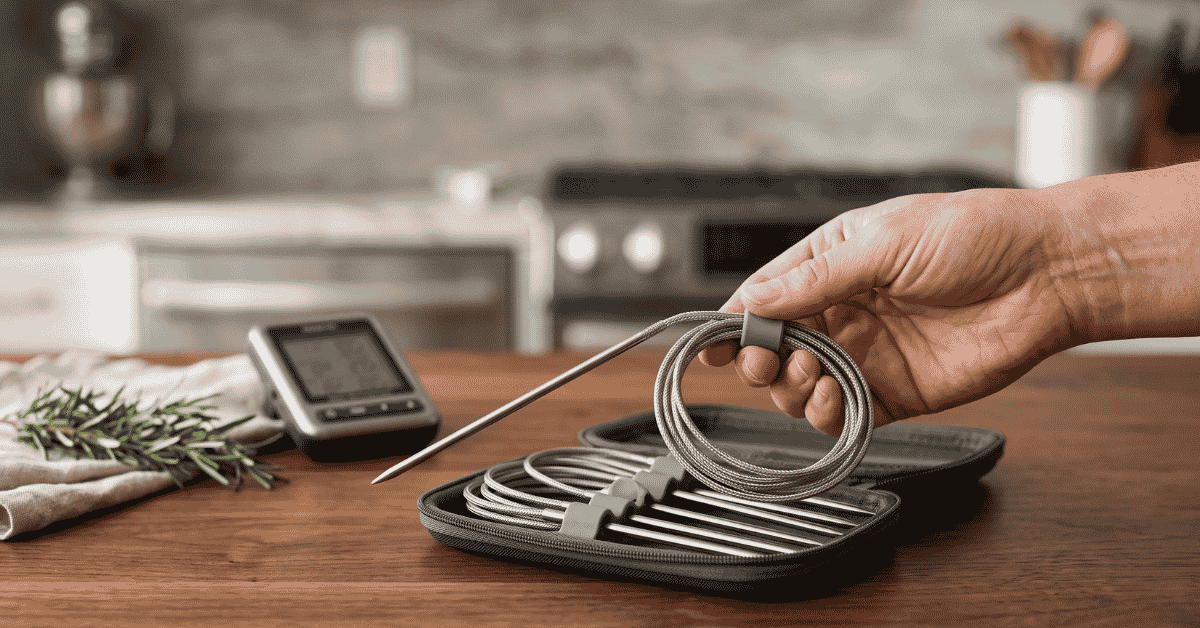
If you have a multi-channel thermometer (like a 4-probe or 6-probe unit), storing them all together is a recipe for disaster. You need physical separation between each wire.
- Individual Zip-Top Bags: This is the cheapest and most effective solution. Coil each probe separately and put it in its own small bag. Even if the bags get tossed in a bin, the wires can’t touch each other.
- A “Probe Roll”: Similar to a knife roll, you can use a cloth or canvas wrap with narrow pockets. Put one probe in each slot and roll the whole thing up.
- Foam Inserts: If you have a hard-shell case, you can cut slots into a piece of pick-and-pluck foam. This keeps the display unit in the center and the probes tucked into organized channels around the edges.
The “Toilet Paper Roll” hack
A common household trick involves using empty cardboard rolls. Coil the probe and tuck it inside the tube. You can write the probe’s purpose on the outside of the tube.
This keeps the wires from expanding and getting caught on other items in your kitchen drawer.
Practical steps for post-cook storage
The storage process actually starts while you’re still cleaning up. Never store a probe while the wire is still sticky or greasy. Residue acts like glue, making tangles much harder to untie later.
- Wipe the wire first: Most people clean the metal probe but ignore the wire. Use a damp, soapy cloth to wipe the entire length of the cable. Dry it immediately with a paper towel.
- Inspect for kinks: Before coiling, run the wire through your fingers. If you feel a sharp bend or a fray in the mesh, try to gently straighten it.
- Cool down completely: Never coil a probe while the wire is still hot from the oven or smoker. Heat makes the internal insulation more pliable. If you coil it while hot, it “sets” in that curled position, making it more likely to tangle next time.
Edge cases and specialized probes
Not all probes are built the same. Some high-end wireless probes (like the Meater or TempSpike) don’t have wires at all, so they usually come with their own charging blocks. However, for those using long-range wired sensors, there are specific things to watch for.
Extra-long smoker probes
Smoker probes can be 6 feet long or more. For these, the over-under method is non-negotiable. Trying to wrap 6 feet of wire around your hand will result in at least 10-12 twists in the cable.
By the third time you do this, the wire will start to loop back on itself, forming a “pigtail” that is nearly impossible to fix and highly prone to breaking.
Air temperature clips
Don’t store your “grill-grate” clips attached to the probes. The sharp edges of the clips can rub against the wire braiding during storage, leading to fraying. Always remove the clip, store the probe in its neat coil, and keep the clips in a separate small jar or bag.
Common mistakes to avoid
- Wrapping around the device: Many people wrap the wire tightly around the thermometer body. This creates extreme stress at the plug end. Over time, the wire will pull away from the plastic jack, leading to a loose connection.
- Using twist ties: The thin wire inside a plastic twist tie can actually “saw” into the metal braiding of your probe if it’s tightened too much.
- The “Stuff and Pray” method: Shoving everything into a gallon bag might seem fast, but the friction of the metal braids rubbing against each other creates static and causes them to “hook” together.
- Hanging by the wire: Some people hang their probes on hooks by the cable. The weight of the metal probe tip constantly pulling down on a single point in the wire will eventually stretch and break the internal copper strands.
| Storage Method | Best For | Pros | Cons |
|---|---|---|---|
| Over-Under Coil | All Probes | Prevents kinks; wires lay flat | Takes a few seconds to learn |
| PVC Pipe/Spool | Extra Long Wires | Superior protection; no bends | Takes up more space in the drawer |
| Zip-Top Bags | Multiple Probes | Zero chance of cross-tangling | Plastic waste; looks less “pro” |
| Cardboard Notches | Budget/Organization | Easy to label; very cheap | Cardboard can get soggy or greasy |
Frequently asked questions
Can I just use a rubber band to hold the wires?
It isn’t recommended. Rubber bands degrade quickly in kitchen heat and can stick to the metal braiding. If the rubber melts onto the wire, it’s a nightmare to clean off and can smell when you next put the probe in a hot oven.
Use Velcro or a loose piece of twine instead.
Why does my probe wire always look like a corkscrew?
This happens because of “coil memory.” You likely wrapped it around your hand or a round object in the same direction every time. To fix it, hang the probe from a high point for 24 hours to let gravity pull the twists out, then start using the over-under method.
Is it safe to store probes in the freezer?
There is no reason to store them in the freezer. Extreme cold can make the wire insulation brittle. If you then move that brittle wire into a 400°F oven, the rapid expansion can crack the insulation.
Room temperature in a dry drawer is best.
How do I know if my storage method broke my probe?
If your thermometer shows erratic jumps in temperature (e.g., jumping from 150°F to 220°F in a second), or if it only works when you hold the wire at a certain angle, you have a “short.” This is almost always caused by tight coiling or kinking during storage.
Worth remembering
Taking thirty seconds to coil your wires properly saves you thirty minutes of frustration on your next cook. A neatly stored probe is a calibrated probe. By keeping each wire separate and avoiding sharp bends, you’ll get years of use out of sensors that normally fail in a single season.
If you find yourself constantly Replacing probes, the issue might not be the brand you’re buying, but rather how they spend their time between meals. Treat the wires with the same care you’d give a delicate electronics cable, and they will stay tangle-free and accurate for a long time.