Most home espresso machines need descaling every two to three months. How often you should descale an espresso machine depends on your water hardness and how many shots you pull daily. Hard water means monthly cleanings, while soft or filtered water stretches that window out safely.
Scale is calcium and magnesium left behind when water heats up. It builds up inside the boiler, pipes, and heating element. Left alone, it blocks water flow, drops brewing temperature, and ruins the taste of your coffee.
Regular descaling dissolves these minerals before they cause damage. Getting the timing right protects a machine that likely cost you hundreds of dollars.
The Short Answer on Timing
A good baseline for most US households is every 60 to 90 days. That covers the average kitchen where the tap water has moderate mineral content and the machine makes two to four drinks a day.
But a single timeline does not work for everyone. Water in the United States varies wildly by region. A home in Phoenix, Arizona deals with much harder water than a home in Seattle, Washington.
Your schedule needs to match what comes out of your tap.
Here is a simple rule based on water type:
| Water Type | Descaling Frequency | Common US Regions |
|---|---|---|
| Hard (over 120 mg/L) | Every 3 to 4 weeks | Southwest, Midwest, parts of Texas |
| Moderate (60 to 120 mg/L) | Every 2 to 3 months | Northeast, Mid-Atlantic, Southeast |
| Soft (under 60 mg/L) | Every 4 to 6 months | Pacific Northwest, parts of New England |
| Filtered / Reverse Osmosis | Every 6 months | Anywhere with a filter installed |
If you use a reverse osmosis system under your sink, scale buildup slows down significantly. But remember that completely pure water can actually be corrosive to certain metal boilers over long periods. A basic carbon filter strikes the best balance for espresso machines.
Why Scale Ruins Espresso Machines
Water passes through a narrow path inside your machine. It moves from the reservoir, through a pump, into a heating element or boiler, and finally out the group head into your cup.
When hard water heats up, dissolved minerals turn solid. They stick to the metal walls inside that path. This layer is called limescale.
Limescale acts as an insulator. The heating element has to work much harder to heat the water through that crusty layer. Your machine draws more power and takes longer to reach the target temperature.
For espresso, brew temperature needs to stay between 195 and 205 degrees Fahrenheit. Even a few degrees off changes how the coffee extracts. You will taste sour or bitter notes that were not there before.
Eventually, the scale narrows the pipes. Water pressure drops. The pump strains to push liquid through.
You might hear a louder buzzing sound or notice a thinner stream coming from the portafilter. If ignored, the pump burns out or the boiler cracks from overheating. Replacing those parts often costs more than buying a new entry-level machine.
The Specialty Coffee Association publishes water standards that explain exactly why mineral balance matters for both extraction and equipment longevity. Keeping minerals in check prevents these mechanical failures.
Signs Your Machine Needs Descaling Now
Do not rely only on the calendar. Your machine will tell you when it needs help. Watch for these physical signs:
Slower flow rate. A healthy espresso shot pours in about 25 to 30 seconds. If it starts taking 40 seconds or drips out slowly, scale is likely blocking the internal tubes.
Louder pump noise. The vibration pump or rotary pump has to push harder against restricted pipes. This creates a strained, higher-pitched sound during brewing.
Temperature drops. If your espresso tastes unusually sour, the water might not be getting hot enough. Scale on the heating element prevents proper heat transfer.
Visible white flakes. Sometimes you will see tiny white specks in your cup or around the shower screen. That is dried scale breaking loose.
Steam wand struggles. If the steam wand sputters or produces weak steam, mineral deposits are clogging the small holes at the tip or the pipe leading to it. Wiping the outside of the wand after every use helps prevent external buildup, but internal blockages require a full descaling cycle. Learning how to steam milk properly relies on consistent pressure, which scale destroys.
Many modern machines have a built-in alert light. Brands like Breville, DeLonghi, and Gaggia include sensors that track water volume or boiler temperature. When the sensor detects abnormal resistance, a “clean” or “descale” light flashes.
Follow that prompt immediately rather than waiting for your scheduled date.
What Happens If You Descale Too Often
Some people worry about scale so much that they run a descaling cycle every week. This causes its own problems.
Descaling solutions are acidic. They dissolve calcium, but they also interact with rubber gaskets and silicone seals inside the machine. Running acid through the system too frequently dries out those seals.
Dry seals shrink and crack, leading to leaks around the group head or inside the chassis.
Over-descaling also strips away any protective patina that forms inside brass or copper boilers. While you want the water path clear, constantly bathing the metal in acid accelerates wear. Stick to the schedule dictated by your water hardness.
If you use soft or filtered water, let the machine go four to six months between treatments.
Choosing the Right Descaling Solution
You have three main options for dissolving scale: commercial descaling liquids, citric acid powder, and white vinegar. Not all of them are equal.
Commercial Descalers
These are formulated specifically for coffee makers and espresso machines. They usually contain mild acids like sulfamic acid or lactic acid, plus corrosion inhibitors to protect metal parts. They rinse out cleanly and leave no flavor behind.
Manufacturers almost always recommend using their branded solution. Using a third-party chemical can sometimes void your warranty if it damages a seal. If your machine is still under warranty, stick to the brand’s official product.
Check current price on Amazon

Citric Acid Powder
Citric acid is a natural, food-safe option. You buy it in bulk powder form and mix it with warm water. A standard ratio is one tablespoon of citric acid per liter of water.
It works well for light to moderate scale.
However, citric acid can leave a slight residue if not rinsed thoroughly. It also requires multiple flush cycles to get the sour taste out of the boiler. It is cheaper than commercial liquids but takes a bit more effort.
White Vinegar
Vinegar is acetic acid. Many older guides suggest mixing half water and half white vinegar to clean coffee makers. For espresso machines, this is a bad idea.
Vinegar smells strong and clings to rubber seals. It takes five or six tank flushes to remove the odor and taste. Worse, acetic acid can degrade the specific types of silicone used in high-pressure espresso pumps faster than milder acids.
Skip the vinegar. Use a proper descaler or citric acid instead.
Regardless of what you choose, never use harsh chemicals like bleach or CLR drain cleaner. Those are toxic and will destroy the machine instantly.
How to Descale Safely Without Damaging Seals
The exact steps depend on your model, but the core process is the same across most semi-automatic and super-automatic machines. Always read your manual first. Some machines have a dedicated descaling mode you must activate; running solution through them manually can confuse the sensors.
Here is the general process:
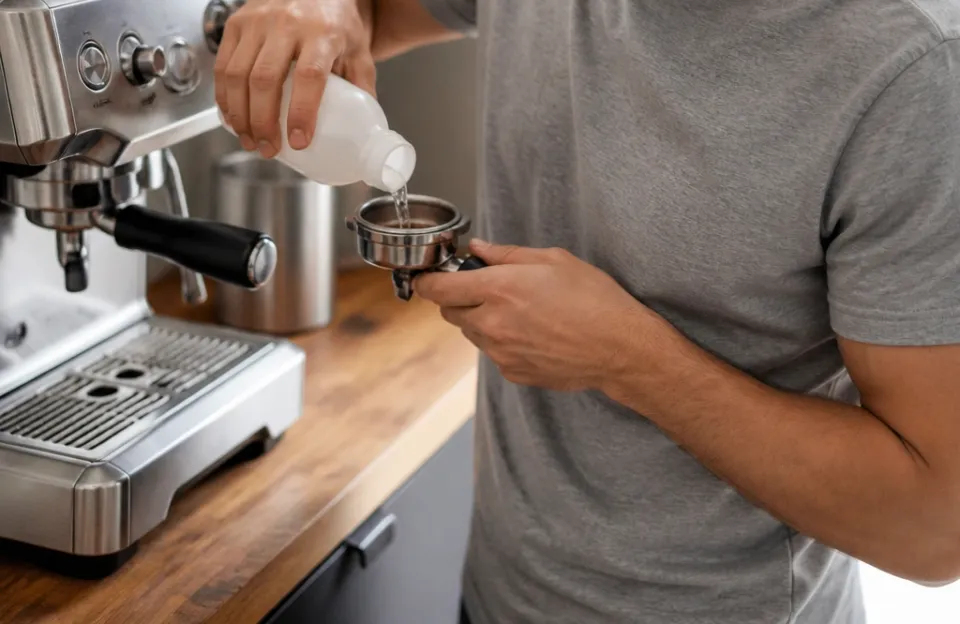
- Empty the machine. Remove any coffee grounds, pods, or beans. Take out the water filter if your reservoir has one. Descaling solution ruins charcoal filters.
- Mix the solution. Fill the water tank with the required amount of warm water and add your descaler according to the package directions. Warm water helps the acid work faster.
- Run the solution through. Turn the machine on. If it has a descale program, start it. If not, run about half the solution through the brew head into a large container. Then run the other half through the steam wand.
- Let it sit. Turn the machine off. Let the remaining solution sit inside the boiler and pipes for 15 to 20 minutes. This dwell time allows the acid to break down stubborn calcium.
- Flush with fresh water. Empty the tank, rinse it, and fill it completely with fresh cold water. Run the entire tank through the brew head and the steam wand. Repeat this flushing step at least twice. You do not want any acid left behind.
- Replace the filter. Once the machine is fully flushed, put a fresh water filter back in.
If you have a super-automatic machine that grinds beans and froths milk automatically, pay close attention to the milk circuit. Some models require you to route the descaling solution through the milk tube as well. Leaving scale in the milk frother leads to poor foam and bacterial growth.
Just like keeping the right fit for accessories matters for cooking gear, matching the correct cleaning routine to your specific machine type prevents unnecessary wear.
Does Water Type Change How Often You Should Descale an Espresso Machine?
Yes. Water type is the single biggest factor in deciding your schedule.
In the United States, water hardness is measured in grains per gallon (gpg) or milligrams per liter (mg/L) of calcium carbonate. You can find your local water report on your city’s utility website, or buy cheap test strips online.
Hard water (over 7 gpg): You must descale every three to four weeks. Machines in areas like Las Vegas, Indianapolis, or San Antonio face heavy mineral loads. If you live here, consider installing an inline water filter or using bottled spring water with low mineral content.
Moderate water (3 to 7 gpg): Every two to three months is safe. This covers cities like New York, Chicago, or Atlanta.
Soft water (under 3 gpg): You can stretch to every four to six months. Cities like Portland or Boston naturally have softer tap water.
Distilled or zero-mineral water: Do not use this in an espresso machine. Espresso extraction relies on some magnesium and calcium to bind with coffee compounds. Zero-mineral water produces flat, dull coffee.
Furthermore, some machines use electrical conductivity in the water to sense tank levels. Distilled water does not conduct electricity well, causing sensor errors. Aim for filtered water with a balanced mineral profile rather than stripped water.
Checking what fits your specific setup applies here too, as not all water sources suit every boiler type.
Preventing Scale Buildup Between Cleanings
Descaling removes scale, but preventing it saves you time and protects your machine. You can slow down mineral buildup significantly with a few habits.
Use filtered water. A simple pitcher filter or an under-sink carbon filter removes chlorine and reduces heavy minerals. It does not strip everything out like reverse osmosis, which keeps the water safe for your boiler sensors.
Purge the steam wand. After frothing milk, always open the steam valve for two seconds to blow out residual milk and water. Wipe the outside with a damp cloth. Milk proteins bake onto the hot metal and trap minerals underneath.
Empty the drip tray and reservoir. Do not let water sit in the plastic tank for days. Stagnant water encourages mineral settling and bacterial growth. Rinse the tank when you refill it.
Backflush regularly. If your machine has a three-way solenoid valve (common on prosumer models like the Breville Barista Express or Gaggia Classic), backflushing with plain water or a blind basket removes coffee oils from the group head. Backflushing does not remove scale from the boiler, but it keeps the brew path clear. Understanding basic maintenance routines for kitchen appliances generally extends their lifespan, and espresso machines are no exception.
When to Call a Professional
Sometimes a descaling cycle is not enough. If your machine has gone years without maintenance, the scale may have hardened into thick crusts that liquid acid cannot dissolve quickly.
Signs you need a technician:
- The pump runs but no water comes out, even after a full descaling cycle.
- The machine trips your kitchen circuit breaker.
- You see water leaking from the bottom of the chassis.
- The boiler makes loud cracking or popping noises when heating up.
A professional repair shop can disassemble the boiler and mechanically remove the scale, or replace damaged heating elements and seals. Attempting to take apart a pressurized boiler yourself is dangerous. High-tension springs and stored heat can cause serious injury.
For very expensive prosumer machines costing over $1,500, sending them in for annual professional servicing is a smart investment. The technician will replace gaskets, lubricate moving parts, and perform a deep descale that goes beyond what the user manual suggests.
Frequently Asked Questions
Can I use vinegar to descale my espresso machine?
You can, but you should not. Vinegar leaves a strong smell that is very hard to rinse out of small boiler tubes. Its acetic acid also degrades rubber seals faster than proper descaling solutions.
Stick to commercial descalers or citric acid.
How do I know if my tap water is hard?
Look up your city’s annual water quality report online, which lists hardness in grains per gallon. Alternatively, buy cheap water hardness test strips at a hardware store. If your glass shower doors get cloudy fast, you likely have hard water.
Will descaling fix a broken pump?
No. Descaling prevents damage, but it rarely fixes a pump that has already burned out. If the motor hums loudly but pushes no water, and a descaling cycle does not clear the blockage, the pump likely needs replacement.
Do super-automatic machines need descaling more often?
They have more internal tubing and complex milk circuits where scale hides. However, they also have precise sensors that tell you exactly when to descale. Follow the machine’s automated prompts rather than guessing a schedule.
Is descaling the same as backflushing?
They are different tasks. Descaling uses acid to dissolve minerals inside the boiler and pipes. Backflushing uses water pressure and detergent to clean coffee oils out of the group head and valves.
You need to do both to keep the machine healthy.
Keeping your espresso machine free of scale is mostly about knowing your water. Test your tap, pick the right cleaning solution, and follow a schedule that matches your daily usage. A clean boiler pulls better shots, lasts longer, and saves you from expensive repair bills.
As an Amazon Associate, we earn from qualifying purchases.