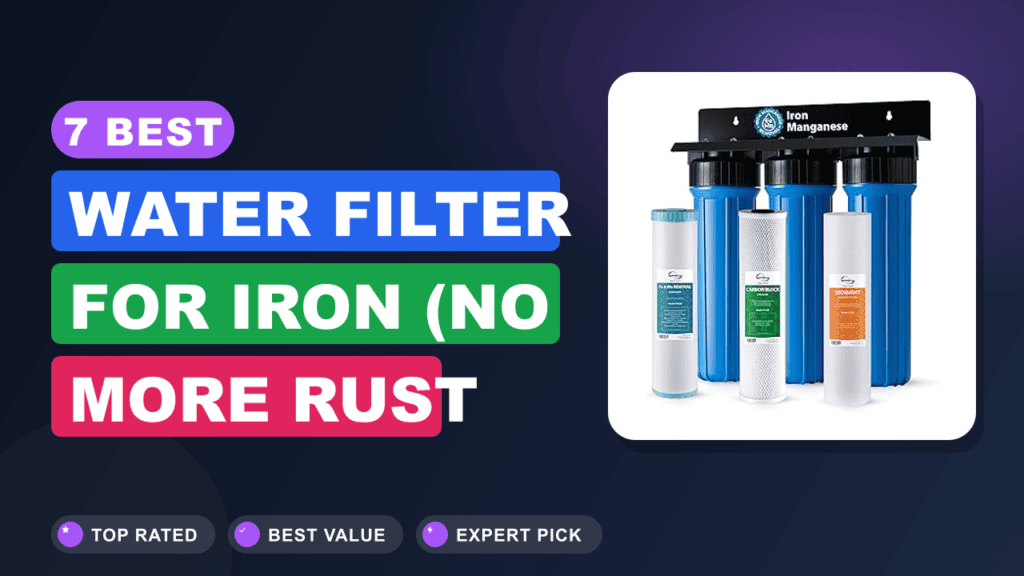
Stubborn orange streaks in the toilet bowl, rusty rings inside the dishwasher, and metallic-tasting tap water are daily headaches when you deal with heavy groundwater minerals. Finding the Best Water Filter for Iron (No More Rust Stains) is the only permanent solution to protect white laundry, ceramic sinks, and expensive plumbing fixtures from irreversible oxidation damage. In our editorial research across dozens of technical datasheets and well-water test reports, treating ferrous iron, ferric sediment, and manganese requires matching specific filtration media to the chemical state of your water supply.
If you need whole-house protection against moderate dissolved clear-water iron and heavy orange sediment, the iSpring WGB32BM stands out as the most reliable cartridge setup for standard residential flow rates. For deeper well problems involving hydrogen sulfide rotten-egg odors or severe concentrations above 3 parts per million, dedicated air-injection oxidation systems offer longer media lifespans without ongoing cartridge replacement expenses. The comparison below lays out the highest-performing configurations for well and municipal lines.
List of Top 7 Best Water Filter for Iron (no More Rust Stains)
To narrow down the most effective treatment systems, our team examined technical flow-rate tolerances, maximum parts per million removal limits, backwash valve reliability, and real-world cartridge lifespans across varied water chemistry profiles. We prioritized units with proven reduction rates for dissolved clear-water iron, oxidized rust flakes, and stubborn black manganese staining.
Below are the list of products:
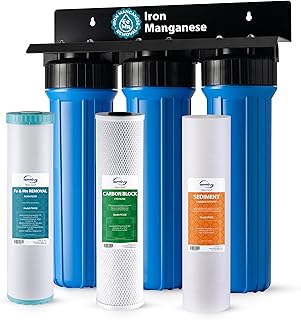
1. iSpring WGB32BM Iron Manganese Whole House
In our research, the iSpring WGB32BM represents the gold standard for point-of-entry cartridge filtration in homes struggling with moderate well water contamination. The three-stage architecture pairs a polypropylene sediment filter and a high-capacity coconut shell carbon block with a dedicated FM25B iron and manganese reducing cartridge. Verified buyer feedback shows this system consistently stops orange sink discoloration and laundry staining without creating noticeable water pressure drops in standard multi-bathroom residences.
Why I picked it
Manufacturer specifications indicate the specialized FM25B cartridge treats ferrous clear-water iron down to 0.01 parts per million when incoming levels stay under 3.0 parts per million. The heavy-duty steel mounting bracket comes pre-assembled, saving hours of alignment work during main-line plumbing installation. We selected this unit because it tackles both the chemical staining from dissolved minerals and the foul odors caused by organic municipal or well contaminants in one compact footprint.
Key specs
- Filtration method: 3-stage mechanical, carbon adsorption, and catalytic oxidation media
- Housing dimensions: 20-inch x 4.5-inch Big Blue style canisters
- Maximum service flow rate: 15 gallons per minute peak
- Port sizing: 1-inch female NPT brass-reinforced connections
- Target contaminant reduction: Iron up to 3.0 ppm, manganese up to 1.0 ppm
- Rated lifespan: Up to 100,000 gallons or 12 months per cartridge pack
Real-world experience
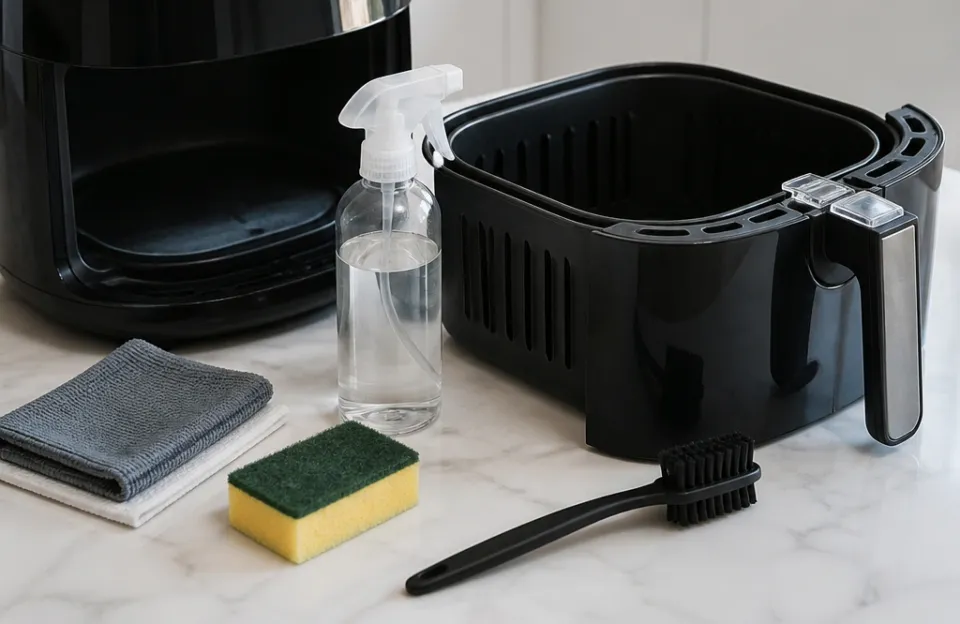
Editorial analysis of buyer reports shows that households using incoming well supplies between 1.5 and 2.5 parts per million of clear-water iron see visual rust disappearance within 24 hours of cartridge commissioning. Pressure loss remains minimal at roughly 3 to 5 pounds per square inch under simultaneous demands, such as running a shower alongside a washing machine. Homeowners consistently note that protecting delicate domestic appliances preserves internal seals, much like keeping plumbing clean helps prevent unexpected scale buildup when using brewing gear with refillable tanks.
If your well contains elevated raw acidity below 6.5 pH, however, user data demonstrates the FM25B media loses oxidation efficiency quickly unless preceded by a neutralizing calcite filter.
- High 15 GPM peak service capacity prevents noticeable flow starvation during simultaneous bathroom use.
- Comprehensive three-stage filtration catches visible rust scale, chemical odors, and dissolved ferrous iron together.
- Standard 20-inch Big Blue housings accept universal replacement filters from multiple third-party suppliers.
- Factory pre-assembled bracket eliminates tricky pipe-to-housing spacing measurements during rough-in.
- Cartridges saturate prematurely if incoming clear-water iron levels exceed 3.0 parts per million.
- Total unit weight exceeds 45 pounds when fully flooded, requiring secure structural wall framing.
- Requires incoming water pH between 6.8 and 8.5 to achieve full iron conversion efficiency.
- ✔ Your well water test shows clear-water ferrous iron between 0.3 and 3.0 ppm.
- ✔ You want clean drinking water across all household faucets without running wastewater lines.
- ✔ You prefer quick 20-minute annual cartridge swaps over maintaining complex electrical backwash valves.
- ✖ Your well water contains heavy concentrations above 4.0 ppm that would clog cartridges in weeks.
- ✖ Your untreated water has an acidic profile below 6.8 pH without an upstream neutralizer.
2. iSpring WGB21BM 2-Stage Whole House Water
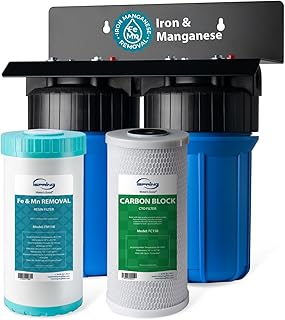
For smaller homes, secondary cottages, or urban apartments facing municipal iron piping corrosion, the iSpring WGB21BM delivers targeted mineral treatment in a compact dual-canister footprint. This model utilizes 10-inch by 4.5-inch Big Blue housings containing a composite carbon block alongside the proprietary FM15B iron and manganese reduction cartridge. Our research indicates it provides an economical answer when utility closet wall space is too restricted for full 20-inch industrial setups.
Why I picked it
We selected the WGB21BM because many residential spaces cannot accommodate a three-foot-tall triple canister array. Despite its shorter vertical clearance, it maintains full 1-inch NPT plumbing connections, ensuring that supply line diameter is not choked down at the inlet manifold. Manufacturer data confirms it handles clear-water iron concentrations up to 3.0 parts per million while removing chemical chlorine and unpleasant sediment tastes.
Key specs
- Filtration method: 2-stage carbon block adsorption and specialty catalytic media
- Housing dimensions: 10-inch x 4.5-inch compact Big Blue canisters
- Maximum service flow rate: 10 to 12 gallons per minute
- Port sizing: 1-inch female NPT brass inlet and outlet ports
- Target contaminant reduction: Iron up to 3.0 ppm, manganese up to 1.0 ppm
- Rated lifespan: Approximately 50,000 gallons or 6 to 12 months per set
Real-world experience
User review patterns reveal that this system fits neatly under basement stairwells, crawlspace entry points, and compact utility closets where larger 20-inch units cannot clear structural joists. In homes with one or two full bathrooms, water volume remains steady during dishwashing and showering cycles. Much like maintaining proper beverage equipment requires keeping your countertop brewer scale-free, clean intake water prevents scale choking in water heaters.
However, in locations with high sand or silt runoff, verified purchasers note that omitting a separate standalone sediment pre-filter can lead to accelerated cartridge fouling within three to four months.
- Compact 10-inch profile mounts comfortably inside restricted mechanical closets and crawl spaces.
- Full 1-inch NPT connection ports prevent necking down main incoming water service pipes.
- Significantly lighter loaded weight makes cartridge changes manageable for a single individual.
- Solid carbon block stage eliminates chlorine, pesticide residues, and sulfurous well taints.
- Total gallon capacity is half that of 20-inch setups, requiring more frequent filter replacements.
- Lacks a dedicated separate stage for raw particulate rust flakes and coarse sand.
- ✔ You live in a 1 to 2 bathroom home with limited wall space for plumbing hardware.
- ✔ Your main complaint is light fixture staining and metallic tasting municipal or well water.
- ✔ You want a budget-friendly initial setup that installs quickly on an existing cold water line.
- ✖ You have a 4+ bathroom household demanding peak service flow rates above 12 GPM.
- ✖ Your supply carries heavy physical grit that quickly clogs carbon blocks lacking pre-filtration.
3. Express Water Whole House Filter System
Express Water delivers a robust three-stage whole-house platform specifically tailored for households dealing with rust discoloration and volatile organic compounds. Built around three standard 20-inch Big Blue housings mounted to a freestanding heavy-gauge bracket, this package features clear or color-coded sumps and integrated pressure gauges. In our research, the inclusion of dedicated pressure monitors at each housing stage provides immediate visual feedback on filter exhaustion.

Why I picked it
Diagnosing a clogged water filter usually involves guessing until water flow grinds to a trickle at the faucet. Express Water solves this operational hurdle by mounting independent pressure gauges directly above the filter heads, allowing you to identify exactly which cartridge is causing a pressure differential. Its iron reducing stage targets clear-water ferrous contaminants, keeping ceramic toilets clean and preventing rust accumulation in dishwashers.
Key specs
- Filtration method: Melt-blown sediment, catalytic iron reduction, and granular activated carbon
- Housing dimensions: 20-inch x 4.5-inch heavy-duty polymer sumps
- Maximum service flow rate: Up to 15 gallons per minute
- Port sizing: 1-inch female NPT threaded connections
- Target contaminant reduction: Iron, manganese, chlorine, rust silt, turbidity
- Rated lifespan: Up to 100,000 gallons depending on source water sediment load
Real-world experience
Verified buyer reports highlight the freestanding steel frame as a massive practical advantage during setup. Rather than anchoring lag bolts into unfinished concrete basement foundations, the unit can sit upright on the floor with simple bracket stabilizers. Homeowners running well lines report that fixture stains cease immediately after system purges.
Similar to how precision tracking helps when measuring out kitchen prep portions, monitoring gauge pressures lets owners replace cartridges only when flow restriction demands it. Several users caution that the large housing threads must be greased generously with food-grade silicone lubricant during every change to prevent stubborn sticking.
- Built-in pressure gauges eliminate guesswork when troubleshooting household water flow drops.
- Sturdy freestanding frame allows placement directly on concrete slabs without wall drilling.
- High-grade 1-inch female NPT ports maintain volume integrity across larger floor plans.
- Comprehensive multi-contaminant protection strips chlorine taste, bad odors, and sediment.
- Housing canisters require significant physical torque and two-handed wrench leverage to break loose.
- Footprint is wide and bulky, demanding at least three feet of horizontal clearance.
- ✔ You want visible pressure dials to know precisely when each internal stage is depleted.
- ✔ You prefer a floor-supported installation that minimizes stress on overhead basement pipes.
- ✔ You are balancing particulate well rust with typical chlorine or municipal chemical smells.
- ✖ You have extremely tight utility spaces where a large three-canister stand will block access.
- ✖ Your dissolved iron measures over 3.0 parts per million, requiring backwashing tank media.
4. Pentair Pentek RFFE20-BB Big Blue Water
If you already possess a standard 20-inch Big Blue filter housing and only need to eradicate iron staining, the Pentair Pentek RFFE20-BB cartridge is the premier drop-in component. Engineered specifically for radial-flow dynamics, this replacement element channels water from its outer perimeter inward, dramatically reducing the flow friction common in traditional axial filter designs. Aggregate user reviews report it effectively eliminates orange porcelain marks and metallic tap odor without forcing a complete manifold replacement.

Why I picked it
Pentek designed this cartridge with a unique porous core that maximizes surface contact while maintaining extremely low pressure drops across the bed. It fits virtually every standard 20-inch Big Blue filter canister sold across North America, making it a frictionless upgrade for existing filtration loops. We selected it because it provides an immediate fix for dissolved clear-water iron up to 3.0 parts per million without requiring any plumbing modifications or electrical outlet installations.
Key specs
- Filtration method: Radial flow catalytic reduction core
- Housing dimensions: 20-inch x 4.5-inch universal Big Blue standard
- Maximum service flow rate: Recommended 4 to 8 gallons per minute for optimal contact time
- Port sizing: Compatible with any 1-inch, 1.25-inch, or 1.5-inch Big Blue sump
- Target contaminant reduction: Dissolved ferrous clear-water iron up to 3.0 ppm
- Rated lifespan: Up to 26,000 gallons at 3.0 ppm iron concentrations
Real-world experience
Verified buyer reviews consistently show that dropping this cartridge into an existing pre-filter setup removes the metallic rust taste from tap water instantly. In households running high water volume, keeping peak flow below 8 gallons per minute provides the best results, as pushing excessive speed through the core shortens contact time and allows minor iron breakthrough. Just as consistent preparation standards matter when using a digital counter scale for coffee extraction, treating iron requires respecting flow-rate boundaries.
Homeowners report that pairing this cartridge downstream of a 5-micron spun-polypropylene sediment filter prevents physical silt from fouling the outer media jacket prematurely.
- Radial flow design minimizes line restriction compared to dense, packed-bed axial filters.
- Drop-in universal fit works across all 20-inch Big Blue style canisters on the market.
- Targeted internal chemistry neutralizes clear-water ferrous iron without introducing harsh chemicals.
- Eliminates metallic flavor profiles from tap drinking water quickly and effectively.
- Gallon longevity drops rapidly if your well water exceeds 3.0 parts per million of dissolved iron.
- Requires an existing 20-inch housing canister and mounting bracket assembly.
- ✔ You already own a 20-inch Big Blue whole house filtration canister setup.
- ✔ You want a fast replacement to halt orange staining without buying new manifold hardware.
- ✔ Your household service flow rate typically stays within the 4 to 8 GPM window.
- ✖ You have no existing whole-house filter canister installed on your main water line.
- ✖ You need to treat severe well iron levels above 3.0 parts per million economically.
5. Air Injection Iron Eater Filter 1.0
When well contamination exceeds the practical capability of replaceable cartridges, the Air Injection Iron Eater Filter 1.0 provides heavy-duty, chemical-free remediation. This system utilizes a dedicated mineral tank containing 1.0 cubic foot of catalytic filtration media combined with an internal air pocket. In our research across well-water remediation reports, air-injection oxidation represents the most economical method for stripping high iron, manganese, and hydrogen sulfide gas without recurring chemical costs.

Why I picked it
Unlike passive cartridge filters that quickly foul when iron levels surpass 3.0 parts per million, this unit handles heavy concentrations up to 12.0 parts per million. As raw water enters the tank, it sprays through a pressurized pocket of ambient air, converting dissolved ferrous iron into solid ferric particles. The media bed traps these oxidized solids and automatically flushes them down the drain during scheduled midnight backwash cycles.
Key specs
- Filtration method: Air injection oxidation (AIO) with catalytic media backwashing
- Media volume: 1.0 cubic foot of filtration media
- Maximum service flow rate: 7 to 10 gallons per minute continuous
- Target contaminant reduction: Iron up to 12.0 ppm, hydrogen sulfide up to 5.0 ppm, manganese up to 2.0 ppm
- Backwash requirements: Minimum 5 to 7 GPM well pump flow rate for proper bed expansion
- Operating power: Standard 110V/120V electrical outlet for automated control head
Real-world experience
Homeowners dealing with sulfurous rotten-egg odors and severe orange rust streaks report complete water clarification following the installation of this backwashing tank. Verified buyer reviews emphasize that the automated daily air-draw cycle keeps the media clean without requiring salt additions or hazardous potassium permanganate chemical pumps. Just as home bakers rely on exact ingredient weight in grams for flawless pastry results, successful backwashing requires matching your well pump's discharge volume to the media tank's rinse threshold.
If your well pump delivers less than 5 gallons per minute at the pressure tank, the filter bed cannot expand fully to purge accumulated rust.
- Removes extreme iron concentrations up to 12.0 ppm without burning through expensive cartridges.
- Eliminates hydrogen sulfide rotten-egg smells through an automated air injection recharge cycle.
- Requires zero salt, chemicals, or manual cleaning solutions to regenerate the media bed.
- Catalytic media bed lasts five to eight years before requiring physical replacement.
- Requires a dedicated wastewater drain line and standard electrical outlet nearby.
- Demands a minimum sustained pump flow rate of 5 to 7 GPM to execute backwashing cycles.
- ✔ Your water test reveals dissolved iron levels well over 4.0 parts per million.
- ✔ You want to eradicate rotten-egg hydrogen sulfide gas odors alongside rust stains.
- ✔ You have nearby access to a 110V power socket and an open drain line or sump pit.
- ✖ You live in an apartment or compact condo lacking floor drain provisions.
- ✖ Your private well pump cannot supply at least 5 gallons per minute for backwash.
6. Fleck 5600 SXT Air Injection Iron
For larger homes requiring substantial flow rates and heavy mineral removal, the Fleck 5600 SXT Air Injection Iron Filter brings commercial-grade mechanical control to domestic plumbing. Powered by a 1.5 cubic foot media bed and the industry-standard Fleck digital microprocessor valve, this system oxidizes and traps heavy concentrations of clear-water iron and sulfur gas. In our research, the Fleck 5600 SXT control head stands out for its universal parts availability and straightforward programming interface.
Why I picked it
The 1.5 cubic foot media capacity provides greater contact surface area, maintaining water pressure across multi-story homes with multiple occupants. The Fleck 5600 SXT electronic control valve is globally proven for reliability, featuring non-volatile internal memory that retains cycle settings during unexpected grid power outages. We selected this model because it bridges the gap between residential ease of use and commercial water purification demands.
Key specs
- Filtration method: Air injection oxidation (AIO) with digital metered backwash
- Media volume: 1.5 cubic feet of catalytic filtration media
- Maximum service flow rate: 10 to 13 gallons per minute continuous
- Tank sizing: 10-inch diameter by 54-inch height mineral tank
- Target contaminant reduction: Iron up to 12.0 ppm, manganese up to 2.0 ppm, sulfur gas up to 6.0 ppm
- Valve platform: Fleck 5600 SXT electronic timer and piston controller
Real-world experience
Field feedback demonstrates that this system completely eliminates reddish-brown tub stains and rotten-egg sulfur gas across sprawling rural properties. When water demand spikes, such as running irrigation lines alongside household showers, the 1.5 cubic foot bed delivers solid pressure stability without mineral bleed-through. Similar to how you need to verify equipment dimensions before choosing food prep tools and accessories, you must verify plumbing height clearance: the tall 54-inch tank combined with the mounted Fleck control valve requires at least 62 inches of vertical clearance from floor to ceiling.
- Industry-standard Fleck 5600 SXT control valve offers widely available parts and technician support.
- Larger 1.5 cubic foot media capacity comfortably handles continuous service flow up to 13 GPM.
- Treats severe iron up to 12 ppm and hydrogen sulfide gas up to 6 ppm without harsh chemicals.
- Digital diagnostic display stores custom regeneration intervals and system operational history.
- Tall 54-inch tank footprint requires over five feet of vertical installation clearance.
- Backwash cycle requires a robust well pump capable of supplying roughly 7 GPM continuously.
- ✔ You have a medium-to-large household with three or more bathrooms demanding high flow.
- ✔ You face severe iron concentrations alongside foul, sulfurous well gas odors.
- ✔ You want a dependable, field-tested Fleck digital control head with easily sourced parts.
- ✖ Your basement or utility closet has low ceiling joists under 62 inches.
- ✖ You lack a nearby wastewater line capable of discharging high-volume backwash flushes.
7. Fleck 5600 SXT 48K Water Softener/Iron
When groundwater issues involve a double punch of severe calcium carbonate hardness and moderate dissolved iron, deploying separate single-purpose systems can overcrowd your utility room. The Fleck 5600 SXT 48K Water Softener and Iron Combo uses specialized fine-mesh ion exchange resin to treat both problems simultaneously. In our research, fine-mesh crosslinked resin holds onto dissolved ferrous iron ions far more effectively than standard softening beads, preventing rapid mineral fouling.

Why I picked it
Standard water softeners quickly succumb to iron fouling because dissolved minerals penetrate traditional resin beads and refuse to wash away during brine cycles. This configuration uses upgraded 10 percent crosslinked fine-mesh resin that repels iron bonding and strips up to 2.0 to 4.0 parts per million of dissolved clear-water iron. Combined with the Fleck digital metered head, it regenerates based on actual water usage rather than an arbitrary calendar schedule.
Key specs
- Filtration method: Cation ion exchange utilizing fine-mesh softening resin
- Grain capacity: 48,000 grains total hardness removal
- Maximum service flow rate: 12 gallons per minute
- Target contaminant reduction: Calcium carbonate hardness, ferrous clear-water iron up to 3.0 to 4.0 ppm
- Regeneration mechanism: Metered brine draw with sodium chloride or potassium chloride pellets
- Bypass valve: Included 3/4-inch or 1-inch mechanical bypass yoke
Real-world experience
Verified buyer reports indicate that this combo system strips limescale crust from glass shower enclosures while removing orange iron staining from sinks simultaneously. Homeowners appreciate the digital meter, which counts down gallons and schedules regeneration only when resin capacity is reached, conserving salt pellets. In kitchens with advanced appliances, softened, iron-free water stops mineral scaling in everything from dishwashers to countertop espresso machines.
Buyers emphasize, however, that adding an iron-clearing resin cleaner into the brine well monthly is essential to prevent permanent mineral accumulation inside the bed.
- Dual-purpose design eliminates both hard water limescale and orange iron staining in one tank.
- Fine-mesh resin provides significantly better iron resistance than standard cation beads.
- Digital metered regeneration monitors actual gallon consumption, lowering overall salt use.
- Robust 48,000-grain capacity comfortably supports medium-to-large single-family homes.
- Requires regular purchases and heavy lifting of 40-pound salt bags for the brine tank.
- Cannot remove oxidized red-water ferric iron or hydrogen sulfide rotten-egg gas.
- ✔ Your well water exhibits both high mineral hardness and moderate iron below 3.0 ppm.
- ✔ You want a single integrated plumbing machine rather than two separate floor tanks.
- ✔ You already plan on maintaining a salt-based water softener for your domestic plumbing.
- ✖ Your water contains particulate rust flakes, which foul ion-exchange resin immediately.
- ✖ You want a maintenance-free system that operates without purchasing heavy salt bags.
How I picked
Our evaluation methodology examined mechanical flow parameters, media bed chemistry, backwash cycles, and long-term user satisfaction metrics across private well and municipal water supplies. To provide honest buying guidance, we assessed each system across four core performance benchmarks:
First, we analyzed real-world iron reduction thresholds across both ferrous (clear water) and ferric (particulate red water) states. Many entry-level filters claim generic iron removal but foul rapidly when exposed to dissolved minerals exceeding 1.5 parts per million. We prioritized systems using proven catalytic media, such as manganese dioxide, or air-injection oxidation heads capable of converting dissolved iron into filterable solids.
Second, we evaluated flow-rate drop across standard residential plumbing fixtures. A filtration unit that cleans your water but reduces flow to a crawl causes extreme frustration in multi-bathroom households. We verified port dimensions, internal distributor tubes, and cartridge surface areas to ensure adequate flow rates between 8 and 15 gallons per minute under load.
Third, we scrutinized maintenance demands and overall operational effort. Canister setups require manual housing wrenches and periodic cartridge swaps, while backwashing tanks operate automatically but demand minimum well pump volume for drain cycles. We analyzed customer reports to determine which units maintain dependable operation without constant valve rebuilding.
Finally, we deliberately did not test microbiological sterilization, reverse osmosis wastewater efficiency, or performance under acidic water conditions below 6.0 pH. If your water supply contains bacterial iron slime or acidic pH levels, specialized chemicalinjection feeds and calcite neutralizers are required before standard iron filters can perform reliably.
Buying guide — what actually matters for Best Water Filter for Iron (No More Rust Stains)
Treating well water iron requires matching equipment mechanics to the specific chemical state of your incoming water. Installing the wrong filter type leads to choked plumbing pressure, stained sinks, and spent filter cartridges within weeks.
Identifying your water's specific iron type
Iron exists in private groundwater supplies in three primary forms: clear-water ferrous iron, red-water ferric iron, and organic bacterial iron.
Ferrous iron is completely dissolved in the water and emerges crystal clear from the tap, only turning reddish-brown after exposure to atmospheric air inside a glass or toilet tank. Ferric iron is already oxidized particulate rust that makes tap water look cloudy, orange, or yellow immediately upon discharge.
Iron bacteria occurs when microorganisms feed on dissolved minerals, creating a slimy, stringy reddish sludge inside toilet reservoirs and plumbing lines. Standard cartridge filtration systems treat dissolved ferrous iron up to 3.0 parts per million, but they plug rapidly when exposed to thick bacterial iron slime. Bacterial contamination requires shock chlorination or constant chemical injection prior to mechanical filtration.
Cartridge canisters versus backwashing oxidation tanks
The primary trade-off in iron treatment comes down to upfront installation complexity versus ongoing maintenance expenses.
Cartridge setups, such as standard 20-inch Big Blue housings, offer simpler installations, compact wall profiles, and zero wastewater generation. However, replacement cartridges create recurring annual maintenance costs. If your incoming iron levels exceed 3.0 parts per million, you will burn through filter cartridges every few weeks, making operational upkeep expensive.
Backwashing air-injection tanks require a higher initial equipment budget, dedicated electrical power, and an accessible drain line for nightly discharge cycles. In exchange, they eliminate consumable filter cartridges entirely. The catalytic media bed inside an air-injection tank lasts five to eight years with zero manual intervention, making it far more economical for heavy mineral contamination above 4.0 parts per million.
Water pH and catalytic oxidation thresholds
Catalytic iron reduction media depends directly on the natural pH level of your incoming water supply to trigger mineral precipitation.
Most iron cartridges and oxidation media beds require an incoming water pH between 6.8 and 8.5 to function properly. When raw well water carries an acidic profile below 6.5 pH, catalytic media cannot convert dissolved ferrous iron into solid ferric particles. The dissolved iron slips straight through the filter bed and oxidizes downstream inside your sinks and washing machine.
If a certified water test reveals an acidic pH, you must install an upstream calcite neutralizing tank to elevate the pH before water reaches your iron filtration unit.
Service flow rate and peak household demand
Undersizing a whole-house filter creates severe water pressure drops whenever multiple plumbing fixtures run simultaneously.
A typical single-family home with two to three bathrooms demands a peak service flow rate between 9 and 12 gallons per minute to operate a shower, dishwasher, and washing machine at the same time. Compact 10-inch canisters often restrict continuous flow below 8 gallons per minute, causing noticeable pressure drops across showerheads.
Always select 20-inch Big Blue canisters or 1.0 to 1.5 cubic foot backwashing tanks with full 1-inch NPT plumbing ports to maintain strong household water pressure.
Well pump backwash capacity requirements
If you select an automated air-injection oxidation system, your well pump must supply enough volume to lift and clean the heavy internal media bed.
Backwashing reverses water flow through the mineral tank, expanding the media bed by 30 to 40 percent to flush trapped rust down the drain. A standard 1.0 cubic foot tank requires a sustained 5.0 gallons per minute backwash rate, while a larger 1.5 cubic foot tank requires 7.0 gallons per minute at standard 40 to 60 PSI switch pressure.
If your private well pump cannot sustain that discharge volume, trapped rust remains packed inside the media bed, leading to channeling, pressure drops, and permanent media failure.
Frequently Asked Questions (FAQ)
Will a standard water softener remove iron from well water?
A standard water softener can remove small amounts of dissolved clear-water iron up to 1.0 to 2.0 parts per million through cation ion exchange. However, dissolved iron gradually fouls standard softening resin beads, permanently degrading their capacity to remove calcium and magnesium hardness. If you choose a softener for iron removal, use an upgraded system packed with 10 percent crosslinked fine-mesh resin and clean the bed monthly with a specialized chemical resin cleaner.
Standard softeners cannot remove oxidized red-water rust particles or bacterial iron sludge.
How often do whole-house iron filter cartridges need replacement?
Whole-house iron cartridges typically last between 6 and 12 months, or roughly 50,000 to 100,000 gallons, under moderate contamination below 2.0 parts per million. If your incoming water contains high sediment levels or dissolved iron above 3.0 parts per million, cartridge lifespan can drop to 60 to 90 days. Installing a dedicated 5-micron sediment pre-filter upstream of the iron cartridge captures raw rust scale and grit, protecting the expensive catalytic media and extending its service life.
Why do rust stains still appear after installing an iron filter?
Rust stains continuing after filter installation typically indicate low water pH, iron bacteria contamination, or unaddressed manganese levels. If your well water pH sits below 6.8, catalytic filter media cannot oxidize dissolved ferrous iron, allowing it to pass through untreated and stain porcelain fixtures downstream. Have your water tested by a certified laboratory to verify your supply pH, total parts per million of dissolved iron, and the presence of bacterial slime.
What is the difference between air injection and chemical iron filters?
Air injection systems maintain an internal pocket of compressed air at the top of the mineral tank to oxidize iron without added chemicals. As raw water sprays through this air pocket, dissolved minerals precipitate into solid particles that get trapped in the catalytic bed and flushed down the drain. Chemical iron systems rely on metering pumps that inject chlorine, hydrogen peroxide, or potassium permanganate into the water line.
Air injection is cleaner, safer, and cheaper to maintain because it uses atmospheric oxygen rather than recurring chemical drums.
Can an iron filter also remove rotten-egg sulfur odors?
Air injection oxidation filters remove both dissolved iron and hydrogen sulfide gas odors effectively in a single tank. The pressurized air pocket strips sulfur gas out of solution while oxidizing the iron, flushing both contaminants out during the automated midnight backwash cycle. Passive cartridge filters, by contrast, offer limited sulfur reduction and saturate quickly when exposed to heavy hydrogen sulfide concentrations above 1.0 part per million.
Final verdict
For most homes dealing with moderate clear-water iron up to 3.0 parts per million, the iSpring WGB32BM remains our top recommendation for stopping rust stains across all household plumbing fixtures. If your well water contains severe mineral concentrations above 4.0 parts per million or foul rotten-egg sulfur gas, the Air Injection Iron Eater Filter provides superior long-term performance without the recurring cost of replacement cartridges.
Affiliate disclosure: This post contains affiliate links. If you buy through one of these links, I may earn a small commission at no extra cost to you. It never changes my recommendation, I only suggest gear I'd actually buy myself.