There are five main types of espresso machines: manual, semi-automatic, automatic, super-automatic, and capsule. The right one depends on how much control you want over the shot and how much time you have in the morning. We compared specs, boiler designs, pump types, and the complaints that come up most often for each category to map out exactly what you get at every price tier.
Types of Espresso Machines Explained by Control Level
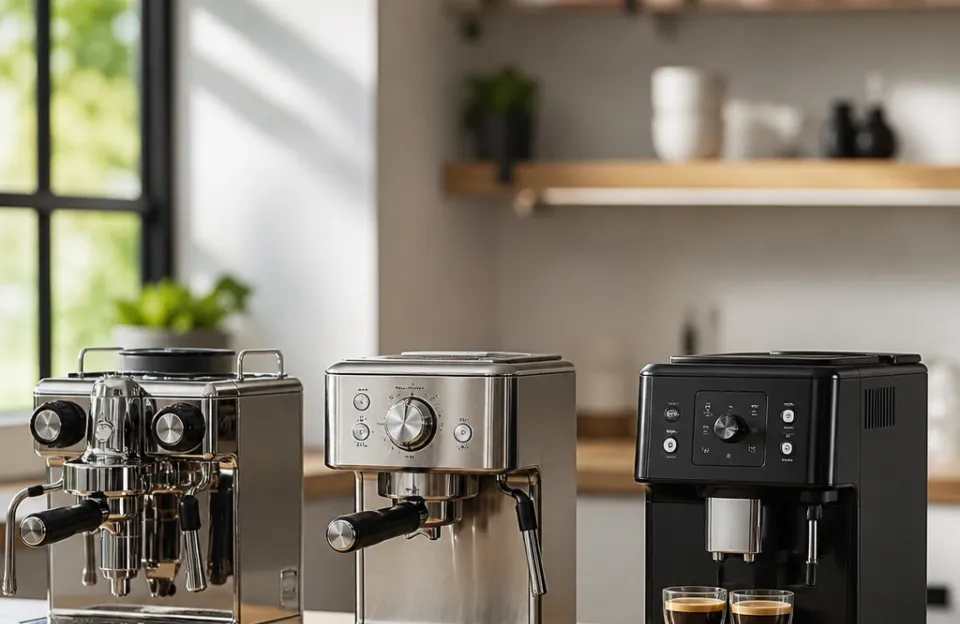
Every espresso machine does the same basic job. It pushes hot water through finely ground coffee at high pressure. The standard target is 9 bars of pressure (about 130 pounds per square inch).
You can see how this compares to standard brewing guidelines from the Specialty Coffee Association. What changes between the five types is who or what controls the grind size, the water temperature, the pressure, and the brew time.
If you want total control over every variable, a manual machine is your only option. If you just want a fast cup before work with zero mess, a capsule machine fits best. Most home buyers land somewhere in the middle, usually picking a semi-automatic model.
Here is a quick look at how the five types compare across the factors that matter most.
| Machine Type | Typical Price Range | Skill Needed | Brew Time | Cleanup Effort |
|---|---|---|---|---|
| Manual (Lever) | $150 to $2,000+ | High | 2 to 4 minutes | Low |
| Semi-Automatic | $100 to $3,000+ | Medium | 1 to 2 minutes | Medium |
| Automatic | $300 to $3,000+ | Medium | 1 to 2 minutes | Medium |
| Super-Automatic | $400 to $3,500+ | Low | Under 1 minute | High |
| Capsule / Pod | $80 to $300 | Very Low | Under 1 minute | Very Low |
Manual and Lever Espresso Machines
A manual espresso machine relies entirely on you. There is no electric pump. You heat the water yourself, fill a chamber, and use a physical lever or direct hand pressure to push the water through the coffee puck.
The most famous example of a lever design is the La Pavoni Europiccola. It uses a spring-loaded piston. You pull the lever down to let water into the group head, then release it so a heavy spring pushes the water through the grounds.
Other models, like the Flair Neo or the ROK Presso, use direct manual pressure where you physically push down on a lever to generate the 9 bars needed.
Manual machines give you complete control over pre-infusion (the initial wetting of the grounds) and pressure profiling (changing the pressure during the shot). This is why professional baristas and serious hobbyists love them. You can adjust your technique to pull a great shot from almost any bean.
The tradeoff is a steep learning curve. If your water is too cool, the shot tastes sour. If you press too hard, the water channels through the puck and the shot tastes bitter and thin.
You also need a separate kettle to heat water for most direct-pressure models, and a high-quality burr grinder is absolutely required. A blade grinder will not produce the fine, even particles these machines demand.
Skip this type if you make coffee for more than two people at a time. Lever machines typically brew one single or double shot per cycle, and resetting them takes a minute or two. They are built for the ritual, not for speed.
Semi-Automatic Espresso Machines
Semi-automatic machines are the standard for home espresso. They have an electric pump, usually a vibratory pump or a quieter rotary pump, that generates the pressure. You grind the coffee, tamp it into a portafilter (the handled basket that locks into the machine), and press a button to start the flow.
You press the button again to stop it.
This last part is what makes them “semi” automatic. The machine controls the pump pressure and heats the water, but you control the exact volume of water that goes through the puck by deciding when to stop the pump.
Models like the Breville Barista Express or the Gaggia Classic Pro fall into this category. They range from simple single-boiler units under $200 to dual-boiler machines costing thousands.
The biggest decision here is the heating system. Understanding how these systems manage heat helps you avoid buying a machine that cannot keep up with your routine.
Single Boiler: One heating element does both brewing and steaming. You brew your shot, then flip a switch or wait for the boiler to reach a higher temperature to steam milk. It is cheaper and smaller, but slower if you drink lattes or cappuccinos.
Heat Exchanger: One large boiler stays at steam temperature all the time. A smaller tube runs through it, flash-heating fresh water for brewing. You can brew and steam at the same time without waiting.
These are common in prosumer machines.
Dual Boiler: Two separate boilers. One is set to brew temperature (usually 195 to 205°F) and one is set to steam temperature (around 260°F). This gives you the most stable temperatures and lets you brew and steam simultaneously.
Semi-automatic machines require a good grinder. In fact, the grinder matters more than the machine itself. If you buy a $500 espresso machine and pair it with a $30 blade grinder, your shots will be terrible.
If you do not own a burr grinder capable of fine espresso adjustments, factor another $150 to $300 into your budget. Knowing what fits your counter space is just as important as knowing your budget, much like figuring out measuring your cooking basket before buying kitchen add-ons.
Choose a semi-automatic if you want cafe-quality drinks and do not mind spending 30 seconds tamping and pulling a shot. Skip it if you want a push-button experience with zero learning curve.

Automatic Espresso Machines
Automatic espresso machines look and act almost exactly like semi-automatic ones. They have a portafilter, an electric pump, and a steam wand. The only difference is volumetric control.
Instead of you pressing a button to stop the water flow, the machine does it for you. You program the single-shot and double-shot buttons once by letting water run until you hit your desired volume. After that, the machine uses a flow meter to stop the pump automatically at that exact amount every time.
This sounds like a minor difference, but it matters if multiple people in your house make coffee. With a semi-automatic, everyone has to watch the cup and stop the pump manually. With an automatic, anyone can press a button and walk away to grab a mug from the cabinet.
Many commercial machines in coffee shops are actually automatics, not semi-automatics, because consistency across different baristas is vital. For home use, brands like Profitec and ECM offer automatic versions of their popular machines.
The limits are the same as semi-automatics. You still need to grind, dose, and tamp the coffee yourself. You still need a high-quality burr grinder.
The only task removed from your hands is timing the end of the shot.
If you drink straight espresso and value repeatability, an automatic is a smart pick. If you mostly drink milk-based drinks, the benefit shrinks, since you still have to manually steam the milk anyway.
Super-Automatic Espresso Machines
Super-automatic machines handle everything. You pour whole beans into a hopper, fill a water reservoir, and press a button. The machine grinds the beans, tamps the grounds internally, brews the shot, and ejects the used coffee puck into a hidden bin.
Many models also have automated milk frothers or tubes that draw milk directly from a carton to dispense a finished latte or cappuccino.
Brands like Jura, De’Longhi, and Philips dominate this space. Prices start around $400 and easily climb past $3,000 for models with touchscreens and dual hoppers.
The appeal is obvious. You get espresso-based drinks with almost no effort and very little mess. There is no portafilter to knock out, no tamper to clean, and no loose grounds on the counter.
But there are real tradeoffs. First, the espresso quality rarely matches a good semi-automatic setup. The internal grinders are decent, but they lack the precise micro-adjustments of a standalone burr grinder.
The internal tampers apply less pressure than a human arm, which can lead to slightly thinner shots.
Second, maintenance is heavy. Because the grinding and brewing happen inside a closed housing, coffee oils build up quickly. You must run cleaning cycles with specific tablets regularly.
The drip tray fills fast, and the internal brew group needs to be removed and rinsed under the tap every week or two, depending on the brand. Some brands, like Jura, seal the brew group inside the machine, meaning you rely entirely on chemical cleaning cycles rather than manual rinsing. Just as you would check if cooking raw poultry safely requires specific appliance settings, you should verify the exact cleaning protocols a super-automatic demands before buying.
Third, repair costs are high. When a $200 semi-automatic breaks, you might replace it. When a $2,000 super-automatic breaks, you need specialized service.
The internal mechanics involve motors, gears, and tubing that are difficult for a layperson to fix.
Pick a super-automatic if convenience is your absolute top priority and you drink several milk-based coffees a day. Skip it if you care deeply about espresso flavor nuances or if you want a machine that lasts decades with simple repairs.
Capsule and Pod Espresso Machines
Capsule machines use sealed plastic or aluminum pods filled with pre-ground coffee. You drop the pod into the slot, close the lid, and press a button. The machine pierces the pod and forces hot water through it.
Nespresso and Keurig (with their K-Cafe line) are the most common names here.
These are the cheapest machines to buy upfront, often falling between $80 and $200. They are also the easiest to use. There is no dialing in a grinder, no tamping, and almost no cleanup.
You throw the pod away when you are done.
The limitation is twofold. First, the coffee is pre-ground and sealed. Even with nitrogen flushing to preserve freshness, pre-ground coffee loses volatile aromatics faster than freshly ground beans.
The resulting shot lacks the thick, syrupy crema and complex flavors of freshly ground espresso. Second, the cost per cup is much higher. A bag of specialty coffee beans might cost $20 and yield 30 shots.
Thirty capsules from a major brand will cost significantly more.
There is also the environmental factor. While aluminum pods are recyclable, many end up in landfills. Reusable pods exist, but filling them yourself defeats the convenience purpose of the machine.
Checking whether your preferred pods contain safe plastics for heating is a smart habit for any countertop appliance that handles hot liquids.
Capsule machines are ideal for offices, dorms, or households where someone wants a fast caffeine fix without learning a new skill. They are not for anyone trying to replicate a true Italian cafe experience at home.
How Boiler and Pump Types Change Your Results
Understanding the hardware inside these machines prevents buyer’s remorse. The two components that dictate your daily experience are the pump and the boiler.
Vibratory vs. Rotary Pumps
Most machines under $1,500 use a vibratory pump. It works via an electromagnetic coil pushing a piston back and forth rapidly. They are small, cheap to replace, and loud.
You will hear a distinct buzzing sound while pulling a shot.
Rotary pumps use a spinning motor to generate pressure. They are larger, heavier, and much quieter. They also allow you to hook the machine directly up to a water line instead of using a reservoir.
You typically find rotary pumps in dual-boiler machines priced above $1,500.
Neither pump makes better-tasting espresso on its own. Both can achieve a steady 9 bars. The difference is noise level, durability, and plumbing options.
Why Temperature Stability Matters
Espresso extracts best between 195°F and 205°F. If the water is too cool, the acids extract first, leaving a sour, sharp taste. If it is too hot, the bitter compounds over-extract, making the shot taste ashy.
Cheaper single-boiler machines struggle here. The thermostat swings widely, meaning your water might be 190°F for one shot and 210°F for the next. Machines with a PID (Proportional-Integral-Derivative) controller solve this.
A PID uses a digital sensor to pulse the heating element on and off rapidly, holding the water within one or two degrees of your target.
If you buy a semi-automatic or automatic machine, look for one with a PID controller. It removes one of the biggest variables that ruin home espresso.
Common Mistakes Buyers Make
People often spend their entire budget on the machine and forget the rest of the setup. Espresso is a system. The machine is only one part.
Ignoring the grinder. As mentioned earlier, a cheap grinder ruins expensive machines. If your budget is $500, spend $250 on the machine and $250 on a dedicated espresso grinder. Do not buy a $500 machine and use pre-ground coffee from the grocery store.
Pre-ground coffee is sized for drip makers, not espresso. It will flow through the portafilter in seconds, producing weak, watery brown liquid.
Buying too much machine. A dual-boiler, rotary-pump machine is incredible. It is also massive, heavy, and requires significant counter space. If you drink one latte a day, a single-boiler machine with a good grinder will serve you perfectly.
Match the machine to your actual daily volume. Thinking ahead about how accessories fit your workflow saves frustration later, similar to checking universal add-on sizes for other countertop appliances.
Skipping water filtration. Tap water in many US cities contains high levels of calcium and magnesium. When heated repeatedly inside an espresso boiler, these minerals form scale. Scale blocks valves, ruins heating elements, and alters the taste of your coffee.
Use filtered water or bottled spring water. Avoid distilled water entirely, as the sensors in some machines need trace minerals to detect water levels properly.
Forgetting maintenance. Backflushing (running water backward through the group head with a blind basket and detergent) is required for machines with three-way solenoid valves. If you skip this, coffee oils turn rancid inside the machine, and your shots will taste bitter within a few weeks.
Choosing the Right Type for Your Kitchen
Use these rules to narrow down your choice based on your actual habits.
If you want to learn the craft of espresso and enjoy tinkering, buy a manual lever machine or a semi-automatic with a PID. Pair it with a stepless burr grinder.
If you want excellent espresso but do not want to time the shot yourself, buy an automatic machine. You still get the hands-on grinding and tamping, but the volume is consistent.
If you drink three or four milk-based drinks every morning and hate washing parts, buy a super-automatic. Budget extra money for the required cleaning tablets and descaling solutions.
If you need coffee in under thirty seconds and do not care about tasting notes or crema, buy a capsule machine.
If you are setting up a small office where ten different people need coffee throughout the day, a super-automatic or a capsule machine prevents bottlenecks. A semi-automatic will frustrate coworkers who do not know how to tamp correctly.
Frequently Asked Questions
Can I use regular coffee beans in an espresso machine?
Yes, any roasted coffee bean can go into an espresso machine. However, beans labeled “espresso roast” are usually roasted slightly darker or blended specifically to taste balanced when brewed under high pressure. Lighter roasts meant for drip coffee can taste extremely sour as espresso unless you adjust your grind finer and lower your water temperature.
Do I really need a special grinder for espresso?
You need a burr grinder capable of very fine, consistent adjustments. Standard drip coffee grinders do not grind fine enough, or if they do, the particle sizes are uneven. Uneven particles cause water to channel through the weak spots in the coffee puck, ruining the extraction.
Dedicated espresso grinders have tighter adjustment steps to dial in the exact flow rate you need.
How long does an espresso machine last?
It depends heavily on the type and maintenance. A well-maintained semi-automatic machine with brass or stainless steel boilers can last 10 to 20 years. Super-automatics have more moving parts and electronics, so their average lifespan is closer to 5 to 10 years.
Capsule machines typically last 3 to 5 years before the pump fails or seals degrade. Descaling regularly is the single biggest factor in longevity.
Why is my espresso coming out too fast?
Water flowing through the puck in under 20 seconds means the resistance is too low. Your coffee grind is too coarse, you did not put enough coffee in the basket, or your tamp was too light. Adjust your grinder to a finer setting first.
Aim for a double shot (about 2 ounces of liquid) to take between 25 and 30 seconds.
Is 15 or 20 bars of pressure better than 9 bars?
No. Marketing materials often advertise 15 or 20 bar pumps, but actual espresso extraction happens at 9 bars. The higher number just refers to the maximum capability of the vibratory pump.
The machine uses an overpressure valve to restrict the flow to 9 bars at the group head. A machine advertising 20 bars is not stronger or better than one rated for 15 bars.
Matching the machine type to your daily routine stops you from overspending on hardware you will never use. A $3,000 dual-boiler setup sits unused if you only have three minutes before rushing out the door, while a capsule machine frustrates you if you care about flavor clarity. Pick the level of involvement you actually want every morning, and buy the machine that matches that exact habit.
As an Amazon Associate, we earn from qualifying purchases.


3 thoughts on “Types of Espresso Machines Explained: Which Is Right for You”