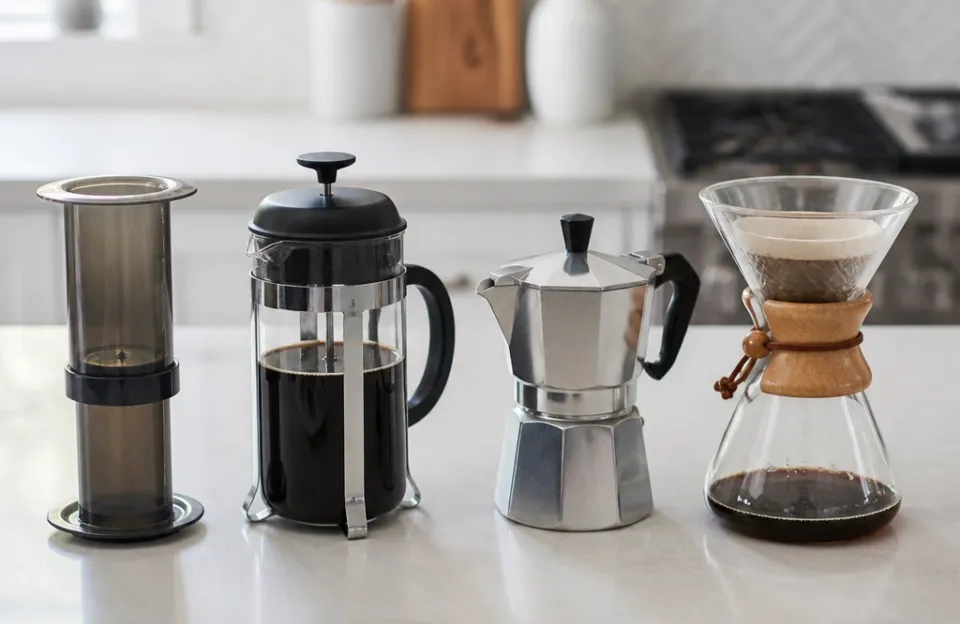
You do not need an espresso machine to make strong, concentrated coffee at home. The best espresso machine alternatives are the AeroPress, the Moka pot, and manual lever brewers like the Flair. Each method produces a rich shot without the high cost or counter space of a traditional setup.
We compared brew pressure, material safety, daily cleanup time, and the common complaints owners share about each option. The goal is simple: help you pick the right tool for your morning cup. If you already own a reliable brewing machine for other kitchen tasks, you know that safe materials matter just as much as performance.
That rule applies here too.
Quick Comparison of Espresso Machine Alternatives
| Method | Typical Price Tier | Max Pressure | Brew Time | Cleanup Effort | Best For |
|---|---|---|---|---|---|
| AeroPress | Under $50 | ~0.5 bar | 1 to 2 minutes | Very low | Travel, fast mornings |
| Moka Pot | $30 to $60 | ~1.5 bar | 5 to 8 minutes | Medium | Stovetop fans, rich flavor |
| Flair Manual | $100 to $200 | Up to 9 bar | 3 to 5 minutes | High | True crema, hobbyists |
| Wacaco Nanopresso | $70 to $90 | Up to 18 bar | 2 to 3 minutes | Medium | Camping, small spaces |
| French Press | $20 to $40 | None | 4 to 5 minutes | Low | Full immersion, groups |
How We Picked These Methods
True espresso requires forcing hot water through finely ground coffee at exactly 9 bars of pressure (about 130 psi). Most home alternatives fall short of that number. They produce “espresso-style” coffee instead.
That means a small volume, intense flavor, and sometimes a thin layer of foam on top.
We picked methods that get close enough to satisfy most people. We looked at how much force they actually generate, how long they take, and what happens when you use them every day. We also checked which plastics are safe for boiling water.
Knowing which materials stay stable under heat helps avoid unwanted chemicals in your cup.
If a method costs over $200 or requires a separate expensive grinder to work at all, we left it out. You are looking for an alternative to save money or space. A $300 manual press defeats the purpose.
AeroPress: The Fastest Espresso Machine Alternative
The AeroPress uses air pressure from your hand pushing down on a plunger. It forces hot water through a paper or metal filter directly into your mug.
It is made of BPA-free plastic. You can brew a highly concentrated one-ounce or two-ounce shot by using less water and a finer grind. It will not give you thick, syrupy crema like a commercial cafe.
But the flavor is remarkably clean, sweet, and strong.
Who it fits: People who want coffee fast. Commuters. Campers.
Anyone with very little counter space.
Strength: Speed and forgiveness. Even if your grind size is slightly off, the AeroPress still makes a good cup. It takes about 60 seconds once the water is hot.
Honest limit: It only makes one serving at a time. You cannot brew a double shot for two people quickly. The plastic body also feels cheap to some users, even though it is durable.
Skip it if: You drink large lattes every morning. Filling a 12-ounce mug requires pressing three or four separate batches. That gets old fast.
Moka Pot: The Classic Stovetop Brewer
A Moka pot sits directly on your stove. Water boils in the bottom chamber. Steam pressure pushes the water up through a basket of ground coffee and into the top chamber.
Bialetti invented this design in 1933. It remains the standard. The physics are simple.
As the National Institute of Standards and Technology explains regarding basic thermodynamics, heating a sealed liquid increases vapor pressure until it forces movement. That pressure reaches about 1.5 bars. It is far below the 9 bars of a pump machine, but higher than a drip brewer.
Who it fits: People who love dark, heavy, almost syrupy coffee. Fans of traditional European brewing.
Strength: Flavor intensity. A Moka pot extracts deep, chocolatey, roasted notes better than almost any other cheap method. It also lasts for decades if you buy the stainless steel version.
Honest limit: It burns coffee easily. If you leave it on the flame too long, or use water that is too hot from the start, the coffee tastes bitter and metallic. You have to watch it closely.
Skip it if: You have an induction stove and buy the classic aluminum model. Aluminum does not work on induction. You must buy the specific stainless steel versions designed for magnetic cooktops.
Also, if you prefer light, fruity roasts, the Moka pot tends to overpower delicate flavors.
When you pair strong stovetop coffee with food, timing matters. Just like getting the temperature right for poultry prevents a ruined meal, pulling the Moka pot off the burner the second it gurgles prevents a burnt cup.
Flair Manual Espresso Maker: Real Pressure Without Electricity
The Flair is a lever-operated press. You boil water separately, pour it into a steel brew cylinder, add coffee, and pull a lever down. Your physical strength generates the pressure.
Unlike the AeroPress or Moka pot, the Flair can actually hit 9 bars of pressure. That means it produces real espresso with genuine crema. No electricity is needed.
It breaks down into a few pieces and fits in a carrying case.
Who it fits: Coffee hobbyists. People who want cafe-quality shots but refuse to buy a bulky electric machine.
Strength: Authentic extraction. Because you control the pressure manually, you can mimic the pressure profiles of machines costing thousands of dollars. The taste is true espresso.
Honest limit: The learning curve is steep. You need a very good burr grinder capable of fine espresso grinds. Pre-ground supermarket coffee will not work here.
The water will flow through it too fast, resulting in sour, watery shots.
Skip it if: You want a push-button morning routine. Dialing in the grind, heating the parts so they do not steal heat from the water, and pulling the lever takes focus. It is a ritual, not a convenience.
Wacaco Nanopresso: Portable Pump Power
The Nanopresso is a handheld device shaped like a thick cylinder. You add hot water and fine coffee, then pump a button repeatedly. Each pump builds pressure inside the unit, eventually forcing water through the grounds at up to 18 bars.
Who it fits: Hikers, road trippers, office workers with no kitchen access.
Strength: Portability and pressure. It hits higher pressure numbers than the Flair or Moka pot. The resulting shot is dense and surprisingly close to machine espresso.
Honest limit: Capacity. It holds very little water. You get one small single shot per fill.
Refilling and pumping again for a second person takes effort. The small internal seals also wear out after a year or two of daily use and need replacing.
Skip it if: You mostly brew at home on a counter. Disassembling, cleaning, and drying the tiny rubber gaskets every morning is tedious compared to a lever press or stovetop pot.
French Press: Strong Coffee, Zero Pressure
A French press steeps coarse coffee grounds in hot water for four minutes. You push a metal mesh plunger down to separate the grounds from the liquid.
This is not espresso. There is zero pressure involved. But many people searching for espresso machine alternatives actually just want stronger coffee than a drip machine provides.
A French press delivers that. By doubling the usual amount of coffee grounds while keeping the water volume the same, you create a highly concentrated base perfect for mixing with milk.
Who it fits: Households that need more than one cup at a time. People who dislike paper filters.
Strength: Volume and simplicity. You can brew 32 ounces (about 950 ml) at once. There are no complicated steps or pressure valves to manage.
Honest limit: Texture. The metal mesh lets fine coffee particles and oils through. The result is heavy and gritty compared to the clean, sharp bite of pressed espresso.
It lacks crema entirely.
Skip it if: You hate sediment at the bottom of your cup. Or if you specifically want the chemical extraction that only high pressure can achieve. Steeping and pressing are fundamentally different processes.
Matching your tools to your vessel size prevents messes. Just as measuring your basket correctly stops overflow during cooking, picking a French press that matches your favorite mug saves you from pouring spills.
Choosing the Right Alternative by Situation
Picking between these espresso machine alternatives depends on your morning reality. Use these rules to decide.
- If you travel constantly or camp: Pick the AeroPress or the Wacaco Nanopresso. Both survive being thrown in a bag. The AeroPress is lighter; the Nanopresso gives higher pressure.
- If you want authentic crema and have patience: Pick the Flair. It is the only affordable way to get true 9-bar extraction without plugging anything into a wall.
- If you want rich, dark coffee fast on a budget: Pick the Moka pot. It costs very little and lasts forever. Just watch the heat carefully.
- If you need to serve multiple people at once: Pick the French press. Make a strong concentrate, divide it into mugs, and add hot water or steamed milk.
- If you only buy pre-ground coffee: Pick the Moka pot or French press. The Flair and Nanopresso demand a fine, consistent grind that pre-ground bags rarely provide.
Think about your whole morning setup. If you already use compact accessories to save space, like fitted liners for smaller appliances, you will likely prefer the minimal footprint of the AeroPress or Nanopresso over a stovetop pot that needs dedicated storage.
Common Mistakes When Ditching Your Espresso Machine
Switching away from a pump machine trips people up in a few specific ways. Avoid these errors.
Using the Wrong Grind Size
Espresso machines use very fine grounds, almost like powdered sugar. If you switch to a French press, you must change your grinder to a coarse setting. Using fine grounds in a French press creates a muddy, over-extracted mess that clogs the mesh filter.
Conversely, if you use standard drip-grind coffee in a Flair or Nanopresso, the water rushes through too fast. You get sour, weak coffee. Always match the grind to the new method.
Expecting Identical Results
An AeroPress shot tastes different than a Breville machine shot. The pressure is lower. The water contact time is different.
The oils are filtered differently. Accept that you are making espresso-style coffee. Judge it on its own merits rather than comparing it directly to a cafe pull.
Ignoring Water Temperature
Electric machines hold water at exactly 200°F (93°C). When you boil water in a kettle for a manual method, it starts at 212°F (100°C) and drops rapidly. Pouring boiling water directly onto coffee scorches it.
Let the kettle sit for 30 to 60 seconds off the boil before pouring.
Forgetting to Preheat
Manual brewers are usually room temperature. When hot water hits cold plastic, glass, or steel, the brewing temperature crashes. Run a blank cycle with hot water first to warm up the AeroPress, Flair, or French press.
Dump that water, add your coffee, and brew. This one step fixes most complaints about sour or weak manual espresso.
Frequently Asked Questions
Can a Moka pot make real espresso?
No. Real espresso requires 9 bars of pressure. A Moka pot generates about 1.5 bars.
It makes very strong, concentrated coffee that works perfectly as a base for lattes and cappuccinos, but it lacks the thick crema and exact extraction of a true espresso machine.
Which espresso machine alternative is easiest to clean?
The AeroPress is the fastest to clean. You simply pop the used coffee puck out into the trash and rinse the rubber seal. It takes about ten seconds.
The Flair requires disassembling several metal parts and drying them to prevent rust or scale buildup.
Do I need a special grinder for manual espresso makers?
Yes, if you use the Flair or Wacaco Nanopresso. These devices rely on high pressure. Standard blade grinders chop beans unevenly.
You need a burr grinder capable of fine adjustments to dial in the correct resistance. For a Moka pot or French press, a basic grinder works fine.
Is the AeroPress safe for hot water?
Yes. The AeroPress is made from medical-grade, BPA-free polypropylene. It handles boiling water without degrading or leaching chemicals.
The manufacturer confirms it meets FDA standards for food contact. Still, letting boiling water cool for half a minute improves the actual taste of the coffee.
Why does my manual espresso taste sour?
Sourness means under-extraction. The water passed through the coffee too fast, or the water was too cool. Try grinding the beans slightly finer, pressing harder, or ensuring your brewer is preheated so the water stays near 200°F (93°C) during the entire process.
The right choice comes down to how much effort you want to spend versus how authentic you need the shot to be. Pick the tool that matches your patience level, and you will stop missing the electric machine within a week.
As an Amazon Associate, we earn from qualifying purchases.