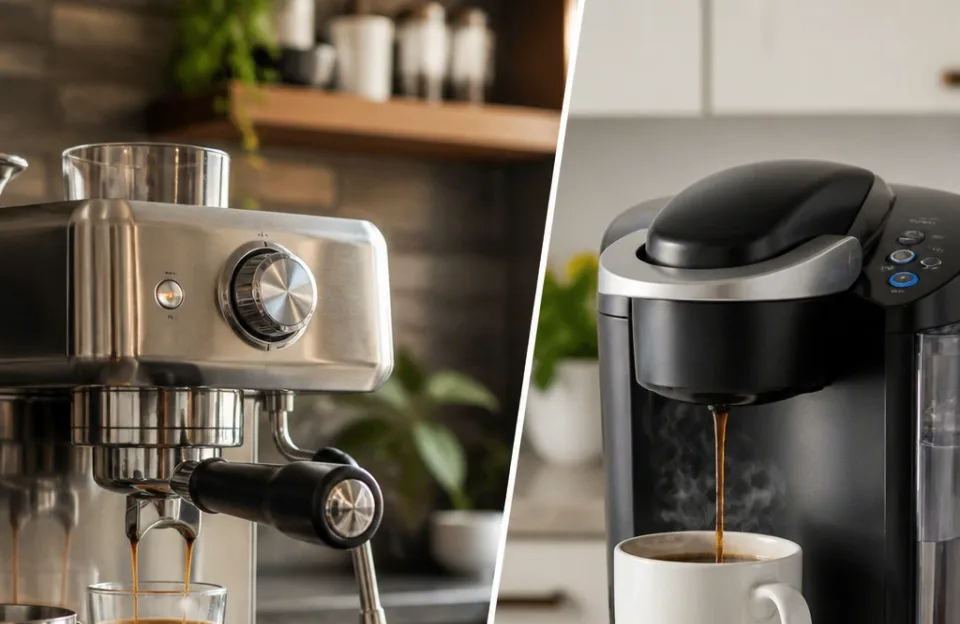
Choose a Keurig if you want hot coffee in under a minute with zero learning curve and minimal cleanup. Pick an espresso machine if you value rich texture, drink customization, and café quality over speed and convenience. These two appliances solve completely different morning problems, and the right choice depends entirely on whether you prioritize ritual and flavor or efficiency and ease.
Most buyers regret their purchase because they expect one device to do the job of the other. A Keurig cannot produce true espresso, and an espresso machine will not brew a large mug of black coffee without significant effort. Understanding this fundamental divide saves money and counter space.
We compared specs, brewing mechanics, long-term costs, and common owner complaints to help you decide which path fits your actual daily routine.
The Core Difference in Brewing Mechanics
The gap between these machines starts with physics. An espresso machine forces hot water through finely ground coffee at 9 bars of pressure. This high pressure emulsifies oils and creates crema, the golden foam that defines real espresso.
The result is a concentrated, syrupy shot with intense flavor and a heavy mouthfeel. You control the grind size, dose, tamp pressure, and extraction time. Every variable affects the final cup.
A Keurig uses low-pressure drip brewing. A needle punctures a sealed pod, and gravity pulls hot water through pre-ground coffee. There is no pressure extraction and no crema.
The output is closer to weak filter coffee than espresso, even when the pod says “espresso roast.” Some newer models add a “shot” button that reduces water volume, but this only makes a smaller cup of drip coffee. It does not replicate the chemical process of espresso extraction.
This mechanical difference explains why taste comparisons often feel unfair. You are comparing two distinct beverage categories. If you love the thick body of a latte or the sharp intensity of a straight shot, a Keurig will always disappoint.
If you just need caffeine delivery without fuss, an espresso machine adds unnecessary complexity.
Daily Routine and Time Investment
Your morning timeline matters more than any spec sheet. A Keurig delivers a cup in 30 to 60 seconds from power-on. You lift the handle, insert a pod, press a button, and walk away.
Cleanup takes five seconds. This system thrives in households where multiple people want different drinks quickly or where mornings are chaotic.
An espresso machine demands participation. Even with a fast heat-up model, you need 5 to 15 minutes for warm-up, grinding, dosing, tamping, pulling the shot, and steaming milk. Dialing in a new bean can take several wasted shots.
Cleaning the portafilter, wiping the steam wand, and backflushing the group head add daily maintenance tasks. Super-automatic machines reduce this burden by grinding and tamping internally, but they still require bean refills, dreg emptying, and regular descaling.
Say you have exactly three minutes before leaving for work. A Keurig fits that window perfectly. An espresso machine requires either waking up earlier or accepting inconsistent results from rushed prep.
Be honest about your patience level. Many espresso machines sit unused because owners underestimated the time tax.
True Cost Per Cup Over Five Years
Sticker price tells only part of the story. Ongoing consumable costs determine long-term value. Keurig pods typically cost $0.70 to $1.20 each.
At two cups daily, that is $510 to $875 per year. Third-party pods lower this to around $0.40 per cup, but quality varies widely. Reusable filters exist but require buying separate ground coffee and add cleanup time, partially defeating the convenience purpose.
Espresso machines have higher upfront costs but cheaper per-cup expenses. Whole beans cost $15 to $25 per pound. A double shot uses about 18 grams, yielding roughly 25 servings per pound.
That puts cost per shot at $0.60 to $1.00 for premium beans, or $0.30 to $0.50 for solid mid-range options. Milk adds expense for lattes and cappuccinos, but dairy or alternative milk costs far less per serving than pod markup.
Over five years at two drinks daily, a Keurig user spends $2,500 to $4,300 on pods alone. An espresso user might spend $1,000 to $1,800 on beans plus $300 to $600 on milk. The espresso machine pays for itself within two to three years for most drinkers, assuming consistent use.
However, if you only drink one cup every other day, the pod premium may be worth the convenience trade-off.
Drink Variety and Customization Limits
Keurigs offer breadth without depth. Hundreds of pod flavors exist, including coffee, tea, hot cocoa, and cider. Switching between them is instant.
But customization stops at brew size and temperature settings on select models. You cannot adjust strength beyond choosing a different pod. You cannot make true cold brew, proper Americanos, or textured milk drinks.
The “latte” pods contain powdered creamer and artificial sweeteners, not fresh steamed milk.
Espresso machines offer depth with narrower range. From a single base ingredient (espresso), you build americanos, cortados, macchiatos, cappuccinos, flat whites, and lattes by varying ratios and milk texture. Fresh milk steaming creates microfoam that blends with espresso rather than sitting on top.
You control sweetness, temperature, and texture precisely. Bean selection dramatically changes flavor profiles. Light roasts taste bright and fruity; dark roasts bring chocolate and smoke.
If variety means trying new flavors weekly, Keurig wins. If variety means crafting different café-style drinks from quality ingredients, espresso machines dominate. Note that some hybrid machines attempt both formats, but reviews consistently show they compromise on both sides.
Dedicated appliances perform better in their lane.
Counter Space and Kitchen Footprint
Physical dimensions constrain choices in small kitchens. Most Keurig models measure 10 to 13 inches wide, 12 to 15 inches deep, and 12 to 14 inches tall. They fit under standard cabinets and leave room beside the sink.
Water reservoirs are usually accessible from the side or front without moving the unit.
Semi-automatic espresso machines typically span 12 to 16 inches wide and 16 to 20 inches deep. Height ranges from 14 to 18 inches, often exceeding clearance under upper cabinets. You also need workspace beside the machine for grinder, tamper, knock box, and milk pitcher.
Super-automatics can be deeper still due to internal grinders and waste bins.
Before buying, measure your available space including vertical clearance. Remember that espresso machines generate steam and heat, requiring ventilation space above and behind. A cramped setup leads to frustration and safety hazards.
If your counter depth is under 18 inches, many semi-automatics will protrude awkwardly or block outlets. For tight spaces, compact Keurig models or manual lever machines like the Flair Neo offer smaller footprints while maintaining true espresso capability.
Maintenance Reality Check
Cleaning habits determine longevity. Keurigs need monthly descaling and occasional needle cleaning. Pod debris rarely causes clogs.
Most parts are dishwasher safe or rinse clean. Neglect leads to slow brewing or mineral buildup, but catastrophic failure from poor maintenance is uncommon.
Espresso machines demand disciplined upkeep. Daily tasks include purging the steam wand, rinsing the portafilter, and wiping the group screen. Weekly backflushing with detergent prevents oil rancidity.
Monthly descaling protects boilers and thermoblocks. Gaskets and screens wear out every 6 to 18 months and need replacement. Grinder burrs dull after 500 to 1,000 pounds of coffee and require professional sharpening or replacement.
Skipping maintenance degrades taste immediately. Rancid oils make shots bitter. Scale buildup causes temperature instability and pump failure.
Repairs on mid-range machines often cost $150 to $300, approaching replacement value. Extended warranties help but add upfront cost. If you know yourself as someone who forgets appliance care, a Keurig’s forgiveness matters.
Espresso rewards diligence but punishes neglect harshly.
Environmental Impact Considerations
Waste generation differs significantly. Single-use K-Cups create substantial landfill volume. Even recyclable pods require separating foil, plastic, and grounds, which most municipal programs do not accept curbside.
Billions of pods enter landfills annually. Compostable pods exist but need industrial composting facilities unavailable in many US areas.
Espresso machines produce biodegradable waste only. Spent pucks compost easily or serve as garden fertilizer. Paper filters for americanos add minimal waste.
Bulk bean packaging generates far less material per serving than individual pods. Stainless steel and brass components last decades with proper care, reducing replacement frequency.
For environmentally conscious buyers, espresso machines align better with waste reduction goals. However, energy consumption slightly favors Keurigs due to shorter active heating cycles. Idle espresso machines with PID controllers maintain temperature continuously, using more standby power.
Unplugging when not in use mitigates this difference.
Decision Rules by Household Type
Pick a Keurig if:
- Multiple household members want different drinks instantly
- Your morning routine allows under two minutes for coffee prep
- You prefer flavored beverages over traditional espresso drinks
- You travel frequently and need consistency across locations
- Maintenance discipline is low or shared among unreliable users
Pick an espresso machine if:
- You drink milk-based espresso drinks daily
- Flavor quality and texture matter more than speed
- You enjoy tinkering with variables and learning skills
- Long-term cost per cup drives purchasing decisions
- You have dedicated counter space and cleaning time
Consider neither if:
- You drink fewer than three cups per week (pour-over or French press suffices)
- You primarily want iced coffee (cold brew makers excel here)
- Budget is under $100 total (decent espresso starts at $300; decent Keurig at $80)
- Rental restrictions prohibit permanent installations or high-wattage appliances
Frequently Asked Questions
Can I make regular coffee in an espresso machine?
Yes, but it requires extra steps. Pull a double shot and add hot water to create an americano. This approximates drip coffee strength but retains espresso’s distinct flavor profile.
True batch brewing needs a separate machine or a dual-purpose model like the Breville Dual Boiler, which costs significantly more.
Do Keurig espresso pods actually make espresso?
No. They produce concentrated drip coffee using darker roasts and finer grinds. Without 9-bar pressure extraction, there is no crema or emulsified oils.
The result tastes similar to strong filter coffee, not authentic espresso. Marketing terms like “espresso style” indicate flavor profile, not brewing method.
Is a super-automatic espresso machine as easy as a Keurig?
Closer, but not identical. Super-automatics grind, tamp, and extract automatically, reducing hands-on time to about 30 seconds. However, they still require bean loading, waste bin emptying, milk system cleaning, and periodic descaling.
Pod insertion remains simpler than managing whole beans and internal mechanisms. Expect 2 to 3 minutes of daily attention versus 30 seconds for Keurig.
Which option is better for entertaining guests?
Keurigs handle diverse preferences faster during brunches or gatherings. Guests self-serve without training. Espresso machines shine for intimate dinners where you craft individual drinks as part of the experience.
For parties over six people, espresso service becomes a bottleneck unless you have barista skills and dedicated prep time.
Making Your Final Choice
Your ideal machine matches your actual lifestyle, not your aspirational one. Honest self-assessment beats feature chasing. If convenience truly rules your mornings, embrace the Keurig without guilt.
If craft brings genuine joy, invest in espresso equipment and accept its demands. Both paths lead to satisfying coffee when aligned with reality.
As an Amazon Associate, we earn from qualifying purchases.