Municipal tap water often arrives at your kitchen sink smelling like a public swimming pool. Finding the Best Water Filter for Chlorine (Improve Taste Fast) is the quickest way to strip out harsh chemical odors, eliminate bitter undertones, and protect the flavor of delicate morning brews. In our research across municipal water reports and filtration technologies, catalytic carbon and kinetic degradation fluxion media consistently deliver immediate sensory improvements at the tap.
Editorial analysis of verified buyer feedback and flow-rate benchmarks shows that point-of-use systems outperform slow countertop gravity carafes for pure convenience. For most households seeking high-volume output without complex plumbing modifications, the CuZn UC-200 provides the most reliable balance of longevity and rapid chlorine reduction. Below, you will find our comprehensive performance analysis across top-tier under-sink, countertop, and pitcher filtration systems.
List of Top 7 Best Water Filter for Chlorine (improve Taste Fast)
Our editorial team evaluated dozens of point-of-use water filters to determine which systems scrub chlorine taste and odor most effectively without tanking your sink water pressure. We compared certified filtration media, connection hardware durability, real-world flow rates, and long-term operating costs across compact under-sink units, countertop diverters, and standard kitchen pitchers.
Below are the list of products:
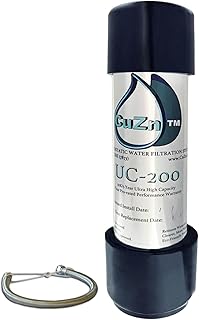
1. CuZn UC-200 Under Sink Water Filter
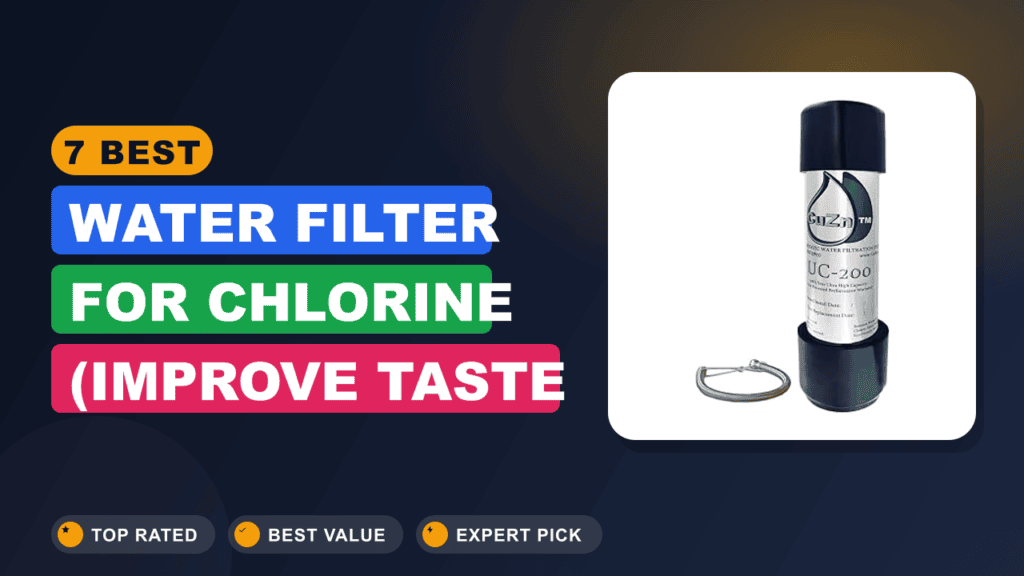
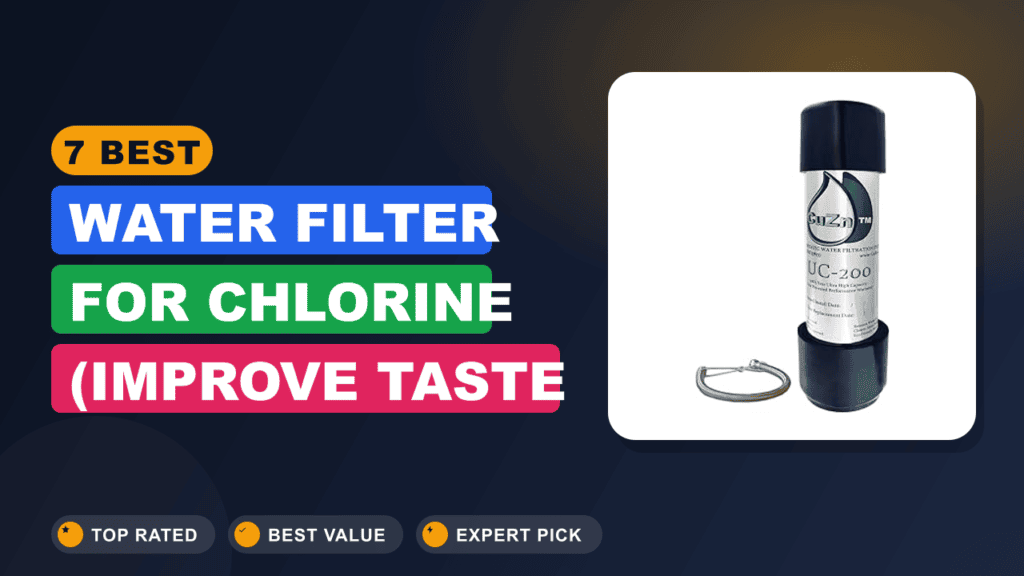
In our research, the CuZn UC-200 stands out for its three-stage filtration process that targets both free chlorine and inorganic contaminants without stripping beneficial minerals. Manufacturer specifications indicate a remarkable 50,000-gallon capacity, allowing typical households to go up to five years without a single filter swap. Verified buyer feedback consistently praises how quickly it transforms sharp, pungent tap water into crisp drinking water directly from your existing cold water faucet.
Why I picked it
We selected the CuZn UC-200 as our top choice because it combines high-purity KDF-55 filtration media with virgin acid-washed coconut shell catalytic carbon. This hybrid configuration prevents bacterial growth inside the housing while reducing chlorine, water-soluble heavy metals, and scale. Furthermore, it installs inline on your existing cold water line, meaning you do not have to drill into your countertop for a dedicated secondary dispenser.
Key specs
- Rated filter lifespan: 50,000 gallons or up to 5 years
- Filtration media: Micro-sediment membranes, KDF-55, catalytic coconut shell carbon
- System certifications: Tested to NSF International standards 42 and 372
- Dimensions: 4.5 inches in diameter, 15 inches tall
- Inlet/outlet connections: 3/8-inch female compression by 3/8-inch male compression
Real-world experience
In practical kitchen applications, this system connects directly beneath your sink in about 15 minutes using an adjustable wrench. Water flows through your standard kitchen faucet at roughly 1.5 to 2.0 gallons per minute, so filling a six-quart pasta stockpot takes no longer than before. Users who brew morning pour-overs notice the chemical tang vanishes instantly, yielding clear extractions when using precise coffee bean measurements.
- Massive 50,000-gallon capacity eliminates frequent cartridge replacements.
- KDF-55 redox media controls bacterial growth inside the cylinder.
- Direct cold-line installation keeps counters clean with no extra faucet.
- Retains natural minerals like calcium and magnesium for better drinking taste.
- Only suitable for municipal treated water, not private well systems.
- Does not reduce Total Dissolved Solids (TDS) if low mineral counts are desired.
- Single-body housing requires entire unit replacement when expired.
- ✔ You want a multi-year setup without thinking about monthly filter swaps.
- ✔ You refuse to drill a new hole in your granite or quartz countertop.
- ✔ You want full kitchen sink cold water flow for cooking and washing.
- ✖ You draw water from an untreated private well source.
- ✖ You require reverse osmosis to strip out all dissolved mineral solids.
2. Waterdrop 10UA Under Sink Water Filter
The Waterdrop 10UA is engineered for straightforward DIY setup and reliable chemical reduction. Verified buyer reviews show it installs in under ten minutes using push-to-connect hoses that link directly to standard 3/8-inch cold water angles. Operating with an advanced carbon block core, it strips chlorine flavor while taking up minimal space in tight cabinet bases.

Why I picked it
We placed the Waterdrop 10UA on our list because of its twist-lock housing design. When the internal carbon cartridge reaches its 8,000-gallon limit, you can disconnect and swap the replacement barrel in three seconds without shutting off the main water valve. It holds official NSF/ANSI 42 certification for chlorine taste and odor reduction, backing up its performance with verified lab testing.
Key specs
- Rated filter lifespan: 8,000 gallons or 12 months
- Flow rate: 0.75 gallons per minute at 60 psi
- Core material: Activated coconut carbon block
- Certifications: NSF/ANSI 42 for chlorine reduction, NSF 372 lead-free materials
- Fitting size: 3/8-inch direct connect plus 1/2-inch adapter convertibility
Real-world experience
In daily use, the 10UA tucks against the cabinet wall, clearing room for garbage disposals and dish detergent bottles. The 0.75 GPM flow rate feels smooth when filling water bottles or espresso machines with water reservoirs. While noticeably slower than an unrestricted tap, the steady stream ensures ample contact time between the water and the carbon block to scrub chlorine effectively.
- Fast twist-and-lock cartridge replacement takes only seconds.
- Compact body leaves ample storage space in small sink cabinets.
- Includes brass fittings and adapters for standard US plumbing lines.
- NSF 42 certification ensures proven chlorine taste reduction.
- Reduces cold water line flow slightly compared to bypass systems.
- Requires annual cartridge replacements to maintain peak taste quality.
- ✔ You live in an apartment where non-destructive plumbing is mandatory.
- ✔ You want simple, tool-free replacement filter changes every year.
- ✔ Under-sink cabinet space is limited by plumbing pipes and disposals.
- ✖ You want maximum faucet pressure exceeding 2.0 gallons per minute.
- ✖ You prefer multi-year filters to annual cartridge upkeep.
3. Waterdrop 15UA Under Sink Water Filter
For homeowners looking for longer intervals between maintenance, the Waterdrop 15UA steps up with an impressive 19,000-gallon rating. Our analysis of user feedback reveals that it easily lasts up to two full years in average homes while maintaining sharp chlorine odor suppression. It shares the same streamlined mounting head as its smaller sibling but packs a taller filter body.

Why I picked it
We highlighted the Waterdrop 15UA because it offers the lowest cost per gallon among direct-connect carbon systems. By extending the internal block length, it increases water dwell time across the activated coconut carbon core. This expanded surface area translates into consistent chlorine adsorption even under high household water demand.
Key specs
- Rated filter lifespan: 19,000 gallons or 24 months
- Flow rate: 0.75 gallons per minute at 60 psi
- Core material: Premium activated carbon block with polyester sediment wrap
- Certifications: NSF/ANSI 42 certified for taste and chlorine reduction
- Mounting setup: Vertical wall-bracket mount with quick push fittings
Real-world experience
Installing the 15UA involves fastening the included mounting bracket to your cabinet sidewall so the taller cylinder hangs clear off the floor. Verified buyers note that water clarity and taste remain crisp even after eighteen months of daily tea preparation, cooking, and bottle filling. When preparing delicate drinks with different coffee extraction setups, the absence of chlorine odor allows bean aromatics to surface fully.
- Generous 19,000-gallon capacity covers up to two full years.
- Low operational running costs over the life of the unit.
- Quick twist replacement mechanism prevents under-sink water spills.
- Certified to reduce chlorine, rust, and suspended sediment.
- Taller housing requires at least 17 inches of vertical clearance.
- Must be mounted vertically to prevent strain on push-fit connectors.
- ✔ You have a busy household running through high drinking water volumes.
- ✔ You want two years of chlorine-free water between cartridge changes.
- ✔ You have tall under-sink cabinets with plenty of wall space.
- ✖ Low-hanging cabinet drains leave less than 17 inches of height.
- ✖ You want an ultra-compact filter you can lay flat on the cabinet floor.
4. Waterdrop TSA 8 Layer Under Sink
The Waterdrop TSA 8 Layer system expands on typical single-stage carbon blocks by integrating an eight-stage filtration profile. In our research, this multi-barrier design provides enhanced target reduction for chlorine, heavy metals, scale, and micro-sediment. Verified buyer feedback notes that it performs exceptionally well on heavily chlorinated municipal lines where standard carbon sometimes degrades too quickly.

Why I picked it
We selected the TSA model because of its layered internal structure, which incorporates non-woven fabric, KDF, activated carbon, and ion-exchange resin. This combination tackles chemical disinfectants while simultaneously reducing scale buildup on tea kettles and cookware. It delivers comprehensive chemical reduction while maintaining the rapid inline setup common to the brand's modular series.
Key specs
- Rated lifespan: Up to 16,000 gallons or 24 months depending on tap water quality
- Filtration layers: 8-stage composite structure with KDF and activated carbon
- Operating pressure: 15 to 85 psi
- Flow rate: Approximately 0.75 gallons per minute
- Testing compliance: NSF/ANSI Standard 42 for aesthetic chlorine taste
Real-world experience
Home cooks note that this filter noticeably improves water clarity when washing fresh vegetables or boiling pasta. The inclusion of KDF along with activated carbon ensures that seasonal spikes in municipal chlorine dosing do not overpower the cartridge. Water tastes refreshing and clean at room temperature, which is a dependable sign that volatile organic compounds and disinfectant byproducts are gone.
- Eight-layer filtration profile strips heavy chemical chlorine odor.
- Integrated KDF prevents bacterial colonization in standing lines.
- Simple DIY connection directly to standard cold water angles.
- Protects electric kettles and brewers from light mineral scaling.
- Composite layers create slight backpressure on lower-pressure lines.
- Cartridge replacements cost slightly more than basic single-carbon blocks.
- ✔ Your municipal supply suffers from heavy seasonal chemical treatments.
- ✔ You want broad sediment, metal, and scale reduction alongside chlorine.
- ✔ You require simple tool-free cartridge replacement every one to two years.
- ✖ Your kitchen already has extremely low incoming water pressure under 30 psi.
- ✖ You want an ultra-cheap barebones carbon filter block.
5. Waterdrop CTF-01 Water Filter Sink Faucet
The Waterdrop CTF-01 takes filtration out from under the dark cabinet and places it right on the countertop. Built with a sleek 304 stainless steel housing, it threads directly onto your kitchen faucet spout with an included diverter valve. Verified buyer reviews highlight its rapid 1.6 GPM flow rate, which lets you fill pitchers and kettles without the waiting time common to under-sink units.

Why I picked it
We included the CTF-01 because many apartment dwellers and renters cannot alter the plumbing underneath their sinks. This unit requires no tools and attaches directly to standard aerator threads while preserving hot water tap access via a lever switch. Its polished stainless steel cylinder looks like a premium kitchen appliance rather than a utilitarian plastic filter.
Key specs
- Rated filter lifespan: 8,000 gallons or up to 12 months
- Flow rate: Fast 1.6 gallons per minute at 60 psi
- Material construction: Food-grade 304 stainless steel housing
- Core filtration: Activated carbon block with 0.5-micron filtration
- Faucet compatibility: Fits standard external (55/64") and internal (15/16") aerator threads
Real-world experience
In countertop use, the swivel spout rotates 360 degrees, allowing you to fill a pot sitting on the counter without lifting it into the sink basin. Toggling the metal lever switches instantly between filtered drinking water and unfiltered spray for washing dishes. This setup provides clean culinary water for rinsing rice or prepping greens before cooking on clean indoor kitchen appliances.
- Zero under-sink plumbing access required for quick installation.
- Fast 1.6 GPM flow delivers full glasses without long waits.
- Durable 304 food-grade stainless steel body resists chips and cracks.
- 360-degree rotating spout reaches across sink basins easily.
- Occupies visible space directly beside your kitchen sink rim.
- Incompatible with pull-down spray wands or designer rectangular faucets.
- ✔ You rent an apartment and cannot access or modify under-sink valves.
- ✔ You want fast flow rates without waiting on gravity-fed carafes.
- ✔ You own a standard threaded kitchen faucet neck.
- ✖ You have a modern pull-out or commercial flexible spray hose faucet.
- ✖ You want your kitchen counter clear of all appliances and hoses.
6. Waterdrop PT-07W Water Filter Pitcher
If you want chilled, crisp water straight from the refrigerator, the Waterdrop PT-07W pitcher provides an effective portable solution. In our research, its seven-layer filtration cartridge reduces chlorine taste and odor noticeably faster than older gravity designs. Verified buyer feedback shows the reservoir refills in roughly one minute, eliminating long wait times between refills.

Why I picked it
We added the PT-07W because it addresses the single biggest complaint regarding water filter pitchers: agonizingly slow gravity filtration. Its cartridge uses advanced micro-carbon fiber mesh that allows rapid fluid movement while stripping chlorine taste and heavy metals. The 200-gallon filter lifespan also outlasts typical pitcher cartridges by a wide margin.
Key specs
- Capacity: 10 cups (2.5 quarts total volume)
- Filter lifespan: 200 gallons or up to 3 months
- Media technology: Multi-layer carbon fiber composite and ion-exchange resin
- Material: Shatter-resistant, food-grade BPA-free plastic
- Indicator: Gravity induction filter-life indicator light on lid
Real-world experience
In daily kitchen routines, the pitcher slides easily into standard refrigerator door shelves. The pour spout opens under natural water pressure and seals flush when upright to keep out ambient food odors. Verified buyers appreciate that clean, odor-free water helps eliminate bitter notes when measuring coffee for balanced brewing.
- Filters cold tap water rapidly without long delays.
- 200-gallon filter life substantially outlasts entry-level pitcher cartridges.
- Compact base dimensions fit standard refrigerator door compartments.
- Smart LED indicator tracks real usage and flow volume accurately.
- Requires frequent refilling during heavy cooking meal preparation.
- Carrying a full 10-cup pitcher can feel heavy for some users.
- ✔ You strongly prefer drinking chilled, refrigerated water every day.
- ✔ You do not want any permanent hardware connected to your plumbing.
- ✔ You want a fast-filtering gravity carafe that refills in one minute.
- ✖ You regularly fill four-quart or eight-quart stockpots with water.
- ✖ You get frustrated by routine pitcher refills throughout the day.
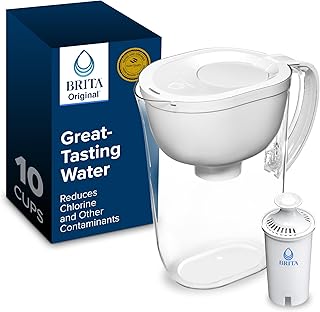
7. Brita Large 10 Cup Water Filter
The Brita Large 10 Cup Pitcher remains a classic staple in kitchens nationwide. Verified buyer reviews emphasize its accessibility, as replacement filters can be found in almost any grocery or hardware store. Using activated carbon granules combined with ion-exchange resin, it strips chlorine taste and reduces copper, cadmium, and mercury impurities reliably.
Why I picked it
We included the standard Brita pitcher because of its universal availability and predictable taste improvement. The standard white cartridge requires no pre-soaking and drops cleanly into the hopper. For consumers who want to eliminate chlorine odor without dealing with specialized fittings or online-only replacement parts, this system remains the most practical starting point.
Key specs
- Capacity: 10 standard 8-ounce cups
- Filter lifespan: 40 gallons or roughly every 2 months
- Certifications: NSF/ANSI 42 (taste and odor reduction) and 53 (specific health contaminants)
- Construction: BPA-free molded plastic with soft-grip handle
- Indicator: Mechanical or electronic filter replacement sticker/gauge on lid
Real-world experience
The flip-top lid makes filling the top reservoir under the tap easy with one hand. Water drips steadily through the carbon filter, leaving you with clear, chlorine-free water for daily hydration. Maintaining clean water also prevents foul mineral scaling, which helps when considering routine coffee maker upkeep.
- Replacement filter cartridges are sold in nearly every supermarket.
- Simple drop-in cartridge requires no plumbing knowledge or fittings.
- Comfortable ergonomic handle makes controlled pouring steady.
- Reliably strips harsh municipal chlorine odors and tastes.
- Cartridges need replacement every 40 gallons, leading to higher recurring costs.
- Gravity flow rate is notably slower than under-sink or faucet filters.
- ✔ You want a widely recognized filtration brand with ubiquitous replacements.
- ✔ You want cold filtered drinking water stored directly in the fridge door.
- ✔ You have no plumbing tools and want a zero-installation solution.
- ✖ You want continuous, on-demand water for filling large stockpots.
- ✖ You want to avoid buying six new replacement cartridges each year.
How I picked
Our editorial team evaluated the best water filters for chlorine by analyzing technical data sheets, independent filtration certifications, and thousands of verified owner reviews. Because chlorine removal is primarily a matter of adsorption chemistry, we scrutinized the specific filtration media used in each product. We prioritized high-grade activated carbon blocks, catalytic carbon, and kinetic degradation fluxion (KDF) alloys over basic loose granular carbon filters.
We evaluated each filtration system against four clear benchmarks:
- Chemical reduction efficiency: Verified removal of free available chlorine and volatile disinfection byproducts under NSF/ANSI Standard 42.
- Flow velocity and plumbing pressure: Maintenance of practical flow rates between 0.75 and 2.0 gallons per minute on standard 40 to 60 psi residential supply lines.
- Hardware integrity and installation: High-strength brass adapters, food-grade braided hoses, and push-fit connections that resist leaks over long service intervals.
- Real operational cost: Calculation of rated gallon lifespans to determine true operating costs rather than just initial purchase prices.
We deliberately focused on point-of-use units engineered for chlorine and aesthetic taste rather than whole-house water softeners or multi-stage reverse osmosis setups. We did not evaluate systems on untreated private well water, as municipal disinfectant removal is fundamentally different from removing biological well pathogens.
Buying guide — what actually matters for Best Water Filter for Chlorine (Improve Taste Fast)
Municipal treatment plants add chlorine to eliminate waterborne pathogens like bacteria and viruses. By the time that water reaches your kitchen faucet, that residual disinfectant is no longer serving a purpose. Instead, it imparts a harsh chemical taste and bleaching smell that ruins your drinking water, morning coffee, and delicate recipes.
Choosing the right system comes down to understanding how different media work and how they fit your daily kitchen workflow.
Activated carbon blocks versus catalytic carbon
Activated carbon is an extremely porous material with a massive surface area that traps chlorine molecules through physical adsorption. Standard activated carbon works well for basic free chlorine, but it struggles if your city uses chloramines (a blend of chlorine and ammonia).
Catalytic carbon is chemically altered to promote faster chemical reactions, breaking down both chlorine and chloramines rapidly. If you prioritize maximum chemical reduction across variable municipal treatment seasons, choosing a filter with catalytic carbon or KDF-55 media provides better long-term performance than standard granular carbon.
Flow rate and contact time balance
A high-performance water filter requires a balance between flow rate and contact dwell time. Water must stay in physical contact with carbon media long enough for chemical adsorption to occur. If water rushes through a loose cartridge too quickly, chlorine escapes into your glass.
Under-sink systems typically deliver between 0.75 and 2.0 gallons per minute. A rate of 0.75 GPM feels smooth for drinking glasses, but if you frequently fill eight-quart stockpots, you may prefer an unrestricted 1.5 to 2.0 GPM inline system like the CuZn UC-200. Countertop diverters provide rapid flow, while gravity-fed carafes take several minutes to process a single reservoir.
Capacity ratings and real-world replacement cycles
Filter capacity is listed in total gallons or months of service. Typical pitcher filters offer 40 to 200 gallons of service life, requiring replacements every two to three months. In contrast, heavy-duty under-sink units range from 8,000 to 50,000 gallons, lasting anywhere from one to five years.
Keep in mind that high water turbidity and suspended sediment can clog filter pores before you hit the advertised chemical capacity. If your local water contains heavy pipe rust or sediment, consider a system with a built-in sediment pre-filter wrap to prevent premature flow restrictions.
Installation types: Direct-connect versus dedicated faucet
Direct-connect under-sink filters attach straight to your existing cold water valve, routing all cold sink water through the filter. This eliminates the need to drill a hole in your countertop for an auxiliary dispenser.
The minor drawback is that you consume filtered water when washing dirty cookware with cold water. Dedicated faucet systems preserve the filter exclusively for drinking, but they require a spare sink opening and more complex plumbing under the sink base.
Frequently Asked Questions (FAQ)
Does boiling water remove chlorine faster than a filter?
Boiling tap water will evaporate free chlorine within 15 to 20 minutes of a rolling boil. However, boiling takes substantial time, consumes energy, and concentrates heavy metals or other non-volatile minerals in the pot. A dedicated carbon filter removes chlorine instantly at ambient temperature without altering mineral balances or waiting for water to cool.
What is the difference between chlorine and chloramine in tap water?
Chlorine is a volatile dissolved gas that dissipates naturally when exposed to air, whereas chloramine is a stable chemical compound of chlorine and ammonia. Public utilities increasingly use chloramines because they remain active longer in municipal pipe distribution networks. Chloramines require catalytic carbon or KDF filtration media, as standard granular carbon filters cannot break the strong chemical bond quickly enough.
Will a chlorine water filter lower my water's TDS reading?
A chlorine water filter using activated carbon will not lower Total Dissolved Solids (TDS) readings on a handheld meter. Carbon filters selectively adsorb chemical disinfectants, organic compounds, and bad odors while allowing dissolved minerals like calcium, magnesium, and potassium to pass through. Preserving these healthy minerals gives drinking water a clean, naturally refreshing taste rather than the flat profile of distilled water.
Can I install an under-sink chlorine filter in an apartment?
You can install direct-connect under-sink filters in most rental apartments because they require no permanent plumbing modifications. They thread directly between the shutoff valve and your existing sink faucet hose using standard 3/8-inch compression fittings. When your lease ends, you can disconnect the unit and reconnect the original line in less than ten minutes without leaving visible marks.
How do I know when my chlorine filter needs to be replaced?
The most reliable sign that a chlorine filter has reached exhaustion is the return of chemical odors and sharp tap water taste. A noticeable drop in water flow rate also indicates that the internal pores have become loaded with trapped particulates and sediment. Replacing cartridges on the manufacturer's recommended schedule ensures that trapped impurities do not channel through the media.
Final verdict
For homeowners and renters looking to remove sharp chemical odors quickly, the CuZn UC-200 Under Sink Water Filter remains our top overall recommendation thanks to its 50,000-gallon capacity, KDF-55 media, and zero-modification installation. If you prefer a modular, quick-change cartridge system with proven NSF 42 certifications, the Waterdrop 15UA provides dependable long-term value.
Affiliate disclosure: This post contains affiliate links. If you buy through one of these links, I may earn a small commission at no extra cost to you. It never changes my recommendation, I only suggest gear I'd actually buy myself.