Silicone air fryer mats are thin, reusable inserts that sit on the basket floor to catch drips, reduce sticking, and protect nonstick coatings. Choosing well comes down to three checks, in order: confirm the mat’s usable size matches your basket, verify the food-contact material and temperature rating against your appliance manual, then pick the perforation and edge design that fits how you cook. Design and color matter far less than those first two checks, and no mat can compensate for a poor fit. This guide breaks down the key differences between available options so you can pick a mat that actually fits your machine and cooking style.
What to Check Before You Buy
Fit is the first filter because a mat that overlaps the basket walls or blocks airflow can hold back the very circulation an air fryer depends on. Material documentation comes second, since a mat sits in direct contact with food at high heat. Design comes last, once you know what the mat has to do.
Buyers often fixate on thickness or color first. A thicker mat resists curling and lasts longer under repeated handling, but thickness cannot fix a mat that is too large. Treat the specification sheet as a starting point and confirm the two or three items below, since product listings vary in how honestly and consistently they describe their own measurements.
How to Match Mat Size to Your Specific Air Fryer Model
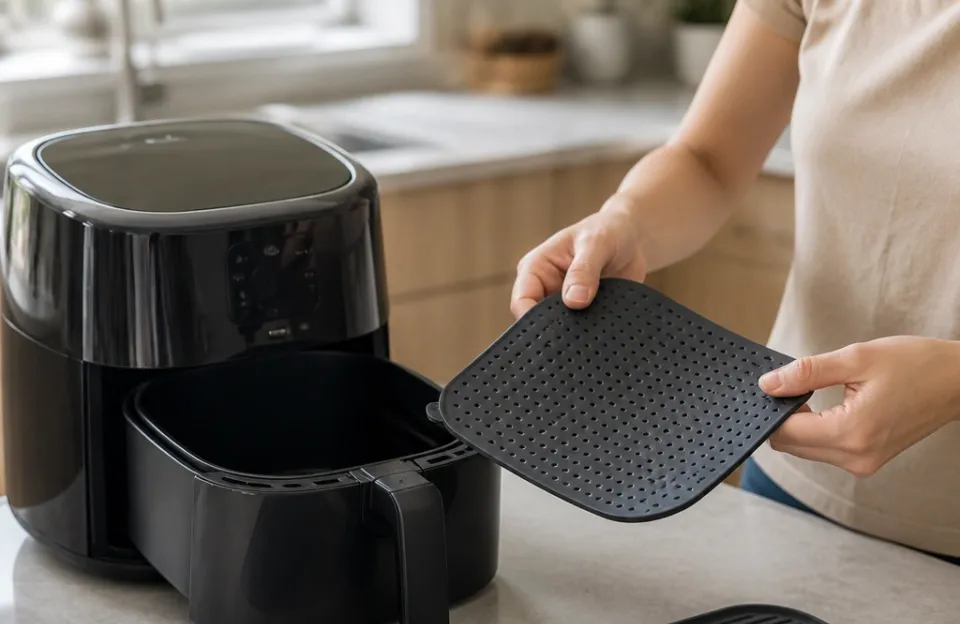
Air fryer baskets are not standardized, so a mat sold as “fits most air fryers” is a loose promise rather than a measurement. Measure the interior floor of your basket at its widest point in both directions, and measure again near the corners if the basket is square or rectangular. That gives you the usable area the mat has to sit within.
Then read the listing carefully for how its dimensions are taken. Some sellers measure the flat base only, while others include the raised lip or rim. A mat listed at a size close to your basket width may still be too large once the rim is counted, or too small in the flat area to stay put. When a listing does not say whether its figures include the lip, treat the numbers as an upper bound and size down slightly.
For dual-zone or multi-chamber air fryers, measure each chamber separately. Two baskets in one appliance can differ in shape, and a mat that fits the left side may not seat flush on the right. Buy per chamber or confirm the mat’s shape matches each one.
Rounded baskets and square baskets create different fit problems. A round mat in a square basket leaves corner gaps where food and drips collect, while a square mat in a rounded basket can buckle at the edges. Match the shape to the basket.
Material Safety Standards and Temperature Ratings
Food-contact silicone is regulated as a food-contact material, which is a different question from whether a mat is heat-resistant. In the United States, food-contact materials are addressed by FDA regulations, and 21 CFR 177.2600 is the section commonly cited for rubber articles intended for repeated use in contact with food. That regulation concerns the material and its extractables; it does not certify a specific mat as safe for your air fryer at any given temperature. LFGB refers to German food and feed law, and products marketed as LFGB-compliant are claiming conformity with German food-contact requirements, not a guarantee of performance. Check the current official text of each standard before relying on a specific claim.
Two practical implications follow. First, a vague “food-grade silicone” description tells you very little; look for an explicit standard reference and the manufacturer’s documentation. Second, a certification and a temperature rating are separate claims. Verify both.
Temperature ratings vary by product because they depend on the silicone formulation, the mat’s thickness, and how the manufacturer tested it. Air fryer maximum temperatures also vary by model. Before buying, read the mat’s stated continuous-use temperature and any peak figure, then compare it with the maximum temperature in your air fryer manual. Choose a mat whose rating comfortably exceeds your appliance’s top setting. If a listing gives no rating at all, that is a reason to hesitate rather than assume.
Perforated Versus Solid Designs for Different Cooking Tasks
The perforation pattern changes how air moves and what the mat catches. Perforated mats have holes or slots that let air circulate beneath and around food. Solid mats present a continuous surface that holds drips, sauces, and small pieces that would otherwise fall through the basket grate.
Perforated designs generally suit tasks where crispness and even browning matter, such as vegetables, fries, and breaded items, because airflow reaches more of the food’s surface. The trade-off is that liquids and small pieces pass through the holes, so cleanup shifts back to the basket. Solid designs suit saucy, wet, or crumbly foods where containment is the point; our notes on keeping wing sauces contained show why that matters for sticky preparations. The trade-off is reduced bottom airflow, which can leave the underside of food less crisp and may call for a longer cook or a flip. If you regularly cook both, a hybrid mat with a perforated center and a solid rim gives you some of each: airflow in the middle, a barrier at the edge.
These are tendencies, not guarantees. Results depend on your appliance, the food, and how full the basket is, so expect to adjust.
Quick Reference Comparison of Key Mat Attributes
| Attribute | What to Check | Why It Matters |
|---|---|---|
| Fit | Interior floor dimensions and whether listed size includes the rim | Overlap or gaps cause buckling, blocked airflow, or missed drips |
| Material documentation | Explicit standard reference and manufacturer documentation | Vague “food-grade” claims tell you little |
| Temperature rating | Continuous and peak figures versus your manual’s maximum | A rating below your top setting is a mismatch |
| Perforation | Perforated, solid, or hybrid | Airflow and crispness versus spill containment |
| Edge design | Flat rim, raised lip, handle tabs | Affects removal, seating, and drips |
| Shape | Round versus square to match the basket | Wrong shape leaves gaps or causes buckling |
Use the table as a checklist for comparing listings, not as a scorecard. A mat that fails the fit or temperature check should be set aside regardless of how well it scores elsewhere.
Real Limitations That Product Photos Don’t Show
Product photos show a clean, flat mat. Real use is messier, and a few limitations are worth knowing before you buy.
First, many mats reduce but do not eliminate basket cleaning. Drips, crumbs, and grease can still reach the basket through gaps around the mat’s edge or through perforations, so plan on washing the basket, just less often and less aggressively.
Second, cooking times can shift. A solid mat between the food and the heat source can slow browning on the underside, and a perforated mat changes airflow in ways that may require small timing adjustments. Check doneness with a digital thermometer for proteins rather than relying on time alone, and treat any first-cook timing as provisional. For texture-sensitive foods like wings, proper wing prep techniques affect the result as much as the liner choice.
Third, fitment in multi-chamber appliances is a recurring problem. A mat sized for a single large basket may not seat in a narrower chamber, and mats sold in pairs are not always identical in shape.
Finally, lifespan varies with use, heat exposure, and washing habits. There is no reliable universal figure. Inspect your mat periodically for cracking, persistent odor, or loss of shape, and replace it if it degrades.
Edge Design and Handling Practicality
Edge design is a small detail with daily consequences. A raised lip contains drips better than a flat rim, but it also adds height that can interfere with seating in a snug basket and must be counted when you check fit. Handle tabs make it easier to lift a hot mat without touching food or scraping the basket, which matters when the mat is greasy.
Storage is worth a thought too. Silicone mats are floppy and can crease if folded tightly, so a mat that rolls or hangs flat stores more easily than one that has to be folded into a drawer. If your kitchen space is tight, this can matter as much as the cooking performance.
Washing by hand is gentler than repeated dishwasher cycles, though many mats are dishwasher-safe. Follow the manufacturer’s cleaning instructions rather than treating dishwasher use as a default; the manufacturer’s guidance is the most reliable reference for your specific mat, including how it should be washed and what heat or detergent exposure it is designed to tolerate.
Making Your Final Selection
Work through the checklist in order and let the first failure rule out a product.
- Fit: Does the mat’s usable flat area fit within your basket floor, with the shape matching round or square?
- Material: Does the listing name a specific food-contact standard and provide manufacturer documentation rather than a vague “food-grade” label?
- Temperature: Does the mat’s stated continuous rating comfortably exceed your air fryer’s maximum setting?
- Design: Does the perforation and edge design suit whether you mostly want crispness or containment?
If you mostly roast vegetables, fries, and breaded foods and want airflow, a perforated mat is the natural choice. If you cook saucy, wet, or crumbly dishes and want containment, a solid mat fits better. If you want one mat to cover most of your cooking, a hybrid with a perforated center and solid rim is a reasonable compromise, provided it passes the fit and temperature checks.
There is no single best mat in the abstract. The right one is the mat that fits your specific basket, has documentation you can verify, and matches how you actually cook. For a broader look at the options before you commit, this air fryer liners buying guide covers related choices.