Commercial espresso machines for home and business share the same core job. They push hot water through tightly packed coffee at high pressure to pull a rich shot. The real difference is how many drinks they can make before slowing down, and how much space they take on your counter.
If you run a small cafe or want cafe-level drinks in your kitchen, picking the right machine comes down to three things: boiler type, group head count, and electrical needs. A single-group heat exchanger works well for most homes and light offices. A dual-boiler two-group machine handles a busy morning rush without breaking a sweat.
We compared specs, build materials, power requirements, and the complaints owners bring up most often to map out exactly what fits where.
How Commercial Espresso Machines for Home and Business Differ
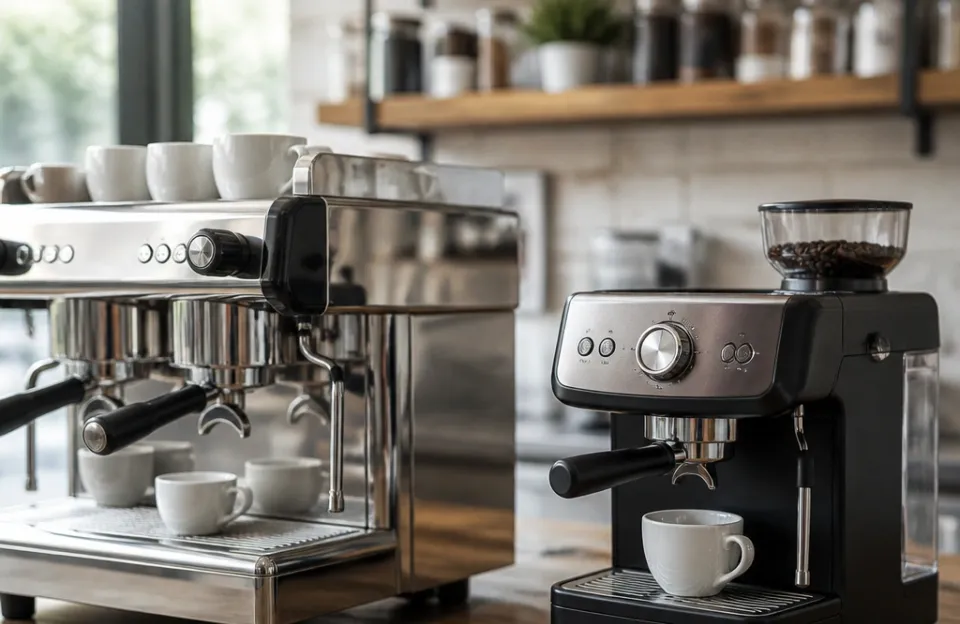
The word “commercial” covers a wide span of hardware. At one end sits a compact single-group machine meant for a home barista who wants heavy-duty parts. At the other end is a massive three-group unit bolted to a cafe counter, pulling hundreds of shots a day.
The main dividing line is the boiler setup. A single boiler machine can brew or steam, but not both at once. You wait between tasks.
That works if you make one cappuccino every morning. It fails completely when three people order lattes at the same time.
A heat exchanger (HX) solves this. It holds one large boiler kept at steam temperature. A tube runs through that boiler, flash-heating fresh water to brewing temperature as it flows to the group head.
You can steam milk and pull a shot together. HX machines are the sweet spot for serious home setups and low-volume businesses like a bakery or an office breakroom.
A dual boiler has two separate tanks. One stays at brew temperature (usually around 200°F). The other stays at steam temperature (around 250°F to 270°F).
Temperature control is exact. Recovery time is fast. If you serve more than 30 drinks an hour, dual boilers keep pace.
Group heads matter just as much. A group head is the part where the portafilter locks in. Most commercial espresso machines for home and business use either an E61 group head or a saturated group head.
The E61 is a heavy brass unit that uses a mechanical lever and a thermosyphon loop to stay hot. Saturated groups are bolted directly to the boiler, meaning they hold temperature even better but cost more to repair.
One detail buyers miss is plumbing. True commercial machines hook directly into a water line. They also need a drain box under the counter for the drip tray.
Many home users do not have this setup. Look for machines with a “pour-over” option or an internal water reservoir if you cannot plumb it in. Just know that running a commercial machine off a reservoir means filling a heavy tank constantly.
Power is another hurdle. Standard US kitchens have 120-volt outlets. Many commercial machines require 220 volts.
Plugging a 220V machine into a standard outlet requires an electrician to run a new circuit. Always check the voltage requirement before buying. If you want to avoid rewiring, stick to 120V models designed for prosumer use.
For safety and compliance, any machine used in a public business in the US should carry proper certification. Check for marks from recognized testing labs like UL (Underwriters Laboratories) to confirm the electrical components meet national safety standards. Running uncertified gear in a commercial space can void your insurance.
What to Look For Before You Buy
Choosing between models gets easier when you measure your actual needs first. Here is the framework we use.
Daily drink volume. Count the maximum number of milk-based drinks you will make in a single hour. Under 15 drinks? A single-group HX is plenty.
Between 15 and 40? Go for a dual boiler or a two-group machine. Over 40?
You need a dedicated two-group or three-group commercial setup.
Counter space and weight. Commercial machines are built from steel and brass. Even a single-group unit can weigh over 60 pounds. Measure your counter depth.
Many commercial units are deeper than standard home appliances. If you place heavy items on counters daily, knowing how to measure your available footprint accurately prevents a costly return.
Water quality. Hard water destroys boilers. Scale builds up inside the heating elements and blocks valves. If you buy a commercial machine, you must install a water filtration system.
Reverse osmosis systems with a remineralization cartridge work best. Never run tap water straight into a high-end boiler.
Maintenance access. Boilers need descaling. Group gaskets wear out and need replacing every six to twelve months. Pick a brand where replacement parts are easy to find in the US.
Italian brands like La Marzocco, Rocket, and Profitec have strong domestic support networks.
Here is a quick reference table to match your situation to the right spec tier:
| Situation | Boiler Type | Groups | Voltage | Typical Weight |
|---|---|---|---|---|
| Home enthusiast | Dual Boiler or HX | 1 | 120V or 220V | 40 to 70 lbs |
| Small office / Bakery | HX or Dual Boiler | 1 or 2 | 220V | 70 to 110 lbs |
| Busy Cafe | Dual Boiler | 2 or 3 | 220V | 120 to 200+ lbs |
Top Picks by Situation
We picked these based on build quality, boiler design, parts availability in the US, and how well they handle their intended workload. Every machine here has a specific limit, so read the notes carefully.
Best for Serious Home Baristas: Rocket Appartamento
The Rocket Appartamento is a compact, heat-exchange machine built for home kitchens that want commercial aesthetics and performance. It uses a copper HX boiler and an E61 group head. The side panels have a distinct cutout pattern that saves a little visual bulk.
This machine fits someone who makes two to five drinks a day and cares about steam power. Because it is an HX machine, you can steam milk and pull a shot at the same time. The steam wand is powerful enough to texture milk for latte art quickly.
Its main limit is temperature stability during long idle periods. HX machines rely on a thermosyphon loop to keep the group head hot. If the machine sits idle for hours, the water in that loop can get too hot, requiring a cooling flush (running water through the group head for a few seconds) before pulling a shot.
It also lacks a built-in PID controller for the brew water, though the steam boiler pressure is adjustable.
Skip this if you plan to serve a crowd. The single group head and smaller boiler mean recovery time slows you down after four or five back-to-back drinks. Also, verify that your cabinet clearance allows for cup warming on top; keeping your cups warm matters for good extraction, much like ensuring safe cooking temperatures matters for food prep.

Best Prosumer Dual Boiler: Profitec Pro 700
The Profitec Pro 700 is a dual-boiler machine with an E61 group head and full PID temperature control. It is built in Germany with heavy stainless steel casing. Both boilers are stainless steel, which resists scale slightly better than bare copper or brass.
This is the pick for a home user who wants absolute control over brew temperature, or a very small office making 10 to 20 drinks a day. The PID lets you set the brew boiler to the exact degree. If you switch between light roast and dark roast beans, changing the brew temperature by a few degrees changes the flavor noticeably.
The honest limitation is size and weight. It weighs around 77 pounds and takes up significant counter depth. It also requires a learning curve.
Managing two boilers and tuning a PID is not plug-and-play. You will spend your first week dialing in temperatures and pressures.
Skip it if you only drink drip coffee occasionally or if you lack a dedicated 220V outlet (though some configurations run on 120V, the 220V version recovers much faster).
Best for Light Commercial Use: Rancilio Silvia Pro X
The Rancilio Silvia Pro X bridges the gap between home and commercial. It packs two boilers (one for steam, one for brew) and PID control into a footprint smaller than most true commercial units. It runs on standard 120V power, which is a massive advantage for pop-up shops, food trucks, or older buildings without 220V wiring.
It fits a small business making under 30 drinks an hour, or a home user who wants commercial-grade reliability without hiring an electrician. The steam power is excellent for its size, and the build quality matches Rancilio’s larger cafe machines.
Where it falls short is continuous heavy volume. The brew boiler is relatively small (0.3 liters). If you pull five double shots back-to-back, the temperature will drop, and the PID will struggle to catch up instantly.
It also uses a proprietary group head rather than the standard E61, meaning replacement parts are specific to Rancilio.
Skip this if you are opening a high-volume cafe. It cannot keep up with a morning rush of 50 customers.
Best for High Volume Cafes: La Marzocco Linea Classic S
The La Marzocco Linea Classic S is the standard for specialty coffee shops in the US. It uses dual stainless steel boilers, saturated group heads, and digital controls. It comes in two-group and three-group configurations.
This machine belongs in a business setting where pulling 100 or more shots a day is normal. The saturated groups are bolted directly to the brew boiler, meaning thermal stability is nearly perfect regardless of how fast you work. The steam pressure is relentless.
The limits are obvious for a home buyer. It requires 220V power, direct plumbing, and a drain. It weighs over 150 pounds for the two-group model.
It is also expensive to maintain. Descaling a dual-boiler La Marzocco usually requires a trained technician.
Skip this if you are outfitting a home kitchen. The plumbing and electrical requirements alone make it impractical for residential use. When dealing with high-end equipment, always verify that any aftermarket accessories or water filtration fittings you buy actually match your specific model before installing them.
Best Budget Entry for Small Offices: Breville Dual Boiler (BES920XL)
While technically a prosumer machine rather than a true commercial unit, the Breville Dual Boiler is widely used in small offices because of its price point and accessibility. It has dual boilers, PID control, and an OPV (over-pressure valve) that is user-adjustable.
It fits an office breakroom where staff make their own drinks and no one has professional barista training. The interface is straightforward. It heats up faster than heavy E61 machines.
The limitation is longevity under stress. Breville uses more plastic and lighter metals internally compared to Rocket or Profitec. If an office of 30 people all use it heavily every morning, the solenoid valves and pumps wear out faster.
Repairs outside of warranty can be difficult, as fewer independent technicians service Breville compared to Italian imports.
Skip this for any customer-facing business. It lacks the durability and steam volume needed for a cafe environment. Also, check that the materials touching your water meet your safety preferences, similar to verifying if plastics are safe for heating in other kitchen gear.
Choose By Situation
If you are still weighing options, use these rules to narrow it down fast.
- If you make under 5 drinks a day at home and want great steam, pick the Rocket Appartamento.
- If you change coffee roasts often and need exact temperature control at home, pick the Profitec Pro 700.
- If you run a food truck or pop-up cart with only 120V power, pick the Rancilio Silvia Pro X.
- If you open a cafe expecting more than 50 customers a morning, pick the La Marzocco Linea Classic S.
- If you equip a small office where staff serve themselves, pick the Breville Dual Boiler.
Common Mistakes Buyers Make
Buying too much machine is the most frequent error. People watch videos of cafes using three-group La Marzoccos and buy a two-group machine for their kitchen. Then they realize they need to hire a plumber to run a water line and an electrician to install a 220V outlet.
Always match the machine to your actual infrastructure.
Ignoring water filtration is the second biggest mistake. A commercial espresso machine for home and business relies on clean water. Tap water contains calcium and magnesium.
When heated repeatedly inside a boiler, these minerals form hard scale. Scale blocks tubes, ruins heating elements, and causes leaks. A simple carbon filter is not enough.
You need a system designed to reduce hardness while leaving enough minerals for the coffee to taste right. Pure reverse osmosis water with zero minerals tastes flat and can actually corrode certain metal sensors.
Skipping the grinder budget is the third issue. A $3,000 espresso machine paired with a $100 blade grinder produces terrible coffee. The grinder dictates the particle size.
Uneven particles lead to channeling, where water finds the path of least resistance through the coffee puck, resulting in sour, weak shots. Allocate at least 30% to 40% of your total budget to a high-quality burr grinder.
Finally, buyers forget about the physical dimensions of the workspace. These machines generate a lot of heat. They need clearance above them for ventilation and cup storage.
They need space behind them for water lines. If you are fitting out a tight station, measuring your available space accurately is just as critical as selecting the right basket or liner size for any countertop appliance.
Keeping Your Machine Running
Commercial hardware lasts decades, but only with routine care. Backflushing is mandatory. This means locking a blind basket (a portafilter basket with no holes) into the group head and running the pump with espresso machine detergent.
It forces water backward through the exhaust valve, clearing out coffee oils. Do this weekly for home use, and daily for business use.
Replace the group gasket and shower screen every six to twelve months. The rubber gasket hardens from heat. When it does, the portafilter will spin too far to the right or leak water during a shot.
Gaskets are cheap. Ignoring them leads to damaged group heads, which are expensive.
Wipe the steam wand immediately after every use. Milk proteins bake onto the metal within seconds. Once hardened, they block the steam holes and harbor bacteria.
Purge the wand (blast steam for one second) before and after wiping.
If your machine sits unused for more than a week, empty the boilers if the manual allows it. Stagnant water promotes corrosion and scale buildup.
Frequently Asked Questions
Can I put a commercial espresso machine in my house?
Yes, but you must check your electrical panel and plumbing first. Many commercial machines require 220-volt outlets and direct water line connections. If you cannot plumb it in, look for a machine that supports an internal water reservoir or a pour-over conversion kit.
How much does a commercial espresso machine for home and business cost?
Prices vary wildly based on boiler count and build quality. Prosumer dual boilers typically range from $1,500 to $3,500. True commercial single or two-group machines start around $4,000 and easily exceed $15,000 for high-end cafe models.
Do I really need a dual boiler?
Only if you need to steam milk and brew espresso simultaneously without temperature drops. If you mostly drink black espresso or Americanos, a single boiler or heat exchanger is fine. If you make milk drinks back-to-back for multiple people, a dual boiler saves time and improves consistency.
What happens if I don’t use filtered water?
Minerals in unfiltered tap water will calcify inside the boiler and tubing. This restricts water flow, causes overheating, and eventually breaks the heating element. Descaling a commercial machine is labor-intensive and sometimes requires disassembling the entire unit.
Is a heat exchanger better than a dual boiler?
Neither is universally better. Heat exchangers are simpler mechanically and often cheaper, making them great for homes. Dual boilers offer precise, independent temperature control for both steam and brew water, which benefits busy cafes or users who experiment heavily with different coffee roasts.
Pick the machine that matches your volume and your building’s wiring. A heavy commercial unit is useless if it trips your breaker every time you pull a shot. Match the specs to your reality, keep the water clean, and the machine will outlast your coffee habit.
As an Amazon Associate, we earn from qualifying purchases.