Yes, you can safely cook raw chicken in an air fryer. The USDA requires all poultry to reach an internal temperature of 165°F (74°C), and an air fryer gets there reliably when you use the right time and temperature settings.
If you're wondering whether you can safely cook raw chicken in an air fryer without drying it out or leaving the center undercooked, the short answer is yes. The circulating hot air cooks the meat evenly, provided you don't overcrowd the basket. This article covers how the appliance handles raw poultry, safe temperature targets for different cuts, prep steps that prevent cross-contamination, and a few edge cases where things go wrong.
How Rapid Air Circulation Cooks Raw Poultry
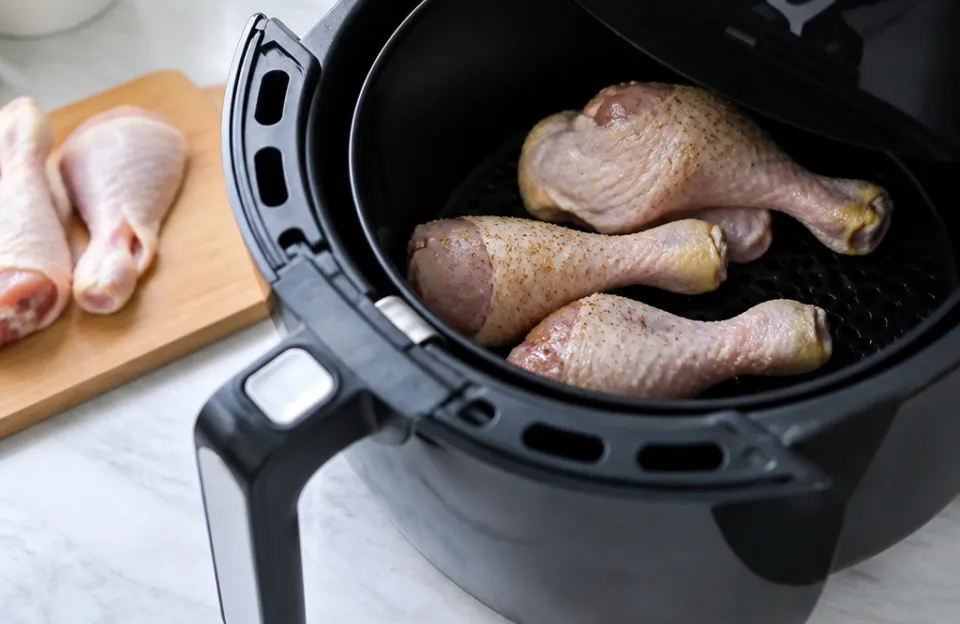
An air fryer works by moving superheated air around the food at high speed. A heating element near the top warms the air, and a powerful fan pushes it down and around the basket. That constant flow strips away the thin layer of cooler air that normally surrounds food in a standard oven.
Raw chicken needs sustained heat to destroy bacteria like Salmonella and Campylobacter. Because the air moves so fast in an air fryer, the surface heats up quickly. That rapid surface heating creates browning through the Maillard reaction, which gives the outside a roasted texture while the inside continues to cook.
The main safety requirement is holding the meat at the target temperature long enough. According to the FDA food safety guidelines, poultry must hit 165°F throughout to be considered safe. The concentrated heat in an air fryer reaches that mark faster than a conventional oven, which reduces the window where bacteria can survive.
Why Basket Size Changes Your Safety Margins
Airflow is the whole point of the appliance. If you pack too much raw chicken into the basket, the air can't circulate between the pieces. The parts touching each other stay cooler longer, creating uneven cooking.
One piece might hit 180°F while the one underneath barely reaches 140°F.
Smaller baskets, like those in 3-quart models, usually handle two boneless breasts or a few drumsticks safely. If you have a larger machine, picking up the right basket liners or racks helps keep pieces separated. Overcrowding doesn't just ruin the texture; it directly impacts whether the thickest part of the meat hits the required temperature.
For families cooking larger batches, a bigger capacity model solves this problem naturally. Using add-on racks designed for larger baskets lets you stack chicken thighs without them resting directly on top of each other. Even with racks, you still need to check the temperature of the pieces on the bottom tier.
Target Temperatures for Different Chicken Cuts
All raw chicken needs to reach 165°F. That's the non-negotiable baseline from the USDA. However, pulling every cut out at exactly 165°F doesn't always give you the best result, because dark meat and white meat behave differently under high heat.
| Chicken Cut | Safe Minimum Temp | Ideal Pull Temp | Typical Time at 375°F |
|---|---|---|---|
| Boneless breasts | 165°F | 160°F (carryover to 165°F) | 12 to 15 minutes |
| Bone-in thighs | 165°F | 175°F | 22 to 25 minutes |
| Drumsticks | 165°F | 175°F | 20 to 24 minutes |
| Wings | 165°F | 175°F | 18 to 22 minutes |
Boneless breasts dry out fast. Pulling them at 160°F and letting them rest for five minutes allows carryover cooking to push the center to 165°F while keeping the meat juicy. Dark meat, like thighs and drumsticks, contains more connective tissue.
Cooking those cuts to 175°F breaks down the collagen, making the meat tender rather than chewy.
Wings are a popular choice for this cooking method. Whether you prefer tossing them in a spicy buffalo coating or rubbing them with zesty lemon pepper seasoning, the high heat renders the fat under the skin effectively. Just remember that heavily sauced wings might need a slightly lower temperature to prevent the sugars in the sauce from burning before the meat hits 165°F.
Prepping Raw Chicken Before It Hits the Basket
You should never put wet, cold chicken straight from the package into a preheated air fryer. Moisture on the surface turns to steam, which prevents browning and lowers the ambient temperature inside the basket temporarily. That brief temperature drop extends the time the meat spends in the bacterial danger zone.
Pat the raw chicken completely dry with paper towels first. Discard the towels immediately. A dry surface browns faster and cooks more evenly.
If you're using a marinade, shake off the excess liquid before placing the pieces in the basket. For something simple, soaking the meat in a basic garlic and herb mixture adds flavor without leaving too much surface moisture.
Lightly coating the chicken in oil helps conduct heat to the surface. You only need about half a teaspoon per breast. Rub it in with your hands or toss the pieces in a bowl.
Avoid aerosol cooking sprays directly on the basket, as the propellants can degrade the nonstick coating over time. If you want to use a spray, apply it to the meat itself before putting it in the machine.
Seasoning goes on after the oil. Salt draws out moisture, so if you salt the chicken and let it sit for twenty minutes, pat it dry again before cooking. Spices, dried herbs, and garlic powder stick better to the oiled surface and won't burn as easily if you keep the temperature at or below 380°F.
Getting an Accurate Temperature Reading Every Time
Guessing doneness by looking at the outside or cutting into the meat is unsafe. Color is not a reliable indicator of whether raw chicken has reached 165°F. The only way to know for sure is to measure the internal temperature with a thermometer.
Insert the probe into the thickest part of the meat. For bone-in pieces, keep the tip away from the bone, because bone conducts heat differently and will give you a false reading. For chicken breasts, insert the probe horizontally into the side, aiming for the geometric center.
A slow analog thermometer forces you to leave the basket open while you wait for the dial to settle. That drops the cooking temperature rapidly. A fast digital probe reads the temperature in a second or two.
Having a quick-read tool nearby means you can check the meat and close the drawer almost immediately. Some cooks prefer a standard digital option that balances speed with a clear display.
If you cook chicken frequently, a leave-in wireless probe saves you from opening the basket at all. You set the alarm for 165°F, place the transmitter outside the machine, and wait for the alert. When shopping for a reliable wireless setup, check that the manufacturer rates the probe wire for temperatures above 400°F.
Some Bluetooth models offer extended range, allowing you to walk away while keeping tabs on the cook via a phone app. A long-range Bluetooth thermometer is particularly useful if your air fryer is in a garage or outdoor kitchen setup.
Handling Raw Poultry Safely in the Kitchen
Cooking the chicken properly is only half the equation. Cross-contamination happens when bacteria from raw poultry transfer to countertops, utensils, or ready-to-eat foods. An air fryer doesn't eliminate this risk during the prep phase.
Wash your hands with soap and warm water for twenty seconds after touching raw chicken. Don't touch your phone, the refrigerator handle, or spice jars until your hands are clean. Use a dedicated cutting board for raw meat, preferably plastic or composite, which can go in the dishwasher.
Wood boards are porous and harder to sanitize thoroughly.
Never rinse raw chicken in the sink. The water splashes bacteria onto surrounding surfaces, including dishes and sponges. The heat of the air fryer kills the pathogens; rinsing just spreads them around your kitchen.
Place the raw chicken directly from the package onto your prep board, season it, and move it straight to the basket.
After cooking, wash the air fryer basket and crisper plate in hot, soapy water. Most removable parts are dishwasher safe, but check your manual. Grease left in the drip tray can smoke during the next use and harbor bacteria if stored at room temperature.
Wipe down the interior heating element area with a damp cloth once the unit is completely cool.
Situations That Require Adjustments
Standard recipes assume uniform pieces of chicken at refrigerator temperature. Real kitchens rarely work that perfectly. Several variables change how safely and evenly the meat cooks.
Frozen raw chicken. You can cook frozen chicken in an air fryer, but it takes roughly 50% longer. The exterior will brown long before the center thaws and reaches 165°F. To do this safely, lower the temperature to 360°F to slow down the surface browning while the core catches up.
Check the temperature in multiple spots, as frozen centers create wild variations within a single piece.
Uneven thickness. A chicken breast that is two inches thick on one end and half an inch on the other will overcook on the thin side before the thick side is safe. Pound the meat to an even thickness before cooking, or fold the thin tail end underneath the breast so it mimics a uniform shape.
Heavy glazes and sugary sauces. Teriyaki, honey garlic, and barbecue sauces contain sugar. Sugar burns at around 350°F. If you coat raw chicken in a sweet sauce and cook it at 400°F, the outside will turn black and bitter while the inside remains raw.
Apply sugary glazes during the last three to five minutes of cooking, or lower the overall temperature to 350°F and extend the time. Trying out a sweet honey garlic finish works well if you add the sauce late in the process.
Stacking small pieces. Chicken nuggets or diced breast meat can technically be stacked, but you must shake the basket halfway through. If you don't agitate the pieces, the ones trapped in the middle won't receive direct airflow and might stay below the safe temperature threshold.
Mistakes People Make With Air Fryer Chicken
Even experienced home cooks run into issues when switching from an oven to an air fryer for raw poultry. A few habits cause most of the problems.
- Skipping the preheat. Putting raw chicken into a cold basket delays the initial sear. The meat sits in warming air, releasing juices that pool at the bottom and steam the chicken instead of roasting it. Preheat the empty machine for three to five minutes.
- Trusting the preset buttons. Many air fryers have a "Chicken" button. That button uses a generic time and temperature based on average-sized pieces. It doesn't know if you're cooking a massive bone-in breast or tiny tenders. Always verify with a thermometer regardless of what the preset says.
- Leaving the basket open too long. Every time you pull the drawer out to check the meat, the temperature drops significantly. The fan stops running when the drawer opens. Limit your checks to the final few minutes of the estimated cook time.
- Ignoring the drip tray. Fat rendering off raw chicken falls to the bottom of the unit. If the drip tray is empty and dry, that fat can smoke or even ignite at high temperatures. Adding a tablespoon of water to the bottom pan (below the basket, not touching the food) prevents grease fires and smoking.
- Assuming carryover cooking fixes large deficits. Resting meat allows the temperature to rise a few degrees. If your chicken reads 150°F when you pull it out, resting won't get it to 165°F. Only pull meat early if it is within five degrees of the target.
Frequently asked questions
Can I put raw chicken directly on the air fryer rack?
Yes, you can place raw chicken directly on the rack or in the basket. The nonstick coating handles raw meat fine. Just make sure the pieces aren't overlapping so the hot air can reach every surface.
Wash the rack thoroughly with hot, soapy water immediately after cooking.
Does air frying chicken kill Salmonella?
Yes, provided the internal temperature reaches 165°F. Salmonella cannot survive at that temperature. The cooking method doesn't matter as much as the final internal heat.
An air fryer reaches that temperature efficiently, but you still must verify it with a meat thermometer.
Is it safe to cook raw chicken and vegetables together in the air fryer?
It is safe if both the chicken and the vegetables reach their required temperatures. However, vegetables cook much faster than raw poultry. If you put them in at the same time, the vegetables will burn before the chicken hits 165°F.
Start the chicken first, then add the vegetables during the last ten minutes of cooking.
Do I need to flip the chicken halfway through?
Flipping isn't strictly necessary for safety because the fan circulates air on all sides. Flipping does promote even browning and prevents the bottom side from sitting in rendered fat. For thick cuts like bone-in breasts, flipping halfway through the cook time yields a better texture.
Can I cook raw chicken in an air fryer without oil?
Yes, raw chicken will cook safely without added oil. The meat contains its own fat, which renders out during cooking. Skipping oil changes the texture, resulting in a drier, less browned exterior.
A very light coating of oil improves heat transfer and browning, but it is not a safety requirement.
What happens if my air fryer shuts off before the chicken is done?
Most air fryers have automatic shutoff timers. If the timer runs out and the chicken hasn't reached 165°F, simply reset the timer and continue cooking. Don't eat the chicken if it sat in the turned-off, cooling appliance for more than a few minutes.
Check the temperature immediately and resume cooking if needed.
Keeping Your Kitchen Routine Safe
Cooking raw chicken in an air fryer is entirely safe when you follow basic temperature rules and avoid overcrowding the basket. The appliance's rapid air circulation handles poultry efficiently, often faster than a traditional oven. Rely on a digital thermometer rather than visual cues, keep your prep areas sanitized, and adjust your timing for frozen or unusually thick cuts.
Once you dial in the times for your specific machine, it becomes one of the most reliable ways to get fully cooked, properly browned chicken on a weeknight.