Measuring an air fryer basket takes about five minutes. You need a tape measure, the basket itself, and a flat surface. The goal is to record the exact interior width, depth, and height so you know what fits inside before buying liners, accessories, or a replacement unit.
Knowing how to measure an air fryer basket correctly prevents wasted money on parts that don't fit. It also helps you figure out your actual cooking capacity. A basket might look large from the outside, but the usable interior space tells the real story.
This guide walks through every dimension you need to capture, how to handle different shapes, and what to do with the numbers once you have them.
Tools for Getting Exact Air Fryer Basket Dimensions
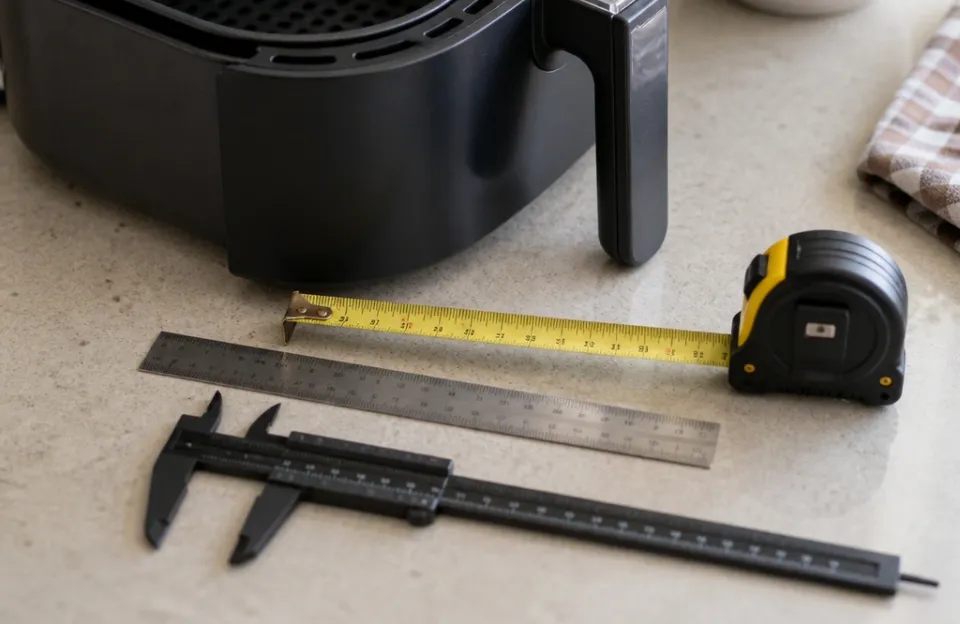
You only need a few basic items to get accurate readings. Grab them before you start so you aren't reaching across the kitchen mid-measurement.
- A flexible tape measure. A standard sewing tape works well for round baskets because it bends along the curve. A metal retractable tape is better for square or rectangular models since it holds its shape across straight edges.
- A rigid ruler or straight edge. This helps when measuring depth. Baskets slope at the bottom, making it hard to tell where the true base sits.
- Paper and pen. Write the numbers down immediately. Relying on memory while shifting the basket around leads to mixed-up dimensions.
- A flat countertop. Place the basket upside down or right side up on a level surface. Measuring a basket while holding it in the air introduces wobble and inaccurate fractions.
If you plan to cook larger batches after checking your capacity, knowing your exact space helps you scale recipes properly. For example, figuring out how many pieces fit comfortably depends entirely on these baseline numbers.
Taking the Width and Depth of the Cooking Area
The width and depth define your flat cooking surface. These two numbers dictate how much food can sit in a single layer without overlapping. Overlapping blocks airflow, which defeats the whole point of convection cooking.
For square and rectangular baskets:
Place the basket right side up on the counter. Hook the end of your metal tape measure over the top left inside edge. Pull it straight across to the top right inside edge.
Record that number as your interior width. Repeat the process from the front inside edge to the back inside edge for the depth. Measure at the widest points.
Some rectangular baskets taper slightly toward the corners. If yours does, take the measurement across the center.
For round baskets:
Round baskets require a diameter measurement rather than separate width and depth numbers. Lay the basket flat. Stretch your flexible tape measure across the exact center, from one inside wall to the opposite inside wall.
Rotate the tape 90 degrees and measure again. If the two numbers differ by more than a quarter inch, your basket is slightly oval. Record both numbers.
Always measure the inside walls, not the outer rim. The outer plastic housing adds bulk that doesn't help you cook anything.
Finding the True Usable Height Inside the Basket
Height is the trickiest dimension to pin down. Most baskets have sloped bottoms or raised ridges designed to let grease drain away from the food. You need to account for this.
Place your ruler flat across the top rim of the basket. Drop your tape measure from the bottom of the ruler straight down to the lowest point of the basket floor. That gives you the maximum interior height.
Next, measure from the top rim down to the highest point of the basket floor, which is usually a raised ridge or the top of a crisper plate. This second number is your minimum clearance.
Why does this matter? If you're trying to figure out whether a tall piece of food will fit without touching the heating element above, you need the minimum clearance. Food that touches the upper heating coil burns instantly and creates smoke.
When testing taller items, always check the gap between the top of the food and the element. Using a reliable probe to monitor internal temperatures means you won't need to pull the basket out constantly just to guess if things are done.
Write down both the maximum and minimum height. Label them clearly so you don't confuse them later.
How to Measure an Air Fryer Basket With Sloped Walls
Many modern air fryers use baskets that flare outward. The bottom is narrower than the top. If you only measure the top opening, you'll buy a liner that bunches up at the base.
If you only measure the base, you'll buy one that falls short at the rim.
Take three sets of measurements for sloped baskets:
- Top interior width and depth. Measure exactly at the upper rim.
- Bottom interior width and depth. Measure the flat area at the very base.
- Midpoint interior width and depth. Measure halfway down the wall.
Record all three. When shopping for parchment paper liners or silicone pots, manufacturers usually list the top diameter. But if you want a snug fit that doesn't block the side vents, the bottom and midpoint numbers are what you actually need to compare.
Sloped walls also change your volume calculation. A basket that flares outward holds less food at the bottom than a straight-walled box of the same top dimensions. Keep this in mind when planning meals that require heavy stacking.
Checking the Outer Footprint for Counter Space
Interior dimensions tell you what fits inside. Exterior dimensions tell you where the machine fits in your kitchen. If you're tight on counter space or planning to store the appliance inside a cabinet, you need the outer footprint.
Flip the basket assembly over or measure the main drawer unit. Run your tape measure across the widest part of the exterior shell, including any handles or latches. Handles often stick out an extra inch or two beyond the main body.
If you forget to include them, the unit won't slide into your designated shelf.
Measure the total depth from the back of the housing to the furthest point of the front handle. Finally, measure the total height from the bottom rubber feet to the highest point of the lid or control panel.
Don't forget ventilation clearance. Most manufacturers require at least four to five inches of open space behind the exhaust vent. Add that to your depth measurement when mapping out your counter layout.
Blocking the exhaust causes overheating and triggers automatic shutoffs.
Round vs Square Basket Measurements Compared
The shape of your basket changes how you calculate usable space. A round basket with a 9-inch diameter does not hold the same amount of food as a 9×9-inch square basket, even though the width sounds identical.
| Dimension Type | Round Basket (9" Diameter) | Square Basket (9" x 9") | Rectangular Basket (10" x 8") |
|---|---|---|---|
| Total Surface Area | ~63.6 sq inches | 81 sq inches | 80 sq inches |
| Max Single Layer Capacity | Lower (curved edges waste space) | Higher (straight edges maximize corners) | Highest (elongated shape fits longer items) |
| Best Measurement Tool | Flexible sewing tape | Metal retractable tape | Metal retractable tape |
| Liner Sizing Rule | Match exact diameter | Match exact width/depth | Match exact width/depth |
Square and rectangular baskets give you roughly 25% more flat cooking area than a round basket of the same stated width. This is why many people upgrade to a rectangular model when they start cooking for more than two people.
When measuring a rectangular basket, pay attention to the ratio. A 10×8 basket fits long items like sausages or asparagus better than a 9×9 square, even though their total area is nearly identical. Think about what you cook most often before deciding which dimensions matter most to you.
If you frequently prepare specific cuts that need precise spacing, understanding your basket's geometry prevents overcrowding. Leaving enough room around each piece allows hot air to circulate, which is especially important when you want that audible crunch on the skin.
Calculating Total Volume in Quarts
Air fryer brands advertise capacity in quarts. A "5-quart air fryer" sounds straightforward, but that number usually refers to the entire drawer volume, not the usable cooking space below the max fill line. You can calculate your own true volume using the dimensions you just recorded.
For a square or rectangular basket:
Multiply the interior width by the interior depth by the usable height (the minimum clearance number you took earlier). This gives you cubic inches. Divide that number by 57.75 to convert it to US liquid quarts.
Example: A basket that is 8 inches wide, 8 inches deep, and has a usable height of 3.5 inches equals 224 cubic inches. Divide 224 by 57.75. The result is roughly 3.8 quarts of usable space, even if the box says 5 quarts.
For a round basket:
Use the cylinder volume formula. Multiply Pi (3.1416) by the radius squared (half the diameter, multiplied by itself), then multiply by the usable height. Divide by 57.75 for quarts.
Example: A 9-inch diameter basket has a 4.5-inch radius. 4.5 squared is 20.25. Multiply by 3.1416 to get 63.6. Multiply by a 3.5-inch height to get 222.6 cubic inches.
Divide by 57.75 for roughly 3.85 quarts.
Knowing your calculated volume helps you scale recipes accurately. If a recipe was developed for a 4-quart basket and yours measures at 2.5 quarts, you need to halve the ingredients or cook in two batches. Guessing leads to soggy results.
Sizing Accessories and Replacement Parts Correctly
Once you know how to measure an air fryer basket, you can shop for add-ons without guessing. Silicone liners, parchment paper rounds, and grill racks all depend on exact sizing.
Parchment liners: Buy liners that match your bottom interior dimensions, not your top rim. If you buy a 9-inch liner for a basket that is 9 inches at the top but 7.5 inches at the base, the paper will fold up the sides. Folded paper blocks the vertical airflow channels built into the basket walls.
It can also blow upward into the heating element and catch fire.
Silicone pots: These stretch slightly, but you still want a close match. Use your midpoint width and depth measurements. A silicone pot that is too small shifts around during cooking.
One that is too large buckles and traps grease underneath.
Stacking racks: If you want to cook on two levels, measure your interior height first. Subtract the thickness of the food on the bottom layer and the rack itself. You need at least half an inch of clearance above the top layer of food.
Without that gap, the top layer steams instead of crisping.
Always double-check accessory packaging. Manufacturers often list the outer diameter of a liner rather than the inner usable space. Compare their specs directly against your written notes.
Reading Manufacturer Specifications Without Getting Confused
Brand spec sheets can be misleading if you don't know what you're looking at. Companies list dimensions differently depending on the region and the marketing team.
Look for the phrase "interior dimensions" or "cooking area." If the spec sheet only lists overall product dimensions, those are the exterior measurements for shipping purposes. They won't help you figure out if your dinner plates fit inside.
Some brands list capacity in liters instead of quarts. One liter equals roughly 1.05 quarts. A 4.7-liter basket is essentially a 5-quart basket.
Don't assume a higher liter number automatically means a massive size difference compared to a quart rating.
Also watch out for "basket capacity" versus "drawer capacity." In dual-basket models, the advertised number might be the combined total of both drawers. A "10-quart dual zone" air fryer actually gives you two 5-quart spaces. You can't cook a single item that requires 10 quarts of space in it.
Verify individual drawer measurements before buying large roasts or whole birds.
If you are tracking nutritional output based on batch sizes, knowing your exact drawer limits helps you portion accurately. Estimating the final caloric count per serving becomes much easier when you know precisely how many ounces the basket holds in a single layer.
Handling Dual Basket Models and Odd Shapes
Dual basket air fryers present a unique challenge. The two drawers are rarely identical. Often, one is wider and shallower, while the other is narrower and deeper.
Measure each basket separately. Do not assume symmetry.
Label your notes "Left Drawer" and "Right Drawer" or "Zone 1" and "Zone 2." Record the width, depth, and height for each. If you buy liners, you might need two different sizes. Buying a single pack of uniform liners for an asymmetrical dual unit guarantees a poor fit in at least one drawer.
Oven-style air fryers use sliding wire racks instead of deep buckets. To measure these, pull the rack completely out. Measure the flat surface from left to right and front to back.
Then measure the vertical distance between racks when they are stacked in their slots. This gap determines how thick your food can be.
Some older or specialty models feature oval baskets. Treat an oval basket like a rectangle for measurement purposes. Take the longest point for the length and the widest point for the width.
Calculate volume using the elliptical cylinder formula if you need extreme precision, though standard width times length times height gets you close enough for buying liners.
Common Mistakes When Measuring Your Basket
People rush this process and end up with numbers that don't match reality. Avoid these frequent errors.
- Measuring the outside instead of the inside. The thick plastic walls and insulation take up significant space. An exterior width of 10 inches might leave you with only 7.5 inches of cooking room. Always drop the tape inside the cavity.
- Ignoring the crisper plate. Most baskets come with a removable perforated plate at the bottom. If you measure depth with the plate removed, your number will be too tall. Food sits on top of that plate, not beneath it. Leave it in place when measuring usable height.
- Pulling the tape diagonally. A tape measure angled even slightly across a square basket adds phantom inches. Keep the tape perfectly parallel to the edges. Rest it against the bottom to keep it straight.
- Rounding up too aggressively. Rounding 7.75 inches up to 8 inches seems harmless. But when buying a rigid silicone insert, that quarter-inch difference means it won't slide into the slot. Record fractions accurately.
- Forgetting the handle clearance. On drawer-style models, the basket slides into a housing. Sometimes the interior back wall curves inward near the top to accommodate the latch mechanism. Check the width at the very top and slightly lower down to catch this taper.
Taking your time here saves frustration later. Good airflow is what makes the appliance work, and blocking it with oversized accessories ruins the texture of everything you cook. Proper spacing matters just as much as getting your marinade ratios right for flavor penetration.
Frequently asked questions
Should I measure the basket with the crisper plate inside or taken out?
Leave the crisper plate inside. Your food rests on top of that plate, so it defines your actual floor level. Measuring without it gives you a false height reading that includes the grease trap underneath, which isn't usable cooking space.
Can I use a standard ruler instead of a tape measure?
You can, but a rigid ruler struggles with round baskets and deep corners. A flexible sewing tape bends along curved walls easily. If you only have a rigid ruler, use it for the height measurement and rely on a string laid across the width, then measure the string flat on the counter.
Why does my measured quart capacity differ from the box label?
Manufacturers measure total internal volume, including the space above the recommended max fill line and the area beneath the crisper plate. Your calculated usable volume will always be smaller than the advertised number. Trust your math for cooking purposes.
Do I need to measure the basket if I am only buying parchment paper?
Yes. Parchment paper needs to lay flat without climbing the walls. If it covers the side perforations, it blocks convection currents.
Measure the bottom base of the basket specifically, and buy paper sized to that smaller dimension, not the top rim.
Is there a standard basket size across all brands?
No. Even within the same brand, a 4-quart model from one year might have different interior dimensions than a 4-quart model released later. Housing designs change, wall thickness varies, and handle mechanisms shift.
Always measure your specific unit.
Does the shape of the basket affect cooking times?
Shape changes airflow patterns. A wide, shallow rectangular basket exposes more food surface area to the top heating element than a narrow, deep round basket holding the same volume. You may need to adjust cooking times or shake intervals when switching between shapes.
Monitoring surface browning closely during your first few cooks helps dial this in. Pairing correct spacing with a fast-reading tool like a quality digital thermometer removes the guesswork entirely.
Before You Start Shopping
Getting the dimensions right takes less time than returning an ill-fitting accessory. Write down your interior width, depth, minimum height, and base dimensions. Note whether your basket is round, square, or sloped.
Keep that paper taped inside your cabinet door or saved in your phone's notes app.
Whenever you look at replacement racks, silicone liners, or try a new recipe meant for a different capacity, pull those numbers out first. Convection cooking relies entirely on air movement. Anything that alters the clearances you've measured changes how the heat behaves.
Stick to the exact measurements, respect the airflow gaps, and your food will cook evenly every time.




2 thoughts on “How to Measure an Air Fryer Basket: The Easy Guide”