The right air fryer silicone mat protects your basket from scratches, prevents food from sticking, and makes cleanup take seconds instead of minutes. Most mats are made from food-grade silicone rated for temperatures between 430°F and 480°F, which covers the full operating range of nearly every consumer air fryer on the market. When shopping, focus first on exact size compatibility with your specific model, then evaluate thickness, perforation pattern, and edge design based on what you cook most often.
This guide breaks down the key differences between available options so you can pick a mat that actually fits your machine and cooking style. We cover sizing standards, material safety certifications, performance tradeoffs between solid and perforated designs, and real limitations that product photos rarely show. You will also find answers to common questions about heat safety, dishwasher cleaning, and whether these mats change cooking times.
How to Match Mat Size to Your Specific Air Fryer Model
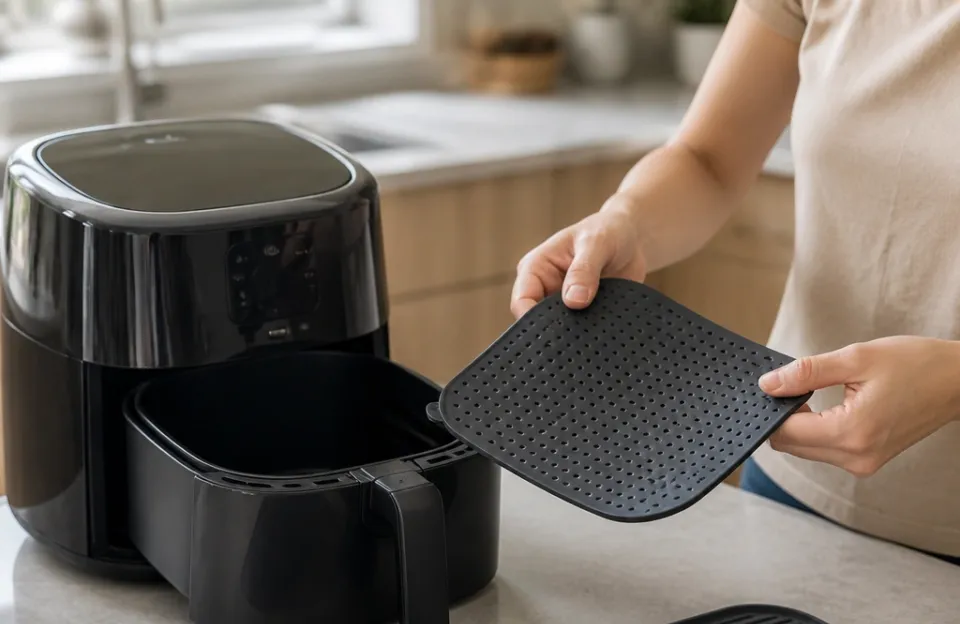
Air fryer baskets are not standardized across brands or even within the same brand’s lineup. A mat labeled "universal" often fails to fit properly because basket shapes vary between round, square, and rectangular designs with different corner radii. The only reliable way to get a proper fit is to measure the interior floor of your basket at its widest points and compare those dimensions against the mat’s stated size.
Most manufacturers list mat dimensions in inches or centimeters, but they rarely specify whether that measurement includes raised edges or lips. A mat advertised as 8 inches might have a usable flat surface of only 7.5 inches if it has a rolled rim. Always check the product description for "usable area" or "interior dimension" specifications.
If that information is missing, assume the listed size includes any border structure and subtract roughly half an inch from each side to estimate actual coverage.
Basket shape matters as much as raw dimensions. Round mats leave significant uncovered corners in square baskets, creating grease traps that defeat the purpose of using a liner. Square mats with rounded corners tend to offer better coverage in both square and round baskets than perfectly circular options.
Some brands now produce model-specific mats designed for popular units like Ninja Foodi, Cosori, or Instant Vortex models. These typically provide superior fit compared to generic alternatives, though they cost more and limit future flexibility if you upgrade your appliance.
Material Safety Standards and Temperature Ratings
Food-grade silicone is the baseline requirement for any mat going into an air fryer. Look for products that explicitly state compliance with FDA 21 CFR 177.2600 or equivalent European LFGB standards for food contact materials. These regulations govern extractable substances, heavy metal limits, and thermal stability for silicone intended for repeated food contact.
Products lacking this certification may still be safe, but there is no independent verification backing the claim.
Temperature ratings vary meaningfully between products. Most quality silicone mats handle continuous exposure up to 450°F, with peak tolerance around 480°F for short periods. Since most air fryers max out at 400°F, this provides adequate headroom for normal use.
However, some budget options carry lower ratings of 400°F or 425°F. Using these near your appliance’s maximum setting risks premature degradation, odor transfer, or surface tackiness over time. Always verify the rated temperature exceeds your typical cooking range by at least 25 degrees.
Odor and taste transfer are legitimate concerns with lower-quality silicone. New mats sometimes emit a faint smell during initial uses, which usually dissipates after two or three wash cycles. Persistent chemical odors beyond that break-in period indicate inferior curing or filler content.
According to FDA guidance on food-contact silicone, properly cured platinum-grade silicone should be odorless and taste-neutral once stabilized. If a mat continues to smell after proper seasoning, discontinue use.
Some mats include fiberglass mesh reinforcement sandwiched between silicone layers. This adds structural rigidity and prevents warping at high temperatures, especially in larger sizes. The fiberglass is fully encapsulated and never contacts food directly.
Reinforced mats maintain their shape better during handling and resist curling at the edges, which improves airflow consistency. Unreinforced thin mats may buckle or fold when loaded with heavier foods like chicken wings or root vegetables.
Perforated Versus Solid Designs for Different Cooking Tasks
Perforated silicone mats have hundreds of small holes punched through the surface to allow hot air circulation beneath the food. This design preserves the convection advantage that gives air-fried food its characteristic texture. Foods that benefit from bottom crisping, such as french fries, breaded items, or frozen appetizers, perform noticeably better on perforated mats.
The tradeoff is that liquids and fine particles can drip through the holes, requiring occasional basket cleaning underneath.
Solid silicone mats create a complete barrier between food and basket. They excel at containing marinades, sauces, or fatty drippings that would otherwise pool in the basket bottom. When preparing dishes with wet batters or glazes, a solid mat prevents mess entirely.
You might reference our notes on keeping wing sauces contained to see why containment matters for sticky preparations. The downside is reduced airflow underneath, which can result in softer bottoms on foods that rely on all-around crisping.
Some manufacturers offer hybrid designs with partial perforation or textured surfaces that attempt to balance airflow and containment. These work reasonably well for general-purpose use but don’t match dedicated perforated mats for crispness or dedicated solid mats for liquid retention. Your choice should reflect your primary cooking habits rather than seeking one perfect solution.
Many experienced users keep both types on hand and swap based on the recipe.
Thickness affects both durability and heat transfer. Standard mats run 0.4mm to 0.7mm thick. Thinner versions heat faster and store easily but tear more readily and may curl at edges.
Thicker mats around 1mm provide better insulation against direct element radiation and resist deformation, though they add slight thermal mass that can extend preheat time marginally. For daily use, mid-range thickness around 0.6mm offers the best compromise between longevity and responsiveness.
Edge Design and Handling Practicality
Raised edges or lips serve two purposes: they contain spills and provide grip points for removal. Mats with quarter-inch to half-inch raised borders keep grease and juices from migrating onto the bare basket surface. This feature is particularly valuable when cooking fatty proteins where rendering produces significant liquid.
Flat-edged mats sit flush against the basket floor but offer no spill protection and can be difficult to extract when hot.
Handle tabs or extended grip zones make removal safer and easier. Air fryer baskets retain intense heat, and reaching into a hot cavity to pinch a thin mat edge invites burns. Mats with integrated pull tabs or wider reinforced rims give you secure grab points without touching the basket walls.
This small detail significantly improves usability, especially when removing the mat immediately after cooking while it’s still flexible from heat.
Storage considerations matter for long-term satisfaction. Silicone retains creases and folds if stored improperly. Mats that come with storage tubes or can be rolled without permanent deformation maintain their flat profile longer.
Folding mats repeatedly along the same lines creates weak points that eventually crack. Hanging storage or flat stacking preserves integrity better than cramming into crowded drawers. Some thinner mats include anti-curl weights or magnetic strips to help them lay flat during use after storage.
Color choices extend beyond aesthetics. Dark-colored mats hide stains and discoloration from oils and spices, maintaining appearance longer. Light-colored mats make it easier to spot residue during cleaning and reveal scorch marks that indicate overheating.
Neutral tones like gray or beige strike a middle ground. Avoid mats with printed patterns or decorative elements on the cooking surface, as these can degrade unevenly and potentially transfer pigments to food at high temperatures.
Quick Reference Comparison of Key Mat Attributes
| Attribute | Perforated Mat | Solid Mat | Hybrid / Textured |
|---|---|---|---|
| Best For | Crispy foods, frozen items, breaded coatings | Saucy dishes, marinated proteins, baking | General purpose, moderate crisp + containment |
| Airflow | Excellent bottom circulation | Blocked underneath | Partial circulation |
| Spill Containment | Poor, liquids drain through | Complete barrier | Moderate depending on design |
| Cleaning Effort | Moderate, holes trap debris | Easy, wipe or rinse | Variable by texture depth |
| Heat Transfer Speed | Fast, minimal insulation | Slightly slower due to mass | Intermediate |
| Durability Concerns | Holes can tear if stretched | Edge curling over time | Texture wear with abrasion |
| Typical Thickness Range | 0.4mm – 0.7mm | 0.6mm – 1.0mm | 0.5mm – 0.8mm |
Real Limitations That Product Photos Don't Show
Silicone mats reduce but do not eliminate cleaning. Grease aerosolizes during air frying and coats surfaces above and around the mat. The basket walls, heating element housing, and crumb tray still require regular wiping regardless of liner use.
Expecting zero maintenance leads to disappointment and potential smoke issues from accumulated residue outside the mat’s coverage area.
Cooking times may shift slightly when introducing a mat, especially solid varieties. The additional thermal mass absorbs some initial heat energy, potentially adding one to three minutes to recipes developed for bare-basket cooking. Perforated mats minimize this effect but don’t eliminate it entirely.
Monitor doneness closely during your first few uses with a new mat and adjust timing accordingly. Using a reliable probe helps track internal temperature accurately when testing adjustments; checking digital thermometer accuracy ensures you’re measuring correctly during these calibration cooks.
Mat lifespan varies dramatically based on usage frequency and care methods. Daily users typically replace mats every six to twelve months as edges fray, surfaces become permanently sticky, or perforations enlarge. Infrequent users may get multiple years of service.
Dishwasher cleaning accelerates wear compared to hand washing due to harsh detergents and prolonged heat exposure. Hand washing with mild soap extends functional life significantly.
Compatibility issues arise unexpectedly with multi-function appliances. Air fryer lids on pressure cooker combos often have different basket geometries than standalone air fryers. Mats sized for one mode may not fit the other.
Similarly, dual-zone air fryers frequently have asymmetric basket sizes that prevent using identical mats in both compartments. Verify fitment for each distinct cooking chamber you intend to line rather than assuming uniformity across your appliance.
Frequently Asked Questions
Are silicone mats safe at maximum air fryer temperatures?
Yes, provided the mat carries a temperature rating exceeding your appliance’s maximum setting. Most quality silicone mats are rated to 450°F or higher, while consumer air fryers typically top out at 400°F. Always confirm the specific product’s rating before use, and avoid placing mats in direct contact with exposed heating elements.
Replace any mat showing signs of melting, excessive discoloration, or persistent odor.
Can I put silicone air fryer mats in the dishwasher?
Most manufacturers label their mats dishwasher-safe, but hand washing preserves longevity. Dishwasher detergents are abrasive and can degrade silicone surfaces over time, leading to stickiness or loss of non-stick properties. If you choose dishwasher cleaning, place mats on the top rack away from heating elements and skip heated dry cycles.
Hand washing with warm soapy water takes under a minute and extends usable life considerably.
Do silicone mats affect cooking time or crispness?
Solid mats can add one to three minutes to cooking time due to thermal mass and reduced underside airflow. Perforated mats have minimal impact on timing and preserve most crisping ability. For foods where maximum crunch is essential, consider skipping the mat entirely or using perforated versions only.
Always verify doneness with appropriate tools rather than relying solely on adjusted timers; referencing proper wing prep techniques shows how method affects texture regardless of liner choice.
Why does my new silicone mat smell strange during first uses?
Initial odor is common and typically harmless, resulting from residual manufacturing compounds releasing during early heat cycles. Wash the mat thoroughly before first use, then run it empty at 350°F for ten minutes to accelerate off-gassing. The smell should fade within two to five uses.
If strong chemical odor persists beyond a week of regular use, the mat may contain fillers or improper curing agents and should be replaced.
How do I prevent the mat from curling or moving during cooking?
Curling occurs when mats are stored folded or subjected to uneven heating. Store mats flat or rolled rather than folded. Preheating the air fryer with the mat already in place helps it conform to the basket shape through thermal expansion.
Heavier foods placed centered on the mat also help anchor it. Some users lightly oil the basket floor beneath the mat to increase friction, though this partially defeats the easy-clean benefit.
Can I cut a silicone mat to fit my specific basket?
Cutting is possible with sharp scissors but voids most warranties and exposes raw edges that may degrade faster. Cut edges lack the sealed finish of factory-molded perimeters and can absorb oils or develop fraying. If no appropriately sized mat exists for your model, consider parchment paper rounds as a disposable alternative or search for brand-specific accessories.
Measure carefully before cutting, as mistakes are irreversible.
Making Your Final Selection
Your ideal air fryer silicone mat depends entirely on your specific appliance dimensions and dominant cooking style. Start by confirming exact basket measurements and prioritizing fit over universal claims. Choose perforated designs if crispness matters most, solid versions for saucy or fatty preparations, and accept that no single mat excels at everything.
Budget for eventual replacement as part of routine kitchen maintenance rather than expecting permanent durability.
Pay attention to verified temperature ratings and food safety certifications over marketing language. A mat that meets FDA or LFGB standards and exceeds your appliance’s max temperature by a comfortable margin will serve reliably. Skip products with vague material descriptions or suspiciously low prices, as these often indicate compromised formulations.
The modest price difference between questionable and certified options pays for itself in safety assurance and functional lifespan.
Remember that a silicone mat is a convenience tool, not a transformation device. It simplifies cleanup and protects your investment in the appliance itself. Proper technique, accurate temperature monitoring, and appropriate food preparation still determine cooking outcomes.
Pair your chosen mat with good fundamentals, and it will earn its place as a dependable supporting player in your air frying routine.