You pull a few breakfast chops or thin-cut center slices out of the pan, and they look golden brown. But when you cut into one, it’s either dangerously pink or as dry as a piece of discarded leather. Because these cuts are only half an inch thick, trying to get a reading feels like trying to spear a moving target.
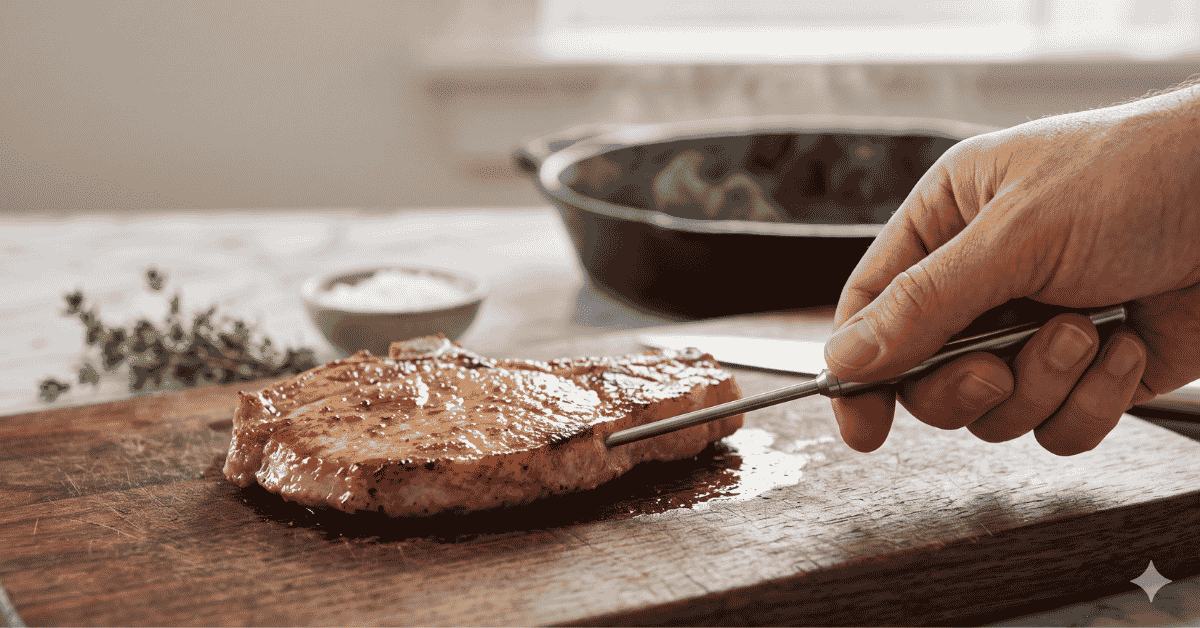
Quick Answer: To accurately check the temperature of a thin pork chop, insert the thermometer probe into the side (the edge) of the meat rather than through the top. Aim for the very center of the chop, keeping the tip away from the bone and the hot pan surface. This side-entry method provides enough contact with the sensor to give a true reading of 145°F (63°C).
Why Side Entry is the Only Way to Measure Thin Chops
When you grill or sear a thin pork chop, the heat moves through the meat almost instantly. Unlike a thick roast where the center stays cool for a long time, a thin chop has a very small “safe zone” for a thermometer tip to rest. If you poke the probe through the top of the meat, the tip often passes straight through and touches the sizzling pan or the grill grate.
This gives you a reading of the cooking surface, not the meat.
Most digital instant-read thermometers have a sensor located about half an inch to an inch from the tip. If you go in from the top on a chop that is only half an inch thick, the sensor isn’t even fully submerged in the protein. By inserting the probe through the side, you allow the entire sensing area of the needle to be surrounded by the meat.
This gives the device enough time and surface area to register the internal heat correctly.
The goal is to hit the “thermal center”, the point furthest from all heat sources. In a thin cut, that center is a narrow plane running through the middle of the thickness. Side entry is the only way to keep the probe on that plane long enough to get a steady number.
The Physics of the Digital Sensor
Standard meat thermometers aren’t all the same. Old-school dial thermometers often need two inches of immersion to work, making them useless for thin pork. Modern digital “instant-read” versions are much better because their sensors are right at the tip.
Even so, they need to be fully encased in the meat to avoid being “tricked” by the cool air in the kitchen or the intense heat of the pan.
Avoiding the Bone and Fat
Pork chops often come with a curved bone or a strip of fat along the edge. Bone conducts heat differently than muscle; it usually heats up faster or holds onto heat longer. If your probe touches the bone, the display might show 160°F while the actual meat is still at 135°F.
Always aim for the thickest part of the muscle, staying at least half an inch away from the bone.
How to Check the Temperature Step-by-Step
Checking a thin chop requires a bit of dexterity. You aren’t just stabbing the meat; you’re grazing the middle of it. Use these steps to get it right every time without burning your fingers.
- Lift the meat: Use a pair of tongs to pick the pork chop up off the pan or grill grate. Holding it vertically makes it much easier to see the side profile.
- Locate the thickest point: Even thin chops have a slightly thicker end. This is where you want to aim.
- Insert horizontally: Push the thermometer probe into the side of the chop. You want the needle to travel toward the center of the meat, staying parallel to the top and bottom surfaces.
- Wait for the settle: Digital thermometers take about 2 to 5 seconds. Hold steady until the numbers stop jumping.
- Check multiple spots: If the chop is irregularly shaped, check two different side-entry points to be sure the whole piece is safe.
According to USDA food safety guidelines, pork should reach a minimum internal temperature of 145°F (63°C) followed by a three-minute rest period. Because thin chops lose heat quickly once they leave the pan, that rest period is vital for finishing the cook and keeping the juices inside.
Choosing the Right Tool for the Job
Not every kitchen tool can handle a thin cut of meat. If you’re using a thick, heavy leave-in thermometer, the kind with a wire that stays in the oven, you’ll likely struggle. Those probes are too bulky and will simply tear a thin chop apart or fall out.
An instant-read digital thermocouple thermometer is the gold standard here. These have very thin tips (often called “reduced tip” probes) that can slide into a quarter-inch space without much resistance. They also react much faster than cheaper thermistor models.
When you’re dealing with a thin chop that can go from perfect to overcooked in sixty seconds, speed is everything.
If you only have an infrared “laser” gun, put it away for this task. Infrared thermometers only measure surface temperature. The surface of your pork chop will hit 200°F long before the inside is safe to eat.
You must use a probe that physically enters the meat.
When the Side-Entry Method Doesn’t Work
There are a few times when even the side-entry method is tricky. If you are cooking “paillard” style pork, which is pounded out until it is paper-thin, you won’t be able to get a probe into the side at all. The meat is simply too thin to hold the needle.
In these cases, you have to rely on visual cues and timing. For meat thinner than a quarter inch, look for the proteins to turn opaque and the juices to run clear. However, for 90% of the thin-cut chops sold in grocery stores (usually listed as “breakfast chops” or “thin-cut loin chops”), the side-entry probe method works perfectly.
Another edge case is the “stuffed” thin chop. Some people try to slice a pocket into a thin chop to add breading or cheese. If you do this, the thermometer should go into the meat part of the “sandwich,” not the stuffing itself.
The meat is what carries the risk of bacteria like Trichinella, so the protein temperature is the priority.
Common Mistakes When Testing Thin Pork
Many home cooks get frustrated and stop using thermometers on thin meat because they keep getting weird results. Usually, it’s because of one of these habit-based errors:
- Measuring while the chop is flat on the pan: The heat from the pan travels up the probe and gives a false high reading. Always lift the meat with tongs before probing.
- Pushing the probe all the way through: If the tip comes out the other side, you’re measuring the air temperature of your kitchen.
- Ignoring the sensor location: If your thermometer has a “dimple” on the shaft, that’s where the sensor is. That dimple must be fully inside the meat. If it’s outside, the reading is junk.
- Forgetting to calibrate: If your thermometer is off by 5 degrees, it’s the difference between a juicy chop and a dry one. Test it in a glass of ice water; it should read exactly 32°F.
Frequently Asked Questions
Can I just cut the pork chop open to see if it’s done?
You can, but it’s not a great idea. Cutting the meat lets the moisture escape immediately. By the time you see that the middle is no longer pink, you’ve lost the juices that make a thin chop palatable.
A thermometer allows you to check without ruining the texture.
Is a little pink in a thin pork chop okay?
Yes. Modern pork is much safer than it was decades ago. The USDA updated their advice years ago to reflect that 145°F (which often results in a blush of pink) is perfectly safe.
If you wait until it is white all the way through, it will likely be over 160°F and very tough.
What if the thermometer won’t stay in the thin edge?
If the meat is too soft to hold the probe, try “stacking.” Fold the chop over itself with your tongs to create a thicker mass, then probe through the doubled-up meat. Just remember that this might give a slightly lower reading than the reality, so use it as a rough guide.
Why does my thermometer show a different temp every time I move it?
Thin chops cook unevenly because of the pan’s hot spots and the way the meat curls. Always trust the lowest number you find. If one side is 150°F but the other is 135°F, the chop isn’t done yet.
Before You Go
Mastering the side-entry technique changes how you cook pork. It takes the guesswork out of quick-cooking meats that usually fail the “poke test.” Don’t be afraid to take the meat off the heat a few degrees early, around 140°F, as “carryover cooking” will bring it up to the safe 145°F mark while it sits on your plate. Just remember: lift the meat, go in from the side, and stay away from the bone.