You’re standing over the grill, peering at a chicken breast that looks perfectly charred on the outside. You poke it with a fork, and the juices run clear, but a quick check with the digital thermometer shows 155°F. You might feel tempted to pull it off and eat, thinking it’s close enough.
But that ten-degree gap is the difference between a safe meal and a night of severe food poisoning.
Quick Answer: Chicken must reach 165°F (74°C) because that is the temperature at which the USDA confirms common foodborne pathogens, specifically Salmonella and Campylobacter, are killed instantly. While lower temperatures can kill bacteria over a longer period, 165°F provides a “safety margin” that accounts for cold spots in the meat and varying thicknesses.
The science behind the 165°F rule
Cooking is more than just making food taste good; it is a biological decontamination process. Raw poultry naturally carries high levels of bacteria that live in the bird’s digestive tract. During processing, these bacteria can spread to the meat.
Unlike beef, where bacteria mostly stay on the surface, the porous structure of chicken allows pathogens to move deep into the muscle fibers.
According to USDA food safety guidelines, 165°F is the magic number for an “instant kill” of Salmonella. At this specific heat, the thermal energy is high enough to break down the proteins and cell walls of the bacteria immediately. If you stop at a lower temperature, some bacteria might survive and multiply rapidly once the meat begins to cool down on your plate.
It’s worth noting that bacteria death is a function of both time and temperature. You could technically make chicken safe at 150°F if you held it at that exact temperature for several minutes. However, in a home kitchen, maintaining a perfectly steady internal temperature across the entire bird is nearly impossible.
Sticking to the 165°F standard removes the guesswork and ensures safety regardless of how your oven or grill fluctuates.
The threat of Salmonella and Campylobacter
Salmonella is the most famous risk associated with undercooked poultry, but Campylobacter is just as common. These pathogens are incredibly resilient. They survive freezing temperatures and can live on kitchen surfaces for hours.
Inside the bird, they thrive in the moist, protein-rich environment of the meat.
When you ingest these live bacteria, they attack the lining of your intestines. This leads to symptoms like fever, cramps, and dehydration. For children, the elderly, or those with weakened immune systems, these infections can become life-threatening.
The 165°F threshold is the industry standard because it has been proven through decades of laboratory testing to neutralize these specific threats across all types of poultry, including turkey and duck.
Why chicken differs from steak
Many people wonder why they can eat a rare steak at 125°F but must blast their chicken to 165°F. The answer lies in the density and harvest process of the meat. Beef is a dense muscle, and the interior is generally sterile.
When bacteria like E. coli land on a steak, they stay on the outside. Searing the exterior of a steak kills those bacteria, leaving the pink center safe to eat.
Chicken has a much looser, more fibrous texture. Pathogens don’t just sit on the skin; they travel through the tissues. Furthermore, the way poultry is processed, often involving water baths, can spread bacteria throughout the entire bird.
Because you cannot be sure where the bacteria are hiding, you have to heat the entire piece of meat to a temperature that kills them everywhere.
How to measure the temperature correctly
Knowing the target is 165°F only helps if you know how to find it. Many home cooks rely on “eye-balling” the meat, looking for white flesh or clear juices. These signs are notoriously unreliable.
A chicken breast can look white and opaque at 150°F, which is still in the “danger zone” for bacteria.
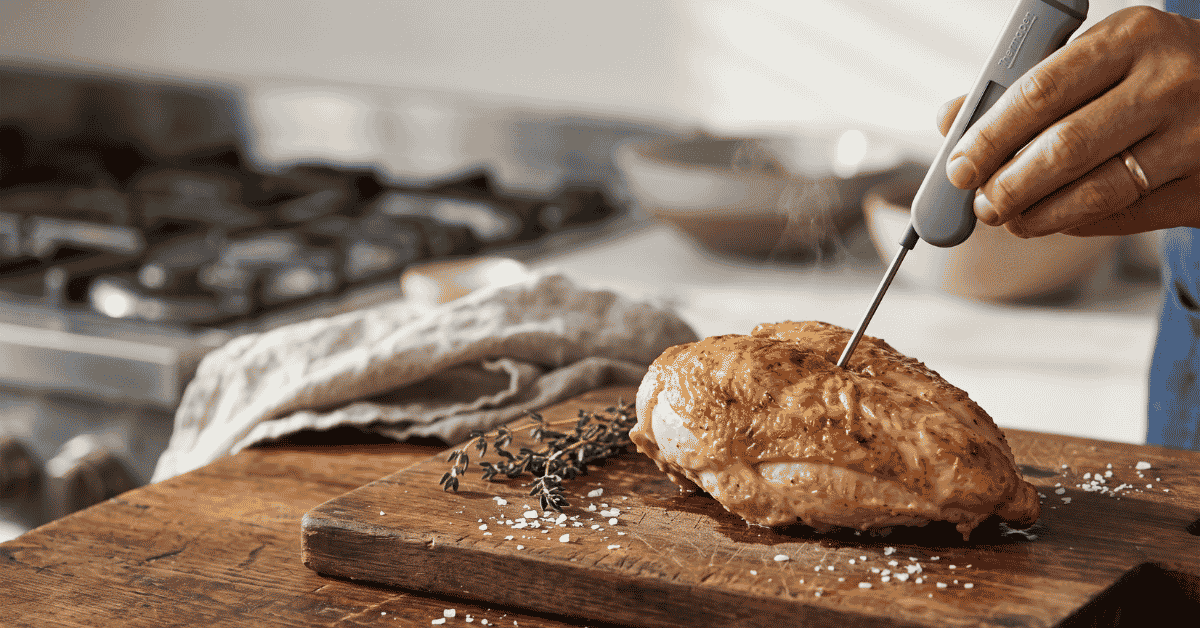
The only way to be sure is with a high-quality digital instant-read thermometer. To get an accurate reading, insert the probe into the thickest part of the meat without hitting bone. Bone conducts heat differently than muscle and can give you a false high reading.
For a whole bird, the best spot is the inner thigh, near the breast, but not touching the bone.
The concept of carry-over cooking
One of the reasons people hate the 165°F rule is that they think it leads to dry chicken. This usually happens because they pull the chicken off the heat exactly at 165°F, and then the temperature continues to rise while the meat rests. This is called carry-over cooking.
In a hot oven or on a grill, the exterior of the meat is much hotter than the center. When you take the meat away from the heat source, that residual heat from the outside continues to move inward. A large chicken breast might rise another 3 to 5 degrees while resting.
To hit that 165°F target perfectly without overcooking, many chefs pull the meat at 160°F or 162°F and let it rest under foil until the thermometer hits the 165°F mark.
Dark meat vs. white meat
While 165°F is the safety minimum for all parts of the bird, it isn’t always the best temperature for flavor. White meat (the breast) is very lean and starts to turn dry and stringy if it goes much past 165°F. It is best to pull it as close to the safety limit as possible.
dark meat (thighs and drumsticks) contains more connective tissue and collagen. While it is technically safe at 165°F, it can be tough or “rubbery” at that temperature. Most cooks find that chicken thighs taste much better when cooked to 175°F or even 185°F.
At these higher temps, the collagen melts into gelatin, making the meat succulent and tender. Because dark meat has a higher fat content, it doesn’t dry out as fast as the breast.
Practical steps for safe handling
Temperature is the final line of defense, but safety starts the moment you bring the chicken home. Pathogens can spread through “cross-contamination” long before the stove is ever turned on.
-
Skip the wash: Many people think they should wash raw chicken in the sink. This is a mistake. Rinsing chicken splashes bacteria-laden water onto your counters, faucets, and nearby dishes. The heat of the oven kills the bacteria; the water in the sink just spreads it.
-
Thaw correctly: Never thaw chicken on the counter. Always move it from the freezer to the fridge 24 hours before you need it. If you’re in a rush, use a cold water bath, changing the water every 30 minutes, or use the defrost setting on a microwave.
-
Separate tools: Use a dedicated cutting board for raw poultry. If you use a knife to trim raw chicken, don’t use that same knife to chop the salad without a thorough scrubbing in hot, soapy water.
Edge cases and variations
There are a few scenarios where the 165°F rule might feel confusing or different. For example, ground chicken must always reach 165°F. Unlike a whole breast, ground meat has been mixed and aerated, meaning any bacteria that were on the surface are now distributed throughout the entire batch.
If you are using a Sous Vide machine, the rules change slightly. Sous vide allows you to hold meat at a very precise temperature for an extended period. Because you can hold the chicken at 145°F for over an hour, you achieve the same bacterial “kill rate” as a split second at 165°F.
This results in incredibly juicy meat, but it requires specialized equipment and a deep understanding of time-to-temperature pasteurization tables. For standard roasting, frying, or grilling, 165°F remains the only safe benchmark.
Leftovers and reheating
The 165°F rule isn’t just for the first time you cook the bird. When you reheat leftover chicken, you should aim for the same temperature. Cold chicken in the fridge can still grow certain types of bacteria, and reheating it to a lower temperature only serves to “wake up” the pathogens without killing them.
Using a microwave often creates cold spots, so it is best to stir or flip the chicken and check it with a thermometer in multiple places.
Common mistakes or misconceptions
Even experienced cooks sometimes fall for myths regarding poultry safety. These errors can lead to either unsafe food or a very disappointing meal.
-
“Pink meat means it’s raw”: This isn’t always true. Young chickens often have thin bones that leak pigment into the surrounding meat, leaving a purple or pink tint even after it hits 165°F. Similarly, smoked chicken often has a pink “smoke ring.” Trust the thermometer, not the color.
-
“Cooking it until it’s tough is safer”: There is no extra safety benefit to cooking chicken to 190°F. Once the bacteria are dead at 165°F, they stay dead. Overcooking past that point only ruins the texture.
-
Forgetting to calibrate the thermometer: If your thermometer is off by five degrees, you could be eating chicken that is actually 160°F. Periodically test your thermometer in a glass of crushed ice and water; it should read 32°F.
-
Checking the wrong spot: If you probe the thin edge of a chicken breast, it will hit 165°F while the center is still 140°F. Always hunt for the thickest point.
Standard Temperature Guide for Poultry
Poultry Type Minimum Internal Temp Best Culinary Temp
Chicken Breast 165°F (74°C) 165°F (Juicy)
Chicken Thighs 165°F (74°C) 175°F-185°F (Tender)
Ground Chicken 165°F (74°C) 165°F
Whole Turkey 165°F (74°C) 165°F in breast / 175°F in thigh
Leftovers 165°F (74°C) 165°F
Frequently asked questions
Can I eat chicken if it’s 160°F?
It is not recommended to eat chicken at 160°F unless you have verified that the temperature stayed at that level for several minutes to allow for pasteurization. For most home cooking methods, 160°F is considered undercooked and may still contain active Salmonella or Campylobacter. If you pull it at 160°F and the “carry-over” heat brings it up to 165°F while resting, it is safe to eat.
Why is 165 the number for chicken but 145 for pork?
Pork used to have a higher recommended temperature due to the risk of trichinosis, a parasite. Modern farming has largely eliminated that risk, and the USDA lowered the pork recommendation to 145°F. Chicken, however, still carries a high natural load of bacteria that require more heat to neutralize instantly.
Is it safe if a whole chicken is still pink near the bone?
Yes, as long as the thermometer confirms the meat has reached 165°F. Hemoglobin in the bones of younger chickens can leach into the meat during cooking, causing a persistent pink or even red color near the joints. This is a cosmetic issue, not a safety one.
Does organic chicken have different temperature rules?
No, the temperature requirements are the same for all chicken, whether it is organic, free-range, or conventionally raised. Pathogens like Salmonella occur naturally in the environment and can be found in any bird regardless of their diet or living conditions.
Worth remembering
Hitting 165°F is the single most effective thing you can do to prevent foodborne illness in your home. It’s a hard science, not a suggestion. While it can be frustrating to wait those extra few minutes or to worry about the meat drying out, the peace of mind that comes with a safe meal is worth the effort.
Invest in a good thermometer, learn where to probe the meat, and always allow for a few minutes of resting time. When you master the balance between safety and technique, you’ll find that chicken can be both perfectly safe and incredibly delicious.