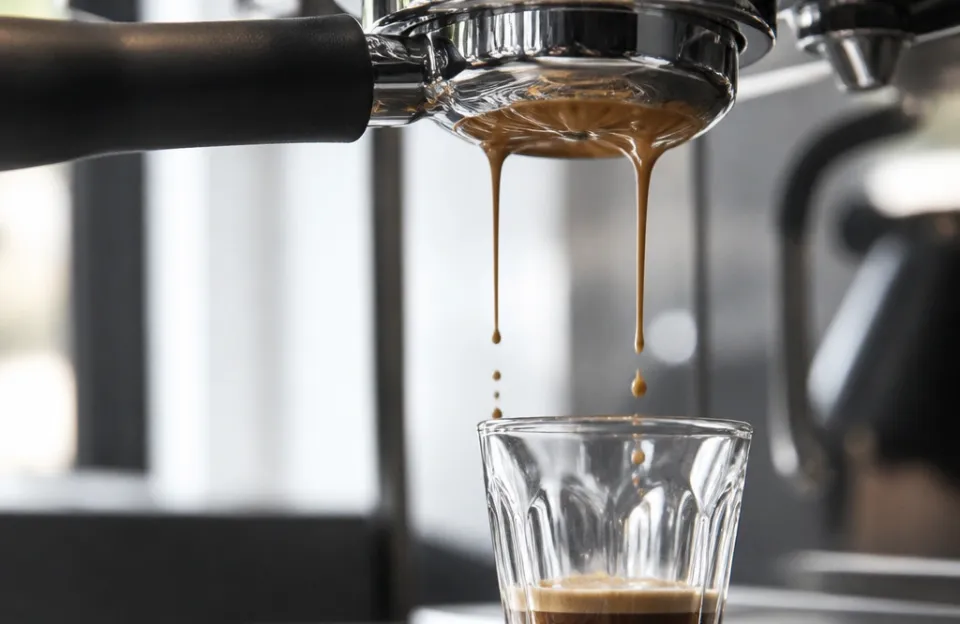
An espresso machine is a device that forces hot water through finely ground coffee at high pressure to produce a concentrated, syrupy shot topped with crema. This process, defined by the National Coffee Association as requiring 9 bars of atmospheric pressure, distinguishes true espresso from all other brewing methods. Understanding how these machines generate and regulate that pressure explains why they range in price from a few hundred dollars to several thousand.
The Core Definition of Espresso
Espresso is not a bean or a roast level. It is a preparation method. To call a drink espresso, it must meet specific physical parameters established by Italian standards and adopted globally.
The Specialty Coffee Association defines a standard double shot as using 18 to 20 grams of coffee, extracted with water between 195°F and 205°F, at 9 bars of pressure, yielding roughly 36 to 40 grams of liquid in 25 to 30 seconds.
If a machine cannot sustain 9 bars of pressure at the group head while water flows through a packed puck of coffee, it is not making espresso. Many budget machines advertise “15 bar” or “20 bar” pumps. These numbers refer to the pump’s maximum output capacity, not the brewing pressure.
Excess pressure is usually bled off via a valve before reaching the coffee. True espresso requires stable pressure during extraction, not just peak pressure at startup.
This distinction matters when shopping. A machine’s ability to hold steady pressure and temperature determines shot quality more than any cosmetic upgrade or digital display. When evaluating options, look for specifications that address thermal stability and pressure regulation rather than marketing claims about bar ratings.
For those comparing kitchen appliances across categories, understanding performance specs over marketing terms is similar to checking safe cooking temperatures rather than relying on wattage alone.
How Pressure and Heat Create Espresso
The magic of espresso happens when two variables collide: hydraulic pressure and thermal energy. Water heated to precisely 200°F acts as a solvent. At 9 bars of pressure (approximately 130 PSI), this water penetrates the dense coffee puck uniformly.
The pressure emulsifies insoluble oils from the coffee grounds into microscopic droplets suspended in water. This emulsion creates the body and mouthfeel unique to espresso.
The golden foam on top, called crema, is a direct result of this pressurized emulsification. Carbon dioxide trapped in fresh coffee beans dissolves into the hot water under pressure. When the liquid exits the portafilter and hits atmospheric pressure, the CO2 expands rapidly, forming tiny bubbles stabilized by coffee oils.
Without sufficient pressure, there is no emulsification. Without proper heat, there is insufficient extraction. Both systems must work in concert.
Temperature stability is often the weak link in entry-level machines. If water enters the group head at 185°F one moment and 210°F the next, the shot will taste sour then bitter within the same extraction. Higher-end machines use saturated groups or active heating elements in the brew path to maintain thermal equilibrium.
This engineering challenge explains much of the cost difference between consumer and commercial equipment.
Main Types of Espresso Machines
Not all espresso machines achieve pressure and temperature the same way. The mechanism used defines the user experience, maintenance needs, and ceiling for shot quality. There are four primary categories found in US homes.
Manual Lever Machines
These are the original espresso machines. You pull a lever to either directly force water through the coffee (direct lever) or compress a spring that then pushes the water (spring lever). There is no electric pump.
Pressure profiling is entirely manual. Spring levers provide a natural pressure curve that starts low, peaks around 9 bars, and tapers off. This forgiveness makes them popular despite the learning curve.
Manual machines have excellent thermal stability because the heavy brass group head retains heat well. They are also quiet since there is no vibrating pump. The trade-off is physical effort and inconsistency until you develop muscle memory.
They suit enthusiasts who view espresso as a craft rather than a convenience.
Semi-Automatic Machines
This is the most common category for serious home baristas. An electric pump provides pressure, but you control the grind dose, tamp, and shot timing. The machine handles water heating and pump activation.
You start and stop the extraction manually via a switch or button.
Semi-automatics offer the best balance of control and consistency. They allow you to adjust variables based on bean age and roast profile while removing the physical variable of manual pressure generation. Most machines in the $500 to $2,000 range fall here.
They require a separate grinder, which is non-negotiable for good results. Choosing the right model often depends on matching it to your existing setup, much like verifying basket dimensions before buying accessories.
Super-Automatic Machines
These machines handle everything from grinding to extraction to milk frothing at the push of a button. Internal grinders dose and tamp automatically. Brew units are self-cleaning.
They prioritize convenience over absolute ceiling quality.
Super-automatics are ideal for households where multiple people want espresso without learning technique. Shot quality is consistent but generally lower than a dialed-in semi-automatic because the internal grinder and brew unit have limited adjustment range. Maintenance involves regular cleaning cycles and descaling.
Prices typically run $800 to $3,000.
Dual Boiler and Heat Exchanger Systems
These are advanced semi-automatics designed for simultaneous brewing and steaming. Single boiler machines require waiting between pulling a shot and steaming milk because brew temp (200°F) and steam temp (250°F+) differ. Heat exchangers solve this with a pipe running through a steam boiler.
Dual boilers use separate dedicated boilers for each function.
Dual boilers offer superior temperature stability and unlimited back-to-back drinks. They are larger, heavier, and more expensive ($1,500 to $4,000+). They make sense only if you regularly serve multiple milk drinks or demand precise temperature control for light roasts.
For most single-drink users, a single boiler or thermoblock suffices.
| Machine Type | Best For | Learning Curve | Price Range (USD) | Key Limitation |
|---|---|---|---|---|
| Manual Lever | Craft enthusiasts | High | $400–$1,500 | Physical effort, slow workflow |
| Semi-Automatic | Home baristas seeking quality | Medium | $500–$2,500 | Requires separate grinder, skill development |
| Super-Automatic | Convenience-first households | Low | $800–$3,000 | Lower shot ceiling, complex repairs |
| Dual Boiler | High-volume or precision seekers | Medium-High | $1,500–$4,000+ | Size, warm-up time, cost |
Critical Components That Drive Performance
Understanding what an espresso machine is requires knowing its vital organs. Three components determine whether a machine can actually produce café-quality results.
The Pump
Rotary pumps are quieter, longer-lasting, and capable of plumbing directly into a water line. They appear in machines above $1,500. Vibratory pumps are smaller, cheaper, and louder.
They dominate the sub-$1,000 market. Neither inherently produces better espresso if pressure is regulated correctly, but rotary pumps offer smoother pressure delivery and easier repair.
Vibratory pumps pulse at 60Hz. This pulsation can cause minor pressure fluctuations. Some manufacturers add dampeners to smooth this out.
Rotary pumps spin continuously, providing laminar flow. For most home users, a well-regulated vibratory pump is perfectly adequate. Don’t dismiss a machine solely because it uses one.
The Group Head
This is where water meets coffee. Commercial E61 groups are heavy brass assemblies that act as thermal buffers. They stay hot between shots, ensuring the first ounce of water isn’t cooled by cold metal.
Saturated groups, where brew water circulates directly through the group, offer even better stability.
Lighter, aluminum groups in budget machines lose heat quickly. The first shot after idle may need a cooling flush or extended warm-up. Group head mass matters.
A 5-pound brass group stabilizes temperature better than a 1-pound aluminum one. This is why weight often correlates with performance in this category.
Temperature Control Systems
PID controllers measure water temperature digitally and adjust heating elements in real-time. They replaced mechanical thermostats in mid-tier and premium machines. A PID maintains temperature within 1-2°F.
Thermostats can swing 10-15°F.
For dark roasts, thermostat machines work fine. Light roasts, which extract best at higher temperatures, demand PID precision. If you plan to explore single-origin coffees or lighter profiles, prioritize PID control.
It removes temperature as a variable so you can focus on grind and dose adjustments.
Why Grinders Matter More Than the Machine
An espresso machine cannot fix bad grind. Uniform particle size is the prerequisite for even extraction. Blade grinders produce boulders and fines that cause channeling, where water finds paths of least resistance through the puck.
The result is simultaneously sour and bitter.
Burr grinders crush beans between two abrasive surfaces set at a fixed distance. This produces uniform particles. Stepless adjustment allows micro-tuning dial-in.
Flat burrs tend toward unimodal distribution (uniform size). Conical burrs produce bimodal distribution (two size peaks), which some argue enhances body and sweetness.
Budget allocation should reflect this reality. A $500 grinder paired with a $500 machine outperforms a $100 grinder paired with a $900 machine every time. The grinder sets the ceiling.
The machine merely reaches it. If funds are limited, buy a capable semi-automatic and the best grinder you can afford. Upgrade the machine later.
This prioritization mirrors how selecting compatible accessories determines actual utility regardless of base appliance quality.
Common Misconceptions About Home Espresso
Several myths persist that lead buyers astray. Addressing them saves money and frustration.
More bars equal better espresso. False. Nine bars is the target. Machines advertising 15 or 20 bars use excess pressure to compensate for poor design or pre-ground coffee pods.
Quality machines include overpressure valves to limit brew pressure to 9 bars regardless of pump rating.
Capsule machines make real espresso. Technically, no. Capsule systems operate at lower pressures with coarser grinds and less coffee. They produce an espresso-like beverage that is convenient and consistent.
If convenience is paramount, they are valid choices. If you seek true espresso texture and intensity, they fall short.
Built-in grinders eliminate the need for standalone ones. Only in super-automatics. Semi-automatics with integrated grinders exist but sacrifice grinder quality for compactness. Standalone grinders offer better burrs, cooler operation, and easier replacement.
Integrated solutions are compromises.
Expensive machines guarantee good shots. No machine guarantees results. Skill, fresh beans, and proper grinding matter more. An expensive machine raises the ceiling and adds consistency.
It does not replace fundamentals. Budget machines can produce excellent shots in skilled hands.
Maintenance Requirements for Longevity
Espresso machines are plumbing devices operating under pressure and heat. Neglect leads to failure. Three maintenance tasks are non-negotiable.
Daily backflushing (for machines with three-way solenoid valves) removes coffee oils from the brew path. Use blind baskets and detergent weekly. Plain water backflush daily.
Oils go rancid and taint future shots.
Regular descaling prevents mineral buildup in boilers and pipes. Frequency depends on water hardness. Test your water.
Hard water requires monthly treatment. Soft water may need it quarterly. Use manufacturer-approved descalers.
Citric acid works for some machines but damages others. Check manuals.
Group gasket replacement every 6-12 months maintains seal integrity. Rubber hardens under heat. Leaks indicate failure.
Replacement costs under $10 and takes five minutes. Ignoring leaks damages group heads and creates mess.
Water filtration extends machine life dramatically. Scale is the number one killer of espresso machines. A simple carbon filter or softening system protects your investment.
Consider filtration part of the initial purchase budget, not an optional add-on. Proper upkeep ensures safety and performance, similar to following material safety guidelines for any heated kitchen appliance.
Choosing Your First Machine Based on Real Needs
Your situation dictates the right choice. Match your profile to the recommendation below.
You want café drinks with minimal fuss. Choose a super-automatic. Accept slightly lower quality for guaranteed morning ease. Budget $1,000-$1,500 for reliable models.
Avoid the cheapest options. Repair costs on complex machines justify mid-tier spending.
You enjoy tinkering and learning. Choose a semi-automatic with PID and E61 or saturated group. Pair with a stepless burr grinder. Budget $1,200-$1,800 total.
Expect three months of learning before consistent results. The journey is the point.
You drink straight espresso and value ritual. Consider a spring lever. Flair or Cafelat Robot offer entry points under $500. Traditional machines like La Pavoni require more investment.
Thermal management becomes your skill. Shots reward patience uniquely.
You entertain frequently. Prioritize dual boiler or heat exchanger. Simultaneous brew and steam capability prevents guest bottlenecks. Warm-up times matter.
Commercial-style machines shine here. Budget $2,000+.
Space is severely limited. Thermoblock machines heat instantly and store compactly. Breville Bambino or similar footprints fit tight counters. Trade thermal mass for space savings.
Accept shorter steam wands and lighter groups.
Frequently Asked Questions
Can I make regular coffee with an espresso machine?
Technically yes, but poorly. Espresso machines use fine grinds and high pressure unsuitable for drip-style extraction. Some machines include pressurized baskets or long-shot settings that approximate Americano-style drinks.
True filter coffee requires different equipment. Buy an espresso machine for espresso.
How long does an espresso machine last?
Quality home machines last 10-15 years with proper maintenance. Cheap plastic-bodied machines often fail within 3-5 years. Metal construction, serviceable parts, and brand support determine lifespan.
Commercial machines in home use can last decades. Treat maintenance as insurance.
Is distilled water safe for espresso machines?
No. Distilled water lacks minerals needed for boiler sensors to detect water level. It can also leach metals from internal components.
Use filtered tap water or third-wave water packets designed for espresso. Target 50-100 ppm total dissolved solids. Zero TDS water damages machines.
Do I really need a scale for espresso?
Yes. Volumetric measurements are unreliable due to bean density variation and grind changes. Weight-based dosing (18g in, 36g out) provides repeatable results.
A $20 scale with 0.1g resolution transforms consistency. Eyeballing doses guarantees frustration during dial-in.
Why does my espresso taste sour or bitter?
Sour indicates underextraction from coarse grind, low temperature, or fast flow. Bitter indicates overextraction from fine grind, high temperature, or slow flow. Adjust one variable at a time.
Grind size fixes most issues. Temperature adjustments address persistent problems. Freshness matters too.
Beans older than six weeks stale regardless of technique.
Understanding what an espresso machine is ultimately comes down to recognizing it as a precision instrument for extracting flavor under controlled conditions. The right machine matches your willingness to engage with that precision. Whether you seek automation or artistry, the physics remain constant.
Respect them, and the machine rewards you. Ignore them, and even expensive equipment disappoints. Start with realistic expectations, invest in grinding, and let your palate guide upgrades over time.
As an Amazon Associate, we earn from qualifying purchases.