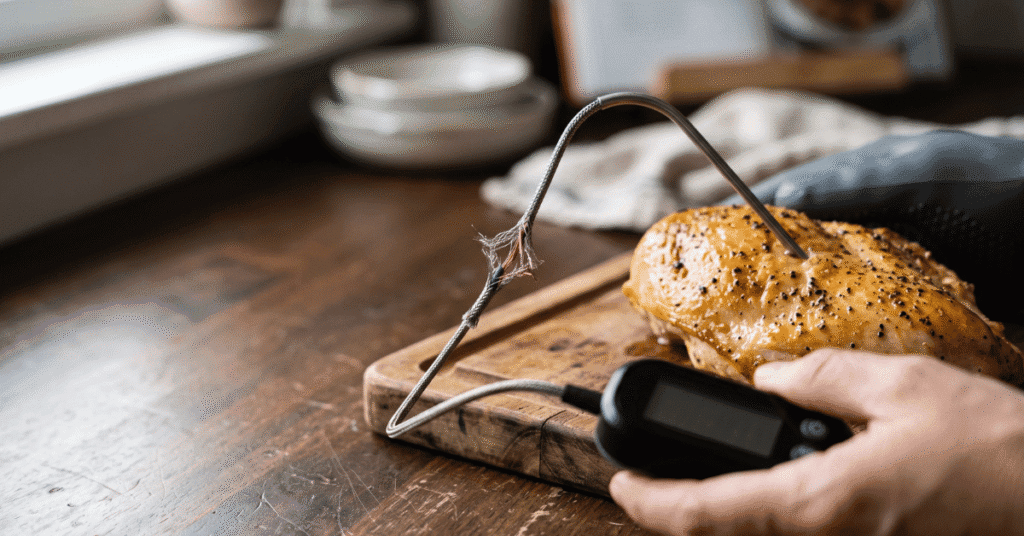
You’re halfway through slow-smoking a brisket or roasting a Sunday chicken when you notice the braided stainless steel cord on your probe looks fuzzy. A few tiny wires are poking out, or perhaps the outer casing has kinked and split, exposing the internal insulation. It’s a moment of frustration because these tools aren’t exactly cheap, and you need an accurate reading right now to avoid serving raw meat.
Quick Answer: A frayed meat thermometer probe wire is not usually an immediate fire or “explosion” hazard, but it is dangerous for food safety. Frayed wires lead to inaccurate temperature readings, which can result undercooked food and foodborne illness. Additionally, exposed sharp metal strands can break off into your food, and damaged insulation can cause a short circuit that ruins your expensive transmitter base.
Why a Frayed Wire is a Risk to Your Meal
When the protective mesh or silicone coating on a probe wire breaks, the internal sensors lose their “shield.” These wires are designed to carry a very specific electrical signal from the thermistor in the tip back to the display unit. This signal is incredibly sensitive to changes in resistance.
A fray in the wire often means the internal copper or nickel wires are being pinched, stretched, or exposed to moisture. When moisture from steam or meat juices enters a frayed wire, it changes the electrical resistance. This causes your thermometer to give a “false high” or “false low” reading.
You might think your steak is a perfect 135°F when it’s actually sitting at a dangerous 110°F.
Beyond the reading itself, small shards of the braided stainless steel jacket can snap off. These wires are thinner than a human hair and can easily get lodged in the meat. If someone swallows a tiny piece of metal wire, it can cause dental damage or internal irritation.
The Accuracy Problem
The most common outcome of a frayed wire is the dreaded “HHH” or “LLL” error code on your digital display. This happens when the two internal wires touch each other, a short circuit, or when one wire snaps completely.
Even if you don’t see an error code, a frayed wire often “drifts.” You might notice the temperature jumping by 10 or 20 degrees whenever you wiggle the cord. In the world of food safety, a thermometer you can’t trust is worse than no thermometer at all. According to USDA Food Safety guidelines, using a calibrated and functioning thermometer is the only way to confirm that harmful bacteria like Salmonella or E. coli have been destroyed.
Electrical and Fire Risks
Most people worry about getting an electric shock from a frayed probe wire. Luckily, meat thermometers run on very low voltage, usually from a few AAA batteries or a small lithium-ion cell. There isn’t enough power running through those wires to give you a dangerous shock.
However, there is a small risk of a fire if you are using an oven or smoker. If the frayed wire allows the internal insulation to touch a heating element, it can melt or ignite. More likely, the short circuit caused by the fray will send a “jolt” back to the main unit, frying the delicate circuit board and turning your $100 wireless setup into a paperweight.
Identifying Different Types of Probe Damage
Not all fraying looks the same, and some types are more urgent than others. Heat, moisture, and mechanical stress are the three main enemies of your probe.
- Braid Fraying: This is when the outer stainless steel mesh starts to look “hairy.” It usually happens near the junction where the wire meets the metal probe handle.
- Kinking: Sharp bends in the wire can break the internal conductors even if the outside looks okay. If your wire doesn’t lay flat or has a permanent “V” shape in one spot, it’s likely damaged internally.
- Insulation Melting: If the wire touches a hot grill grate or a flare-up occurs, the internal plastic or Teflon coating can melt. This usually leads to immediate failure because the wires inside fuse together.
- Carbonized Wires: High heat can “carbonize” the food grease that seeps into a frayed wire. Carbon conducts electricity, which will mess up your temperature readings even after the wire dries out.
The “Pinch” Point
Most fraying happens at the door seal of your oven or the lid of your smoker. We often forget that these heavy metal doors act like scissors. Every time you close the lid on a probe wire, you are crushing the internal components.
Over time, this repeated pressure weakens the outer braid. Once one tiny strand of the stainless steel breaks, it starts to unspool. This is the most common place to find dangerous fraying that could drop metal bits into your cooking area.
Water Ingress
Meat thermometer probes are rarely 100% waterproof at the point where the wire enters the probe. If your wire is frayed near that junction, washing the probe in a sink can be fatal for the device. Water travels up the frayed braid via capillary action, essentially “wicking” deep into the sensor.
Once water is inside the probe tip, the thermometer will show wildly soaring temperatures as soon as it heats up, as the trapped water turns to steam and disrupts the sensor.
How to Test if Your Frayed Probe is Still Usable
If you see a fray and want to know if you can finish your current cook, you need to perform a quick calibration test. This won’t fix the physical danger of metal shards, but it will tell you if the food safety risk is manageable.
- The Ice Bath Test: Fill a glass with crushed ice and just enough water to fill the gaps. Stir it and let it sit for a minute.
- Submerge: Put the probe tip into the ice water without touching the sides or bottom of the glass.
- Check the Reading: It should read exactly 32°F (0°C).
- The Wiggle Test: While the probe is in the ice water, gently move and flex the frayed part of the wire.
If the temperature jumps to 45°F or 0°F while you wiggle the wire, the probe is broken. If the temperature stays steady at 32°F despite the fray, you might be able to finish your meal, but you should still replace the probe immediately afterward.
Can You Repair a Frayed Probe Wire?
The short answer is: usually not. While it’s tempting to wrap the frayed area in electrical tape or heat-shrink tubing, this is generally a bad idea for a few reasons.
First, standard electrical tape is not food-safe and certainly not heat-resistant. If you put tape-wrapped wire into a 350°F oven, the adhesive will melt and off-gas chemicals into your cooking chamber. It can also catch fire.
Second, the wires inside the braid are often thinner than a needle and are insulated with specialized materials like Kapton or Teflon. Soldering these back together is nearly impossible for most home cooks. Even if you succeed, the solder joint changes the electrical resistance of the wire, which means the thermometer will no longer be accurate.
Temporary Fixes vs. Permanent Solutions
If you are in a pinch and have high-heat food-grade silicone, you might be able to dab a small amount over a minor fray to keep moisture out. However, this won’t help if the internal wires are already damaged.
Most modern brands like ThermoWorks, Meater, or Maverick sell replacement probes separately. It is much cheaper to buy a new $15 probe than to risk a $50 piece of meat or a $200 hospital bill for food poisoning.
Preventing Future Fraying and Damage
Once you buy a replacement probe, you can take steps to make sure it lasts longer than the first one. Most probe failures are caused by “user error” during storage or cleaning.
- Avoid the “Wind-Up”: Don’t wrap the wire tightly around the transmitter base. This creates tension at the plug and the probe head, leading to fraying. Use a loose coil or the plastic wrap-tools that some brands provide.
- Hand Wash Only: Never submerge the wire or the junction point in water. Use a damp, soapy cloth to wipe the probe clean, then dry it immediately.
- Use a Grommet: If your smoker has a silicone port for probes, use it. If not, try to thread the wire through a vent rather than crushing it under the heavy lid.
- Heat Shields: If you must run a wire near a direct flame or a very hot spot on the grill, you can loosely wrap a small piece of aluminum foil around that section of the wire to reflect some of the radiant heat.
Common Misconceptions About Probe Safety
There are several myths about what a “broken” thermometer can do. It’s helpful to separate the real dangers from the tall tales.
- Myth: It will explode if it shorts out. There is no explosive material in a probe. A short circuit might cause a tiny puff of smoke inside the display unit, but it won’t cause an explosion.
- Myth: The metal braid is poisonous. The braid is usually stainless steel, which is non-toxic. The danger isn’t chemical; it’s physical (sharp shards) and biological (bacteria from undercooked food).
- Myth: You can “burn off” water inside a probe. While some people suggest putting a wet probe in a low oven to dry it out, this rarely works. High heat often expands the trapped steam so quickly that it pops the internal seals, ruining the probe forever.
| Damage Type | Visual Sign | Risk Level | Recommended Action |
|---|---|---|---|
| Minor Fray | Fuzzy stainless steel braid | Moderate | Check for metal shards; replace soon. |
| Exposed Wire | Colored plastic seen through braid | High | Stop use; risk of short circuit and failure. |
| Kinked Wire | Permanent sharp bend | Moderate | Calibrate; replace if readings jump. |
| Melted Casing | Bubbled or blackened outer layer | Extreme | Discard immediately; potential fire/toxin risk. |
Frequently Asked Questions
Can a frayed wire make my food taste like metal?
Generally, no. The wire itself isn’t in the meat; only the food-grade stainless steel probe is. However, if small shards of the frayed braid fall into the food, you might notice a metallic crunch, which is a major safety hazard.
Is it safe to use a frayed probe if I only cook to “Well Done”?
It is still risky. If the wire is damaged, the thermometer might tell you the meat is “Well Done” when the center is still practically raw. You should never rely on a damaged tool to make safety decisions.
Will a frayed wire ruin my thermometer base?
It can. If the frayed wires touch each other and create a short circuit, it can send an electrical surge back into the main unit. This can burn out the ports on your transmitter, making it unable to read even a brand-new probe.
What is the “HHH” error code?
On most digital meat thermometers, “HHH” means the temperature is above the device’s range or there is a short circuit in the wire. In the case of a frayed wire, it usually means the two internal conductors are touching.
Worth Remembering
A frayed meat thermometer probe wire is more than just an aesthetic issue. While it won’t likely cause a fire or a shock, the risk of eating undercooked meat is very real. If you see metal poking out or the wire feels “crunchy” when you bend it, it’s time to retire that probe.
For the sake of your health and the longevity of your gadgets, treating the wires with care is just as important as the cooking itself. Always keep a spare probe in your kitchen drawer; they are inexpensive “insurance” for your next big barbecue or holiday dinner.