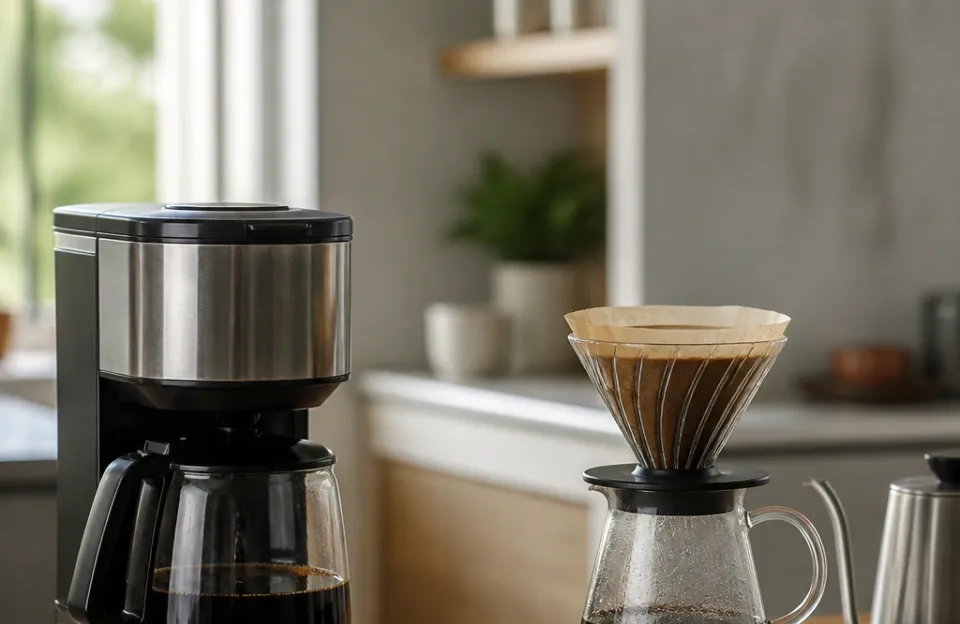
If you want one answer before reading further: choose an automatic drip coffee maker if you need several cups with almost no hands-on effort, and choose pour over if you brew one cup at a time and want to fine-tune how it tastes. There is no objectively better method, because the best brewing method is the one that produces the coffee you most enjoy drinking. The practical differences come down to effort, batch size, cost, maintenance and how much control you want over each cup. The sections below walk through each of those factors so you can match a method to your own routine.
Key Differences at a Glance
| Factor | Automatic Drip Coffee Maker | Pour Over Setup |
|---|---|---|
| How it brews | Machine controls the process; simple and convenient | You hand-pour water over grounds in a filter |
| Daily effort | Push a button, then walk away | Active pouring that usually takes more time |
| Batch size | Many machines make a larger batch at once | Often one cup at a time, depending on the brewer |
| Flavor control | Less control over the process | The whole process can be tuned to your taste |
| Equipment needed | One machine | Brewer, filters, kettle, thermometer, scale and ideally a grinder |
| Skill to start | None beyond reading the manual | Requires learning new techniques |
| Quality benchmark | SCA certification available on some models | Depends on brewer design and your technique |
Each row reflects the general pattern for that method rather than a fixed rule, since specific machines and brewers vary.
The table summarizes the trade-offs covered in the sections that follow.
Flavor: Control Versus Consistency
Pour over gives you more room to shape the cup. Because you control the pour, the water contact and the timing, the entire brewing process can be fine-tuned to your taste, and the National Coffee Association notes that pour-over coffee can be more flavorful for that reason. Drip machines take most of those decisions out of your hands, which is why drip coffee is described as not accentuating flavors as much and offering less control over the process overall. Neither method is universally better; they simply give you different amounts of control.
Water quality affects both methods, and the National Coffee Association recommends filtered water for brewing. If your coffee tastes bitter or sour, the cause may be your water or your grind rather than the brewer, and our guide to why your coffee maker makes bitter coffee walks through the likely culprits.
Your brewing process matters as much as the coffee variety and roast you buy. That cuts both ways. A pour over brewed carelessly will taste worse than a well-made drip batch, so the “better flavor” advantage only appears when you are willing to learn and repeat a technique.
Where the Filter Makes a Difference
Both methods typically use paper, and paper filters absorb more of coffee’s oils, which can contribute to a cleaner, lighter taste. Pour-over filters come in paper, metal and cloth, and each material has its merits. Metal and cloth let more oils through, which changes body and texture. If you dislike sediment or heavy body, a paper filter in either method suits you better.
Beginner-Friendly Pour-Over Brewers
Not all pour-over brewers demand the same skill. Flat-bottom brewers have three small holes that create a slower, more even flow rate, making a consistent brew easier to achieve; the NCA suggests this style for people new to pour over. Conical brewers have 60-degree walls that create a faster, more continuous flow and require more skill to pour evenly. Starting flat-bottom reduces the learning curve considerably.
Convenience and Batch Size
Drip coffee is simple and convenient, and many drip coffee makers can brew a larger batch at one time. If two or more people drink coffee before work, or you like a second cup an hour later, the machine’s carafe solves that in one cycle.
Pour over is a manual process. You hand-pour the water, which usually takes more time than an automatic drip machine, and depending on the brewer it may only make one cup at a time. For a single drinker who enjoys the ritual, that is not a drawback. For a household on a schedule, it means repeating the whole process for each cup.
Who Should Pick Which
Pick an automatic drip coffee maker if:
- You brew for more than one person
- You want coffee ready with minimal attention
- You would rather not learn a pouring technique
- You want an independently certified machine
- You want to compare drip against other pod-style machines before deciding
These conditions describe the common case, and a household that meets only one of them may still prefer pour over.
Pick pour over if:
- You usually drink one cup at a time
- You enjoy adjusting grind, pour and timing to taste
- You want a lighter, cleaner cup from a paper filter
- You are willing to practice for consistency
Equipment and What It Costs to Start
A drip coffee maker is a single purchase: one machine that handles brewing for you. Some certified models add features worth knowing about, such as a thermal carafe, a programmable 24-hour timer or an integrated water filter. To keep the machine running well, budget for descaling supplies as your manual directs.
Pour over is a kit rather than a single object. The NCA lists the components: a brewer, filters, a kettle or other hot water source, a thermometer unless one is built into the kettle, a scale, and preferably a grinder. Filters are a recurring cost you will need to replenish. When choosing a brewer, the NCA advises weighing cost including accessories and replacement filters, plus size, capacity, design and customer reviews. If you already own a gooseneck kettle and a burr grinder, your remaining outlay is smaller than the full kit list suggests.
For drip machines, the NCA’s buying guidance also covers capacity, features and reviews, so the same checklist applies to both methods.
Actual prices vary by model, retailer and region, so check current listings rather than relying on a fixed figure. The structural difference is what matters: drip concentrates spending into one machine, while pour over spreads it across several small items plus ongoing filters. Neither pattern is inherently cheaper, because the total depends on which components you already own.
Maintenance and Cleanup
Drip machines need periodic descaling, and the correct interval and method depend on your model, your water hardness and the manufacturer’s manual. Follow the manual for your specific machine rather than a generic schedule. Daily cleanup is usually limited to the filter basket and carafe. Our guide to how to descale a coffee maker explains the general process, though your manual remains the authority for your model.
Pour over cleanup is quick: discard the filter and rinse the brewer. The catch is that there are more pieces to store and keep clean, including the kettle, scale and server. Filters run out and must be reordered. Neither method is dramatically more work day to day, but drip shifts the effort to occasional descaling while pour over spreads it across more items.
What SCA Certification Tells You
SCA Certified Home Brewers are coffee makers that meet the Specialty Coffee Association’s standards for brewing quality, consistency and performance and have passed third-party testing. If you want an independent quality signal before buying a drip machine, this is the list to check, and it is updated with certification years. The official list is the only reliable source for current certification status. You can browse it at the Specialty Coffee Association’s certified home brewer page.
Several current certified models illustrate the range of capacities and features available. The Technivorm Moccamaster KBGV Select holds 40 oz (1.25 L) in a glass carafe with a hotplate, and its switch selects a half or full carafe from 16 to 40 oz. The Bonavita 8-Cup Drip Coffee Brewer delivers a full carafe in under six minutes and has a flat-bottomed filter basket with optional pre-infusion. The OXO Brew 8-Cup Coffee Maker offers a podless single-serve function and a Rainmaker showerhead for water distribution. For larger households, the Technivorm Moccamaster CDT Grand holds 60 oz (1.8 L) in a thermal steel carafe and is described as suited to offices and gatherings. Specifications and features vary by model, so confirm details on the manufacturer’s page before buying. These examples show the range of options rather than a ranking, and other certified models may suit you better.
Smaller and single-serve options exist too. The Technivorm Moccamaster Cup-One brews one 10 oz cup in about four minutes. The Bonavita 5-Cup Drip Coffee Brewer has a thermal carafe, brews a full carafe in five minutes and shuts off automatically. Certification status and model availability change over time, so confirm the current list before you buy. A single-serve certified machine can bridge the gap if you want automation without a full carafe.
There is no equivalent certification program for pour-over brewers in these sources. Pour-over quality rests on brewer design, filter choice and your technique.
When Another Method Fits Better
Neither option is ideal for every drinker. If you want full-bodied coffee with more oils and no paper filter, a French press is a better fit than either method. If you want speed and espresso-style concentration in small volumes, an espresso machine serves a different purpose entirely. If you want cold coffee, cold brew is made with room-temperature or cooler water rather than the hot water used in most brewing methods.
Making Your Final Decision
Start with your routine, not the flavor debate. Count how many cups you brew each morning and how much attention you can spare. Multiple cups and a rushed schedule point to an automatic drip machine, ideally one on the SCA certified list. One cup and an interest in tuning the result point to pour over, preferably a flat-bottom brewer while you learn. If your routine falls between those cases, either method can work and the deciding factor becomes which one you will actually use every day.
Then account for the full kit. A drip machine is one purchase, while pour over requires a brewer, filters, kettle, thermometer, scale and ideally a grinder, with filters to replenish. Finally, accept the maintenance each method demands and follow your manufacturer’s descaling guidance for a drip machine. If you already own some pour-over gear, the cost comparison shifts in its favor.
Taste remains personal: the best brewing method is the one that produces your favorite coffee. If you are still weighing other machines, our comparison of coffee makers and Keurigs covers another common alternative. For related brewing styles, see our guide to coffee maker versus French press and our breakdown of coffee maker versus espresso machine.
As an Amazon Associate, we earn from qualifying purchases.
This disclosure applies to affiliate links on this page; it does not indicate that any specific product was tested or independently reviewed.