You’ve just pulled a heavy prime rib out of the oven. You stick your instant-read probe into the center, and the digital screen flashes 135°F, the perfect medium-rare. You let it rest, carve it open, and find the center is cold and deep purple, while the edges are grey and overcooked.
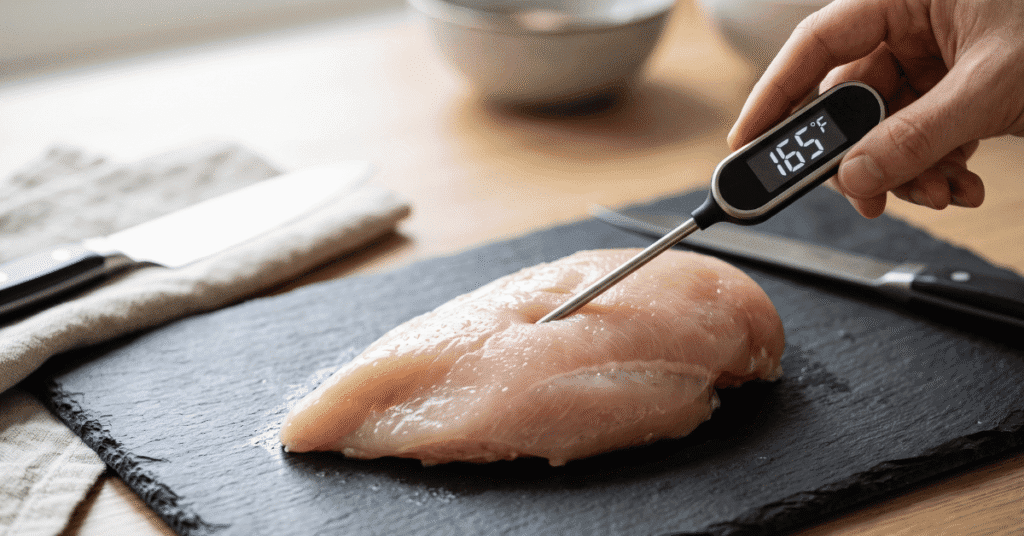
Or worse, you pull a chicken breast at 165°F only to find raw, translucent pink meat near the bone five minutes later.
Quick Answer: Yes, a meat thermometer can give a false “safe” reading due to improper calibration, bad probe placement, or physics-based errors like touching a bone or an air pocket. If the sensor sits in a fat deposit or too close to the surface, it may report a high temperature while the rest of the meat remains in the “danger zone” for bacterial growth.
Why a False Reading Happens
A meat thermometer is a precision tool, but it doesn’t actually “know” if your meat is safe. It only knows the temperature of the tiny area touching the sensor. Most digital thermometers have a sensor at the very tip of the probe, while older dial-style models might measure an average across the first inch of the metal stem.
If that sensor isn’t in the “thermal center”, the coldest part of the meat, the reading is technically accurate for the spot it’s in, but false for the piece of meat as a whole. Heat moves through food from the outside in. If you don’t find the absolute core, you are reading a “heat front” that hasn’t reached the middle yet.
According to USDA food safety guidelines, poultry must reach 165°F to kill pathogens like Salmonella. If your probe hits a pocket of rendered fat, which heats up faster than muscle fiber, you might see 165°F on the screen even if the surrounding muscle is still at 140°F. This is a primary cause of foodborne illness in home kitchens.
Mechanical vs. Digital Errors
Not all false readings are the cook’s fault. Sometimes the tool itself is broken. Bimetal coil thermometers (the round dial ones) use two different metals that expand at different rates.
Over time, or after being dropped, that coil can lose its tension. It might show 160°F when the actual temperature is 140°F.
Digital thermistors are generally more reliable but can fail if moisture gets into the probe. If you submerge a non-waterproof probe in a sink, water can bridge the electrical connections inside. This usually leads to wildly fluctuating numbers, but it can also cause the reading to “stick” at a specific temperature, giving you a false sense of security while your dinner undercooks.
The Impact of Calibration
A thermometer that is off by just five degrees can be the difference between a safe meal and a night of stomach cramps. Most professional-grade tools allow you to “zero” or calibrate them. If you haven’t checked yours in a few months, it might be drifting.
Thin probes are especially prone to this. Because they respond so quickly to temperature shifts, even a tiny bit of oxidation on the internal wiring or a weakened battery can shift the voltage. When the voltage shifts, the digital chip translates that into the wrong temperature.
How to Avoid False Readings
The most common mistake is “the one-and-done” poke. You cannot trust a single reading from a single spot in a large piece of meat. To get a true sense of safety, you need to treat the probe like a dipstick.
-
Find the Deepest Point: Insert the probe into the thickest part of the meat . For a whole chicken, this is usually the inner thigh, near but not touching the bone.
-
Push and Pull: Instead of just sticking it in, push the probe all the way through and slowly pull it back out. Watch the numbers change. The lowest number you see during that movement is the actual internal temperature.
-
Avoid the Bone: Bones conduct heat differently than meat. In a convection oven, bones can act as “heat pipes,” making the meat right next to the bone hotter than the rest. In other cooking methods, the bone might stay colder. Either way, touching a bone will give you a reading that doesn’t represent the rest of the muscle.
-
Angle Matters: For thin items like burgers or fish fillets, don’t poke from the top down. You’ll likely go all the way through or hit the hot pan. Insert the probe sideways through the edge to ensure the sensor stays centered in the meat.
Testing for Accuracy (The Ice Bath Rule)
The easiest way to see if your thermometer is lying to you is the ice bath test. It’s more reliable than the boiling water test because boiling points change based on your altitude, but ice always melts at 32°F (0°C) at sea level.
Fill a glass with crushed ice and just enough water to fill the gaps. Stir it and let it sit for a minute. Put your probe in the center of the slush, making sure not to touch the glass walls.
It should read exactly 32°F. If it reads 35°F or 29°F, your thermometer is giving you false readings, and you need to either calibrate it or adjust your cooking math accordingly.
The Role of “Carryover Cooking”
Sometimes the thermometer is 100% correct, but the meat still ends up in an unsafe or undesirable state. This is often due to carryover cooking. When you take a roast out of a 400°F oven, the outer layers are much hotter than the center.
Once the meat sits on the counter, that energy continues to migrate inward. The internal temperature can rise by 5 to 10 degrees while resting. However, if you pull meat too early, expecting carryover to save you, and the meat is too small (like a thin steak), there isn’t enough thermal mass to raise the temperature.
You might pull a steak at 120°F hoping for 130°F, but it stays at 120°F, leaving it in a temperature range where bacteria can survive if the meat was previously contaminated.
Environmental Interference
Strange as it sounds, the environment around your grill or stove can mess with your readings.
-
Steam: If you open a pot and the probe is engulfed in a cloud of 212°F steam, the sensor may pick up the steam temperature rather than the meat temperature.
-
Induction Cooktops: Some high-end induction burners create an electromagnetic field that can interfere with the electronics in cheap digital thermometers. If the numbers jump around when you get close to the pan but steady when you lift it three inches away, the induction field is causing a false reading.
-
Cold Probes: If the probe itself is very cold (perhaps you just pulled it out of a cold drawer), it takes a few seconds to equalize. Fast “instant-read” thermometers take 2-3 seconds, but cheaper ones can take up to 20 seconds. If you pull the probe out before it settles, you are getting a false low reading.
Common Pitfalls and “Ghost” Readings
Many cooks fall victim to what I call “ghost readings.” This happens when the thermometer detects a localized hot spot and you stop cooking, thinking the job is done.
-
Air Pockets: In rolled roasts or stuffed meats, an air pocket can trap superheated steam. If your probe hits that pocket, it will spike to 180°F+ instantly. This isn’t the meat temp; it’s the air temp.
-
Fat Glands: Large deposits of fat in brisket or pork shoulder can render into liquid. This liquid can be significantly hotter than the surrounding “stall-speed” meat.
-
The “Surface Effect”: If you don’t insert the probe deep enough, the sensor is actually picking up a mix of the meat temp and the ambient oven temp. This almost always results in a false “safe” reading that is much higher than the actual core.
Meat Type Worst Probe Spot (False High) Best Probe Spot (Accurate)
Whole Turkey Near the wing joint or skin surface Deepest part of the breast / inner thigh
Beef Roast Touching the ribs or in the fat cap Dead center of the thickest muscle
Pork Chops Touching the bone Side-entry into the center
Burgers Top-down (hitting the skillet) Side-entry to the middle
Frequently Asked Questions
Can a low battery cause a meat thermometer to be wrong?
Yes. As the battery dies, the reference voltage inside the thermometer drops. This often causes the display to show a temperature that is several degrees higher or lower than reality.
If the screen is dim or flickering, don’t trust the reading. You can check for signs of a low battery if your device isn’t performing correctly.
Why does my thermometer show a lower temp when I push it in further?
This usually means you haven’t reached the “thermal center” yet. The temperature should drop as you move toward the middle of the meat and rise as you move toward the surface. If it gets lower as you go deeper, keep going until the numbers stop falling, that is your true internal temperature.
Is it possible for meat to be pink but have a safe reading?
Absolutely. Factors like pH levels, nitrites, or how the animal was slaughtered can keep meat pink even at 165°F. Conversely, meat can look grey or “done” but still be at an unsafe 130°F because of surface oxidation.
Trust the (calibrated) thermometer over your eyes.
How often should I calibrate my thermometer?
If you are a frequent cook, check it every three months. You should also check it if you drop it on a hard floor or if you transition from cooking something very cold to something very hot (thermal shock).
Worth Remembering
A meat thermometer is a guide, not a magic wand. It can only tell you the temperature of the exact spot where the sensor is located. To stay safe, always check multiple spots, especially in oddly shaped cuts like a turkey or a tri-tip.
If you ever doubt the reading, trust your hands and your logic. If a thick roast has only been in the oven for 20 minutes and the thermometer says it’s 160°F, something is wrong. Test your tool in an ice bath, check your probe placement, and never settle for a single data point when your health is on the line.