An air fryer replacement power cord is a detachable electrical cable that connects your countertop cooker to a standard wall outlet. Most modern air fryers use a three-prong connector that plugs directly into the back or bottom of the appliance. When the original cable frays, melts, or stops delivering consistent power, swapping it for a compatible replacement restores normal operation without buying a whole new machine.
This guide covers how these cords work, what specifications matter most, and why matching the exact electrical rating protects both your kitchen and your appliance. You'll also find details on common connector shapes, safety certifications, and the mistakes people make when ordering a new cable online.
How Air Fryer Power Cords Actually Work
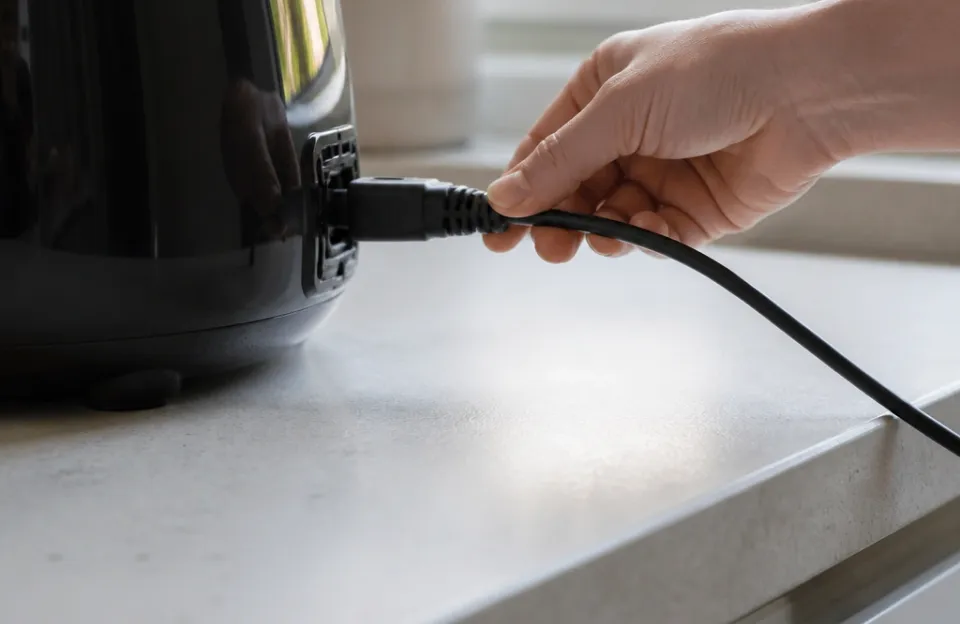
Air fryers draw a lot of electricity. A typical 1500-watt model running on a standard 120-volt US circuit pulls about 12.5 amps of current. The power cord has to handle that continuous load without overheating.
Inside the thick outer jacket, copper conductors carry the electricity from your breaker panel to the heating element and fan motor inside the unit.
The connection point matters just as much as the wire itself. Most units use a standardized coupler that mates with a recessed inlet on the appliance. This design lets you detach the cable for storage or cleaning.
It also means the cord acts as a weak link by design. If a short circuit happens, a properly rated cord will fail before the internal wiring of the air fryer catches fire.
You can read more about safe countertop cooking temperatures in our related guides, but the principle applies to the electrical side too. Heat and electricity require strict tolerances. A cord rated for 10 amps will overheat rapidly if forced to carry 13 amps for twenty minutes while you cook dinner.
That thermal buildup degrades the insulation and creates a shock hazard.
Wire Gauge and Amp Ratings Explained
The thickness of the copper wire inside the jacket determines how much current the cord can safely carry. This measurement is called the American Wire Gauge, or AWG. Lower numbers mean thicker wire.
A 16 AWG cord handles less current than a 14 AWG cord.
Most small kitchen appliances ship with 16 AWG cables. Air fryers sit right at the upper limit of what a 16-gauge wire should handle continuously. Many manufacturers use 14 AWG cords for their larger 1700-watt or 1800-watt models to provide a wider safety margin.
When shopping for an air fryer replacement power cord, check the manual or the sticker on the back of your unit to find the required gauge.
Using a cord with a higher gauge number (thinner wire) than the original is dangerous. The wire will run hot. Using a lower gauge number (thicker wire) is perfectly safe, provided the connector fits.
Thicker wire simply offers less resistance and stays cooler under heavy loads.
The Three Main Connector Shapes
Not every plug fits every machine. Manufacturers use a few standard shapes defined by the International Electrotechnical Commission. Knowing which one your appliance uses saves you from ordering the wrong part.
| Connector Type | IEC Standard | Common Appliance Use | Pin Shape |
|---|---|---|---|
| C13 / C14 | IEC 60320-C13 | Desktop computers, some large air fryers | Trapezoid with three rectangular slots |
| C15 / C16 | IEC 60320-C15 | High-heat appliances like kettles and air fryers | Similar to C13 with a ridge replacing the bottom notch |
| C5 / C6 | IEC 60320-C5 | Laptops, very small low-wattage devices | Cloverleaf shape with three round prongs |
The C15 connector is extremely common for air fryers because it includes a physical ridge that prevents you from plugging a standard computer cable (C13) into a high-heat appliance. A C13 plug lacks the heat-resistant insulation required for devices that generate intense thermal energy near the socket. Always match the exact shape.
Forcing a slightly different plug damages the internal pins and voids any remaining warranty.
If you need to verify how hot your appliance runs during a cycle, using an infrared surface reader on the exterior casing near the power inlet gives you a baseline idea of the thermal stress the cord endures.
Finding the Right Air Fryer Replacement Power Cord
Matching the connector shape is only half the job. You also need to match the electrical ratings and the physical length. Ordering a generic "universal" cord often leads to problems because universal usually just means it fits multiple brands that share the same plug shape, regardless of their wattage requirements.
Start by looking at the silver or white compliance sticker on the bottom or back of your air fryer. It lists the voltage (usually 120V in North America), the wattage (e.g., 1500W), and sometimes the required amperage. Write these numbers down.
Any replacement cord you buy must meet or exceed all three values.
Next, measure the distance from your countertop outlet to where the appliance sits. Standard cords are usually 3 to 5 feet long. Buying a 10-foot cord for a plug located two feet away leaves excess cable coiled on the counter.
Coiled wires trap heat. Keep the length practical.
Reading Safety Certifications on the Jacket
Legitimate electrical components carry marks from independent testing laboratories. In the United States, look for stamps from UL (Underwriters Laboratories), ETL (Intertek), or CSA (Canadian Standards Association). These organizations test cords to verify they won't melt, catch fire, or deliver shocks under their stated maximum loads.
A cord without any certification mark might be cheaper, but it hasn't been tested to recognized safety standards. The UL Solutions organization sets rigorous benchmarks for consumer electronics accessories. When a product carries their mark, it means samples were pulled from production lines and subjected to thermal, mechanical, and electrical stress tests.
Printed text on the rubber jacket itself also provides clues. You should see something like "14AWG 13A 125V" stamped directly into the material. If the jacket is completely blank, avoid it.
Blank jackets usually indicate unregulated manufacturing where the internal wire gauge might not match the advertised specs.
Brand-Specific vs Universal Options
Some manufacturers sell proprietary replacement parts directly through their customer service channels. These are guaranteed to fit and meet the exact electrical specs of your specific model. They tend to cost more than third-party options.
Third-party or "universal" cords work fine as long as you manually verify the connector type, wire gauge, and amp rating. Brands like OmniHil, Tpower, and various generic sellers on Amazon produce high volumes of these cables. Read the product description carefully.
Sellers frequently list dozens of compatible appliance names in their titles to capture search traffic, even if the cord's amp rating is too low for some of those listed machines. Trust the printed numbers on the spec sheet over the marketing title.
When prepping meals that require precise timing, having a reliable power connection is foundational. A failing cord causes intermittent power loss, which resets digital timers mid-cycle. We've covered batch cooking strategies extensively elsewhere, and consistent electrical delivery is a prerequisite for any scheduled prep work.
Signs Your Current Cable Needs Replacing
Power cords degrade over time due to heat exposure, physical bending, and general wear. Catching the signs early prevents electrical fires and damage to the appliance's internal control board.
Visible damage is the most obvious indicator. Cracks in the rubber jacket expose the inner insulation. Fraying near the plug head suggests the internal copper strands are breaking from repeated bending.
Discoloration or dark scorch marks around the metal prongs mean arcing has occurred inside the socket. Arcing generates extreme localized heat and requires immediate replacement of both the cord and potentially the appliance inlet.
Intermittent power issues are another major red flag. If your air fryer shuts off randomly, flickers, or only works when you hold the cord at a specific angle, the internal wires are broken or the connector pins are loose. Stop using it immediately.
Wiggle-testing a damaged cord can cause sparks.
A burning plastic smell near the outlet or the back of the unit indicates the insulation is melting. Unplug the machine from the wall by gripping the wall plug itself, never by pulling the cord. Once disconnected, inspect the prongs for pitting or melted metal.
Why Intermittent Power Ruins Cooking Results
Beyond the safety risk, a failing cord ruins food. Air fryers rely on consistent wattage to maintain their set temperature. When a damaged cord drops voltage due to high resistance, the heating element cools down.
The thermostat tries to compensate, but rapid power fluctuations create uneven cooking zones inside the basket.
If you're trying to achieve perfectly blistered skin on poultry, steady heat is mandatory. Voltage drops caused by a bad connection lead to steaming instead of roasting. Before assuming your appliance's heating element is broken, rule out the power cord.
Swapping the cable takes ten seconds and costs under twenty dollars.
Installing a New Cord Safely
Replacing a detachable air fryer power cord requires no tools. The process is entirely plug-and-play. However, doing it correctly involves a few basic safety checks.
- Unplug the old cord from the wall first. Never pull the connector out of the back of the air fryer while it is still receiving live power from the wall outlet. This can cause an arc flash.
- Remove the old cord from the appliance. Pull it straight out. Do not twist or yank it sideways, as this bends the internal pins of the appliance's inlet.
- Inspect the appliance inlet. Look inside the socket on the back of the air fryer. Check for black soot, melted plastic, or bent metal pins. If the inlet itself is scorched, a new cord will not fix the problem. The appliance needs professional repair.
- Align the new cord. Match the shape of the plug to the shape of the inlet. Notice the grounding pin or the alignment ridge. It only goes in one way.
- Push firmly until seated. The plug should sit flush against the housing. If it wobbles or sticks out significantly, the connector type is wrong or the pins are misaligned.
- Plug the wall end into the outlet last. Ensure your hands are dry. Push the wall plug in fully so no metal prongs are exposed.
Once connected, turn the air fryer on without food inside. Let it run for two minutes at its maximum temperature setting. Stand nearby and listen.
Buzzing, crackling, or humming sounds coming from the cord connection point indicate a poor fit or a defective replacement. Turn it off and unplug it immediately. If it runs silently and the plug remains cool to the touch, the installation was successful.
Having accurate monitoring equipment helps confirm your appliance reaches the right temperature after a repair. A fast instant-read probe verifies the cooking chamber recovers its heat properly once powered by the fresh cable.
Mistakes People Make When Buying Replacements
Ordering electrical parts online is easy. Ordering the correct electrical part requires paying attention to details that most product listings bury at the bottom of the page.
Ignoring the amp rating. Buyers frequently look only at the plug shape. A C15 plug fits a C15 inlet physically, but if the cord is wired with thin 18 AWG wire meant for a small desk lamp, it will overheat when attached to a 1500-watt air fryer. Always cross-reference the amperage.
Using extension cords instead of replacements. Some people try to solve a short cord problem by plugging the original cable into an extension cord, then plugging that into the wall. Each connection point adds electrical resistance. High-wattage appliances should plug directly into a wall receptacle whenever possible.
If you absolutely must extend the reach, use a heavy-duty appliance extension cord rated for at least 15 amps, though direct connection remains the standard recommended by the Consumer Product Safety Commission.
Mixing up C13 and C15 connectors. As mentioned earlier, these look nearly identical. A C13 plug will often slide into a C15 inlet if forced, bypassing the safety ridge designed to keep lower-rated cables away from high-heat devices. Double-check the IEC code printed on your old cord before buying a new one.
Buying based solely on price. Electrical components have a baseline manufacturing cost driven by the price of copper. If a cord is significantly cheaper than comparable options, the manufacturer likely used thinner wire, aluminum instead of copper, or skipped safety testing. Save money on accessories, not on the component carrying 120 volts into your kitchen.
Assuming all regional plugs are identical. If you bought an air fryer overseas or imported one, the wall plug end might be a UK Type G or European Type F. You cannot simply use a travel adapter for a high-draw appliance permanently. Travel adapters lack the contact surface area needed for sustained 15-amp loads and will melt.
Buy a replacement cord with the correct appliance-end connector and the correct wall-end plug for your country.
Edge Cases and Unusual Situations
Standard detachable cords cover about ninety percent of air fryers on the market. The remaining ten percent present unique challenges.
Some older or highly specialized commercial-grade countertop fryers use hardwired connections rather than detachable plugs. If your unit does not have a socket on the back and the cord disappears directly into the chassis, it is hardwired. Replacing a hardwired cord requires opening the appliance casing, disconnecting terminal blocks, and splicing new wires.
This violates most household warranties and introduces significant shock risk if done incorrectly. Hardwired replacements should be handled by a licensed appliance repair technician.
Dual-basket air fryers with massive total wattages (sometimes exceeding 3000 watts combined) may use heavier gauge cords than standard models. In North America, appliances drawing over 15 amps continuously sometimes require dedicated 20-amp circuits. Plugging a high-draw dual unit into a shared 15-amp kitchen circuit will trip the breaker repeatedly, regardless of how good your replacement cord is.
Verify your home's circuit capacity if upgrading to a larger machine.
Moisture damage is another edge case. If your original cord failed because liquid spilled into the socket, simply plugging in a new cord might short out the appliance. The internal inlet needs to be completely dry and free of corrosion before introducing new power.
Leave the unplugged unit in a dry area for 48 hours if a spill caused the failure.
Finally, consider the environment where the appliance lives. If your air fryer sits under a low cabinet where the cord is forced into a tight bend radius constantly, even a brand-new replacement will fatigue quickly. Reroute the cable or move the appliance to allow the cord to hang naturally without sharp kinks.
Tight bends break the internal copper strands over time, leading to the exact intermittent power issues you just tried to fix.
Frequently Asked Questions
Can I use a computer power cord for my air fryer?
Usually no. While many desktop computers use a C13 connector that looks similar to the C15 inlet found on high-heat appliances, the C13 lacks the necessary thermal rating for the socket area. Computer cords are designed for environments where the plug doesn't sit next to a 400-degree heating element.
Only use a cord explicitly rated for the wattage and heat profile of your specific appliance.
How do I know what size power cord my air fryer needs?
Check the manufacturer label on the bottom or back of the unit. It lists the voltage, wattage, and sometimes the amperage. Divide the wattage by the voltage to calculate the amps if they aren't listed.
For example, 1500 watts divided by 120 volts equals 12.5 amps. Your replacement cord must be rated for at least that amperage and match the physical plug shape exactly.
Is it safe to use an extension cord with an air fryer?
Manufacturers generally advise against it. Extension cords introduce extra connection points that increase electrical resistance and generate heat. If your kitchen layout forces you to use one, select a heavy-duty appliance extension cord rated for 15 amps or more, keep it as short as possible, and never coil the excess wire while the appliance is running.
Why does my new replacement cord get warm during use?
Slight warmth is normal when pushing 1500 watts through a cable. The cord should never become hot to the touch. If it is uncomfortably warm, the wire gauge is too thin for the electrical load, the connection at the plug is loose, or the wall outlet itself has degraded contacts causing resistance.
Stop using it immediately and verify the cord's AWG rating matches the appliance requirements.
Where can I buy a reliable air fryer replacement power cord?
Major online retailers like Amazon carry numerous options from brands like OmniHil and Tpower. You can also contact the original appliance manufacturer's customer support to order an exact OEM replacement. Regardless of where you buy it, verify the cord carries a UL, ETL, or CSA safety certification mark before plugging it in.
Keeping Your Countertop Setup Safe
A functioning air fryer replacement power cord is a basic requirement for safe cooking. Paying attention to wire gauge, connector shape, and safety certifications prevents electrical hazards and extends the life of your appliance. Don't guess at the specifications.
Read the sticker on your machine, match the numbers exactly, and inspect the connection periodically for signs of heat damage. Routine maintenance of your electrical connections keeps your kitchen running safely and your meals cooking evenly.