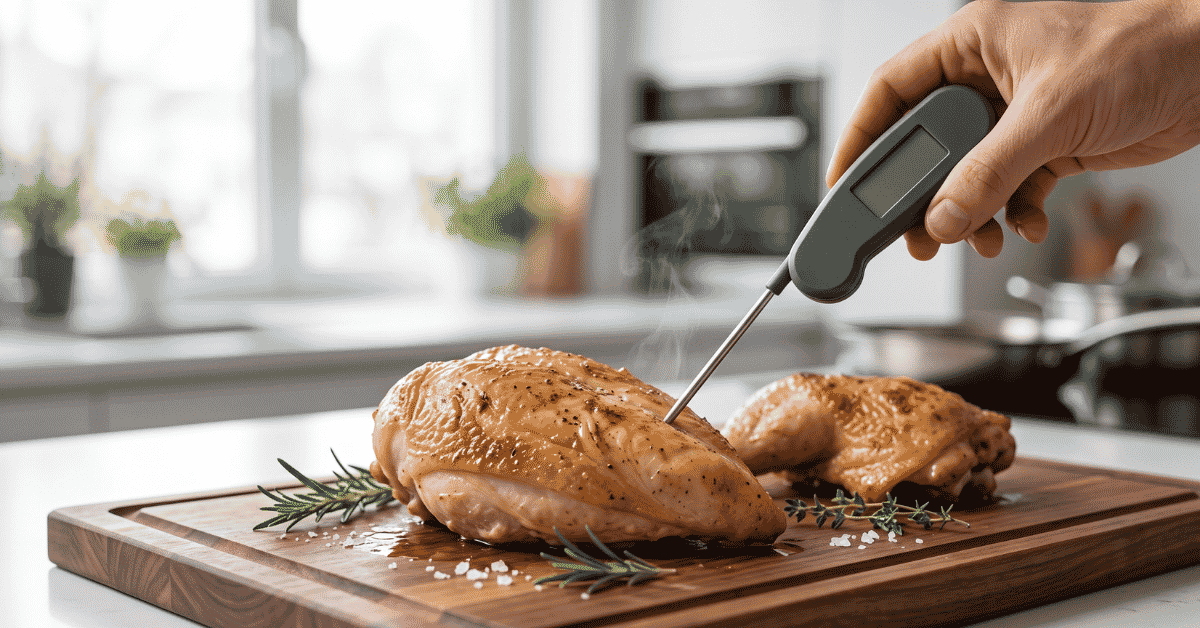
You pull a tray of chicken out of the oven, insert your digital thermometer, and see 165°F. For the breast meat, that’s great news. But when you bite into the thigh at that same temperature, it feels rubbery, chewy, and strangely unappetizing.
You followed the safety rules, yet the texture is all wrong.
Quick Answer: While the USDA states all chicken is safe to eat at 145°F (with proper rest time) or 165°F (instant safety), chicken breasts and thighs reach peak quality at different marks. Breast meat is best at 155°F to 160°F (resting up to 165°F) to stay juicy. Thighs are much better at 175°F to 185°F, as the higher heat breaks down tough connective tissue.
Why the Ideal Temperature Varies by Cut
The reason a breast and a thigh don’t act the same way under heat comes down to biological makeup. Chicken breasts are “white meat,” designed for short bursts of energy. They contain very little fat and almost no connective tissue.
When you heat white meat, the proteins coil up and squeeze out moisture. If you push a breast past 165°F, it quickly turns into something resembling dry saw dust.
Chicken thighs are “dark meat,” used by the bird for constant standing and walking. These muscles are loaded with myoglobin (which gives them the darker color) and, more importantly, collagen. Collagen is a tough, structural protein.
At 165°F, that collagen is still tight and firm, making the meat feel rubbery. You need more heat over a longer period to turn that collagen into gelatin. Once that melt happens, the thigh becomes silky and tender.
According to USDA guidelines, the minimum internal temperature for safety is 165°F. However, the culinary “sweet spot” for these two cuts is almost 20 degrees apart. Understanding this gap is the secret to moving from “safe but bland” food to restaurant-quality meals at home.
The Science of Tenderness in White Meat
Breast meat is lean. Because it lacks fat and collagen, there is nothing to “save” the meat if it overcooks. Think of white meat like a sponge full of water.
As it heats up, you are essentially wringing that sponge out.
At 150°F, the meat is safe if held there for about three minutes, and it remains incredibly juicy. By the time it hits 165°F, it has lost a significant amount of its internal moisture. If it climbs to 175°F, the proteins have tightened so much that the meat becomes stringy and difficult to swallow.
This is why many chefs pull breast meat off the grill at 155°F or 160°F and let “carryover cooking” bring it the rest of the way.
The Role of Fat and Collagen in Dark Meat
Thighs and drumsticks are built differently. They have a higher fat content, which acts as a thermal insulator and a flavor enhancer. But the real player here is the connective tissue.
If you take a thigh off the heat at exactly 165°F, it often looks pinkish near the bone and has a “bouncy” texture that many people find unappealing.
When you allow a chicken thigh to reach 175°F or even 185°F, the fat renders and the collagen dissolves. This process bastes the meat from the inside out. Even though the temperature is higher, the meat feels “moister” to your tongue because of the liquified fat and gelatin, even though it technically has less water than a breast.
Practical Application: How to Cook Both Correctly
If you are roasting a whole bird or cooking a mixed tray of parts, you have to manage two different thermal goals at once. It’s a balancing act that usually results in one part being overcooked or the other being undercooked.
Measuring the Temperature
Don’t guess by looking at the color of the juices. Use a fast-read digital meat thermometer.
- For Breasts: Insert the probe into the thickest part of the meat, making sure not to go all the way through to the pan. Pull the meat when it hits 155°F-160°F and tent it with foil for five minutes.
- For Thighs: Insert the probe into the thickest part of the muscle, avoiding the bone. Bones conduct heat differently and will give you a false high reading. Look for a reading of at least 175°F.
Mixed-Cut Strategies
If you are cooking a whole chicken, the breasts are exposed on top while the thighs are tucked underneath. This is actually helpful because the breast meat heats up faster. To get both to their ideal spots:
- Spatchcock the bird: Removing the backbone and flattening the chicken lets the legs and thighs sit in a higher-heat area of the oven while the breasts stay slightly cooler.
- Use different heat zones: On a grill, keep the thighs over the direct flame longer and move the breasts to the cooler “indirect” side once they start to brown.
- Ice the breasts: Some high-end chefs place a bag of ice on the breast meat for 20 minutes before roasting the whole bird. This starts the breasts at a much lower temperature than the legs, giving the dark meat a “head start” in the oven.
Edge Cases and Texture Variations
There are times when these temperature rules shift based on how you are preparing the meat. The type of heat (wet vs. dry) and the presence of skin or bone can change how the meat handles these temperatures.
Braising vs. Grilling
When you braise chicken thighs (cooking them in liquid), you can actually take them well past 190°F. Because they are submerged in fluid, they won’t dry out like a grilled thigh might. This is why “fall-off-the-bone” chicken is almost always dark meat.
If you tried to braise a chicken breast to 190°F, it would turn into flavorless wood pulp, regardless of the liquid.
Air Chill vs. Water Chill
How the chicken was processed matters too. Most supermarket chicken in the US is water-chilled, meaning the meat absorbs water during processing. This extra water can sometimes mask overcooking, but it also causes the meat to shrink more.
Air-chilled chicken has a more concentrated flavor and reacts more predictably to the temperatures listed above. If you use air-chilled breasts, you must be even more careful not to exceed 165°F, as there is less “fake” moisture to lose.
The “Pink” Bone Myth
Sometimes you might cook a thigh to a perfectly safe 180°F, but the meat right against the bone still looks purple or red. This is common in young chickens where the bones aren’t fully calcified. Pigment from the bone marrow can leached into the meat during cooking.
As long as your thermometer confirms the temperature, the color is not a sign of raw meat.
Common Mistakes to Avoid
Many home cooks fall into patterns that lead to either dry breasts or chewy thighs. By focusing on the numbers rather than the clock, you can avoid these pitfalls.
- Trusting the “Clear Juices” Test: Some chicken is safe while the juices are still slightly pink, and some dry chicken can still produce clear liquid. Only a thermometer is reliable.
- Forgetting Carryover Cooking: Meat continues to rise in temperature after you remove it from the heat. A breast pulled at 165°F will often hit 170°F or higher while sitting on the plate, leading to dryness.
- Treating the Whole Bird as One Piece: You wouldn’t cook a steak and a pot roast to the same internal temperature; don’t do it with different parts of the chicken.
- Cutting Too Soon: If you slice into a breast the second it leaves the pan, the pressure from the tightened protein fibers will push all the juice out onto the cutting board. Give it five minutes to relax.
Quick-Reference Temperature Table
| Cut | Minimum Safe (USDA) | Culinary Ideal | Texture at 165°F | Texture at 180°F |
|---|---|---|---|---|
| Chicken Breast | 165°F | 155°F – 160°F | Firm and Juicy | Dry and Stringy |
| Chicken Thigh | 165°F | 175°F – 185°F | Chewy / Rubbery | Tender / Silky |
| Chicken Wing | 165°F | 190°F+ | Tough Skin | Crispy and Tender |
Frequently Asked Questions
Is it safe to eat chicken breast at 155°F?
Yes, it is safe as long as the meat stays at that temperature for at least 44 to 50 seconds. Safety is a function of both heat and time. Most people pull the meat at 155°F and let it rest; during that rest, the temperature remains high enough long enough to kill bacteria like Salmonella.
Why does my chicken thigh look bloody near the bone?
This is usually not blood. It’s myoglobin and bone marrow staining. In younger chickens, the bones are porous, and the marrow seeps out when heated.
If your thermometer reads 175°F or higher, the meat is fully cooked and safe to eat despite the color.
Can you overcook chicken thighs?
It is much harder to overcook a thigh than a breast, but it is possible. If you take a thigh past 200°F in a dry environment (like an oven or grill), the fat will eventually all render out, and the meat will become dry and mushy. However, they are much more forgiving than white meat.
Why is 165°F the standard if 175°F is better for thighs?
The 165°F standard is purely for food safety. It is the temperature at which bacteria are killed instantly. The USDA is focused on preventing illness, not culinary perfection.
It’s up to the cook to understand which cuts need more heat for better texture.
Worth Remembering
The most important thing to keep in mind is that “safe” and “delicious” are two different benchmarks. For a chicken breast, your goal is to hit the safety mark without going a single degree over. For a chicken thigh, the safety mark is just the beginning; you need to keep going to let the heat do its job on the connective tissue.
Next time you’re in the kitchen, don’t treat the bird as a single unit. Think of it as two different ingredients that happen to be attached. If you can master the 20-degree gap between the white and dark meat, you’ll never have to settle for a mediocre chicken dinner again.