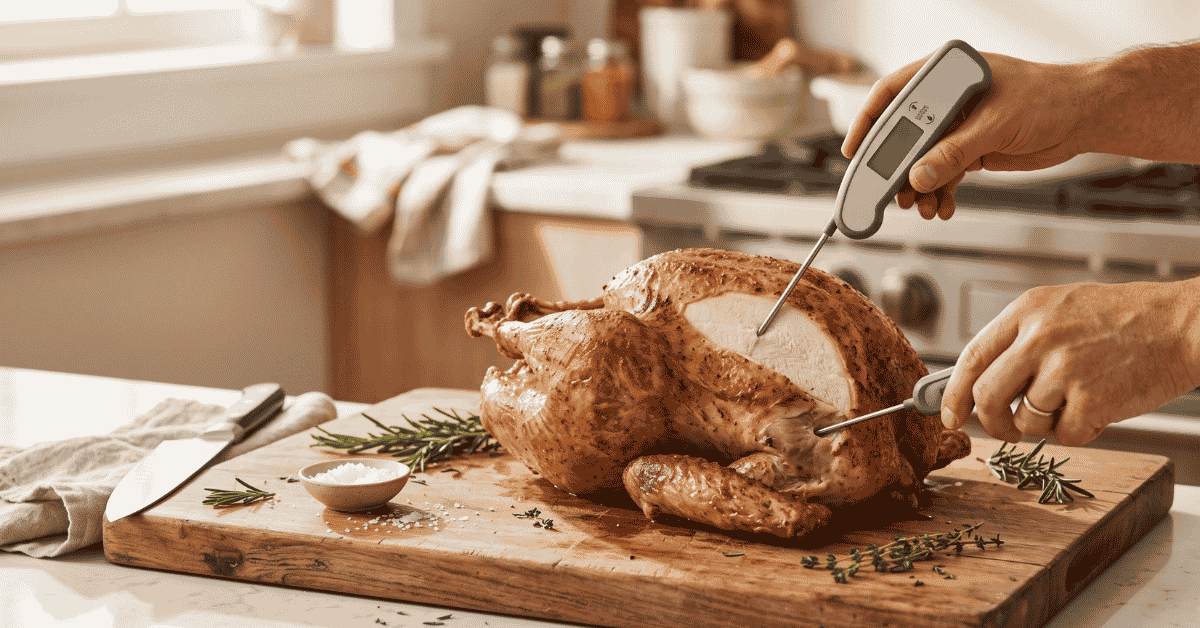
You pull the roasting pan out of the oven, insert your thermometer into the thickest part of the bird, and see two wildly different numbers. The breast is already hitting 160°F, but the thigh is barely at 155°F. If you wait for the thigh to catch up, you’re worried the white meat will turn into dry sawdust, but if you pull it now, the dark meat might stay chewy and unappealing.
Quick Answer: Turkey breast and turkey thighs require different temperatures because they consist of different muscle types. White breast meat is lean and best at 165°F to stay juicy, while dark thigh meat contains high amounts of connective tissue that needs to reach 175°F, 180°F to break down and become tender.
The fundamental biology of white vs. dark meat
The reason these two parts of the same bird behave differently in the oven comes down to how the turkey lived its life. Turkeys are ground-dwelling birds that spend most of their time walking or standing rather than flying. This lifestyle creates two distinct types of muscle fibers: fast-twitch and slow-twitch.
Breast meat consists of “fast-twitch” muscles. These are designed for quick, short bursts of energy, like a frantic flutter to escape a predator. Because these muscles don’t work constantly, they don’t need a heavy supply of oxygen-carrying proteins or fat for long-term fuel.
This results in the pale color and lean texture we call white meat. Without much fat or collagen to protect it, white meat dries out the moment it climbs past the safe zone.
Thighs and legs are “slow-twitch” muscles. These are the workhorses used for walking, standing, and scratching at the ground all day long. Continuous exercise requires a steady flow of oxygen, provided by a protein called myoglobin.
This protein gives the meat its darker reddish-pink hue. More importantly, these hardworking legs are packed with connective tissue and fat to support constant movement. While a breast is “done” as soon as it’s safe, a thigh needs extra heat to melt that tough tissue into succulent gelatin.
The role of myoglobin and fat content
Myoglobin does more than just change the color of the meat; it influences how we perceive doneness. In dark meat, myoglobin can sometimes stay pink even after the meat has reached a safe temperature. This often leads cooks to overcook the breast while waiting for the pinkness in the thigh to disappear.
Fat also acts as a thermal insulator. The higher fat content in turkey thighs means they can withstand higher temperatures without losing their palatability. In fact, they taste better at higher temps.
While a turkey breast at 180°F is an Olympic-level disaster, a turkey thigh at 180°F is often at its peak of flavor and tenderness.
The collagen factor in turkey thighs
Connective tissue is mostly made of collagen. Think of collagen like a collection of tough rubber bands holding the muscle fibers together. At lower temperatures, these bands are tight and chewy.
You can’t simply “cook” them away at 165°F; they need sustained heat to transform.
When the internal temperature of the dark meat hits the 170°F to 175°F range, the collagen begins to denature. It turns into gelatin, which coats the muscle fibers and provides that rich, “melt-in-your-mouth” feel. This is why a thigh cooked to only 165°F, though technically safe by USDA standards, often feels rubbery and is difficult to pull away from the bone.
How to reach two temperatures in one bird
The biggest challenge in roasting a turkey is that these two sections are attached to the same frame, but they have opposite needs. The breast sits high and exposed, while the thighs are tucked deep against the carcass and protected by the legs. In a standard oven, the breast usually finishes 15 to 30 minutes before the legs are ready.
To manage this, many cooks use specific positioning or shielding. Since the breast is prone to overcooking, you can cover it with a double layer of aluminum foil halfway through the roasting process. This reflects radiant heat away from the lean white meat while allowing the dark meat to continue absorbing the heat it needs to reach that 175°F sweet spot.
Another method involves temperature gradients. Some people start the bird breast-side down for the first hour. This keeps the delicate white meat submerged in the juices at the bottom of the pan and further away from the direct heat at the top of the oven.
Regardless of the method, the goal is always the same: delay the breast and accelerate the thigh.
Why the “165°F for everything” rule is misleading
Food safety guidelines generally state that poultry is safe to eat at 165°F. This is the temperature at which salmonella is destroyed instantly. However, “safe to eat” and “good to eat” are not the same thing.
If you pull a whole turkey when the breast hits 165°F, the thighs will likely be around 155°F or 160°F. While the breast is perfect, the thighs will be undercooked in terms of texture. Conversely, if you wait until the thermometer in the thigh reads 165°F, the breast has likely climbed to 175°F or higher, leaving it stringy and dry.
The secret to a Great Turkey is navigating this 10-to-15-degree gap.
The physics of the roasting pan
Airflow in the oven also contributes to the temperature mismatch. The wings and the upper part of the breast are exposed to the hottest circulating air. The thighs are shielded by the body cavity and the roasting pan’s walls.
This physical barrier creates a “heat lag.”
To fight this, you can use a V-shaped roasting rack. This lifts the bird up, allowing hot air to circulate under the thighs and around the back. Without a rack, the bottom of the bird sits in a pool of liquid, which limits the temperature to 211°F (the boiling point of water/stock) while the top of the bird is blasted by 325°F or 350°F air.
Practical application: How to measure and pull
To get the best results, you need a high-quality digital instant-read thermometer. Relying on the “pop-up” timers that come embedded in some turkeys is a mistake. Those timers are usually calibrated to pop at 180°F or higher, which is far too late for the breast meat.
-
Check the breast early: Start checking the breast 45 minutes before you think it should be done. Insert the probe into the deepest part of the breast, making sure not to hit the bone .
-
Aim for carryover cooking : Pull the bird when the breast hits 160°F. The temperature will rise to 165°F while the bird rests on the counter.
-
Check the thigh deep: At the same time, check the thigh. You want to see at least 170°F here. If the thigh is still low, you may need to shield the breast and keep roasting.
-
The “Joint Test”: If you don’t have a check meat temperature without a thermometer, the thigh is usually ready when the leg joint moves freely and the juices run clear rather than pink. However, a thermometer is much more reliable.
Edge cases and variations
Not every turkey follows the same rules. If you are roasting a wild turkey, for example, the meat is significantly leaner across the board. Wild birds have much less fat than the broad-breasted whites found in grocery stores.
In this case, you cannot afford to let the thighs go as high as 180°F, or they will become tough rather than tender.
Spatchcocking is another game-changer. By removing the backbone and flattening the bird, you put the thighs and breast on the same level. This levels the playing field, allowing the legs to be more exposed to the heat while the breast sits slightly lower.
This usually results in the two sections finishing much closer to each other in time.
If you are cooking just a turkey breast or just turkey thighs, the strategy changes. For a standalone breast, pull it at 155°F-160°F and let it rest under foil. For a pack of thighs, you can braise them or roast them slowly until they hit 180°F without any fear of ruining the meal.
Common mistakes or misconceptions
Many home cooks fall into patterns that make the temperature gap even worse. Avoid these common pitfalls to keep your bird balanced:
-
Stuffing the bird: Putting stuffing inside the cavity increases the mass the heat must penetrate. By the time the stuffing reaches a safe 165°F, the breast is almost always overcooked. Cook stuffing in a separate dish instead.
-
Trusting the “Clear Juices” rule alone: Juices can run clear while the meat is still biologically under 165°F, or they can stay pink (due to nitrates or young bone marrow) long after the meat is safe. Always use a thermometer.
-
Skipping the rest: If you cut into a turkey the second it leaves the oven, the juices will flood the cutting board. resting for at least 30 to 45 minutes allows those juices to redistribute and the temperature to equalize.
-
Ignoring the bone: When measuring temperature, if your thermometer probe hits the bone, you’ll get a false high reading. Bones heat up faster than meat. Always aim for the center of the muscle.
Recommended Temperature Reference
Turkey Part Minimum Safe Temp Ideal Target for Texture Why?
Breast 165°F 160°F (pull temp) Lean meat dries out above 165°F.
Thigh 165°F 175°F – 180°F Needs higher heat to melt collagen.
Drumstick 165°F 180°F Highly exercised muscle; very tough.
Wings 165°F 175°F+ High skin-to-meat ratio; benefits from crisping.
Frequently asked questions
Why is my turkey thigh still pink if the thermometer says 175°F?
Pinkness in poultry can be caused by several things other than undercooking. In young turkeys, the bones are porous, and marrow can leak through into the surrounding meat during cooking. Also, myoglobin can react with oven gases to create a pinkish hue.
If your calibrated thermometer says 175°F, it is safe and ready.
Can I cook a turkey breast to 180°F just to be safe?
You can, but you probably won’t want to eat it. At 180°F, the proteins in the breast meat have contracted so tightly that they’ve squeezed out all the moisture. The meat will be crumbly, dry, and require a lot of gravy to swallow.
Stick to 165°F for the white meat.
Is it better to measure temperature in the wing or the thigh?
The thigh is the thickest part of the bird and the slowest to cook, making it the “master” measurement for safety. However, because the breast is the most sensitive to heat, you should monitor both. Never rely on the wing, as it is too small and thin to give an accurate reading of the bird’s internal state.
How do I fix a bird where the breast is done but the thigh is only 150°F?
This is a common “emergency” scenario. The best fix is to carve the legs and thighs off the bird and return them to the oven on a separate tray or in a skillet. This allows you to let the breast rest (and stay juicy) while the dark meat gets the extra 20 minutes of heat it needs to become tender.
Worth remembering
Achieving the perfect turkey is less about the clock and more about managing two different biological structures. Treat the breast like a delicate steak that needs to be pulled early, and treat the thighs like a pot roast that needs time and heat to soften. If you can keep the breast near 165°F and the thighs near 175°F, you’ll have a bird that satisfies everyone at the table.