An air fryer cake is a small batch dessert baked inside an air fryer basket using rapid hot air circulation. It works the same way as a standard oven cake, just on a smaller scale and usually in less time. You mix your batter, pour it into a pan that fits your machine, and bake it at a slightly lower temperature than a traditional recipe calls for.
Most people try this method when they want a quick treat without heating up a full sized oven. It takes about 20 to 35 minutes from mixing to pulling the finished cake out of the basket. The result is a moist crumb with a lightly browned top.
This article covers how the appliance bakes differently than a conventional oven, which pans fit, how to adjust temperatures, and what goes wrong most often.
How Rapid Air Bakes Cake Batter
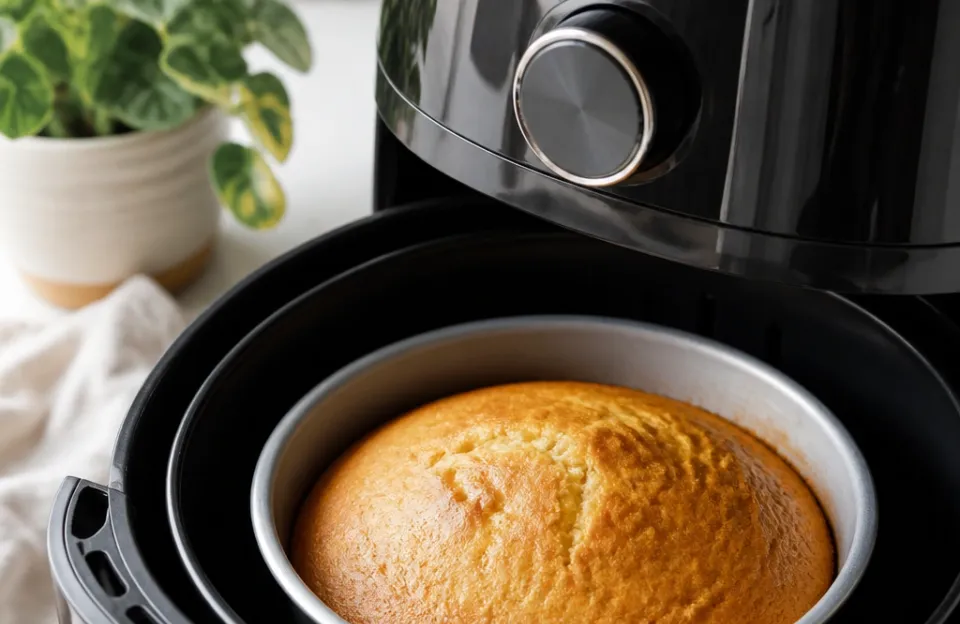
Air fryers cook by pushing superheated air around a confined space with a powerful fan. That fan moves air much faster than the convection setting on a standard wall oven. When you put cake batter inside, the intense airflow sets the outer edges quickly while the center stays liquid longer.
This speed changes how the leavening agents work. Baking powder and baking soda react to heat and moisture to create gas bubbles. In an air fryer, those bubbles expand fast because the outside of the cake crusts over early.
If the temperature is too high, the top hardens before the middle finishes rising. That leaves you with a domed or cracked surface and a dense, undercooked core. Dropping the baking temperature by 25 degrees Fahrenheit compared to a regular recipe solves this problem most of the time.
The concentrated heat also means moisture evaporates faster. Cakes baked in these machines tend to dry out if left in too long. Checking for doneness five minutes before the recipe's stated bake time prevents a crumbly texture.
A toothpick inserted into the center should come out clean or with a few moist crumbs attached.
Pans That Fit Inside the Basket
You cannot pour batter directly into the perforated basket. You need a solid baking vessel. The pan must leave at least half an inch of space between its edges and the walls of the air fryer drawer.
Without that gap, the hot air cannot circulate, and the cake will bake unevenly.
Round six inch or seven inch cake pans work well for machines with a four to six quart capacity. Silicone molds are popular because they flex, making them easy to drop in and lift out of a tight space. Metal pans conduct heat faster, which can lead to darker edges.
If you use a metal pan, lining the bottom with parchment paper stops the base from sticking.
Ramekins or oven safe mugs handle single serving portions. These are good for testing a new batter without committing to a full cake. Just remember that smaller vessels bake significantly faster.
A mug cake might only need eight to twelve minutes at 320°F.
Adjusting Temperatures for Convection Speed
Standard cake recipes assume a still or gently moving heat environment. An air fryer delivers aggressive convection. To adapt any boxed mix or scratch recipe, subtract 25°F from the suggested oven temperature.
If a box says 350°F, set your machine to 325°F.
Time adjustments are less predictable because every model has a different wattage and fan speed. Start checking the cake at the two thirds mark of the original baking time. If a recipe says 30 minutes, open the drawer at 20 minutes.
Use a toothpick or a skewer to test the center.
According to the FDA guidelines on food safety, batters containing raw eggs or flour carry a risk of foodborne illness if undercooked. Always verify that the internal structure is fully set before eating. The center should spring back lightly when pressed with a finger.
If it leaves a deep indentation, it needs more time.
Mixing Batters for Smaller Batches
A standard two layer cake recipe makes too much batter for most countertop appliances. Overfilling a pan causes the batter to rise into the heating element, where it burns and creates smoke. Fill your chosen pan no more than halfway to allow room for expansion.
Halving a recipe is the easiest approach. Divide all ingredients by two. For eggs, beat one whole egg in a bowl and measure out two tablespoons to equal half an egg.
This keeps the ratio of fat, protein, and moisture accurate. Precision matters more in small batches because there is less total volume to absorb minor errors.
Boxed mixes require a bit of math. A standard 15.25 ounce box yields enough batter for two eight inch rounds. For a single six inch air fryer cake, use roughly one third of the dry mix and scale down the water, oil, and eggs proportionally.
Store the remaining dry mix in a sealed bag for later.
If you enjoy scaling down savory dishes for quick dinners, like when preparing crispy garlic parmesan wings for two, the same portion control logic applies to desserts. Small batches prevent waste and keep prep times short.
Flavor Variations That Hold Up to High Heat
Delicate cakes struggle in high velocity air. Angel food cake relies on whipped egg whites for structure, and the aggressive fan can deflate the foam before it sets. Dense batters perform much better.
Pound cake, chocolate fudge cake, carrot cake, and banana bread all hold their shape under rapid convection.
Chocolate batters benefit from the intense heat because cocoa solids bloom faster, producing a richer flavor. Adding a tablespoon of instant coffee granules to a chocolate batter deepens the taste without making it taste like coffee. Vanilla based cakes can dry out faster, so adding an extra tablespoon of sour cream or yogurt to the batter introduces fat and acid that protect the crumb.
Fruit additions change the moisture content. Blueberries or diced apples release water as they heat. Toss fresh fruit in a teaspoon of flour before folding it into the batter.
This stops the fruit from sinking to the bottom and helps absorb excess juice so the cake does not turn soggy.
When planning a full menu around your appliance, pairing a sweet finish with a savory main course works well. You could start dinner with a sweet honey garlic glaze over chicken, then swap the basket out and bake a small vanilla cake for dessert using the same machine.
What Usually Goes Wrong During the Bake
Baking in a confined space with a powerful fan introduces specific failure points. Knowing them ahead of time saves wasted ingredients.
- Sunken centers. This happens when the top crusts over while the middle is still liquid. The trapped steam eventually bursts through the weak spot, or the center collapses as it cools. Lower the temperature by another 10°F and extend the bake time slightly.
- Burnt tops with raw middles. The heating element sits very close to the food. If the top browns too fast, loosely tent a small piece of aluminum foil over the pan. Do not let the foil touch the heating element, as it can scorch or blow into the fan.
- Sticking to the pan. The rapid air dries the edges quickly, bonding them to ungreased surfaces. Always grease the pan thoroughly with butter or cooking spray, and line the bottom with parchment paper cut to fit exactly.
- Uneven rising. The fan blows air in a specific direction, often creating a hotter zone on one side of the basket. Rotate the pan 180 degrees halfway through the estimated baking time to promote even browning.
- Smoking during the bake. Drips of batter or excess grease hitting the bottom of the drawer will burn. Place a small piece of parchment or a silicone liner at the very bottom of the drawer, underneath the rack holding your pan, to catch drips.
Tracking the internal temperature removes the guesswork from these issues. While we typically rely on probes for poultry, like when checking wing doneness to track macros and safety, inserting a digital thermometer into the center of a cake confirms it has reached the 200°F to 210°F range where starches gelatinize and proteins set completely. Using a reliable tool, such as a fast reading kitchen probe, gives you an exact number instead of relying solely on the toothpick test.
Adapting Oven Recipes for Your Machine
Converting a favorite family recipe requires adjusting three variables: pan size, temperature, and time. Here is the sequence to follow.
- Calculate the volume difference. An eight inch round pan holds about six cups of batter. A six inch round pan holds about four cups. Reduce the recipe by one third to fit the smaller pan without overflowing.
- Lower the thermostat. Take the original oven temperature and subtract 25°F. If the recipe calls for 375°F, set the dial to 350°F.
- Shorten the timer. Start with 75% of the original baking time. If the oven recipe bakes for 40 minutes, set your timer for 30 minutes and begin checking early.
- Test the structure. Insert a wooden skewer into the dead center. Wet batter means it needs more time. Clean or slightly crumb covered means pull it out immediately.
- Cool in the pan. Let the cake sit in the pan for ten minutes after removing it from the fryer. The residual heat finishes setting the center, and the structure firms up enough to transfer to a wire rack without breaking.
Mastering these conversions opens up the appliance for all sorts of batch cooking. The same logic used to shrink a cake recipe applies when you are organizing weekly meal prep portions for lunches. Once you understand how the machine handles volume and heat, you can scale almost anything down.
| Variable | Standard Wall Oven | Countertop Air Fryer |
|---|---|---|
| Typical Pan Size | 8 or 9 inch round | 6 or 7 inch round |
| Temperature | As written (e.g., 350°F) | Reduced by 25°F (e.g., 325°F) |
| Bake Time | 30 to 40 minutes | 20 to 30 minutes |
| Airflow | Gentle or still | Aggressive, high speed |
| Batch Yield | 12 to 16 slices | 4 to 6 slices |
Cooling and Storing Leftovers
Because these cakes are smaller, they cool faster than full sheet cakes. Leaving a hot cake in the pan too long traps steam against the bottom, creating a gummy layer. Transfer it to a wire rack after the initial ten minute rest period.
Once completely cool, wrap the cake tightly in plastic wrap. The rapid air baking process produces a slightly drier exterior than a water bath oven method, so sealing out ambient air is necessary to maintain softness. A properly wrapped cake stays fresh at room temperature for two days.
For longer storage, slice the cake and place parchment paper between the layers in an airtight container. Refrigerate for up to five days. Freezing works well too.
Wrap individual slices in foil and place them in a freezer bag. They thaw quickly on the counter in about thirty minutes, giving you a ready made snack without running the appliance again.
If you plan to frost the cake, wait until it reaches room temperature. Buttercream melts instantly on a warm surface. A simple dusting of powdered sugar or a drizzle of ganache works best for warm servings straight from the basket.
Frequently asked questions
Can I use a boxed cake mix in an air fryer?
Yes, boxed mixes work perfectly fine. You just need to scale down the amount of dry mix and wet ingredients to fit a six inch or seven inch pan. Do not fill the pan more than halfway, as the batter will rise significantly.
Lower the temperature on the box by 25°F and check for doneness ten minutes earlier than the package suggests.
Why did my cake sink in the middle?
A sunken center usually means the outside baked too fast while the inside remained liquid. The structure collapsed as it cooled because the center never fully set. Lower your baking temperature by 10 to 15 degrees next time, and avoid opening the drawer during the first half of the baking cycle, as sudden temperature drops cause the rising batter to fall.
Do I need a special pan for an air fryer cake?
You do not need a branded specialty pan, but you do need one that fits with clearance. Any oven safe metal, ceramic, or silicone pan works as long as it leaves at least half an inch of space around the edges for air circulation. Measure the inside of your basket before buying bakeware.
Is baking a cake in an air fryer healthier than an oven?
The health profile depends entirely on your ingredients, not the appliance. The machine does not remove calories or sugar from the batter. However, because it bakes smaller portions, it naturally limits how much you have available to eat at one time compared to baking a massive sheet cake.
Can I bake multiple layers at once?
Stacking pans blocks the airflow that the appliance relies on to cook evenly. Unless you have a large dual basket model or a rack specifically designed to stack without blocking the fan, bake one layer at a time. Trying to force two pans in usually results in one raw cake and one burnt cake.
Does altitude affect air fryer baking times?
Altitude impacts all baking because lower air pressure causes gases to expand faster and liquids to evaporate quicker. At high elevations, you may need to increase the temperature slightly and reduce the leavening agents, just as you would for a conventional oven. The confined space of the appliance amplifies moisture loss, so watch the bake closely.
Before you start mixing
Baking an air fryer cake comes down to respecting the physics of a small, high powered fan. Drop the temperature, shrink the batch size, and monitor the progress earlier than you think you need to. Dense batters like pound cake or chocolate give you the widest margin for error, while airy sponges demand precise timing.
Once you dial in the conversion for your specific machine, you get a fresh dessert in under half an hour without heating up the entire kitchen.