Start frozen French fries in a preheated air fryer at about 360°F, fill the basket no more than halfway, and cook standard straight-cut fries for roughly 12 to 13 minutes, shaking halfway through. Check the package instructions for your specific cut and brand, and cook only to a light golden color without overcooking.
That single setting and timeframe gives you a reliable starting point, but the best results come from two habits: loading the basket lightly and checking before the timer runs out. Everything below builds on those basics so you can adjust for your fries, your appliance, and your taste.
Why Frozen Fries Crisp in an Air Fryer
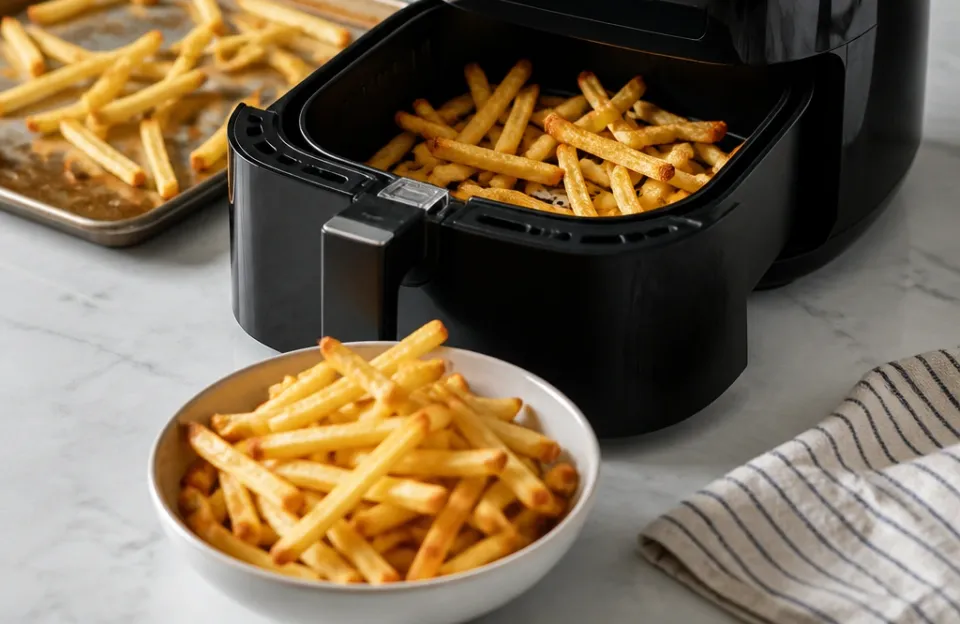
Most commercial frozen fries are already par-fried at the factory, which is why they brown so well with hot circulating air rather than a vat of oil. The air fryer’s fan moves heat across the surface of each fry, driving off moisture and building a crisp shell. Because the fries go in frozen, you get the benefit of that factory par-fry without the sogginess that comes from thawing first.
Package directions for these products generally call for cooking from the frozen state at the recommended time and temperature. Thawing is not only unnecessary but counterproductive: it lets the fries soften and release water before they ever hit the heat, which is the opposite of what you want.
A note on food safety: even though frozen fries may look browned or precooked, they still must be cooked before eating. Read the label to confirm how your specific product should be prepared rather than judging by appearance.
Time by Cut: Start Here, Then Check
Thickness and surface area change cooking time more than any other factor. Thin shoestring fries cook fast and can scorch, while thick steak cuts need longer to heat through. The package directions for your specific product are the only reliable source for time and temperature, so read them first and treat any general range as a rough starting point.
| Cut | Starting temperature | Approximate time | What to watch |
|---|---|---|---|
| Shoestring | Follow package | Follow package | Check early; thin cuts brown fast |
| Crinkle cut | Follow package | Follow package | Shake well so ridges crisp evenly |
| Standard straight cut | 360°F | 12 to 13 minutes | Manufacturer-recommended baseline |
| Steak cut | Follow package | Follow package | Longer for thick interior; check early |
| Waffle cut | Follow package | Follow package | Edges brown before the center |
For any cut, pull the basket out a minute or two before the timer ends and look. If the fries are pale and soft, push them back in. If they are already golden, take them out. Cooking time varies by air fryer and by how full the basket is, so your machine may run hot or cool compared with the label.
Temperature and Preheating
Manufacturer instructions for standard straight-cut fries call for preheating the air fryer to 360°F. Not every appliance or every recipe requires a preheat step, so check your air fryer manual for the recommended approach with frozen foods. If your manual or package does not call for preheating, you can skip it and rely on the package time, checking the fries a minute or two before the timer ends.
Do You Need to Add Oil?
For most standard commercial frozen fries, no added oil is needed. These products are par-fried and contain oil already, which is enough to help them crisp in circulating hot air. Adding more oil tends to make the surface greasy rather than crunchier.
There is one qualification worth knowing: not every frozen fry product is par-fried the same way, and some may be formulated or marketed differently. Check the package directions for your specific product and follow them rather than assuming the no-oil approach applies universally.
If you do add oil, a light spray or toss is enough. Heavy coatings pool in the basket and can smoke.
Basket Loading and Batching
Overcrowding is the most common cause of soggy fries. When fries are piled on top of each other, the hot air cannot reach every surface, moisture gets trapped, and the result steams instead of crisps.
Manufacturer guidance for standard fries is to fill the basket halfway with frozen fries. That is a useful ceiling for most air fryers, and staying at or below it gives the air room to circulate. A single, loosely packed layer is ideal. If you are cooking for a crowd, cook in batches rather than filling the basket higher; the extra time is worth the better texture.
Shake the basket or toss the fries at the halfway point, as the package instructions specify. This exposes new surfaces to the hot air and helps everything brown evenly. If your air fryer runs hotter on one side, rotate the basket or give it an extra shake near the end.
Checking Doneness and Troubleshooting
The package tells you to cook to a light golden color and not to overcook, and that is the simplest check you can use. Pick up a fry, let it cool for a second, and bite in. It should be crisp on the outside, tender inside, and free of any cold or icy center. The product must be fully cooked for both food safety and quality, so do not stop while the middle is still cold.
Here is how to fix the most common problems:
- Soggy fries. The basket was too full, the fries were shaken too late, or the temperature was too low. Reduce the load, shake at the midpoint, and confirm your temperature setting.
- Burnt edges. The temperature was too high, the cut was too thin for the time, or the fries sat too close to the heating element. Lower the temperature slightly and check a minute earlier.
- Uneven batches. Hot spots in your appliance cause some fries to brown before others. Shake more than once and rotate the basket if your model allows it.
If you notice smoke during cooking, stop and check the manual for your specific model before continuing. The safe handling depends on your appliance, so follow the manufacturer’s guidance rather than improvised tricks, and never leave a smoking air fryer unattended.
Seasoning and Serving
Salt and season fries after they come out of the air fryer, not before. A pinch of fine salt immediately after cooking, while the surface is still hot, sticks well and keeps the exterior crisp.
For a more substantial meal, serve your fries alongside crispy seasoned poultry or sweet glazed wings, or pair them with a garlic and cheese combination for a heartier plate. If you are prepping for the week, the same batch-cooking approach that works for prepping wings ahead of time applies here: cook in half-basket loads, cool completely, and reheat in the air fryer rather than the microwave.
Adjusting for Your Air Fryer
Air fryer models vary, so your first batch is your calibration: note the time and temperature that worked, then adjust for the next one. Check your manual for any model-specific guidance on preheat, maximum fill and accessories.
Cooking time also varies by how full the basket is, so a loaded batch will take longer than a sparse one. If you are switching between appliance sizes, start with the lower end of the package time range and check early.
The Bottom Line
Set your air fryer to about 360°F, preheat if your manual or package calls for it, fill the basket no more than halfway, and shake at the midpoint. Cook to a light golden color and stop before the fries darken. For anything other than standard straight-cut fries, use the package time as your guide and check a minute or two before the timer ends. Two habits make the biggest difference: keep the basket lightly loaded, and trust your eyes over the clock.