The right air fryer egg mold comes down to three checks: whether the mold leaves room for air to circulate in your basket, whether its manufacturer-stated heat rating covers the temperature you plan to use, and whether its cup diameter and depth match the egg format you actually want. Flat silicone egg-bite trays suit cooks making several sandwich-sized rounds at once. Individual stainless steel rings suit cooks making one or two round eggs with minimal footprint. Deep silicone molds suit loaded, thicker egg bites. None of these is a universal winner; your basket size and intended format decide the purchase.
Compare the Three Mold Types
Flat Silicone Egg-Bite Trays
A flat tray holds several shallow round cups in one piece of flexible silicone. Eggs release easily when you flex the tray, and one batch produces multiple sandwich-sized rounds. The tradeoff is footprint: a flat tray covers a large share of the basket floor, so you need to confirm it fits with clearance around the edges.
Individual Stainless Steel Rings
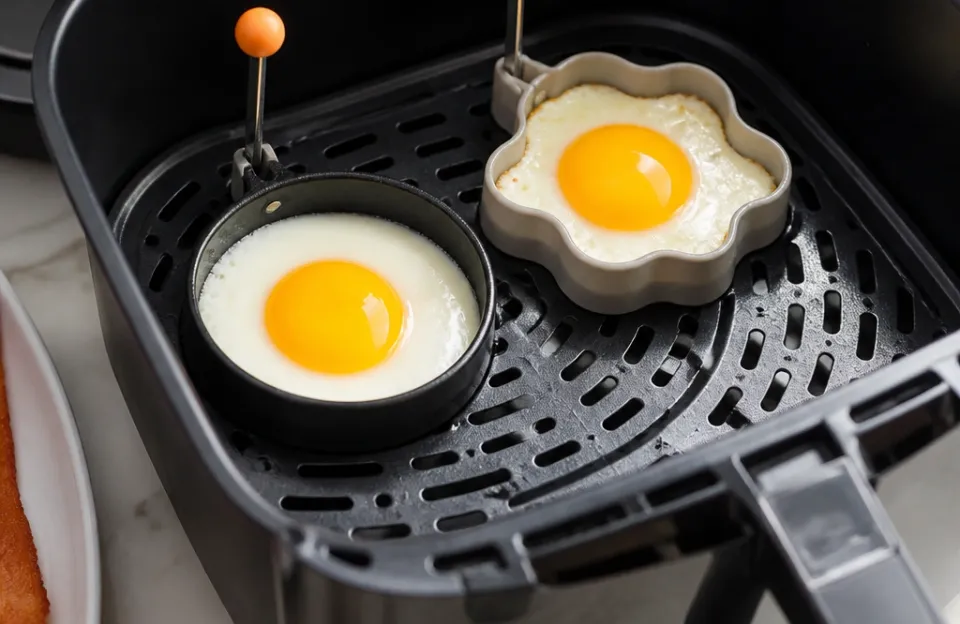
Rings are small, separate molds you position one at a time. Their small footprint leaves room for air to move around each egg, and they are easy to space out in a crowded basket. They demand more care when hot and require greasing to prevent sticking.
Deep Silicone Molds
Deep molds have taller cups that hold more egg and add-ins per bite. That extra height uses more vertical space, so check the mold against your basket’s height as well as its floor area. Deep cups also take longer to set in the center than shallow ones.
At a glance:
| Mold Type | Basket Fit | Heat Rating | Cleaning | Best For |
|---|---|---|---|---|
| Flat silicone tray | Uses most of the basket floor; check clearance | Check the product listing | Check the product listing | Several sandwich rounds at once |
| Stainless steel rings | Small footprint; easy to space | Check the product listing | Hand-wash; grease to prevent sticking | One or two round eggs |
| Deep silicone mold | Taller profile; check basket height | Check the product listing | Check the product listing | Loaded, thicker egg bites |
This table compares form factors, not verified specifications. Heat ratings and cleaning instructions vary by product, so confirm both against the specific listing or instruction sheet before you buy.
Match Cup Size to Your Egg Format
Measure the bread or muffin you plan to use before you buy. A cup that is too wide produces an egg that overhangs the bread; one that is too shallow gives you a thin patty that tears when you lift it out. As a starting point, look for a sandwich cup slightly smaller than the bread so the egg stays inside the edges, and a deeper cup if you want room for add-ins. These are measuring suggestions, not verified standards, so check the listed cup dimensions against your own bread.
Depth matters as much as diameter. Shallow cups set quickly and suit thin patties, while deep cups need more time for the center to reach a safe temperature. If you want both formats, a set with two cup depths is more useful than a single-size tray.
Measure Your Air Fryer Basket for a Mold That Fits
Basket floors vary by model, so measure yours rather than relying on a manufacturer’s capacity in quarts. Lay a ruler across the flat floor at its widest point, then measure the narrowest usable width and the height from the floor to the top of the basket or heating element guard. For a related look at how bakeware dimensions interact with basket space, see our air fryer muffin pans buying guide. Write the three numbers down and compare them with the mold’s listed dimensions before ordering.
Leave a gap around the mold so air can move. Air fryers generally do not have much room inside, and crowding the appliance can prevent enough air circulation to cook food properly. Do not overfill the air frying basket, because uneven cooking and undercooking can follow. For a round basket, a round or small rectangular mold is likely to fit better than a large square tray; check that the corners do not touch the basket wall.
If you are considering a related silicone accessory, the same clearance logic applies, and our guide to air fryer silicone mats explains how flat accessories affect airflow. For solid-sided bakeware, see the air fryer baking pans guide.
Check Heat Limits and Material Safety
Treat any temperature rating as specific to one product. Read the manufacturer’s stated maximum temperature on the listing, packaging, or instruction sheet, and compare it with the temperature in your recipe. If the label gives no rating, ask the seller before you buy. For a useful background on how silicone performs in air fryer heat, our silicone air fryer liners guide covers the same material questions. Follow the accessory instructions that came with your appliance, and handle hot molds with tongs and a heat-safe surface.
Decode Food-Contact Labels
Labels such as food-grade, BPA-free, FDA-related, and LFGB describe a material or a test, not a guarantee of performance in your appliance. Before buying, look for the specific standard named, the testing body, and a document you can request from the seller. If a listing says only “food-grade” with no standard named, ask which one applies. Because labeling regimes differ by country, check the requirement for your own market rather than assuming one global rule. Treat the label as one input among several rather than proof of safety.
Cook Eggs to a Safe Temperature
Cook eggs until they reach a safe internal temperature measured with a food thermometer before you remove them from the heat source. The USDA FSIS lists 160 degrees F (71.1 degrees C) as the minimum internal temperature for eggs. You may prefer to cook them further for personal preference, which FSIS permits.
Insert the thermometer into the thickest part of the egg or egg bite, avoiding the mold wall. The safe internal temperature is the same regardless of air fryer size or power, though cooking times vary by appliance. Refrigerate leftovers within 2 hours, and keep food out of the 40 degrees F to 140 degrees F range where bacteria multiply. For the official air fryer guidance behind these rules, see the USDA FSIS air fryer food safety page.
Clean, Grease, and Store Your Mold
Grease silicone cups lightly before the first use and follow the manufacturer’s washing instructions. Wash flexible silicone by hand or in a dishwasher only if the product’s care instructions allow it, and wash metal rings by hand after they cool. Dry silicone fully before storage, and store molds flat or loosely rolled rather than crushed under heavy pans. Your product’s care instructions take priority over these general practices.
Inspect the mold before each use. If it is cracked, warped, or holds a persistent chemical odor after washing, check the manufacturer’s care instructions for your specific mold before using it again.
Before You Buy: A Decision Checklist
- Measure the usable basket floor and the available height, then add clearance for airflow.
- Read the mold’s manufacturer-stated heat rating and compare it with your cooking temperature.
- Match cup diameter and depth to your bread, muffin, or bite format.
- Review the food-contact labeling and ask the seller for documentation if it is unclear.
- Check the cleaning instructions and confirm you have a food thermometer for doneness.
These checks are a starting point, not a guarantee of fit or performance. Your appliance manual and the product’s own instructions take priority.
If you cook several sandwich rounds at once, a flat tray that fits with clearance is the practical choice. If you want one or two eggs, stainless steel rings leave more room for air. If you want thick, loaded bites, a deep mold is worth the height check. In every case, verify the heat rating and cook the eggs to a safe internal temperature rather than relying on time alone.