Most air fryer accessories earn their place by solving one specific problem you already have. A perforated parchment liner helps if saucy marinades keep gluing food to the basket. A stackable rack helps if you regularly cook small items for several people. Everything else, including bundled kits full of parts you will never unwrap, usually ends up in a drawer.
This guide gives you a conditional buying framework rather than a generic shopping list. It covers which accessory types are worth owning, which to skip, and how to check fit, heat rating and food-contact compliance before you spend anything.
The Short Answer: What’s Worth Buying and What to Skip
Worth buying, if the problem applies to you:
- Perforated parchment liners if you cook marinated, sticky or breaded foods and hate scrubbing the basket.
- A reusable silicone liner if you want a washable option for wet or saucy dishes.
- Silicone-tipped tongs if you turn food often and want to protect the basket coating.
- An instant-read thermometer if you cook poultry, pork or fish. This is the one purchase that directly supports food safety rather than convenience.
- An oil mister bottle if you want a light, even film of oil for crisping.
Most cooks can skip:
- Large accessory bundles with parts sized for a different machine.
- Stacking racks unless you genuinely cook small items in volume.
- Dedicated cleaning brushes when a general kitchen brush already reaches the corners.
- Foil used as a basket lining.
Air fryers are essentially compact countertop convection ovens, and they cook faster than a full oven while using less energy. That speed comes from moving hot air through a small cavity, so anything you add inside competes with airflow. USDA’s Food Safety and Inspection Service warns that air fryers do not have much room inside and that overcrowding can prevent enough air circulation to cook food properly. That single constraint should shape every accessory decision you make.
A Simple Rule: Buy an Accessory Only When You Hit a Specific Wall
Skip the “complete accessory kit” reflex. Ask what problem you keep running into, then buy the smallest item that solves it.
| Your recurring problem | First accessory to consider | Why |
|---|---|---|
| Marinades and glazes stick to the basket | Perforated parchment liners | Catch drips and reduce scrubbing |
| Saucy foods drip through perforations | Reusable silicone liner | Holds liquid; washable |
| Small items like wings or vegetables need more surface area | Stackable wire rack | Adds a second layer, but increases load |
| Turning food scratches the basket coating | Silicone-tipped tongs | Lifts and turns food without metal contact |
| Uneven browning or food sticking | Oil mister bottle | Applies a thin, even oil film |
| You are unsure whether meat is done | Instant-read thermometer | Confirms internal temperature |
If you cook mostly frozen fries, nuggets and plain vegetables, you may not need any of these. The basket alone handles those well.
For a broader comparison of accessory categories, see this guide to the best air fryer accessories.
Measure First: Fit and Clearance Checks Before You Buy
“Universal” is a marketing word, not a measurement. Basket shape, interior dimensions and heating element placement vary enough between models that a liner or rack that fits one machine can block airflow in another.
Before ordering, do this with your own air fryer:
- Measure the flat floor of the basket at its widest point, and again at its narrowest. Liners must fit the smaller figure.
- Measure the usable depth from the basket floor to the lowest point of the heating element. Leave clear space; a liner that sits too high can contact the element.
- Check whether your basket has a removable crisper plate. If it does, measure both with and without the plate, because a rack may need to sit on the plate rather than the basket floor.
- Note the basket shape. Square, round and oval baskets take different insert shapes, and a round liner in a square basket wastes corner space and can curl upward.
- Confirm the drawer still closes fully with the accessory inside, with the basket empty. If it catches, the item is too tall.
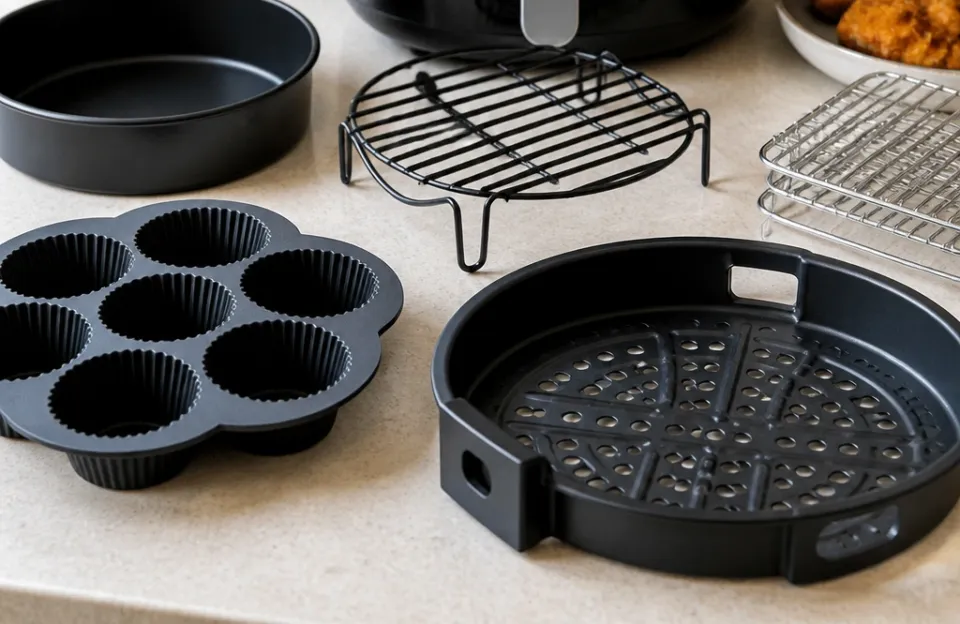
If you are unsure whether a specific insert will fit, this compatibility guide to air fryer accessory fit walks through basket dimensions by model type. For a broader look at how “universal” accessories actually fit across models, see this guide to universal air fryer accessories. The practical rule is simple: if you cannot confirm the measurement, do not buy.
How to Verify Heat Rating and Food-Contact Compliance
Two questions decide whether an accessory is safe to put in a hot air fryer: will it survive the temperature, and is it safe to touch food?
Heat rating. Check the manufacturer’s stated maximum temperature on the packaging, the product page or the instruction leaflet. Compare that figure against the highest temperature you actually use, not the machine’s maximum. If the label gives no temperature rating, do not assume it is oven-safe.
Food-contact compliance. In the United States, food-contact materials fall under FDA oversight of food contact substances. Reputable sellers state compliance clearly, and you can read the FDA’s own pages on food contact substances to understand what that claim means. Look for an explicit food-contact statement, not a vague “food grade” badge with no source.
A few practical checks:
- Buy from sellers who publish a temperature rating and a material specification.
- Wash new silicone and coated items before first use, following the manufacturer’s instructions.
Perforated Parchment Paper Liners
These are the single most useful purchase for anyone who cooks marinated or glazed food. A liner catches drips and caramelized sugars that would otherwise cement themselves to the basket, and the perforations let some air through so the base of the food still crisps.
Buy them if: you cook wings in a flavorful marinade, glazed salmon, sticky ribs or breaded items, and you dislike soaking the basket afterward.
Skip them if: you mostly cook dry frozen foods, where the liner adds little and slightly reduces airflow.
Limitations to respect:
- They are single-use, so the cost recurs.
- Keep the liner flat on the basket floor and follow your air fryer manual’s guidance on paper and liners. If the manual does not address liners, check the liner packet for usage instructions before relying on it.
- Check the stated temperature rating on the packet, and stay below it.
- Do not let the liner sit above the basket rim or near the heating element, and never preheat with an empty liner in place.
Reusable Silicone Liners
A silicone liner is a shallow, flexible bowl that sits inside the basket. It holds sauces, marinades and small pieces that would otherwise fall through the crisper plate, and it goes in the dishwasher.
Buy it if: you cook wet or saucy dishes, or you want to stop buying disposable liners.
Skip it if: you mainly want maximum crisping. A solid liner blocks more airflow than a perforated one, so food sitting in it can steam rather than crisp.
Limitations to respect:
- Solid silicone liners restrict air circulation at the base of the basket. USDA guidance on overcrowding applies here: do not fill the liner so full that air cannot move around the food.
- Do not use a liner as an excuse to cook a larger batch. If the basket is crowded, cook in batches instead.
- Follow the manufacturer’s stated maximum temperature rather than assuming a universal silicone limit.
Stackable Wire Racks
A stackable rack adds a second cooking level for small items: wings, skewers, vegetable pieces or reheating multiple portions. It is genuinely useful for a household cooking small foods in volume.
Buy it if: you regularly cook for three or more people and your basket is wide enough that a second level still leaves air gaps around the sides.
Skip it if: you cook for one or two, or your basket is small. Adding a rack increases the load inside a cavity with limited room, which works against even cooking.
Limitations to respect:
- More food in the same space is the definition of crowding. USDA advises batching large amounts of food rather than air frying it all at once, and warns that overfilling the basket causes uneven cooking and undercooking.
- Follow your air fryer manual’s guidance on accessories and clearance. If the manual does not address racks, keep the rack clear of the heating element and fan outlet, and stop using it if the drawer will not close fully.
If capacity is your real problem, a larger basket solves it better than a rack. This comparison of accessory kits and capacity add-ons covers what different kit types actually include.
Silicone-Tipped Tongs
Tongs matter more than they sound. Turning food halfway through cooking is how you get even browning, and metal tongs can scratch non-stick basket coatings.
Buy them if: you turn food regularly and your current tongs are bare metal, or your hands are too close to a hot element when reaching in.
Skip them if: you already own tongs with silicone or nylon tips.
What to check: tip temperature rating, a locking mechanism so the tongs store compactly, and a length that keeps your hand clear of the basket rim. Inspect the tips periodically and replace the tongs if the silicone is damaged.
Turning food supports even cooking, but it does not confirm doneness. That requires a thermometer reading.
Oil Mister Bottles and Dedicated Cleaning Brushes
These two small tools are grouped because both are cheap, optional and easy to overbuy.
Oil mister bottle. A refillable mister applies a thin, even film of oil, which helps browning on foods like potatoes and vegetables and gives a crisp finish on chicken skin. Buy one if you want controlled oil use. Skip it if you already get good results with a brush or a light toss in a bowl. Check the bottle’s materials against the oils you plan to use, and follow the maker’s cleaning instructions for the nozzle.
Dedicated cleaning brush. Useful for reaching the corners of a basket and the gaps in a crisper plate, but a general kitchen brush usually does the same job. Buy one only if your current brush cannot reach those areas without scratching. Choose a brush with soft bristles and no exposed metal.
Instant-Read Thermometers
This is the accessory that most directly protects you, and it is the one purchase worth prioritizing over liners and racks.
Air fryer cooking times vary with the size and power of the appliance, but the safe internal temperature does not change. USDA’s safe minimum internal temperature chart lists 165°F (73.9°C) for all poultry, including ground poultry. The same guidance sets 145°F for fish, 160°F for ground meat products, and 145°F with a three-minute rest for whole cuts of beef, pork, veal and lamb. Cook food to those minimums, measured with a food thermometer, before removing it from the heat source.
Buy it if: you cook poultry, pork, fish or reheated leftovers. That covers most air fryer owners.
What to check: a thin probe, a fast read time, and a stated accuracy figure on the packaging. A reliable digital probe thermometer should also let you calibrate it.
Stop condition: if readings seem inconsistent between thick and thin parts of the same piece, check the probe in ice water before trusting it for poultry.
When Accessories Cause Problems: Smoke, Uneven Cooking and Shutdowns
Accessories fail in predictable ways. Here is how to diagnose each one.
Smoke from the unit. Likely causes: grease pooled on a solid liner burning, a parchment liner touching the heating element, or residue baked onto a rack. Check for paper or foil in contact with the element, remove any pooled fat, and clean the element area only once the machine is fully cool and unplugged, following your manual.
Uneven cooking or pale patches. Likely causes: a solid liner blocking airflow at the base, a rack crowding the cavity, or food piled above the basket rim. Remove the accessory, reduce the batch, and cook in two rounds instead.
The drawer will not close or the machine shuts off mid-cook. A tall rack or curled liner is the usual culprit. Stop using it and check your manual for the manufacturer’s guidance on accessories, clearance and vents.
Loose liner blown around inside. This happens with lightweight liners and empty preheating. Never preheat with an empty liner in place, and always put food on top of the liner to weigh it down.
Stop conditions in every case: unplug the machine before investigating, and follow your manual’s guidance on damaged accessories and liners.
Bundle Versus Individual Purchase
Bundles look like value, but most contain items sized for a different basket, duplicates of tools you own, and filler pieces that never get used. For example, a round pan sized for a larger basket will not fit a smaller square one.
A better approach: buy the one or two items that solve problems you actually have, verify fit by measurement, and check the heat rating and food-contact statement on each. If a bundle happens to contain exactly those items at a lower combined price, and each piece is rated for your machine, it can be worth it. Otherwise, individual purchases give you control over fit and material quality. For a closer look at what typical kits include, see this comparison of air fryer accessory kits.
Keeping Your Setup Simple
Small accessories add up. A liner, a rack, two pans, tongs, a brush, a mat and a thermometer can consume more cabinet space than the air fryer itself. Before adding another item, ask whether the last one you bought is still in use.
A workable default setup for most households is three items: perforated liners or a silicone liner for messy foods, silicone-tipped tongs for turning, and an instant-read thermometer for doneness. Add a rack only when capacity is a documented, repeated problem, and add small tools only when a specific gap appears.
One more food-safety point that accessories do not change: refrigerate leftovers within two hours, because the range between 40°F and 140°F is where foodborne bacteria multiply. A liner does not extend that window. And if a package carries its own cooking instructions, follow them, since manufacturer directions on food packaging take precedence over general guidance.
Buy for the wall you keep hitting, verify fit and rating before checkout, and let the thermometer, not the accessory, tell you when dinner is safe.