The short answer: pat the wings completely dry, toss them in a light cornstarch and seasoning blend, arrange them in a single layer in a preheated air fryer, and cook at roughly 400°F for about 20 to 25 minutes, flipping halfway, until the thickest part of the meat registers 165°F on a food thermometer.
That sequence matters more than any single ingredient. Cornstarch gives you a hard, glassy shell; the air fryer’s fast-moving hot air dries that shell out and browns it; and a thermometer confirms the meat inside is actually safe to eat. This guide walks through each stage, from drying the wings to fixing a chalky coating, plus the places where the method simply doesn’t work.
Why Cornstarch Creates That Specific Crunch
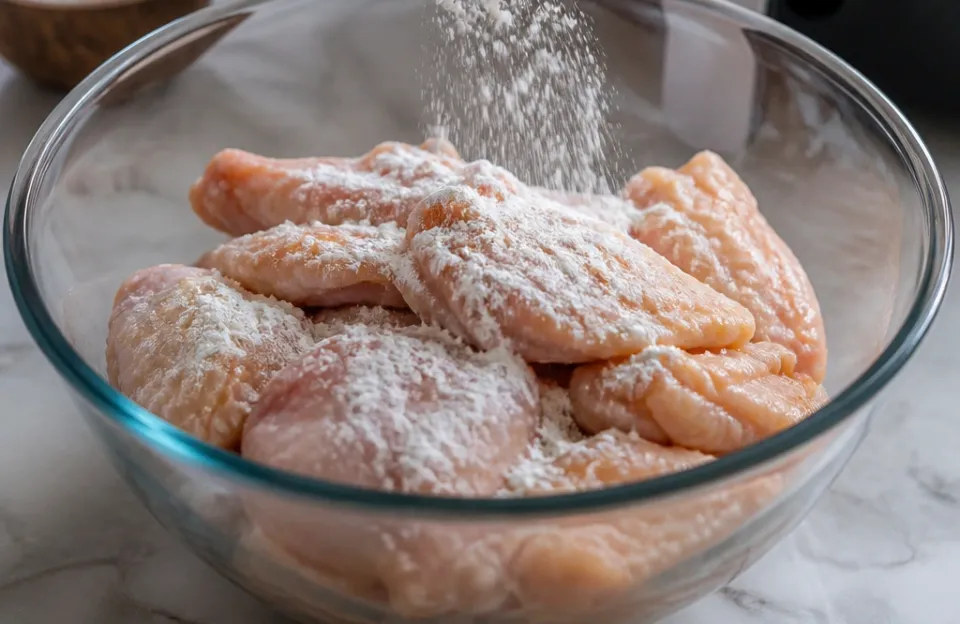
Cornstarch is almost pure starch, with no protein. Wheat flour, by comparison, contains gluten proteins that form elastic networks once they meet water.
When you coat wet chicken wings in flour, the gluten can trap steam beneath the crust as it cooks, leaving the coating slightly chewy or soft. That is a particular problem in an air fryer, where hot air circulates quickly but never submerges the food in oil.
Cornstarch avoids the gluten issue. Under the air fryer’s intense heat, the starch granules absorb moisture, swell, and then dehydrate, fusing into a rigid layer on the outside of the wing. Because the fan constantly strips humid air away from the food, that layer dries faster than it would in a standard oven. The practical result is a crust that stays firm and cracks when you bite into it.
Air fryers themselves are essentially countertop convection ovens that cook food faster and use less energy than larger ovens, and wings are among the foods the USDA lists as suitable for them. Food becomes crisp in these appliances because of the quick circulation of hot air.
What Cornstarch Does and Does Not Do for Doneness
A crisp coating does not make a wing safe to eat, and it does not slow cooking in any meaningful way you can rely on. What determines safety is the internal temperature of the meat.
All poultry, including wings, is safe once it reaches an internal temperature of 165°F. The official minimum is 165°F (73.9°C) for all poultry, wings included. Check that by inserting a probe thermometer into the thickest part of the meat, away from the bone.
How It Compares to Baking Powder Coatings
You will see baking powder recommended often for oven-baked wings. Baking powder works chemically, and its alkaline nature raises the pH of chicken skin, which breaks down surface proteins and encourages browning. It also releases tiny carbon dioxide bubbles that add texture.
Cornstarch works physically: it holds moisture at the surface and forms a shell as it dries. You can combine the two. A mix of two parts cornstarch to one part aluminum-free baking powder gives you both the rigid shell and the extra micro-blisters. Cornstarch alone still produces an excellent tight, crunchy crust if that is what you are after. The trade-offs are summarized below.
| Coating Type | Texture Result | Best Used For | Main Drawback |
|---|---|---|---|
| Cornstarch Only | Hard, glassy crunch | Air frying, high heat | Can taste chalky if applied too thick |
| Flour Only | Chewy, bread-like | Deep frying, batters | Gets soggy fast in an air fryer |
| Baking Powder Only | Puffy, blistered skin | Oven roasting | Metallic taste if overused |
| Cornstarch + Baking Powder | Crisp with micro-blisters | Air frying, maximum crunch | Requires precise ratio measuring |
The Moisture Problem with Raw Wings
Raw chicken wings release a lot of liquid as they cook. Fat renders out of the skin and water evaporates from the muscle fibers. If you put bare, wet wings directly into the basket, that liquid pools underneath and steams the underside of the meat.
Cornstarch intercepts some of that surface moisture during the first minutes of cooking, which helps the skin start browning instead of sitting in its own juices. It is not a substitute for drying the wings. The paper towels and the refrigerator do most of that work, and the starch handles the remainder.
Without drying, the skin stays rubbery through the first half of the cook time, and the air fryer struggles to crisp it before the meat overcooks.
Preparing the Wings: Drying and Separating
The coating will fail if the wings are dripping wet. Remove as much surface moisture as you can before the cornstarch touches the meat.
Take the wings out of their packaging and spread them on a large rimmed baking sheet lined with paper towels. Pat them firmly on all sides, and switch to fresh towels once the first set is soaked.
Leave them uncovered in the refrigerator for at least an hour, or overnight if you have time. Cold, circulating air dries the skin noticeably. This step alone makes a large difference in the final crunch.
Separate the drumettes from the flats if you bought whole wings. The joint between them holds moisture and fat, and leaving them whole means the cornstarch tends to clump in that crevice, producing gummy spots. Cut through the joint with a sharp knife or heavy kitchen shears. Discard the wing tips or save them for stock.
Food Safety During Prep
Raw poultry carries a cross-contamination risk, so set up your workspace before you start coating. Wash your hands with soap and water for 20 seconds before and after handling the raw wings. Use a separate cutting board for raw meat and poultry, and another for any vegetables or ready-to-eat items. Clean and sanitize the counter and tools before and after preparation. Keep the raw wings away from cooked food and anything you plan to eat uncooked.
When the wings come out of the fryer, do not return them to the plate that held them raw.
The Cornstarch Coating Ratio and Seasoning
Put the dried wings in a large bowl and add the cornstarch. For about two pounds of wings, start with three tablespoons.
You want enough to leave a faint, dusty film on every piece. Too much starch creates thick, pasty patches that taste chalky and can burn before the meat cooks through. The exact ratio is a starting point rather than a fixed rule, so adjust it to the size of your batch and how wet the wings still feel.
Add dry seasonings directly to the cornstarch before tossing. Salt, black pepper, garlic powder, smoked paprika, and onion powder all work well. Mix the spices into the starch so they distribute evenly. If you sprinkle spices onto the wings first and then add starch, the coating slides off in uneven clumps.
Toss the wings vigorously with your hands until every piece of skin has a dull, matte finish and no wet, shiny spots remain. If you spot wet patches, sprinkle another half tablespoon of cornstarch over them and toss again.
A reliable baseline blend for two pounds of wings: three tablespoons cornstarch, one teaspoon kosher salt, half a teaspoon black pepper, half a teaspoon garlic powder, and a quarter teaspoon cayenne. It gives a savory, slightly spicy base that pairs with almost any finishing sauce.
Cooking Temperatures, Times, and Flipping
Air fryers vary widely in wattage and basket size, and cooking times vary with the size and power of the appliance. The temperatures below are a working range, not a guarantee for your specific machine. Air-fried foods generally require 5 to 25 minutes at 350°F to 400°F, which puts wings comfortably inside that window.
Preheat your air fryer to 380°F. Do not skip preheating: dropping cold, starch-coated wings into a cold basket lets the cornstarch absorb rendered fat slowly, which turns the coating greasy instead of crisp. A hot basket sets the starch on contact.
Arrange the wings in a single layer with space between each piece. Overcrowding prevents enough air circulation to cook the food properly, and overfilling the basket invites uneven cooking and undercooking. Steam escaping from one wing softens the starch on its neighbor, so cook in batches if your basket is small.
- Preheat to 380°F.
- Arrange the coated wings in a single layer, not touching.
- Cook at 380°F for 12 minutes.
- Open the basket and flip every wing with tongs. The side that touched the basket should already be pale gold and firm.
- Raise the temperature to 400°F and cook for another 8 to 10 minutes, until deeply browned.
The final blast at higher heat drives off the last moisture in the starch shell and browns it quickly. Watch closely during the last three minutes. Cornstarch goes from golden to burnt fast because it lacks the proteins that slow browning in flour.
The USDA advises following the manufacturer’s instructions for your appliance and any food packaging when available, and always confirming doneness with a thermometer rather than relying on the clock. A reliable wireless thermometer lets you monitor progress without repeatedly opening the drawer and dropping the temperature.
Managing Rendered Fat in the Basket
Chicken wings contain a lot of subcutaneous fat. As they cook, it melts and drips through the basket grate into the bottom pan, and the heating element sits close to the food. Fat that splatters onto the element smokes heavily.
Follow your manufacturer’s instructions on liners and drip-pan placement, and never let paper or foil sit where it could contact the heating element. Perforated air fryer liners are an option, but a bare wire grate gives the best air circulation.
If white smoke starts billowing halfway through, pull the basket out carefully and pour off the excess liquid fat from the bottom drawer. Wipe the drawer with paper towels and resume. If smoke continues, switch the appliance off, unplug it, and let it cool before investigating further.
Checking That the Wings Are Safely Cooked
The thermometer is the deciding tool, not the color of the crust. Poultry, including wings, is safe to eat once it reaches an internal temperature of 165°F, and the official safe minimum internal temperature chart lists 165°F (73.9°C) for all poultry, wings included.
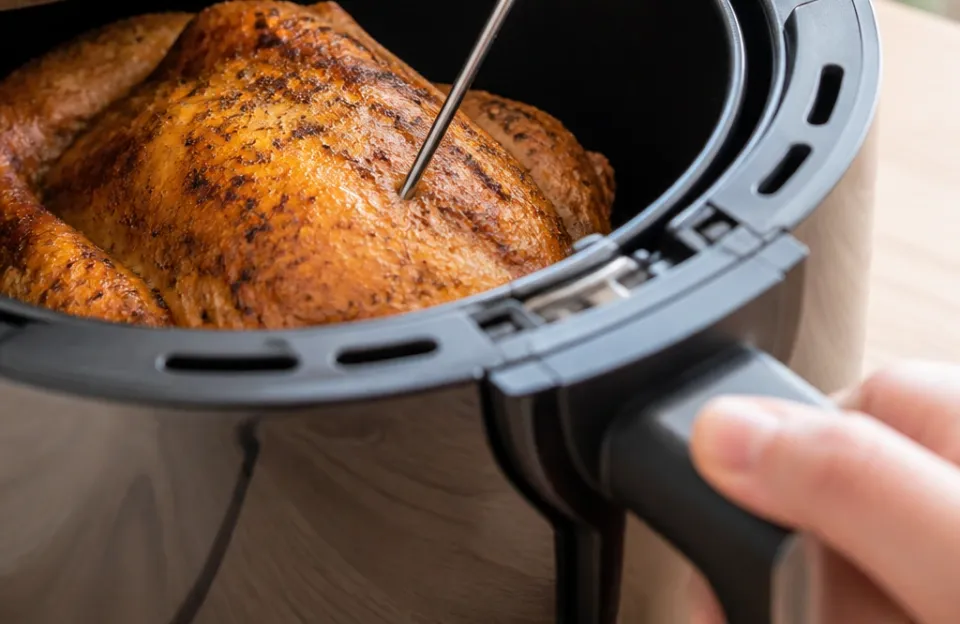
For whole poultry, the USDA advises checking the innermost part of the thigh and wing and the thickest part of the breast. Wings are small, so the practical approach is to probe the thickest part of the largest drumette in the batch, angling the probe toward the center of the meat and avoiding the bone, which heats faster and can give a false reading.
Slide the probe in, wait for the reading to settle, and check two or three pieces rather than just one. If any wing reads below 165°F, return the batch to the air fryer and check again after a few minutes. Following the manufacturer’s instructions for your appliance and for any packaged food supports safe cooking as well, and the USDA’s consistent advice is to confirm every batch with a food thermometer.
Once cooked, refrigerate leftovers within 2 hours.
Troubleshooting Powdery, Soggy, or Smoking Results
Most failures trace back to moisture, crowding, or temperature, and each has a specific fix.
| Symptom | Likely Cause | Fix |
|---|---|---|
| White, powdery patches on the crust | Air fryer not preheated, basket crowded, or starch applied too thick | Preheat fully, cook in a single layer, and shake off excess starch before cooking |
| Soggy or soft skin | Wings not dried, wings touching, or basket overloaded | Pat dry and air-dry in the fridge, then spread in a single layer |
| Uneven browning | Pieces of different sizes, or no flipping | Flip every wing at the halfway point and sort by size |
| Burnt edges with raw centers | Temperature too high for the wing size, or too much starch in patches | Lower the temperature slightly, apply a thinner coat, and verify with a thermometer |
| Heavy smoke from the appliance | Rendered fat hitting the heating element | Pour off accumulated fat, wipe the drawer, and follow the manufacturer’s liner guidance |
Because cooking times vary by appliance, a result that worked in one machine may need adjustment in another. Treat any time in this guide as a starting point and let the thermometer make the final call.
Saucing Without Losing the Crust
The point of the cornstarch coating is a dry, rigid crust, and a wet sauce applied immediately after cooking works against that. The starch shell absorbs liquid and softens within minutes.
You have two workable options. Serve the sauce on the side for dipping, which preserves the crunch completely. Or toss the wings in a light glaze immediately before eating.
For a glaze, melt butter and whisk in hot sauce or barbecue sauce in a separate large bowl. Keep the ratio heavy on the fat and light on the watery liquids. Drop the finished, piping-hot wings into the bowl and toss gently just twice, then serve immediately. Do not let them sit in the bowl.
Thick, sticky sauces such as teriyaki or sweet chili cling to the outside of the shell better than thin vinegar-based sauces, which soak through faster. These are practical guidelines rather than tested rules, so taste and adjust as you go.
Cleanup matters too. Grease and starch residue bake onto heating elements over time, and old carbonized starch smokes during the next cook. Wipe down the interior according to your manufacturer’s instructions after the appliance has cooled.
Where the Cornstarch Method Falls Short
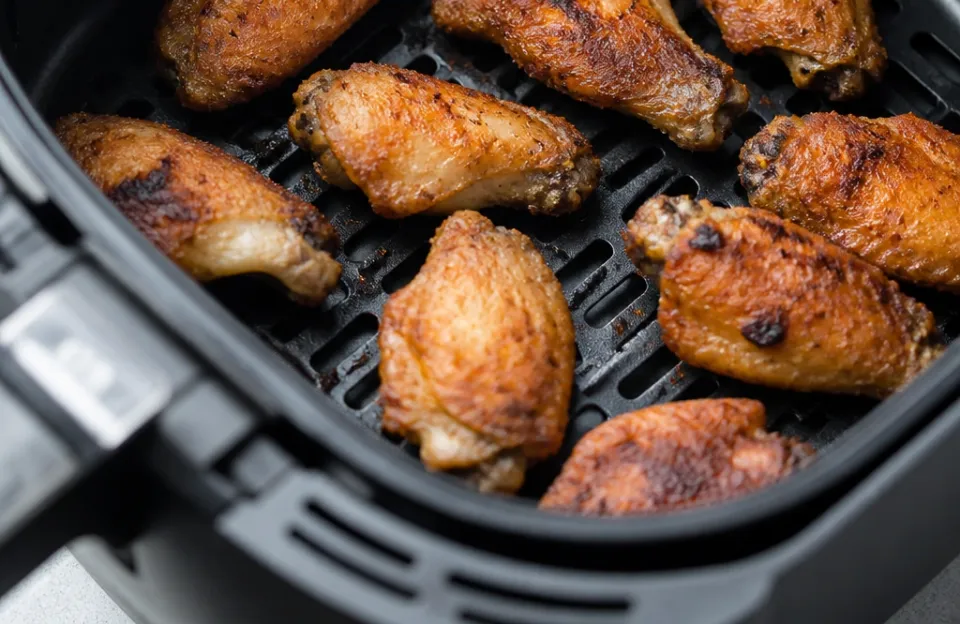
Cornstarch coatings excel in dry heat. They perform poorly when introduced to heavy moisture too early.
Wet batters. If you are making beer-battered or tempura-style wings, cornstarch alone will not hold up. Wet batters need the structure of wheat or rice flour combined with leavening agents to puff in oil, and an air fryer cannot replicate the full immersion of hot oil needed to set a wet batter. Pouring a wet cornstarch batter onto wings and air frying them will drip through the grates and make a mess. Stick to the dry dusting method.
Frozen wings. Do not apply cornstarch to icy wings. The starch mixes with melting ice crystals and forms a thick, gummy paste. Thaw completely in the refrigerator, pat aggressively dry, then dust.
Very small party wings. With less mass, the meat reaches 165°F much faster than large jumbo wings, so the crust may still be pale when the interior is done. Lower the initial temperature to 360°F so the crust has more time to brown before the meat overcooks, and track the heat closely with a precise instant-read thermometer.
Raw stuffed poultry products. The USDA advises against cooking raw, stuffed breaded chicken breast products in an air fryer. That guidance is specific to those products, but it is a reminder to check package directions rather than assuming any chicken product behaves like plain wings.
Spicing Variations That Work with the Starch
Not all spices behave the same way under 400°F air circulation. Some burn, some bloom, and some fade.
Sugar-based rubs are the riskiest. Brown sugar, honey powder, or sweet barbecue rubs caramelize and then scorch before the chicken fat finishes rendering. If you want sweet wings, apply the sweetness as a glaze after cooking, or use a very small amount of sugar mixed heavily with salt and savory spices.
Smoked paprika and cayenne hold up well. They color and flavor the cornstarch layer without burning easily. Garlic powder and onion powder are standard, but use them in moderation, since powdered alliums can turn bitter under direct, dry high heat.
Dried herbs such as oregano, thyme, or rosemary tend to scorch and lose their flavor. If you want herbal notes, stir finely chopped fresh herbs into melted butter and toss the cooked wings in that mixture after they leave the air fryer.
These observations reflect common cooking behavior rather than controlled comparisons, so treat them as starting points and adjust to your own results.
Quick Recap and Serving Notes
Getting that shattering crunch comes down to removing moisture before the heat ever comes on. The cornstarch does the heavy lifting, but it needs a dry surface to grip. Pat the wings thoroughly, measure the starch so you don’t overcoat them, and resist the urge to crowd the basket.
Once you have dialed in the starch-to-spice ratio and learned how your machine behaves at 400°F, this becomes a repeatable routine. Always verify the internal temperature on the largest drumette in the batch. The crust tells you when it is browned; the thermometer tells you when it is done.
For leftovers, skip the microwave, which turns the cornstarch shell rubbery. Three to four minutes back in the air fryer at 375°F restores most of the texture. If you keep probes and accessories on the move, a sturdy travel case keeps them protected between cooks.


2 thoughts on “Crispy Air Fryer Chicken Wings with Cornstarch”