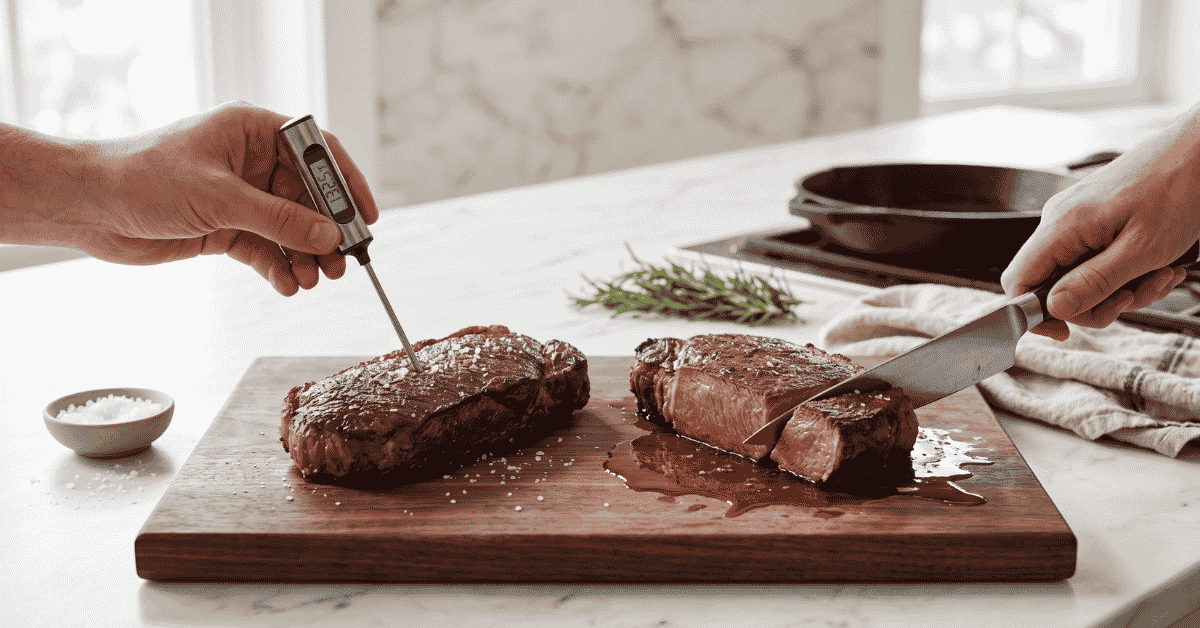
You pull the steak off the grill exactly when the digital display hits 135°F. It looks flawless, charred on the outside and hits that perfect medium-pink target. But if you slice into it the second it hits the cutting board, all that savory juice ends up in a puddle rather than in your mouth.
Quick Answer: Resting time is necessary because heat causes muscle fibers to contract and push moisture toward the center of the meat. Even with a perfect temperature reading, these fibers need time to relax and reabsorb liquid. Skipping the rest results in a dry, tough meal as the internal pressure forces juices out the moment you cut it.
The Science Behind the Rest
When you cook meat, the protein fibers react to the heat by tightening up. Think of a sponge being squeezed tight; the water has nowhere to go but out. In a piece of beef or pork, that juice moves toward the cooler center of the cut.
If you slice it immediately, the high pressure at the center causes all that flavored liquid to gush out.
Resting allows the temperature to even out across the entire piece of meat. As the exterior begins to cool slightly, the tightly wound muscle fibers start to loosen and expand. This creates room for the juices to redistribute back through the outer layers.
A rested steak stays plump and moist because the liquid is held within the cellular structure of the meat, not just sitting between the fibers.
The “perfect reading” you see on your thermometer only tells you the temperature at a single point in time. It doesn’t tell you the state of the physical structure of the proteins. Even at the ideal pull temp, the meat is still in a state of stress from the high heat of the pan or grill.
Resting is the final step of the cooking process that moves the meat from “hot” to “ready.”
The Role of Carryover Cooking
One reason resting is so vital is a phenomenon called carryover cooking. When you remove a roast or steak from the heat, the exterior is much hotter than the interior. That residual heat continues to travel inward, raising the internal temperature by several degrees even after the meat leaves the stove.
If you pull a chicken breast at exactly 165°F and don’t rest it, carryover cooking might push it to 170°F or higher while you’re eating it. Experienced cooks often pull meat 5°F below their target to account for this rise. Without a resting period, you lose control over that final temperature peak, often leading to overcooked results despite a “perfect” initial reading.
Connective Tissue and Texture
Resting also helps with the texture of fats and connective tissues. In larger cuts like brisket or pork shoulder, the collagen has turned into gelatin during the long cook. If you cut into it while it’s piping hot, that gelatin is very thin and watery.
Resting allows it to thicken slightly, giving the meat a silky, rich mouthfeel.
For smaller cuts like steaks or chops, the resting period helps the exterior crust (the Maillard reaction) stabilize. Cutting too soon can steam the crust from the inside out, making a crisp sear turn soft and gummy. Giving it five to ten minutes allows the steam to dissipate slowly, keeping the texture of the sear intact.
Why a Perfect Reading Isn’t the Finish Line
A thermometer is a guide, not a stop sign. While hitting 145°F for pork or 130°F for a rare steak is the goal, those numbers represent the start of the stabilization phase. The reading proves the meat is safe and has reached the desired doneness, but the structural integrity of the meat is still in flux.
If you ignore the rest, you are essentially wasting the precision of your thermometer. The goal of a “perfect reading” is a juicy, tender result. By cutting early, you discard the juice that the thermometer was meant to help you save.
You end up with a piece of meat that is technically the right color but lacks the moisture that makes it palatable.
How Long Should You Actually Rest Meat?
The amount of time required depends entirely on the size and thickness of the cut. A thin skirt steak doesn’t need nearly as much time as a thick-cut ribeye or a full Thanksgiving turkey. A general rule of thumb is to rest meat for about five minutes per inch of thickness, or roughly one-third of the total cooking time for larger roasts.
- Steaks and Chops: 5 to 10 minutes.
- Chicken Breasts: 5 to 10 minutes.
- Pork Loins and Small Roasts: 15 to 20 minutes.
- Whole Chickens: 20 to 30 minutes.
- Large Roasts (Prime Rib, Brisket): 30 to 60 minutes.
For these larger items, you can tent the meat loosely with aluminum foil to keep it warm. However, avoid wrapping it tightly, as this can trap steam and ruin the bark or crust you worked hard to build.
Step-by-Step Guide to a Proper Rest
- Pull Early: Remove the meat from the heat 5°F before your target final temperature.
- Transfer to a Warm Surface: Place the meat on a room-temperature cutting board or a warmed platter. Do not leave it in the hot pan, or it will continue to cook too aggressively.
- Tent Loosely: Cover with a piece of foil if the rest is longer than 10 minutes. Leave gaps at the sides so steam can escape.
- Wait Patiently: Do not poke, prod, or cut the meat during this time.
- Slice Against the Grain: Once the time is up, carve the meat to further enhance tenderness.
Edge Cases and Exceptions
Not every piece of meat requires a long rest. Very thin cuts, such as thinly sliced stir-fry beef or carpaccio-style seared meats, have so little mass that they cool almost instantly. In these cases, a rest of just sixty seconds is usually enough to let the fibers relax without the meat getting cold.
Similarly, if you are using a cooking method like sous-vide, the meat is held at a constant temperature for a long time. Because the temperature gradient between the outside and inside is so small, there is very little internal pressure. While a short rest is still helpful after a final sear, it isn’t as critical as it is for meat cooked over a roaring flame or high-heat oven.
On the other end of the spectrum, very large BBQ meats like brisket are often “rested” in an insulated cooler for several hours. This is less about juice redistribution and more about allowing tough connective tissues to continue breaking down at a very slow, controlled pace. For these specific BBQ applications, the rest is just as important as the cook itself.
Common Resting Mistakes
- Resting in the Pan: Leaving the meat in the cast iron skillet or roasting pan will cause it to overcook. The pan holds a massive amount of heat that will keep driving the internal temp up long after the burner is off.
- Wrapping Too Tight: Wrapping meat tightly in foil creates a mini-sauna. This will steam your steak, making the surface wet and soft.
- Resting in a Cold Spot: If you put a steak on a cold marble countertop or under a ceiling fan, the exterior will get cold before the interior can redistribute juices.
- Cutting to “Check”: Every time you slice into the meat to check the color, you create an escape path for the juices. Trust your thermometer reading and wait for the rest to finish.
Frequently Asked Questions
Won’t the meat get cold while resting?
If you rest it properly, the internal temperature actually goes up before it starts to go down. For larger cuts, the mass holds heat very well. If you’re worried about smaller steaks getting cold, you can use a warm (not hot) plate and a loose foil tent.
Does “perfect” doneness mean it’s safe without resting?
According to the USDA food safety guidelines, certain meats like pork and beef should reach a specific internal temperature and then rest for at least three minutes for safety reasons. This ensures that any potential bacteria are fully neutralized by the sustained heat.
Can you rest meat for too long?
Yes. If you rest a small steak for thirty minutes, it will eventually drop below a pleasant eating temperature. The goal is to let the fibers relax while keeping the meat warm enough to enjoy.
For large roasts, however, you have a much wider window of time.
Why does the juice still run even after resting?
Some liquid loss is inevitable, especially with very juicy cuts or high-fat meats. However, a rested piece of meat will lose significantly less fluid than an unrested one. If a large puddle still forms, you may need to increase your resting time for that specific cut size next time.
Before You Go
Next time you’re at the grill, remember that the clock doesn’t stop when the alarm on your thermometer goes off. That “perfect reading” is simply your cue to move the meat to a resting spot. Giving those protein fibers a few minutes to relax is the difference between a professional-quality meal and a dry, disappointing one.
It takes patience, but the results on the plate are always worth the extra few minutes of waiting.