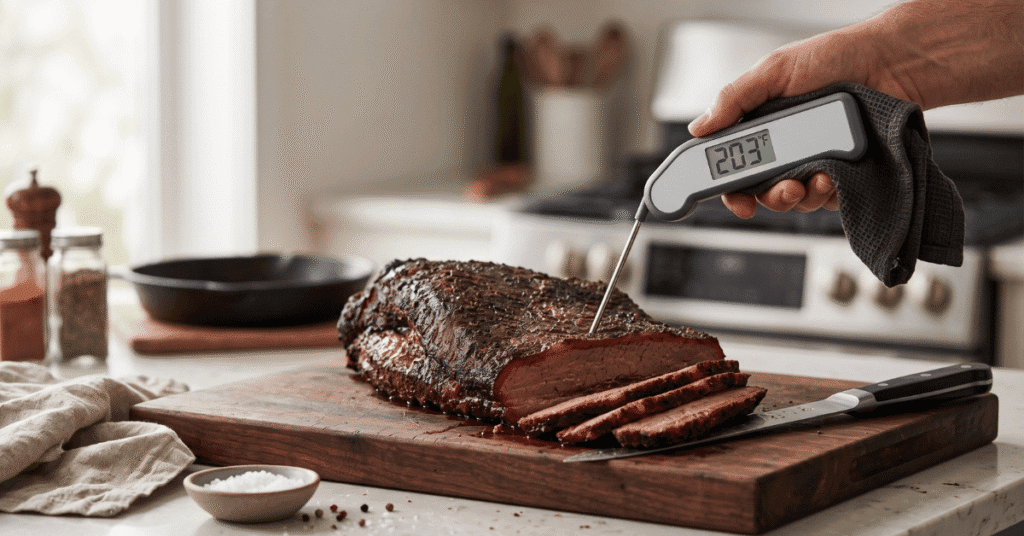
You’ve spent twelve hours tending a fire, monitoring the blue smoke, and obsessing over the bark. The brisket finally hits that magic 203°F mark, and the temptation to grab your knife is overwhelming. But if you slice it right now, the steam will carry away all the moisture you worked so hard to keep, leaving you with dry, gray meat that crumbles instead of bends.
Quick Answer: The ideal internal brisket temperature for slicing is between 140°F and 150°F. Slicing at this range allows the melted collagen to thicken into a gelatinous sauce and keeps the juices inside the muscle fibers. If you slice earlier, often called “hot slicing,” the liquid fat runs out onto the board rather than staying in the meat.
Why Slicing Temperature Dictates Texture
A brisket is a tough muscle held together by a tight web of connective tissue. During the long cook, that tissue breaks down into gelatin. When the meat is bubbling hot, that gelatin is a thin liquid.
If you cut into the meat at 200°F, that liquid escapes instantly. By waiting until the internal temperature drops to 145°F, you allow that liquid to “set,” creating that tacky, melt-in-your-mouth feel people expect from world-class Texas barbecue.
This cooling period also relaxes the muscle fibers. Think of the brisket like a sponge that has been squeezed tight during the cook. As the temperature drops, those fibers expand slightly, pulling the rendered fat and moisture back into the meat.
If you cut too soon, you lose that suction, and the moisture evaporates into the air as steam.
The Physics of the Rest
When you pull a brisket off the smoker, it creates a temperature gradient. The outside is hotter than the inside. If you wrap it and put it in a cooler right away, the internal temperature will actually continue to rise for 20 to 30 minutes.
This is known as “carry-over cooking.”
If you don’t account for this, a brisket pulled at 203°F might hit 210°F while resting, which can lead to overcooking and a mushy texture. Most pros open the foil or butcher paper for 10 minutes to let the steam escape before the final long rest. This stops the cooking process and protects the bark from getting soggy.
Preventing the “Gray Meat” Effect
Slicing hot also changes the color of the meat. High-heat slicing can cause the meat to oxidize rapidly, turning a beautiful pink smoke ring into a dull gray in a matter of minutes. At 140°F, the proteins are stable.
The meat stays vibrant and holds its structural integrity, meaning you can get those perfect pencil-thick slices without the meat falling apart under the weight of the knife.
How to Measure the Temperature Correctly
You cannot guess the internal temperature by feeling the outside of the butcher paper. To get a perfect slice, you need to use a high-quality instant-read thermometer.
-
Wait for the settle: Don’t just look for a single number. If the temperature is still dropping rapidly, wait another 15 minutes.
-
Check different spots : Brisket varies in thickness. Make sure the entire muscle has cooled to at least 150°F before you pick up the knife.
If you don’t have a meat thermometer, you can use the “shrinkage” test. A brisket is usually ready to slice when it has significantly pulled back from its original size and feels flexible rather than stiff. However, for the best results, the 140°F, 150°F window is the golden rule.
The Role of the Long Rest
You might wonder how to get the brisket down to 140°F without it getting cold. The answer is a controlled rest. Many pitmasters use a “faux cambro” method.
Once the initial steam has been vented and the meat is around 180°F, they wrap it back up and put it in a dry plastic cooler with towels.
A well-insulated cooler can keep a brisket in the safe slicing zone for six to eight hours. This long, slow descent in temperature is actually a second stage of cooking. It allows the last bits of stubborn collagen to melt without drying out the edges.
In fact, many of the most famous barbecue joints in Austin rest their briskets for 12 hours or more in holding ovens set to 145°F.
Resting in a Home Oven
Most home ovens don’t go low enough to hold a brisket safely. A standard oven often bottoms out at 170°F, which is too hot for a long rest, it will eventually overcook the meat. If your oven has a “warm” setting, test it with an oven thermometer first.
If it stays between 145°F and 155°F, it is a perfect place to let your brisket sit until it’s time to eat.
Safety and the Danger Zone
The USDA recommends that cooked meat should not stay between 40°F and 140°F for more than two hours to prevent bacterial growth. This is why the 140°F slicing temperature is so specific. It is the floor of the safety zone.
If you are resting your meat for a long time, you must track the temperature to make sure it doesn’t dip into the 130s for an extended period.
Edge Cases: When to Slice Hotter or Colder
While 140°F, 150°F is the standard, there are times you might break the rule.
-
The “Overcooked” Brisket: If your brisket feels too soft (the probe goes in with zero resistance, like air), you should let it cool even further, perhaps to 135°F. The cooler temperature will help firm up the fats and proteins so you can still get a clean slice instead of shredded meat.
-
The “Tight” Brisket: If you realize the meat is a bit undercooked, you might want to slice it slightly hotter, around 160°F. The heat makes the meat appear more tender than it actually is, though you will sacrifice some juiciness.
-
Chopped Beef: If your goal isn’t slices but “chopped beef” sandwiches, the temperature matters much less. You can chop a brisket right off the smoker because the loss of juice will be soaked up by the bun or mixed with sauce.
Common Myths About Slicing Temperature
There is a lot of misinformation in the barbecue world. Let’s look at some of the most common errors.
-
“Touching it tells you it’s ready”: Some people think if the bark is cool to the touch, the meat is ready. Because brisket is so dense, the core can still be 180°F even when the outside feels lukewarm. Always probe the center.
-
“Warming the knife helps”: There is a myth that heating your slicing knife prevents the fat from sticking. A sharp, room-temperature knife is all you need. The meat temperature does the work, not the blade.
-
“Slicing early saves time”: It actually creates more work. When you slice a hot brisket, the meat is harder to handle, the board gets flooded with liquid, and you end up with a mess. Waiting 30 extra minutes is the easiest way to improve the quality of the meal.
Slicing Strategy for Maximum Tenderness
Once you hit that 145°F mark, your work isn’t done. How you cut the meat is just as vital as the temperature.
-
Find the grain: The muscle fibers in a brisket run in different directions for the flat and the point.
-
cut against the grain: Look for the “lines” in the meat and cut perpendicular to them. This shortens the fibers, making each bite easy to chew.
-
Slice to order: Only slice what you are about to eat. Brisket dries out incredibly fast once the surface area is exposed to air. Keep the rest of the roast wrapped until someone asks for seconds.
Brisket State Internal Temp (°F) Slicing Result
Too Hot 180°+ Massive juice loss; steam-dried meat; gray color
Ideal 140° – 150° Maximum juice retention; tacky gelatin; tender slices
Food Safety Floor 140° The lowest safe temp for long-term holding
Too Cold Below 120° Fat begins to turn solid/waxy; meat feels “heavy”
Frequently Asked Questions
Can I slice brisket at room temperature?
You can, but the eating experience won’t be as good. When the fat drops below 110°F, it starts to solidify and feel greasy on the tongue. For the best flavor, you want the fat to be in a semi-liquid state, which happens right around 140°F.
What happens if I wait too long to slice?
If the brisket drops to 120°F or lower, the fat loses its silky texture. The meat will still be tender, but it won’t have that “melt-in-your-mouth” quality. If it gets too cold, you can tightly wrap it and gently reheat it in a 250°F oven until the internal temp reaches 145°F again.
Why do some people slice at 160°F?
Slicing at 160°F is common in high-volume restaurants where they don’t have enough holding space to let every brisket drop to 140°F. It’s an acceptable compromise, but it is not as good as the lower range for home cooks who have the luxury of time.
Does the wrap material affect slicing temperature?
Butcher paper allows the meat to breathe more than foil. Briskets rested in paper tend to have a firmer bark, which makes slicing easier even if the temperature is on the higher side of the 140, 150 range. Foil-wrapped briskets often need to drop to exactly 140°F to keep the softened bark from sliding off.
Worth Remembering
The most important tool in your barbecue kit at the end of the day is patience. A brisket is not a steak; it doesn’t just need five minutes of rest. It needs a slow, methodical descent in temperature.
If you can master the wait and keep your knife in the drawer until that internal probe reads 145°F, you will see a massive leap in the quality of your barbecue.
According to USDA guidelines, always keep an eye on your thermometers to stay out of the danger zone, but don’t rush the process. Your guests will notice the difference in every juicy, tender bite.