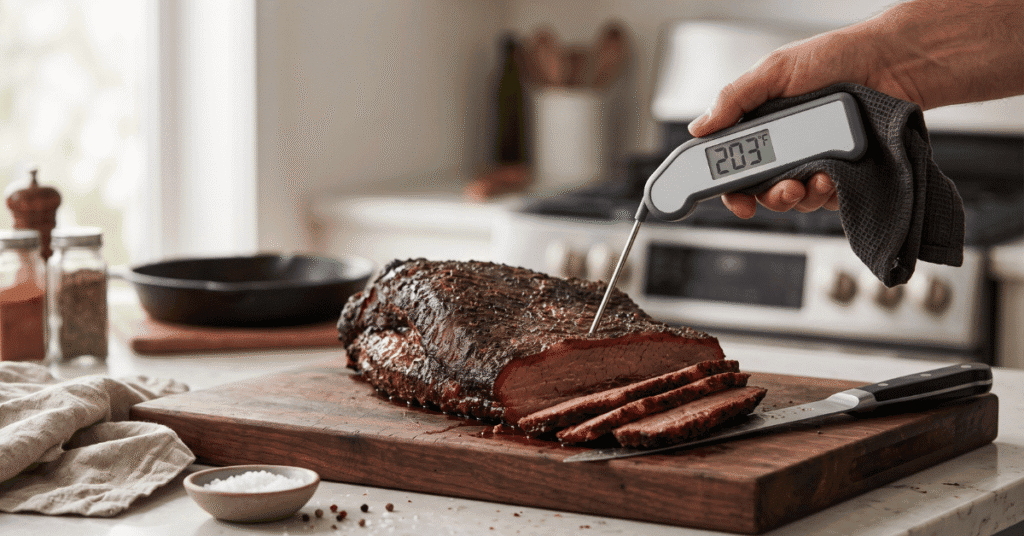
Brisket is ready to slice when it is probe-tender and has rested enough that its internal temperature has settled, not when it hits one fixed number. Cook it to roughly 190°F to 205°F in the thickest part of the flat, confirm tenderness with a probe, then rest before slicing. Slicing near the finish temperature is a texture and handling choice rather than a safety requirement: the meat is still hot and harder to manage, and it releases more moisture at the first cut than a rested brisket does. Keep the rested brisket at or above 140°F if it will be held before serving.
Quick Answer: When Brisket Is Ready to Slice
The quick answer has two parts, because “done cooking” and “ready to slice” are different checkpoints. Brisket reaches doneness when it sits in the 190°F to 205°F range in the thickest part of the flat and a probe slides in with little resistance. It is ready to slice once it has rested and the internal temperature has come down enough that it is no longer steaming and shedding juice at the first cut. During that rest, keep the brisket at or above 140°F if it is going to be held before serving. No supplied source sets a single ideal slicing temperature, so treat the settled reading as a practical guide rather than a fixed rule.
The difference matters because the characteristic tenderness of barbecue comes from connective tissue that has broken down, not from a single thermometer number. Texas A&M explains that collagen conversion in barbecue cuts requires internal temperatures in the range of 185 to 195°F, and that failing to reach that endpoint produces tough barbecue. Slicing at finish temperature is fine for texture if the meat is probe-tender, but the cut will release more moisture than a rested brisket will. The exact slicing temperature is a matter of practice rather than a documented standard, so use the settled reading together with tenderness.
Why Brisket Needs a Higher Internal Temperature Than Steak
Steak is tender because the muscle itself is tender, so it can be eaten at 145°F. Brisket is a working muscle, so it needs more heat for longer to become pleasant to chew. Muscle-fiber tenderness decreases as internal temperature rises, while connective-tissue tenderness increases. The two effects pull in opposite directions, which is why brisket needs that higher, slower cook.
When the connective tissue breaks down, it converts toward gelatin, and that conversion in barbecue cuts requires internal temperatures in the range of 185 to 195°F. If you stop short of that endpoint, the barbecue turns out tough. This is also why probe tenderness, rather than a single fixed temperature, should decide when the cook is finished. The 190°F to 205°F finish range used in this article comes from a commercial barbecue retailer’s guide, so treat it as a practical starting point and let tenderness confirm the endpoint.
How to Measure Brisket Temperature Correctly
Probe the thickest part of the flat, check more than one spot, and wait for a stable reading. Brisket varies in thickness, and a single quick reading can land in a cooler pocket or near a bone. Use a reliable instant-read thermometer and give it time to settle before you trust the number.
- Probe the thickest part of the flat, then check a second spot to confirm the reading.
- Hold the probe still until the number stops changing.
- At the end of the cook, judge doneness together with a tenderness check, since probe tenderness, not one fixed number, determines when the cook is finished.
- During any hold, verify that the meat stays at or above 140°F, the temperature hot food should be kept at if it is not served right away.
A thermometer tracks progress; tenderness confirms the finish. Use a high-quality instant-read thermometer and treat repeat readings as your check, not a guess based on how the wrapped package feels from the outside.
A Note on Carry-Over Cooking
Meat continues to cook after it comes off the heat, and internal temperature can keep rising during the early part of the rest. The exact rise varies with the size of the brisket, the wrap, the pit temperature and the room, so there is no fixed number you can bank on. Judge the finish on tenderness and start your rest knowing the temperature may climb slightly before it falls. For more on how carry-over works, see this explanation of carry-over cooking.
Resting, Carry-Over Cooking and Safe Hot Holding
Resting serves two purposes: it lets the meat settle so slices hold together, and it gives you a window to bring the temperature down without leaving food unsafe. The food-safety anchor here is the USDA consumer guidance that hot food you are not serving right away should be kept at 140°F or above. Rest and holding time spent above that line is time you do not need to count against the two-hour limit for food left out of refrigeration.
Holding in a Cooler
A preheated cooler with towels can keep a wrapped brisket warm, but performance depends on the cooler, how well it was preheated, how full it is and how often you open it. No supplied source gives a verified safe hold time for a cooler, so no universal limit applies. Check the internal temperature periodically with a probe and move the brisket to a 140°F-or-above oven or serve it if the reading is dropping toward that line.
Holding in a Low Home Oven
A home oven on its lowest setting can hold a cooked brisket warm, provided you verify the actual temperature with an oven thermometer first and confirm the brisket itself stays at or above 140°F. No supplied source verifies low-oven holding of cooked brisket as a safe method, so treat this as a practical option only when you can confirm the meat stays at or above 140°F. Note that this is holding already-cooked meat, not roasting raw meat. USDA guidance for roasting raw meat and poultry calls for an oven temperature no lower than 325°F, so low-oven holding should be treated as a post-cook hold, not a cooking method.
Also remember that hot-holding equipment maintains temperature; it cannot reheat food, which must be brought to a safe temperature before it goes into the holding setup. If you are resting your meat for a long time, track the reading so it does not drift below 140°F.
What the Danger Zone Rule Actually Covers
The USDA consumer guidance describes the range between 40°F and 140°F as the Danger Zone, where bacteria grow most rapidly. Hot food that is not served right away should be kept at 140°F or above. Food should never be left out of refrigeration for more than two hours, or more than one hour when the ambient temperature is above 90°F.
That two-hour clock is about food sitting out, not about a brisket descending through warm temperatures during a rest. A brisket held at or above 140°F is on the safe side of the line, and the rest is your window to slice and serve. If the brisket will not be eaten within that window, cool it properly rather than leaving it out.
Cooling and Reheating Leftover Brisket Safely
Improper cooling of cooked foods is one of the most common causes of foodborne illness, and bacteria can be reintroduced to food after it has been safely cooked. That is why leftovers need to move through the warm range quickly. Place leftover brisket in shallow containers for quick cooling and refrigerate at 40°F or below within two hours.
Reheat leftovers thoroughly to an internal temperature of 165°F. Reaching 165°F is the federal leftover standard, so check the center of the thickest piece with a thermometer rather than relying on how hot the outside feels.
Slicing Strategy for Maximum Tenderness
Once the brisket has rested and settled, the cut matters as much as the temperature. The flat and the point have muscle fibers that run in different directions, so locate the grain on each section before you start and cut across it, perpendicular to the visible lines. That shortens the fibers in each bite and makes the meat easier to chew. This slicing technique is general barbecue practice rather than a point covered by the food-safety sources cited here.
Slice only what you are about to serve. Brisket dries out quickly once a cut face is exposed to air, so keep the rest of the roast wrapped and slice to order.
| Brisket State | Internal Temperature | What to Expect |
|---|---|---|
| Just off the heat | Around 190°F to 205°F in the thickest part of the flat | Probe-tender finish; ready to rest, not yet settled |
| Rested and safe to hold | At or above 140°F | Firm enough to slice cleanly; stays within hot-holding guidance |
| Left out too long | In the 40°F to 140°F range past the time limit | Discard rather than serve |
| Cold leftovers | 40°F or below in the refrigerator | Reheat to 165°F before serving |
Edge Cases: Overcooked, Undercooked and Chopped Brisket
An overcooked brisket that probes with almost no resistance can be hard to slice cleanly. Let it rest a little longer so the meat firms up before you cut, and consider serving it chopped rather than in slices. This is general barbecue practice rather than a point covered by the food-safety sources cited here.
An undercooked brisket that still feels tight will not slice well, and no amount of resting will make up for a missed endpoint. Return it to the heat until it reaches the doneness range and turns probe-tender. The 190°F to 205°F range comes from a commercial barbecue retailer’s guide, so confirm the endpoint with tenderness rather than the number alone.
If you are making chopped beef sandwiches, the temperature is less critical because the meat is broken down anyway. Chop it after a normal rest, and mix in any juices that collect on the board.
Conclusion: A Decision You Can Use at the Cutting Board
Brisket is truly ready to slice when two things are true: it reached the 190°F to 205°F doneness range in the thickest part of the flat and turned probe-tender, and it has rested without dropping below the 140°F hot-holding line while you wait. Probe more than one spot, trust tenderness over a single number, and keep the meat wrapped and hot until you are ready to cut. The 190°F to 205°F range comes from a commercial barbecue retailer’s guide, so treat it as a practical starting point rather than a documented standard. Cool and refrigerate leftovers within two hours, and reheat them to 165°F.