You’re hovering over a hot grill, checking a thick slab of brisket. As soon as you pull the needle out, you look at the raw chicken breast sizzing next to it. You wonder if you can just jab the probe straight into the poultry, or if that tiny bit of beef juice on the tip is a one-way ticket to a stomach ache.
It’s a split-second decision that happens in backyard cookouts every weekend.
Quick Answer: You must clean and sanitize your thermometer probe between different types of meat, especially when moving from raw or undercooked items to those nearing completion. Failing to do so causes cross-contamination, spreading bacteria like Salmonella or E. coli from one piece of food to another. A quick wipe with an alcohol swab or hot soapy water protects your meal from foodborne illness.
The Science of Cross-Contamination on a Probe
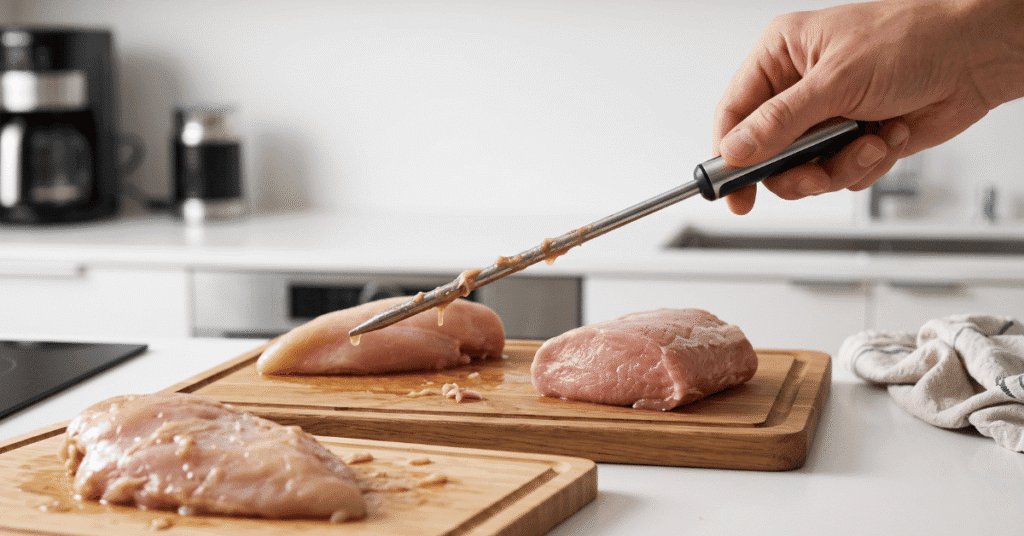
When you stick a metal probe into a piece of meat, you aren’t just measuring heat. Kinetic energy drives that needle through muscle fibers, and as it enters, the surface of the probe picks up microscopic hitchhikers. These include proteins, fats, and, most importantly, bacteria.
If the meat is raw or only halfway cooked, those bacteria are still very much alive.
If you then take that same probe and insert it into a different type of meat, or even a different cut of the same meat that is closer to being finished, you are physically transporting those pathogens. The USDA points out that cross-contamination is one of the leading causes of food poisoning. It doesn’t take a large visible glob of fat to cause a problem; a microscopic colony of bacteria is enough to contaminate a “clean” piece of protein.
Think of the thermometer as a bridge. While the heat of the second piece of meat might eventually kill the bacteria you just introduced, there is no guarantee. If the second piece of meat is seconds away from being pulled off the heat, the bacteria you just wiped onto it won’t have enough time to reach a lethal temperature.
You’ve effectively poisoned the “safe” meat with juice from the “unsafe” meat.
The Problem with Mixed Protein Grilling
Grilling often involves a “mixed bag” approach. You might have burgers, chicken thighs, and maybe a few sausages all going at once. Each of these meats carries different bacterial risks.
Chicken is notorious for Salmonella and Campylobacter , whereas ground beef is a common vehicle for E. coli .
When you move the probe from chicken to beef without cleaning it, you are introducing poultry-specific pathogens into a red meat environment. People often eat beef at lower internal temperatures (like medium-rare at 135°F), which is not high enough to kill the bacteria typically found in poultry (which requires 165°F). This mismatch in safety thresholds makes cleaning the probe a non-negotiable step for anyone cooking multiple types of protein simultaneously.
Heat Does Not Sanitize the Probe Instantly
A common myth is that the heat of the grill or the meat itself cleans the probe as you use it. This is dangerously incorrect. While the air inside a smoker might be 225°F and the surface of a grill might be 500°F, the probe only stays in that environment for a few seconds during a reading.
Standard instant-read thermometers are designed to give a result in two to three seconds. That is nowhere near enough time for the heat to sterilize the metal surface. Sterilization requires sustained exposure to high heat.
By the time you’ve pulled the probe out and moved it to the next steak, the tip is still contaminated with the juices of the previous check.
When Cleaning is Most Critical
Not every single probe insertion carries the same level of risk, though you should aim for consistency. The danger level peaks during specific transitions in the cooking process. Overlooking these moments is where most home cooks run into trouble.
Moving from Raw to “Almost Done”
The highest risk occurs when you check a piece of meat that is clearly raw or undercooked to see how far it has progressed, then immediately check a piece that is nearing its target temperature. For example, if you check a pork chop that is only at 100°F and then use that same probe on a finished piece of fish, you have just transferred live bacteria from the raw pork onto the ready-to-eat fish.
Because the fish is finished, it won’t be returning to the heat. Those pork bacteria will sit on the surface of the fish, migrate into the puncture hole, and be consumed by whoever eats that portion. This is the most common path for thermometer-based food poisoning.
Swapping Between Different Species
As mentioned earlier, different animals harbor different bacteria. If you are cooking a “surf and turf,” the microbes found in raw shrimp are vastly different from those in a ribeye. According to FDA food safety guidelines, keeping different food types separate is a pillar of kitchen safety.
Using a dirty probe to jump between species breaks the physical barrier you worked so hard to maintain by using different cutting boards or tongs.
Checking Ground Meats vs. Whole Muscle Cuts
Ground meats (like burgers or sausages) are higher risk than whole muscle cuts (like steaks or roasts). In a steak, bacteria usually stay on the outside surface, which gets seared. In ground meat, the outside surface is ground into the middle, meaning bacteria are everywhere.
If you poke a burger that isn’t done yet, the probe gets coated in a slurry of fat and pathogens from the center. Moving that to a steak that you plan to serve rare is a recipe for disaster.
Tools You Need for Quick Cleaning
You don’t need to run back to the kitchen sink every time you check a temperature. In fact, if you’re grilling outside, that isn’t practical. Pro cooks use a few different methods to keep things moving without sacrificing safety.
-
Alcohol Prep Pads: These are the gold standard. They are cheap, portable, and kill bacteria almost instantly. Keep a box of these by the grill. After each check, rip one open, wipe the needle from the base to the tip, and you’re ready for the next piece of meat.
-
Sanitizer Wipes: Food-safe wipes designed for kitchen surfaces also work. Just ensure they are rated for food-contact surfaces so you aren’t leaving behind harmful chemicals.
-
Soapy Water Bucket: A small container with warm, soapy water and a clean rag allows you to wipe the probe down mid-cook. Follow this with a quick rinse or a wipe with a clean, dry paper towel.
-
The “Double Probe” Technique: If you have two thermometers, you can dedicate one to high-risk meats (chicken) and one to lower-risk meats (beef). However, you still need to clean them eventually, so this just delays the inevitable.
Steps for Proper Probe Hygiene
-
Insert the probe: Take your reading as usual.
-
Withdraw and wipe: Immediately wipe away any visible debris (fat, gristle, or meat juices) with a clean paper towel.
-
Sanitize: Use your alcohol swab or soapy cloth to thoroughly clean the entire length of the probe that entered the meat.
-
Dry: If using water, dry it off so you don’t affect the next reading or steam the next piece of meat.
-
Repeat: Do this every time you switch between different pieces of meat, especially if they are at different stages of doneness.
Exceptions to the Rule
Are there times when you can skip the deep clean? Technically, yes, but only in very specific scenarios. If you are checking four identical chicken breasts that all went on the grill at the exact same time and you are checking them all for a final temperature of 165°F, the risk is lower.
In this case, if one breast is at 160°F and the next is at 162°F, you are moving between two “unsafe” environments that are both headed toward the same “safe” destination. However, even here, if the first breast happens to be contaminated with an unusually high load of bacteria and the second one finishes first and is pulled off, you’ve still created a risk.
For the sake of habit, it’s always better to wipe the probe. It takes five seconds and removes the “human error” factor. If you get into the habit of cleaning it every time, you won’t accidentally forget to do it when the stakes are higher, such as moving from a raw chicken leg to a finished steak.
The Risks of Non-Probe Contamination
It isn’t just the needle you have to worry about. Often, the housing of the thermometer or your own hands can become contaminated during the process of checking temperatures.
If you grab a raw chicken thigh to flip it, then pick up your thermometer with that same hand, the handle of the thermometer is now contaminated. Even if you clean the needle, you might transfer bacteria back to your hands or the meat next time you pick it up.
A holistic approach to grill safety involves:
-
Wiping the handle of the thermometer along with the probe.
-
Washing your hands after handling raw meat before touching your tools.
-
Keeping the thermometer in a clean “zone” of your prep table, away from raw meat trays.
Common Mistakes with Thermometer Hygiene
Even well-meaning cooks often mess up the cleaning process. These mistakes can lead to a false sense of security while still leaving bacteria on the equipment.
-
Only wiping with a dry cloth: A dry paper towel removes the “gunk,” but it doesn’t kill the bacteria. It just spreads the microbes around the surface of the metal.
-
Rinsing with plain water: Cool or lukewarm water from a garden hose or a kitchen tap isn’t a disinfectant. You need soap or a chemical agent (like alcohol) to break down the bacterial cell walls.
-
Cleaning only the tip: Many people only wipe the very end of the probe. If you pushed the needle two or three inches into a roast, that entire three-inch section is contaminated. You must clean the full length that was submerged.
-
Storing a dirty probe in a sheath: Most digital thermometers come with a plastic sleeve or sheath. If you put a dirty probe back into that sheath, the inside of the sleeve becomes a breeding ground for bacteria. Even if you clean the probe later, the next time you slide it into that dirty sheath, it gets re-contaminated.
Digital vs. Analog: Does the Tool Matter?
The type of thermometer you use doesn’t change the biology of the meat. Whether it’s a high-end $100 digital instant-read or a $5 analog dial thermometer, the metal probe behaves the same way.
However, digital probes are often thinner, which creates a smaller “wound” in the meat and picks up less debris. Analog thermometers usually have thicker probes that can hold onto more fat and juice. Regardless of the technology, the sanitation requirement remains the same.
If it touches raw meat, it’s dirty.
One advantage of high-end digital thermometers is that they are often dishwasher safe (rated IP67 or higher). This means you can actually dunk the whole unit into soapy water or hold it under the tap without frying the electronics. If your thermometer isn’t waterproof, you have to be much more careful to only clean the metal stem.
Temperature Tables for Cross-Contamination Context
Understanding why we clean the probe requires knowing the gap between “safe” temperatures. If you move a probe from a meat with a high safety threshold to one with a lower one, you are in the danger zone.
Meat Type Minimum Safe Internal Temp (USDA) Primary Bacterial Concern
Poultry (Chicken, Turkey) 165°F (74°C) Salmonella, Campylobacter
Ground Meats (Beef, Pork) 160°F (71°C) E. coli
Fresh Beef, Veal, Lamb 145°F (63°C) + 3 min rest E. coli, Listeria
Pork Chops/Roasts 145°F (63°C) + 3 min rest Trichinella, Yersinia
Fish and Shellfish 145°F (63°C) Vibrio, Norovirus
Note how high the poultry requirement is. If you use a probe on chicken that is currently “in the red” at 140°F and then move it to a medium-rare steak at 135°F, that steak will never reach the 165°F required to kill the poultry bacteria you just introduced.
Frequently Asked Questions
Can I just use a flame to sanitize my probe?
While a flame can kill bacteria, it’s not recommended for most meat thermometers. High heat from a lighter or the grill burners can damage the sensors inside digital probes or throw off the calibrate a meat thermometer of analog ones. It’s also an inconsistent way to clean the entire surface.
Stick to alcohol wipes or soapy water.
Do I need to clean the probe between two pieces of the same meat?
If you are moving from a piece that is raw to a piece that is done, yes. If both pieces are at roughly the same stage of cooking and are the same type of meat, the risk is lower, but cleaning is still the safest practice. It prevents the transfer of any localized bacterial clusters from one cut to another.
Is it enough to just dip the probe in boiling water?
Boiling water (212°F) is an effective sanitizer if the probe is submerged for enough time. However, a quick dip might not be sufficient, and you risk getting water into the electronics of the thermometer. A wipe with a sanitizer is faster and safer for the tool.
Should I clean the probe before the first use of the day?
Yes. Dust, kitchen grease, or bacteria from the storage drawer can settle on the probe between uses. Always give it a quick wipe before you start your cook to ensure you’re starting with a sterile surface.
Before you go
Cleaning your thermometer probe is one of those small habits that separates a great cook from a lucky one. It takes very little effort but eliminates one of the most common ways people get sick from home-cooked meals. Keep a pack of alcohol wipes in your grill kit or a soapy sponge nearby.
By treating your thermometer like a surgical tool rather than just a kitchen gadget, you ensure that the only thing you’re serving is great-tasting, safe food. If you’re looking for a new tool that can handle frequent cleaning, check out our guide on the best waterproof instant-read thermometers to find a model that can stand up to the sink. If you aren’t sure if your meat is finished, always refer to your temperature charts before serving.