You’re staring at a beautiful prime rib on the grill, the digital display says it’s hit 135°F, but the meat feels suspiciously soft when you poke it. You pull it anyway, slice into the center, and find it’s still cold and gray-blue. A failing probe just ruined your Sunday dinner, and now you’re wondering if you should have seen this coming.
Quick Answer: You should replace a meat thermometer probe as soon as it shows signs of physical wear or consistent inaccuracy, which typically happens every 1 to 3 years for frequent cooks. While the base unit can last a decade, the probe is a wearable part prone to moisture damage, wire fraying, and heat stress. If your probe fails a simple ice bath calibration test by more than 2°F, it is time for a replacement.
Why probes fail while the base unit stays perfect
The probe is the only part of your thermometer system that faces the “war zone” of your grill or oven. While the digital screen sits safely on the counter or magnetically attached to the smoker’s exterior, the probe is buried in cold meat and surrounded by fire, steam, and grease. Because of this, the probe is considered a consumable item by most high-end manufacturers like Thermoworks or Maverick.
Most modern probes use a thermistor or a thermocouple. These are delicate electronic sensors protected by a stainless steel sheath. The point where the wire meets the steel housing is the most vulnerable spot.
It is usually crimped or sealed with high-temp silicone, but even the best seals break down over time. Once that seal fails, moisture gets inside and short-circuits the sensor, leading to wild temperature swings or “HHH” error codes on your screen.
The impact of heat cycles on sensor accuracy
Every time you cook, the internal components of the probe expand and contract. If you regularly cook at high temperatures, say, searing steaks at 500°F, the metal and internal wiring undergo significant stress. This repeated thermal cycling eventually causes the tiny wires inside the cable to become brittle and snap.
Over time, this wear causes “drift.” Drift is when the sensor slowly loses its ability to report the truth. It might not break completely, but it starts reading 5 degrees too high or too low. In the world of food safety and culinary perfection, 5 degrees is the difference between a juicy medium-rare steak and a dry, overcooked one.
Water damage: The silent probe killer
Many people assume that because a probe is made of stainless steel, it is waterproof. In reality, most probes are only water-resistant. If you submerge the entire probe and its cable in a sink of soapy water, capillary action can pull moisture up into the sensor housing.
This doesn’t always kill the probe instantly. Sometimes it works fine until the next time you heat it up. As the trapped moisture turns to steam inside the probe, it interferes with the electrical resistance the base unit uses to calculate temperature.
This leads to the common “jumping” numbers seen on a failing display.
How to measure the health of your probe
You don’t have to guess if your probe is still good. The easiest way to check is a calibration test. This should be done every few months or anytime you suspect your cook didn’t turn out quite right.
-
The Ice Bath Test: Fill a tall glass with crushed ice and just enough water to fill the gaps. Stir it and let it sit for a minute. Insert your probe, ensuring it doesn’t touch the sides or bottom of the glass. It should read exactly 32°F (0°C).
-
The Boiling Water Test: Bring a pot of distilled water to a rolling boil. Insert the probe. At sea level, it should read 212°F (100°C). Remember to adjust for your altitude if you live in the mountains.
-
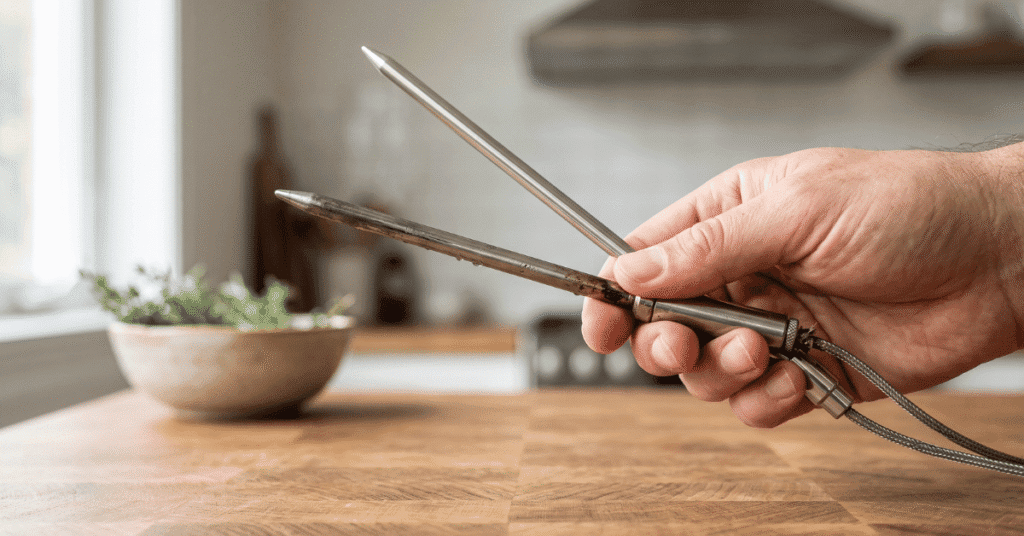
The Physical Inspection: Run your fingers down the length of the wire. If you feel kinks, see frayed steel braiding, or notice the wire pulling away from the plug, the probe is nearing the end of its life.
If your probe is off by 1 degree, you can usually just account for that in your head. If it’s off by 3 degrees or more, and your base unit won’t let you “offset” or calibrate the display to match, the probe needs to go.
Factors that shorten your probe’s lifespan
Some habits will force you to buy new probes every six months, while better care can push that out to several years. High-heat exposure is the primary culprit. Most standard probes are rated for temperatures up to 482°F or 572°F.
If you leave a probe in a steak while you flare up the grill to 700°F, you will likely bake the internal insulation, destroying the probe instantly.
The way you store your wires also matters. We often see people tightly wrapping the probe wire around the base unit. This creates sharp bends at the “neck” of the plug and the transition to the probe.
These internal copper or nickel wires are thinner than a human hair. Repeatedly bending them back and forth, much like a paperclip, will eventually cause them to break.
Smoker vs. Grill usage
If you primarily use your thermometer for low-and-slow smoking (225°F to 275°F), your probes will naturally last longer. The lower thermal stress preserves the sensor and the silicone seals. However, smokers involve a lot of grease and carbon buildup.
If you let “gunk” bake onto the probe, it creates an insulating layer that slows down the response time, making the thermometer feel sluggish.
The “Dreaded Kink” and cable management
Cable management is the secret to making a probe last three years instead of three months. Using a “large loop” storage method or a dedicated probe spool keeps the internal wires from FATIGUING. When you run the wire through the lid of a grill or smoker, avoid pinching it against the metal rim.
Most modern smokers have a dedicated “probe port” (a small hole with a rubber grommet). If yours doesn’t, try to run the wire through a spot where the lid has the most gap.
When to replace vs. when to clean
Sometimes a probe isn’t broken; it’s just dirty. If your thermometer is reading high or seems to be reacting slowly, look at the tip. If there is a charred crust on the steel, that’s carbon buildup.
Use a scouring pad and some warm soapy water to scrub the probe back to shiny steel. Be extremely careful not to get the wire transition wet. If the accuracy returns after a good cleaning, you’ve saved yourself the cost of a replacement.
However, if you see any of the following, cleaning won’t help:
-
The display shows “No Probe” when it’s plugged in.
-
The temperature jumps from 75°F to 210°F and back in a split second.
-
There is visible melting on the wire’s insulation.
-
The stainless steel probe has a permanent bend or “pitting” from corrosion.
Replacing the probe vs. the whole unit
One common mistake is throwing away the entire thermometer because the probe died. Most mid-to-high-tier digital thermometers use standard 2.5mm or 3.5mm jacks. You can buy replacement probes for $15 to $25, which is much cheaper than a new $80 base unit.
Check the manufacturer’s website for the specific sensor type. You cannot mix a “Thermistor” probe with a “Thermocouple” base unit; they speak different electrical languages. According to NIST standards, high-precision sensors are calibrated to the electronics they ship with, but for home kitchen use, a high-quality replacement probe from the original manufacturer will be perfectly accurate.
Common mistakes or misconceptions
-
Mistake: Thinking “Pro” probes are indestructible. Even commercial-grade probes fail if they are submerged or overheated. Price doesn’t always equal immortality in the kitchen.
-
Mistake: Using a probe in a closed grill without a port. If the heavy lid of a Weber kettle or a Big Green Egg slams down on the wire, the internal wires will eventually sever.
-
Mistake: washing probes in the dishwasher. The high-pressure jets and extreme humidity of a dishwasher are almost guaranteed to force water into the probe housing.
-
Mistake: Believing “L” or “HH” means the battery is low. In most digital thermometers, these codes actually mean the probe has shorted out or reached a temperature beyond its range.
Frequently asked questions
Can I fix a probe that got wet?
Sometimes you can save a water-logged probe by “baking” it. Place the probe (not the plastic plug) in an oven at 250°F for about an hour. This can help evaporate the moisture inside the housing.
It doesn’t always work, but it’s worth a try before buying a new one.
Why does my new probe read differently than my old one?
No two sensors are identical. Even high-end probes have a tolerance of ±0.7°F to ±2°F. If you have two probes side-by-side and they are within 2 degrees of each other, they are both considered “accurate” by industry standards.
How long do wireless (no-wire) probes last?
Wireless probes, which house the battery and electronics inside the probe itself, have a different lifespan. The internal battery is the weak link. These often last 2 to 5 years depending on the number of “charge cycles” the battery can handle before it stops holding a charge.
Does the brand of the replacement probe matter?
Yes. Using a cheap, generic replacement probe on a high-end base unit can often result in inaccurate readings. The resistance curves of the sensors must match the programming of the base unit.
It is always best to buy the official replacement from the brand that made your thermometer.
Worth remembering
The probe is a high-precision instrument disguised as a piece of kitchen hardware. Treat it like a delicate sensor rather than a sturdy spoon. If you cook three nights a week, expect to buy a replacement probe every two years.
By keeping your wires unkinked and your connections dry, you’ll ensure that the next time you pull that roast off the heat, it’s exactly the temperature you intended.