You’ve just pulled a prime rib out of the oven, but the screen on your digital thermometer is flashing “LLL” or jumping erratically from 150°F to 300°F. If you’ve ever had a probe quit on you right in the middle of a holiday meal, you know the frustration of a sudden hardware failure. Most of the time, these tools don’t die because of a bad battery or a tech glitch; they fail because the delicate internal wires in the probe stay wet or get too hot.
Quick Answer: To make your meat thermometer probe last longer, never submerge the wire in water, avoid pinching the cable under heavy grill lids, and keep the cord away from direct flames. Simply wipe the stainless steel tip with a soapy sponge and dry it immediately to prevent moisture from seeping into the transition crimp where the wire meets the probe.
Why Probe Care Is the Secret to Accuracy
A meat thermometer is only as good as the electrical resistance inside its probe. Most high-quality digital thermometers use a thermistor or a thermocouple. These systems rely on a very specific flow of electricity through thin wires buried inside the steel tube.
When a probe fails, it’s usually because that electrical flow has been disrupted by water, heat, or physical tension.
The most vulnerable part of the tool is the “transition” point. This is the spot where the flexible mesh or silicone wire enters the rigid metal probe. Even if the probe itself is rated for high heat, the internal insulation on those tiny wires can melt if they touch a hot grill grate.
Likewise, while the steel tip is waterproof, the crimp at the end of the wire usually isn’t. If grease or water gets into that crimp, it causes a short circuit, leading to those “HHH” or “Err” messages on your base unit.
The Role of Moisture in Probe Failure
Water is the primary enemy of digital kitchen gear. When you soak a probe in a sink full of sudsy water, liquid travels by capillary action up the wire casing. Once moisture sits against the internal sensor, it creates a bridge that messes with the resistance readings.
This doesn’t just give you a wrong temperature; it can permanently corrode the internal components.
Heat Limits and Component Stress
Every probe has a max temperature rating, often around 500°F to 700°F for the metal and much lower for the cable. Many people assume they can use their probe for high-heat searing. But flare-ups on a charcoal grill can easily exceed 1,000°F.
At those levels, the thin copper or alloy wires inside the mesh can snap or fuse together, ending the life of the probe instantly.
1. Clean the Tip, Save the Crimp
Cleaning is where most probes meet their end. Many home cooks treat the probe like a spoon or a whisk and toss it into the dishwasher or a sink of soaking water. This is a mistake that often leads to immediate failure.
To clean it properly, use a damp cloth or a sponge with a bit of dish soap. Wipe down the stainless steel portion that was inside the meat. You can even use an alcohol wipe for extra sanitation.
The key is to keep the water far away from the junction where the wire meets the metal tube.
- Process: Hold the probe by the wire with the metal tip pointing down toward the floor.
- Wipe: Run the soapy sponge down the metal part away from your hand.
- Dry: Immediately use a dry paper towel to remove any trace of moisture.
If you do accidentally get the wire wet, don’t plug it in. Some users find success by placing the probe in an oven at a very low temperature (around 150°F) for an hour to “bake out” the moisture, but it’s better to avoid the wetness entirely.
2. Guard Against the “Pinch”
If you use a remote leave-in thermometer for smoking brisket or roasting a turkey, the wire has to pass from the inside of the cooker to the outside. This is a major failure point. Heavy cast-iron grill lids or tight-fitting oven doors can act like scissors.
Over several cooking sessions, the repeated pressure of the lid slamming down on the wire kinks the internal filaments. Eventually, these filaments break. You might notice the temperature stays accurate as long as the wire is straight, but as soon as you move it, the reading jumps.
To prevent this, look for a “probe port” on your smoker or grill. This is a small silicone-lined hole designed specifically for cables. If your grill doesn’t have one, try to lead the wire through a side vent or the corner of the door where the seal is usually a bit softer.
Avoid letting the cable hang over sharp metal edges that might saw through the protective mesh.
3. Manage Flare-Ups and Proximity to Coals
Direct heat is the fastest way to kill a thermometer. While the stainless steel tip is designed to handle the heat of a 165°F chicken breast, the external wire is often only rated for ambient air temperatures. If that wire rests against a hot grill grate or hangs directly over a flaming coal, the insulation will melt.
When setting up your cook, use a “grill clip” or a small ball of crumpled aluminum foil to hold the ambient probe in place. Ensure the cable is routed away from the main heat source. If you are cooking over an open fire or a high-heat charcoal bed, consider using an instant-read thermometer instead of a leave-in probe.
Instant-read models are only exposed to the heat for a few seconds, which protects the electronics from the long-term stress of a multi-hour smoking session.
4. Store Wires Without Kinks
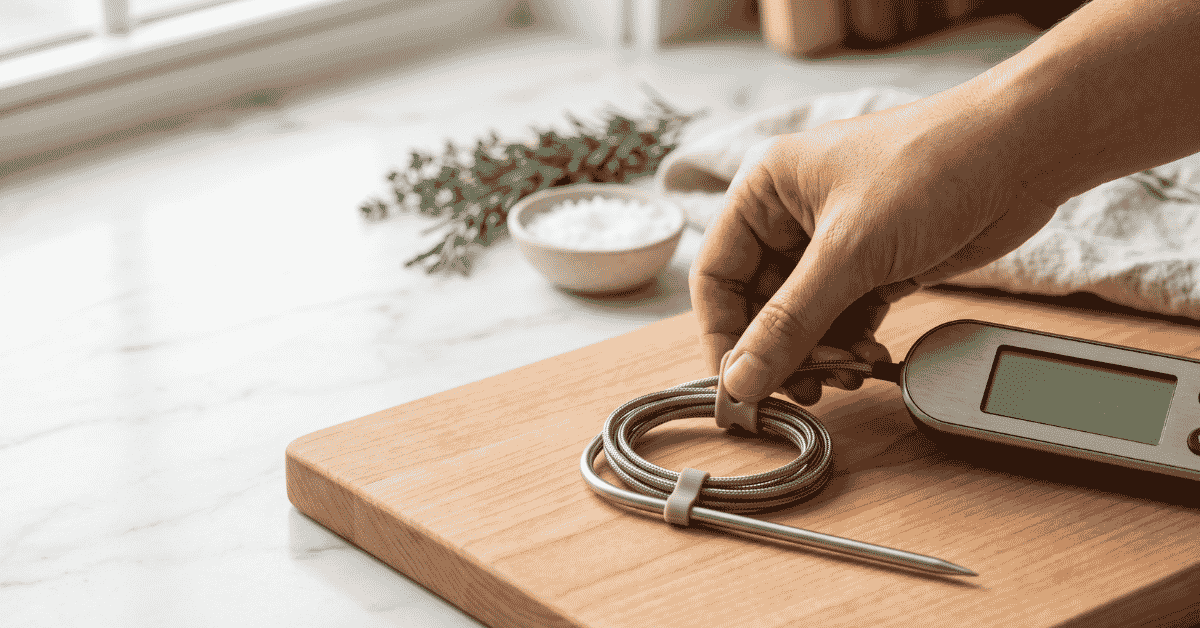
The way you put your thermometer away is just as important as how you use it. Tightly wrapping the wire around the base unit might seem organized, but it puts constant tension on the connection points. Over time, this leads to “fraying” at the plug or the probe end.
Instead of a tight coil, try the “over-under” method used by audio engineers, or simply loop the wire loosely in a circle. You want the wire to have a diameter of at least three or four inches when coiled.
- Avoid: Using tight rubber bands or zip ties.
- Try: Using a loose velcro strap or a dedicated probe spool.
- Check: Before storing, look for any oily residue on the wire. Grease can actually degrade some types of silicone insulation over months of storage. A quick wipe with a dry cloth keeps the material supple.
5. Use the Right Tool for the Temperature Range
Don’t ask a standard kitchen probe to do industrial-level work. If you are deep-frying or making candy, the temperatures are consistent and high. While many probes are rated for 400°F+, the constant immersion in boiling oil can be hard on the seals.
For extremely high-heat applications, use a “high-temp” rated probe if the manufacturer offers one. These often have specialized fiberglass or metal shielding. If you only have a standard probe, try to keep the wire as far as possible from the edges of the pot where the heat is most concentrated.
Knowing the limits of your specific model, usually found in the manual or on the manufacturer’s site like Thermoworks or Maverick, prevents you from pushing the gear past its breaking point.
Common Misconceptions About Probe Failure
There are a few myths that lead people to throw away perfectly good thermometers or, conversely, treat them too roughly.
- “They are waterproof/submersible”: Even if the base unit is rated IP67 (meaning it can be dropped in a puddle), the probes are rarely fully waterproof at the wire junction. Most “waterproof” claims only apply to the stainless steel tip.
- “The wire is just a metal string”: It looks like a simple metal braid, but inside that braid are Teflon or Kapton-coated wires thinner than a human hair. Treat the wire with the same care you would a high-end pair of headphones.
- “An Err message means the base is broken”: 99% of the time, the problem is the probe, not the screen or the computer inside. Replacing a $15 probe is much cheaper than buying a whole new $80 system. Check for a short by plugging in a different probe if your unit supports multiple channels.
Quick-Reference Care Chart
| Action | Why it helps | Risk if ignored |
|---|---|---|
| Hand-wipe tip only | Prevents moisture entry | Short circuit / Err message |
| Loose coiling | Protects internal filaments | Internal wire breakage |
| Use probe ports | Prevents kinking/crushing | “Flickering” temp readings |
| Avoid direct flame | Keeps insulation intact | Melted wires / Fire hazard |
| Dry immediately | Prevents corrosion | Permanent sensor damage |
Frequently Asked Questions
Why is my meat thermometer showing a much higher temperature than it should?
Usually, this indicates moisture has entered the probe’s transition crimp. This moisture creates a bridge between the wires, lowering the resistance and making the base unit think it’s hotter than it is. You can try drying the probe in a low oven at 150°F for an hour to see if the reading returns to normal.
Can I use my probe in a pressure cooker or Dutch oven?
It is not recommended. The high pressure and steam in a pressure cooker will force moisture into the probe seals almost instantly. In a Dutch oven, the heavy lid will likely crush the wire, leading to a permanent kink or break.
Is it okay to leave the probe in the meat while it rests?
Yes, this is actually a great way to monitor carry-over cooking. Since the oven or grill is off, there is no risk of ambient heat damage. Just be careful not to trip over the wire or pull the base unit off the counter when moving the meat to a carving board.
How often should I calibrate my probes?
Testing in an ice-water bath once every few months is a good habit. Fill a glass with crushed ice, add just enough water to fill the gaps, and stir. The probe should read 32°F (0°C).
If it is off by more than a degree or two and your unit doesn’t allow for manual calibration, it might be time to replace the probe.
Worth Remembering
A high-quality meat thermometer is an investment in food safety and flavor. While the digital displays and Bluetooth features get all the attention, the probe is the part that actually does the work. By treating the wires with a little more “respect”, keeping them dry, unkinking them, and shielding them from direct flame, you can easily double or triple the lifespan of your gear.
In practice, a well-cared-for probe should last years, even with weekly use. If you start seeing erratic numbers, don’t immediately bin the whole unit. Often, a gentle cleaning and a slow “drying out” period are all it takes to get things back to 32 degrees.
For those who cook frequently, keeping a spare probe in the drawer is a smart move, but following these five tips means you won’t have to reach for that spare very often.