Air frying is a cooking method that uses rapidly circulating hot air to brown and crisp food. A heating element warms the air inside a compact chamber, and a powerful fan pushes it around the food at high speed. The result mimics the texture of deep frying with only a fraction of the oil.
If you've been wondering what is air frying and how it differs from using a standard oven, the short answer is airflow speed and chamber size. Air fryers move heat much faster than conventional ovens because the cooking space is small and the fan is strong. This article explains the mechanics behind the process, the types of machines available, what foods work best, and where the method falls short.
How Rapid Air Circulation Cooks Your Food
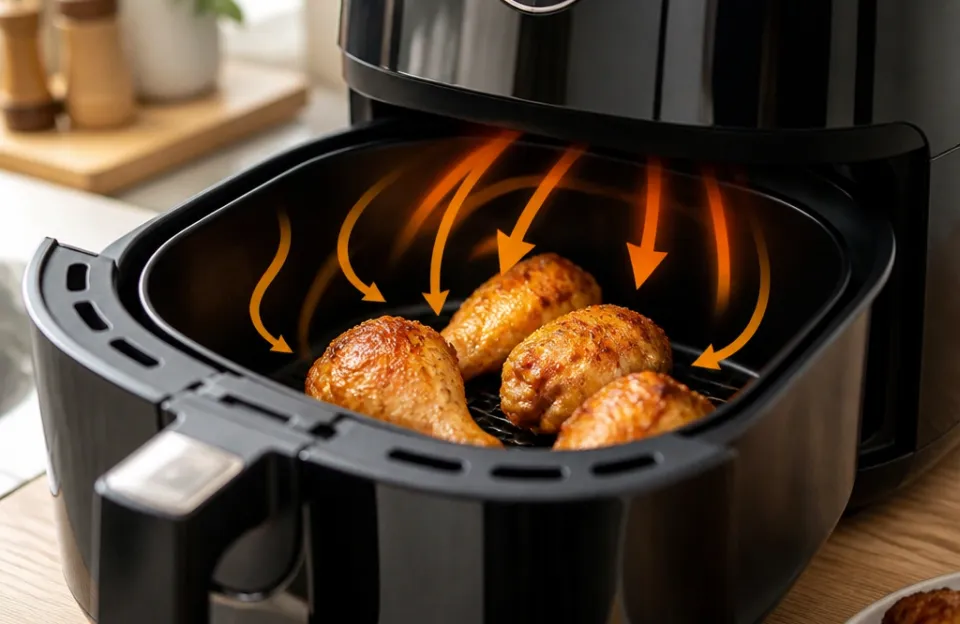
The core mechanism relies on convection. A metal coil or halogen bulb near the top of the machine generates intense heat. Directly above or beside that heating element sits a fan.
When you turn the machine on, the fan pulls air across the heat source and forces it down into the basket holding your food.
That air hits the bottom of the chamber and flows back up through the perforated walls of the basket. This creates a continuous loop of superheated wind moving at speeds far higher than a traditional convection oven. The constant movement strips away the thin layer of cooler moisture surrounding raw food.
Once that moisture barrier is gone, the surface temperature rises quickly.
This rapid surface drying triggers the Maillard reaction. That is the chemical process responsible for browning meat, crisping potato skins, and giving baked goods their golden crust. According to the USDA, safe internal temperatures remain the same regardless of cooking method: 165°F for poultry and 145°F for whole cuts of beef or pork.
An air fryer reaches those targets quickly because the concentrated heat transfers energy efficiently.
You still need a small amount of fat for the best results. Tossing vegetables in a tablespoon of olive oil before cooking helps conduct heat directly to the surface. Without any fat, some foods dry out before they brown.
With too much fat, the excess drips through the basket and smokes at the bottom of the drawer.
The Maillard Reaction Without Submerged Oil
Deep frying works by submerging food in oil heated between 350°F and 375°F. Oil transfers heat roughly four times faster than air. That is why deep-fried food cooks so quickly and develops an even crust.
Air frying compensates for the slower heat transfer of air by moving it violently. The high velocity increases the rate of thermal exchange. You get a similar crunch without needing cups of peanut or canola oil sitting in a vat.
A light spray or a single tossed tablespoon is usually enough to promote browning.
Why Compact Size Changes Everything
A full-sized oven has to heat 3 to 5 cubic feet of space before the temperature stabilizes. Most countertop air fryers have a capacity between 2 and 8 quarts. Heating that tiny volume takes minutes rather than fifteen or twenty.
The proximity of the heating element to the food also matters. In a large oven, the top rack is inches away from the broiler. In an air fryer, the food sits directly under the heat source while the fan blasts it.
This tight geometry concentrates the thermal energy.
What Is Air Frying Compared to Baking or Broiling?
People often assume these machines are just miniature ovens. While the underlying physics share similarities, the practical differences change how food turns out. Understanding what is air frying compared to other methods helps you decide when to use which appliance.
Standard baking relies mostly on radiant heat from the walls of the oven and natural convection currents. Even a convection oven setting moves air much slower than a dedicated fryer. Baking is gentler.
It suits large roasts, cakes, and casseroles that need even, gradual heating.
Broiling uses direct radiant heat from an exposed top element without a fan. It chars the top of food quickly but leaves the bottom untouched unless you flip it. Air frying surrounds the food with heat from all angles simultaneously, reducing the need to manually rotate items halfway through.
| Cooking Method | Primary Heat Transfer | Typical Preheat Time | Oil Required | Best For |
|---|---|---|---|---|
| Air Frying | Forced convection | 0 to 3 minutes | Light coating or none | Crispy proteins, roasted vegetables, reheating |
| Convection Baking | Moderate forced convection | 10 to 15 minutes | Varies by recipe | Large batches, pastries, whole birds |
| Deep Frying | Conduction via hot oil | 10 to 20 minutes | Full submersion | Maximum crunch, battered foods |
| Standard Baking | Radiant and natural convection | 15 to 20 minutes | Varies by recipe | Cakes, breads, slow roasting |
| Broiling | Direct radiant heat | 3 to 5 minutes | Minimal | Melting cheese, charring tops |
The table shows why air frying occupies a specific niche. It trades batch size and gentle heating for speed and surface texture. If you want to cook a twelve-pound turkey evenly, use an oven.
If you want crispy skin on chicken thighs in twenty-five minutes, use the smaller appliance. Knowing how long different foods take prevents burning the outside while the inside stays raw.
Basket Models Versus Oven-Style Machines
The hardware comes in two main shapes. Each design affects how the hot air moves and what you can realistically cook.
Basket-style models look like oversized coffee makers with a pull-out drawer. The food sits in a perforated basket suspended over a drip tray. Air flows down through the food, hits the curved bottom, and rushes back up the sides.
This shape maximizes the air circulation effect. Basket models are generally faster and produce crispier results because the airflow path is tightly controlled. They are ideal for fries, wings, and chopped vegetables.
Oven-style models look like miniature toaster ovens. They use wire racks instead of a deep basket. Some include a rotisserie spit.
Because the chamber is wider and flatter, the air has more room to dissipate before circling back. These models cook slightly slower than basket types. However, they offer more usable surface area.
You can lay out flatbreads, toast multiple slices of bread, or cook a larger piece of fish without stacking. If you plan on cooking delicate fillets, the flat rack prevents them from breaking apart when you try to flip them.
Some newer hybrid designs include dual baskets. These let you cook two different foods at separate temperatures simultaneously. A divider keeps the airflow independent.
This solves the biggest complaint about single-basket units: limited capacity for family meals.
When choosing a model, consider your counter space and typical portion sizes. A 4-quart basket feeds one or two people comfortably. A 6-quart unit handles three to four.
Anything larger starts taking up significant real estate, at which point a full oven might make more sense. Brands vary widely in build quality, so reading reviews on specific models like the Ninja AF101 or checking options with unique materials such as a glass chamber design helps narrow down what fits your kitchen workflow.
Foods That Excel Under High-Speed Heat
Not everything belongs in this appliance. The method favors foods that benefit from a dry, crispy exterior and relatively fast cooking times.
Proteins with natural fat content perform exceptionally well. Chicken thighs, drumsticks, and wings render their own fat as they cook. The circulating air carries that rendered fat away from the skin, leaving it blistered and crunchy.
Getting that perfect bite on poultry requires spacing the pieces out so the air can reach every surface. Stacking meat causes it to steam in its own moisture.
Root vegetables and dense produce roast beautifully. Potatoes, sweet potatoes, carrots, and Brussels sprouts develop caramelized edges. Cutting them into uniform pieces guarantees they finish at the same time.
Softer vegetables like zucchini cook very fast and can turn mushy if left in too long. Checking guides for timing softer vegetables prevents overcooking.
Reheating leftovers is where many owners find daily value. Pizza crust re-crisps instead of turning rubbery like it does in a microwave. Fried chicken regains its crunch.
Breaded items that went soggy in the fridge dry out and firm up again in three or four minutes.
Bacon is another standout. The grease drips safely away from the strips into the bottom pan, preventing the splattering mess of a stovetop skillet. Monitoring how long fatty meats need keeps them from smoking or burning.
Dense ground meat mixtures also hold together well when shaped properly before going into the basket.
Foods that fail in this environment share common traits. Wet batters drip straight through the perforations before they can set. Fresh cheese melts and blows around the chamber.
Leafy greens like spinach fly up into the heating element and burn. Large roasts block the airflow entirely, resulting in a burnt exterior and a raw center.
Where the Method Falls Short

Understanding what is air frying also means recognizing its limits. The marketing often presents it as a replacement for all other cooking methods. It isn't.
Capacity is the most obvious restriction. You cannot cook dinner for six people in a standard 4-quart basket without working in multiple batches. By the time the third batch finishes, the first one is cold.
For large families, it functions better as a side-dish cooker or a tool for proteins while the oven handles the starches.
Moisture retention can be tricky. Lean proteins like chicken breasts dry out rapidly if cooked past 165°F. The aggressive airflow strips moisture faster than a conventional oven.
Brining lean meats beforehand or pulling them out exactly when they hit temperature prevents tough, chalky textures.
Smoke is a frequent issue when cooking fatty foods. As grease drips into the bottom of the drawer, it hits the hot base plate and vaporizes. Adding a tablespoon of water to the drip tray before cooking catches the grease and prevents it from smoking.
Cleaning the machine after every use stops old carbonized grease from triggering the smoke alarm during your next meal.
Noise is another factor. The fan runs continuously at high speed. Most units generate between 55 and 65 decibels of noise, comparable to a running dishwasher or a loud conversation.
If you have an open-concept living space, you will hear it running from the couch.
Finally, the health claims require context. Cooking with less oil reduces overall calorie density compared to deep frying. However, charring meat at high temperatures produces heterocyclic amines (HCAs) and polycyclic aromatic hydrocarbons (PAHs).
These compounds form whenever muscle meat meets intense heat, whether on a grill, in a pan, or in a rapid-air machine. Avoiding blackened, heavily charred surfaces keeps the process as safe as any other high-heat method.
Adjusting Recipes Written for Traditional Ovens
Most recipes you find online or in cookbooks are written for standard baking. Converting them requires adjusting both temperature and time.
Drop the temperature by 25°F. If a recipe calls for roasting vegetables at 400°F in a conventional oven, set the machine to 375°F. The concentrated airflow delivers heat more aggressively.
Using the original temperature often scorches the outside before the inside cooks through.
Reduce the cooking time by 20 percent. A dish that takes 30 minutes in an oven usually finishes in 20 to 24 minutes here. Start checking early.
Open the drawer and shake the basket or flip the protein halfway through. Unlike opening an oven door, opening the drawer doesn't cause a massive heat loss because the element recovers almost instantly.
Avoid aerosol non-stick sprays directly on the basket. Many commercial cooking sprays contain propellants and lecithin that degrade the non-stick coating over time, causing it to peel and flake. Buy a refillable oil mister and fill it with avocado, canola, or olive oil instead.
Alternatively, brush the basket lightly with oil using a silicone pastry brush.
Spacing matters more than in a regular oven. Crowding the basket blocks the air channels. Cook in a single layer whenever possible.
If you must stack, shake the basket vigorously every five minutes to redistribute the food. Items like french fries forgive crowding better than thick pieces of meat.
Common Misconceptions About Rapid-Air Cooking
Plenty of myths surround this appliance. Clearing them up makes the learning curve shorter.
- It literally fries food. Frying requires cooking food in hot fat. This method roasts food using hot wind. The name is a marketing term adopted when Philips introduced the technology in 2010.
- You never need any oil. Completely dry food often turns leathery rather than crispy. A light coating of fat conducts heat into the surface and promotes browning. One teaspoon per pound of food is usually plenty.
- It cooks everything faster. Thin items cook faster. Thick, dense items like a whole potato or a thick steak may actually take longer than expected because the outside burns before the center heats through.
- All models work identically. Wattage varies from 1,200 to 1,800 watts. Fan speed and basket geometry differ between brands. A recipe that works perfectly in one machine might burn in another. Always treat the first attempt as a test run.
- It eliminates all unhealthy aspects of fried food. Reducing oil lowers calories. However, heavily processed frozen foods designed for deep frying still contain high sodium, preservatives, and refined carbohydrates. The cooking method changes the texture, not the nutritional profile of the ingredients themselves.
Frequently Asked Questions
Does air frying produce acrylamide?
Acrylamide forms when starchy foods are cooked at high temperatures. Studies show this method can reduce acrylamide formation by up to 90 percent compared to traditional deep frying. The shorter exposure time and lower oil volume limit the chemical reaction.
Soaking potatoes in water for thirty minutes before cooking reduces it further.
Can you put aluminum foil or parchment paper inside?
Yes, but with strict rules. Never place loose paper or foil in the basket during preheating. The fan will blow it directly into the heating element, causing a fire.
Only add liners after placing food on top to weigh them down. Use perforated parchment made specifically for these machines so the air can still flow through the bottom.
Is it safe to leave the house while it runs?
No. Like toaster ovens and deep fryers, these are high-wattage appliances generating intense heat in a small plastic or metal shell. They require supervision.
If grease splatters or a piece of food flies into the element, it can smoke or ignite within seconds. Stay in the kitchen while it operates.
Do you need to preheat the machine?
Most modern units do not require preheating because they reach temperature in under three minutes. However, adding food to a cold basket can slightly increase total cook time and delay the initial browning phase. If a recipe demands a hard sear immediately, run the empty machine for two or three minutes first.
Why does my food come out pale instead of brown?
Pale food usually means too much moisture or too little fat. Pat proteins completely dry with paper towels before seasoning. Ensure vegetables are lightly coated in oil.
Overcrowding the basket also traps steam, which prevents the surface temperature from rising high enough to trigger browning.
Are air fryers just expensive convection ovens?
They use the same scientific principle, but the engineering is scaled differently. The smaller volume and significantly higher fan speed create a more aggressive cooking environment. A full-size convection oven cannot replicate the exact crisping effect on small items like tater tots or wings because the air disperses over a much larger area.
Worth Remembering
What is air frying boils down to physics: high heat moved at high speed in a confined space. It excels at creating texture quickly and reheating leftovers without making them soggy. It struggles with large batches, wet batters, and lean meats that dry out easily.
Treat it as a specialized tool alongside your stove and oven rather than a total replacement. Knowing its boundaries saves you from ruined dinners and smoke alarms. If you're ready to start testing it out, grabbing a simple ingredient like potatoes or chicken thighs gives you the fastest feedback on how your specific model handles heat and timing.